
Lactose Free Food Market Report 2026
Global Outlook – By Type (Lactose-Free Products, Lactose-Reduced Products ), By Technology (Enzymatic Lactase Hydrolysis, Membrane Filtration (Ultrafiltration/Nanofiltration), Chromatographic Separation, Fermentation-Based Lactose Reduction, Combined or Hybrid Processing Technologies), By Distribution Channel (Supermarkets/Hypermarkets, Online Stores, Other Distribution Channels ), By Application (Milk & Milk Beverages, Cheese, Yogurt & Fermented Dairy Products, Ice Cream & Frozen Desserts, Cream, Butter & Spreads, Infant Formula & Clinical Nutrition, Bakery & Processed Foods Using Lactose-Free Dairy Ingredients) – Market Size, Trends, Strategies, and Forecast to 2030
Lactose Free Food Market Overview
• Lactose Free Food market size has reached to $18.53 billion in 2025 • Expected to grow to $31.78 billion in 2030 at a compound annual growth rate (CAGR) of 11.4% • Growth Driver: Surge In Lactose Intolerance Fueling The Growth Of The Market Due To Rising Digestive Health Needs • Market Trend: Innovative Lactose-Free Greek Yogurt Meeting The Growing Demand For Healthier Alternatives • Asia-Pacific was the largest region in 2025 and Western Europe is the fastest growing region.What Is Covered Under Lactose Free Food Market?
Lactose is a sugar found in milk and food with ingredients including milk and whey. Lactose-free food is used as an alternative to dairy-free food items. Lactose-free dairy products contain an enzyme called lactase that helps in breaking down milk sugar galactose to avoid stomach problems such as abdominal cramping, gas, diarrhea, and bloating in people with lactose intolerance. The main types are lactose-free products and lactose-reduced products. Lactose is a type of sugar found in milk products that can be difficult for some people to digest, and lactose-free food is a commercial product that is free of lactose. The applications of lactose free food are in milk, cheese, yogurt, ice-cream, non-dairy products, and others. The various distribution channels are supermarkets, hypermarkets, online stores, and others. The different sources of lactose-free food are rice, almond, soy, hemp milk, coconut, and various technologies used are chromatographic separation, acid hydrolysis, and membrane reactor.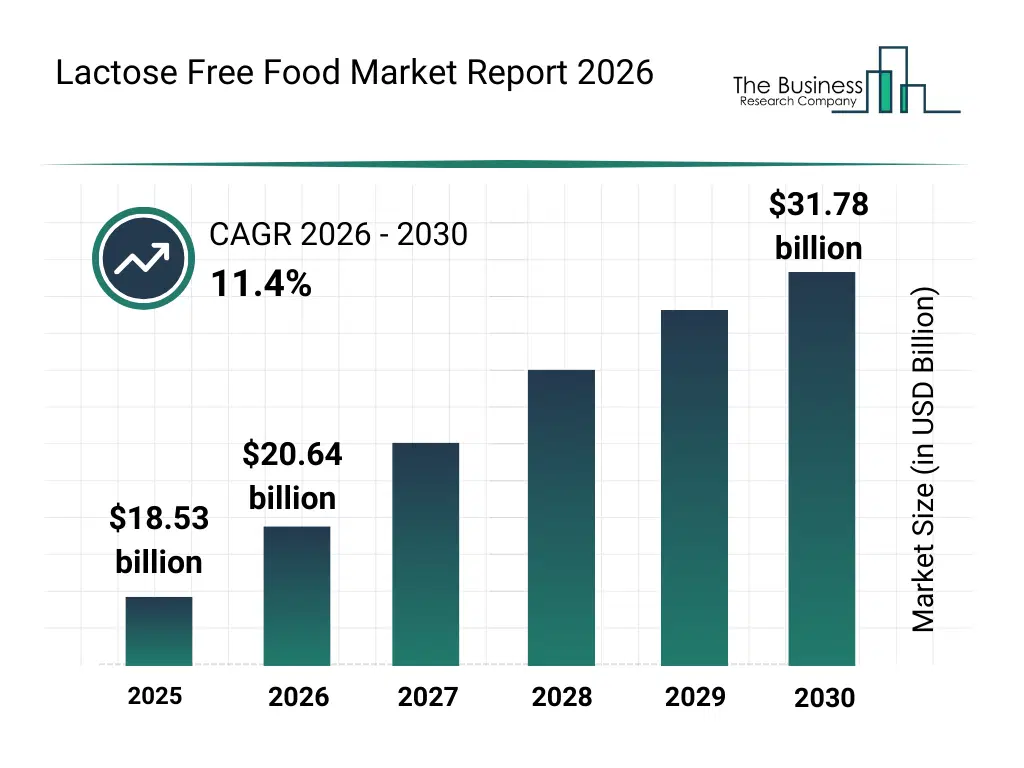
What Is The Lactose Free Food Market Size and Share 2026?
The lactose free food market size has grown rapidly in recent years. It will grow from $18.53 billion in 2025 to $20.64 billion in 2026 at a compound annual growth rate (CAGR) of 11.4%. The growth in the historic period can be attributed to increasing prevalence of lactose intolerance, expansion of dairy processing capabilities, rising consumer awareness of digestive health, availability of lactase enzyme technologies, growth of packaged dairy consumption.What Is The Lactose Free Food Market Growth Forecast?
The lactose free food market size is expected to see rapid growth in the next few years. It will grow to $31.78 billion in 2030 at a compound annual growth rate (CAGR) of 11.4%. The growth in the forecast period can be attributed to increasing demand for functional dairy products, rising investments in dairy processing innovation, expansion of lactose-free offerings in emerging markets, growing preference for clean-label dairy, increasing penetration of online dairy retailing. Major trends in the forecast period include increasing demand for lactose-free dairy alternatives, rising adoption of enzyme-based processing technologies, expansion of lactose-free product portfolios, growing focus on digestive health products, enhanced investment in dairy innovation.
Global Lactose Free Food Market Segmentation
1) By Type: Lactose-Free Products, Lactose-Reduced Products 2) By Technology: Enzymatic Lactase Hydrolysis, Membrane Filtration (Ultrafiltration/Nanofiltration), Chromatographic Separation, Fermentation-Based Lactose Reduction, Combined or Hybrid Processing Technologies 3) By Distribution Channel: Supermarkets/Hypermarkets, Online Stores, Other Distribution Channels 4) By Application: Milk & Milk Beverages, Cheese, Yogurt & Fermented Dairy Products, Ice Cream & Frozen Desserts, Cream, Butter & Spreads, Infant Formula & Clinical Nutrition, Bakery & Processed Foods Using Lactose-Free Dairy Ingredients Subsegments: 1) By Lactose-Free Products: Lactose-Free Milk, Lactose-Free Yogurt, Lactose-Free Cheese, Lactose-Free Ice Cream, Lactose-Free Butter And Margarine 2) By Lactose-Reduced Products: Reduced-Lactose Milk, Reduced-Lactose Yogurt, Reduced-Lactose Cheese, Reduced-Lactose Ice Cream, Reduced-Lactose Cream And Sour CreamWhat Is The Driver Of The Lactose Free Food Market?
The increasing number of people with lactose intolerance is expected to propel the growth of the lactose-free food market going forward. Lactose intolerance is a digestive condition in which the body cannot properly break down lactose, the natural sugar found in milk and dairy products. The number of people with lactose intolerance is rising because global epidemiological studies continue to confirm widespread lactase non-persistence in adults across diverse populations. The lactose-free food market supports this trend by offering dairy alternatives that allow consumers to maintain nutritional intake without discomfort. For instance, in June 2023, the National Dairy Council (NDC), a US-based non-profit organization, about 70% of the global adult population exhibits lactase non-persistence (i.e., lactose malabsorption), a condition that often leads to lactose intolerance. Therefore, the increasing number of people with lactose intolerance is driving the growth of the lactose-free food market.Key Players In The Global Lactose Free Food Market
Major companies operating in the lactose free food market are Nestlé SA, Groupe Lactalis SA, Danone SA, Arla Foods amba, Fonterra Co-operative Group Limited, Valio Ltd., Emmi AG, TINE SA, Parmalat SpA, FrieslandCampina N.V., Müller Group, Saputo Inc., Yili Group, Mengniu Dairy, Meiji Co., Ltd., Morinaga Milk Industry Co., Ltd., Dean Foods Company, Land O’Lakes, Inc., Organic Valley, HP Hood LLC, Lactalis USA, Glanbia plc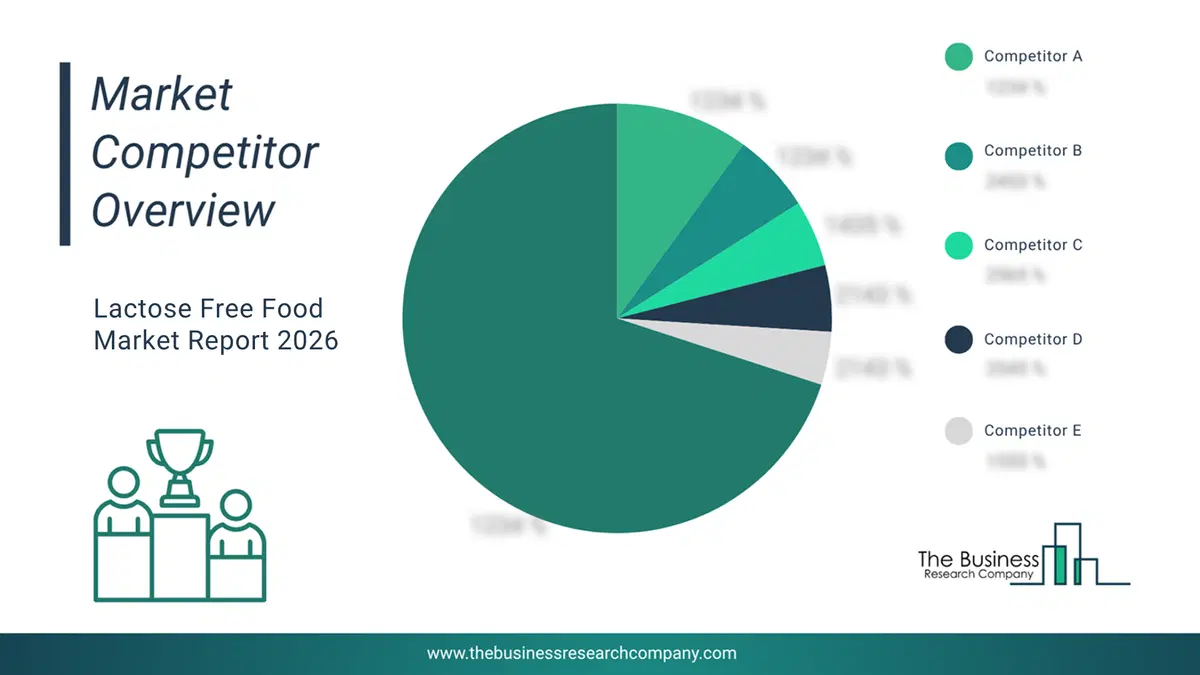
This chart is for illustrative purposes; the full report includes a detailed competitor analysis and comprehensive overview of the top 10 companies in the market.
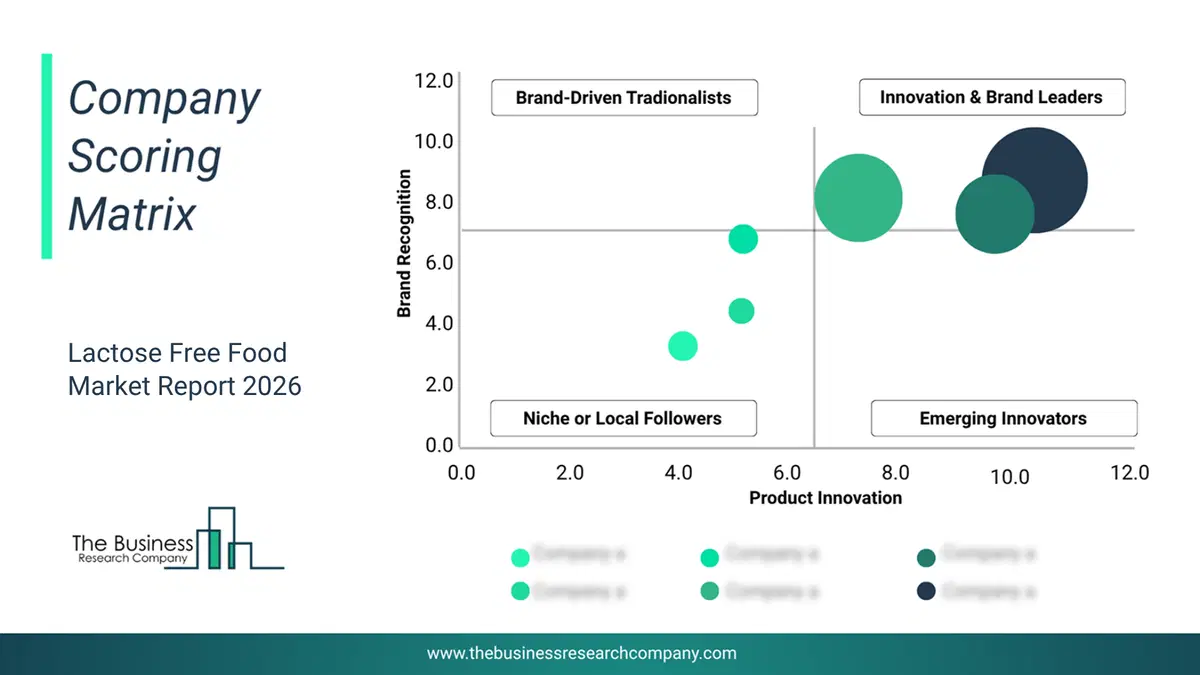
This chart maps companies by product innovation and brand strength, with bubble size indicating relative revenue, helping identify market leaders, challengers, and niche players. This is an illustrative chart; the full report provides a complete and accurate competitive analysis.
Global Lactose Free Food Market Trends and Insights
Major companies operating in the lactose-free food market are developing product innovations such as lactose-free Greek yogurt to meet the growing demand for lactose-free foods and expand their product portfolio. Lactose-free Greek yogurt is made with A2 milk from Indian cows and live Icelandic cultures. It is also low in fat and sugar and contains no preservatives. For instance, in August 2023, Skyrrup, an India-based lactose-free yogurt company, launched its new lactose-free Greek yogurt, which is a unique and delicious product. It is low in fat and sugar, making it a healthier alternative to regular Greek yogurt, and it contains no preservatives. It is a good source of protein and calcium. Overall, it is a healthy and delicious product with a number of features that make it a good choice for consumers.What Are Latest Mergers And Acquisitions In The Lactose Free Food Market?
In March 2023, Next Gen Foods, a Singapore-based food manufacturer, acquired Mwah Ltd. for an undisclosed amount. Through this acquisition, Next Gen Foods aims to expand its portfolio of plant-based products and strengthen its position in the growing plant-based dairy market. Mwah Ltd. is a UK-based dairy company that develops and produces plant-based alternatives to dairy products, such as milk, cream, and gelato.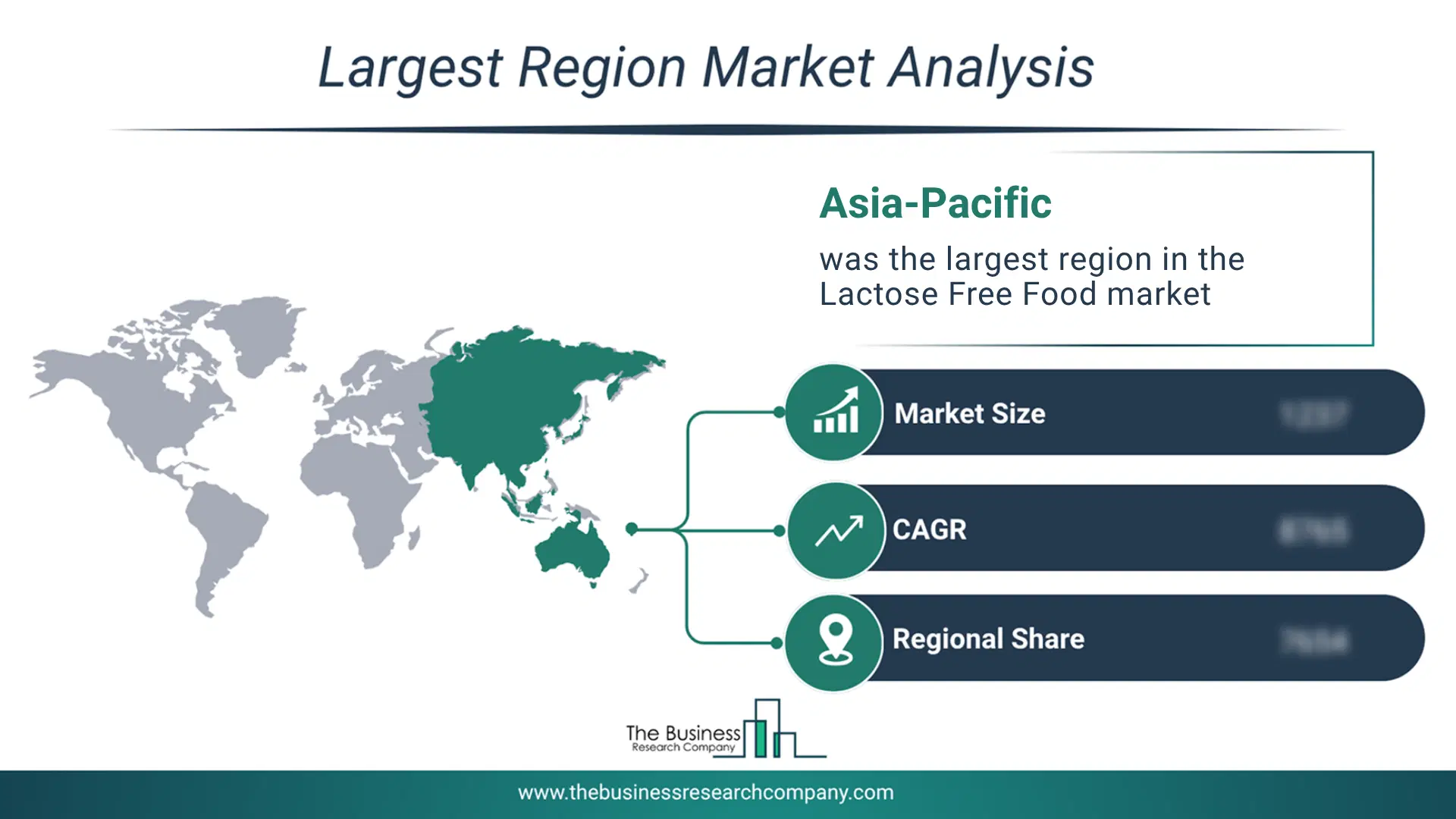
Regional Outlook
Asia-Pacific was the largest region in the lactose free food market in 2025. Western Europe was the second-largest region in the global lactose free food market. The regions covered in this market report are Asia-Pacific, South East Asia, Western Europe, Eastern Europe, North America, South America, Middle East and Africa. The countries covered in this market report are Australia, Brazil, China, France, Germany, India, Indonesia, Japan, Taiwan, Russia, South Korea, UK, USA, Italy, Spain, CanadaWhat Defines the Lactose Free Food Market?
The lactose-free food market consists of sales of soya yogurts and cheeses, oat milk, rice milk, coconut-based yogurts and cheeses, carob bars, and food with “dairy-free” and “suitable for vegan” signs. Values in this market are factory gate values, that is the value of goods sold by the manufacturers or creators of the goods, whether to other entities (including downstream manufacturers, wholesalers, distributors and retailers) or directly to end customers. The value of goods in this market includes related services sold by the creators of the goods.How is Market Value Defined and Measured?
The market value is defined as the revenues that enterprises gain from the sale of goods and/or services within the specified market and geography through sales, grants, or donations in terms of the currency (in USD unless otherwise specified). The revenues for a specified geography are consumption values that are revenues generated by organizations in the specified geography within the market, irrespective of where they are produced. It does not include revenues from resales along the supply chain, either further along the supply chain or as part of other products.
This chart presents market attractiveness based on a quantitative evaluation of growth, competition, strategic alignment, and risk, offering a clear view of opportunity areas for decision-making. This chart is for illustrative purposes; the full report contains the complete analysis.

This chart highlights the Total Addressable Market (TAM) by estimating the maximum revenue opportunity using an assumption-driven approach, supporting strategic planning and opportunity sizing across markets. The chart is illustrative; the full report provides a more comprehensive analysis.
What Key Data and Analysis Are Included in the Lactose Free Food Market Report 2026?
The lactose free food market research report is one of a series of new reports from The Business Research Company that provides market statistics, including industry global market size, regional shares, competitors with the market share, detailed market segments, market trends and opportunities, and any further data you may need to thrive in the lactose free food industry. The market research report delivers a complete perspective of everything you need, with an in-depth analysis of the current and future state of the industry.Lactose Free Food Market Report Forecast Analysis
| Report Attribute | Details |
|---|---|
| Market Size Value In 2026 | $20.64 billion |
| Revenue Forecast In 2030 | $31.78 billion |
| Growth Rate | CAGR of 11.4% from 2026 to 2030 |
| Base Year For Estimation | 2025 |
| Actual Estimates/Historical Data | 2020-2025 |
| Forecast Period | 2026 - 2030 |
| Market Representation | Revenue in USD Billion and CAGR from 2026 to 2030 |
| Segments Covered | Type, Technology, Distribution Channel, Application |
| Regional Scope | Asia-Pacific, Western Europe, Eastern Europe, North America, South America, Middle East, Africa |
| Country Scope | The countries covered in the report are Australia, Brazil, China, France, Germany, India, Indonesia, Japan, Taiwan, Russia, South Korea, UK, USA, Canada, Italy, Spain. |
| Key Companies Profiled | Nestlé SA, Groupe Lactalis SA, Danone SA, Arla Foods amba, Fonterra Co-operative Group Limited, Valio Ltd., Emmi AG, TINE SA, Parmalat SpA, FrieslandCampina N.V., Müller Group, Saputo Inc., Yili Group, Mengniu Dairy, Meiji Co., Ltd., Morinaga Milk Industry Co., Ltd., Dean Foods Company, Land O’Lakes, Inc., Organic Valley, HP Hood LLC, Lactalis USA, Glanbia plc |
| Customization Scope | Request for Customization |
| Pricing And Purchase Options | Explore Purchase Options |