
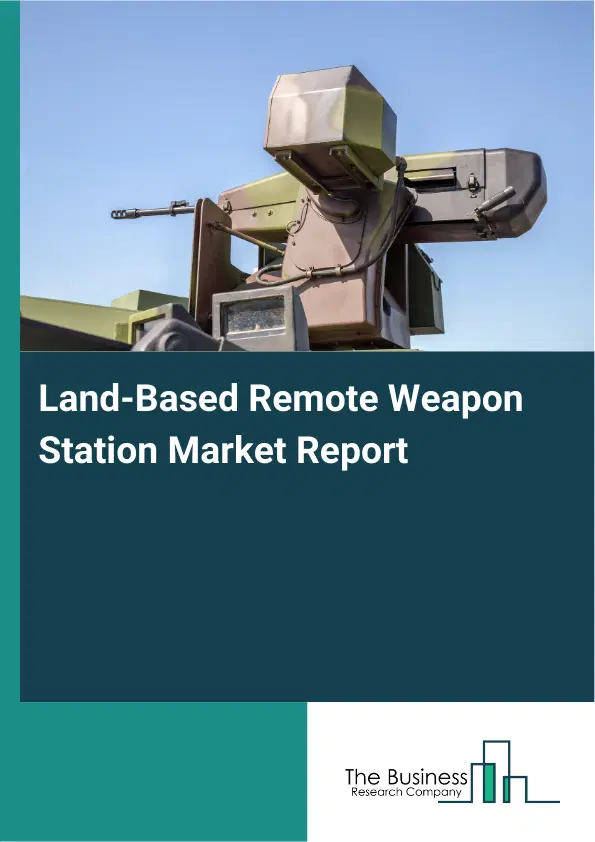
Land-Based Remote Weapon Station Market Report 2026
Global Outlook – By Component (Weapon Systems, Fire Control Systems, Ammunition Handling Systems, Other Components), By Platform (Armored Vehicles, Unmanned Ground Vehicles, Mobile Platforms, Fixed Installations), By Application (Military Operations, Border Security, Counter-Terrorism, Peacekeeping Missions), By End-User (Military, Paramilitary, Law Enforcement Agencies) – Market Size, Trends, Strategies, and Forecast to 2030
Land-Based Remote Weapon Station Market Overview
• Land-Based Remote Weapon Station market size has reached to $4.71 billion in 2025 • Expected to grow to $6.71 billion in 2030 at a compound annual growth rate (CAGR) of 7.3% • Growth Driver: Rising Incidences Of Geopolitical Tensions Fueling The Growth Of The Market Due To Rising Cross-Border Conflicts And Security Threats • Market Trend: Advanced Remote-Controlled Systems Enhance Battlefield Safety • North America was the largest region in 2025 and Asia-Pacific is the fastest growing region.What Is Covered Under Land-Based Remote Weapon Station Market?
A land-based remote weapon station (RWS) is a remotely operated system mounted on ground vehicles or stationary platforms, designed to control and fire various weapon types such as machine guns, grenade launchers, or anti-tank missiles. It enables operators to engage targets from within the safety of armored protection or at a distance. The main purpose of an remote weapon station is to enhance crew survivability while increasing accuracy and operational effectiveness in combat environments. The main component types of land-based remote weapon stations are weapon systems, fire control systems, ammunition handling systems, and others. Weapon systems are core components of remote weapon stations, enabling precise, remote-controlled firepower while keeping operators safely out of harm’s way. These utilize various technologies such as electro-optical systems, infrared systems, laser designation systems, radar systems, and ballistic tracking systems and are classified by platforms into armored vehicles, unmanned ground vehicles, mobile platforms, and fixed installations. Land-based remote weapon stations find applications, in military operations, border security, counterterrorism, and peacekeeping missions, serving end users such as military, paramilitary, and law enforcement agencies, private security firms, and defense contractors.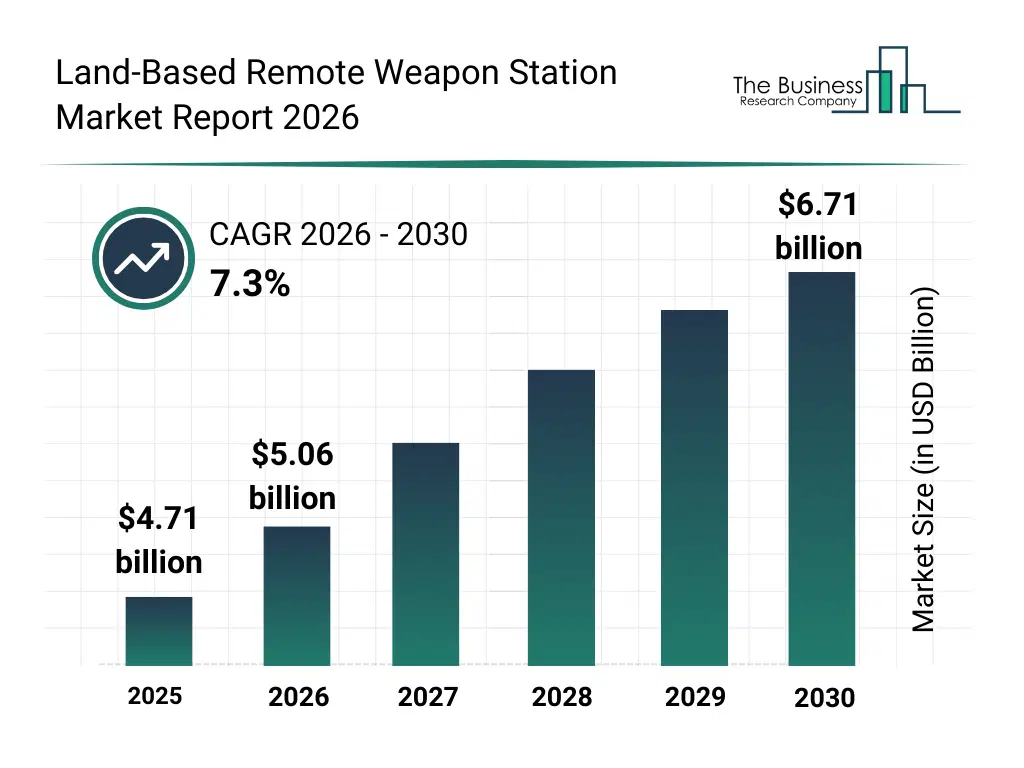
What Is The Land-Based Remote Weapon Station Market Size and Share 2026?
The land-based remote weapon station market size has grown strongly in recent years. It will grow from $4.71 billion in 2025 to $5.06 billion in 2026 at a compound annual growth rate (CAGR) of 7.4%. The growth in the historic period can be attributed to military modernization programs, demand for force protection, asymmetric warfare threats, border security needs, armored vehicle upgrades.What Is The Land-Based Remote Weapon Station Market Growth Forecast?
The land-based remote weapon station market size is expected to see strong growth in the next few years. It will grow to $6.71 billion in 2030 at a compound annual growth rate (CAGR) of 7.3%. The growth in the forecast period can be attributed to increase in unmanned combat systems, adoption of AI fire control, rising geopolitical tensions, defense budget growth, autonomous combat platforms. Major trends in the forecast period include remote controlled weapon deployment, integration of AI based target tracking, growth of vehicle mounted rws, enhanced crew survivability solutions, multi weapon platform compatibility.Tariff Impact On Land-Based Remote Weapon Station Market
Tariffs have impacted the land based remote weapon station market by increasing costs of electro optical sensors, stabilization units, and precision electronics. These effects are most evident in advanced RWS platforms in North America and Europe. Procurement costs have risen. However, tariffs are driving localization of defense production.
Global Land-Based Remote Weapon Station Market Segmentation
1) By Component: Weapon Systems, Fire Control Systems, Ammunition Handling Systems, Other Components 2) By Platform: Armored Vehicles, Unmanned Ground Vehicles, Mobile Platforms, Fixed Installations 3) By Application: Military Operations, Border Security, Counter-Terrorism, Peacekeeping Missions 4) By End-User: Military, Paramilitary, Law Enforcement Agencies Subsegments: 1) By Weapon Systems: Medium Caliber Weapons, Heavy Machine Guns, Automatic Grenade Launchers, Anti-Tank Guided Missiles (ATGM), Non-Lethal Weapons 2) By Fire Control Systems: Electro-Optical Sensors, Thermal Imaging Systems, Laser Rangefinders, Ballistic Computers, Target Tracking Systems 3) By Ammunition Handling Systems: Ammunition Feed Mechanisms, Storage And Retrieval Systems, Ejection Systems, Reloading Systems 4) By Other Components: Stabilization Units, Communication Modules, Power Supply Units, Mounting Platforms, Operator Interface UnitsWhat Is The Driver Of The Land-Based Remote Weapon Station Market?
The rising incidences of geopolitical tensions are expected to propel the growth of the land-based remote weapon station market going forward. Geopolitical tensions refer to conflicts, disputes, or rivalries between countries or regions that arise due to political, economic, territorial, or strategic interests. The rise of geopolitical tensions is due to territorial disputes, as they threaten national sovereignty and control over strategically important regions. Land-based remote weapon stations address geopolitical tensions by providing advanced, remotely operated firepower, enhancing national defense readiness. They improve operator safety and precision targeting in conflict zones, strengthening military effectiveness in high-risk environments. For instance, in October 2024, according to the U.S. Department of Homeland Security, a US-based federal agency, the migrant encounters at the US-Canada border reached over 181,000 in 2024, marking a 6.5% increase compared to 170,000 in 2023. Therefore, rising incidences of geopolitical tensions are driving the growth of the land-based remote weapon station industry.Key Players In The Global Land-Based Remote Weapon Station Market
Major companies operating in the land-based remote weapon station market are Kongsberg Gruppen ASA, Elbit Systems Ltd., Rafael Advanced Defense Systems Ltd., Rheinmetall AG, Aselsan A.S., BAE Systems plc, Leonardo S.p.A., Thales Group, Saab AB, Hanwha Systems Co., Ltd., Electro Optic Systems Holdings Limited, FN Herstal S.A., KNDS Deutschland GmbH & Co. KG, Denel Land Systems, Singapore Technologies Engineering Ltd., RTX Corporation, Lockheed Martin Corporation, Northrop Grumman Corporation, Israel Aerospace Industries Ltd., L3Harris Technologies Inc., Moog Inc., Hyundai Rotem Company, Norinco Group, Rosoboronexport, Otokar Otomotiv ve Savunma Sanayi A.S.
This chart is for illustrative purposes; the full report includes a detailed competitor analysis and comprehensive overview of the top 10 companies in the market.
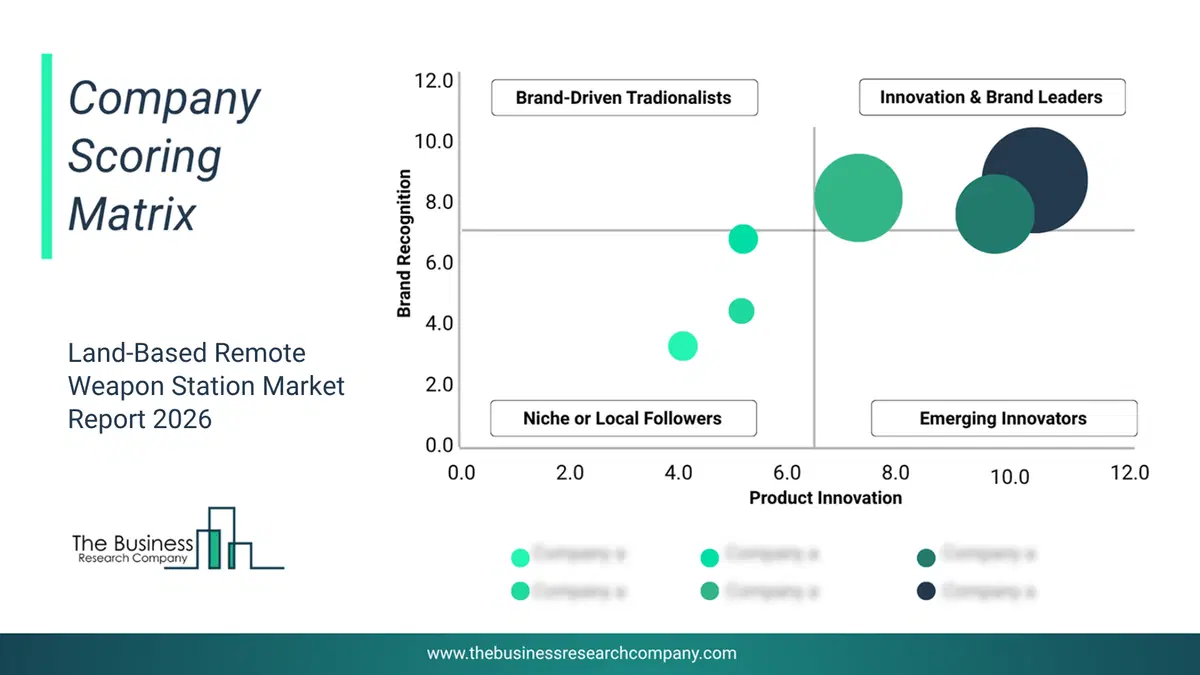
This chart maps companies by product innovation and brand strength, with bubble size indicating relative revenue, helping identify market leaders, challengers, and niche players. This is an illustrative chart; the full report provides a complete and accurate competitive analysis.
Global Land-Based Remote Weapon Station Market Trends and Insights
Major companies operating in the land-based remote weapon station market are focusing on developing advanced products, such as remote-controlled weapons and surveillance systems, to enhance battlefield effectiveness and ensure operator safety in high-risk environments. Remote-controlled weapons and surveillance systems enable operators to observe and strike targets remotely, ensuring greater safety. These systems integrate live imaging and accurate weapon control to boost operational security and effectiveness. For instance, in September 2024, Zen Technologies, an India-based provider of training solutions, launched a new range of four advanced systems, including the RCWS-7.62x51MMG (Parashu), the Tank Mounted RCWS-12.7x10⁸HMG (Fanish), the Naval RCWS–12.7×99HMG (Sharur), and the Artillery Rugged Camera (Durgam). These systems are equipped with advanced features such as thermal imaging, multi-environment stabilization, and anti-drone capabilities, ensuring versatility across land, naval, and artillery platforms.What Are Latest Mergers And Acquisitions In The Land-Based Remote Weapon Station Market?
In March 2023, Sig Sauer, a US-based firearms and defense technology company, acquired General Robotics Ltd. for an undisclosed amount. With this acquisition, Sig Sauer aims to expand its portfolio by integrating lightweight remote weapon stations and tactical robotics, enabling advanced pairing of its next-gen weapons with remote weapon stations for improved mobility, precision, anti-drone defense, and crew safety. General Robotics Ltd. is an Israel-based defense tech company specializing in lightweight naval remote weapon stations (RWS) and tactical robotics.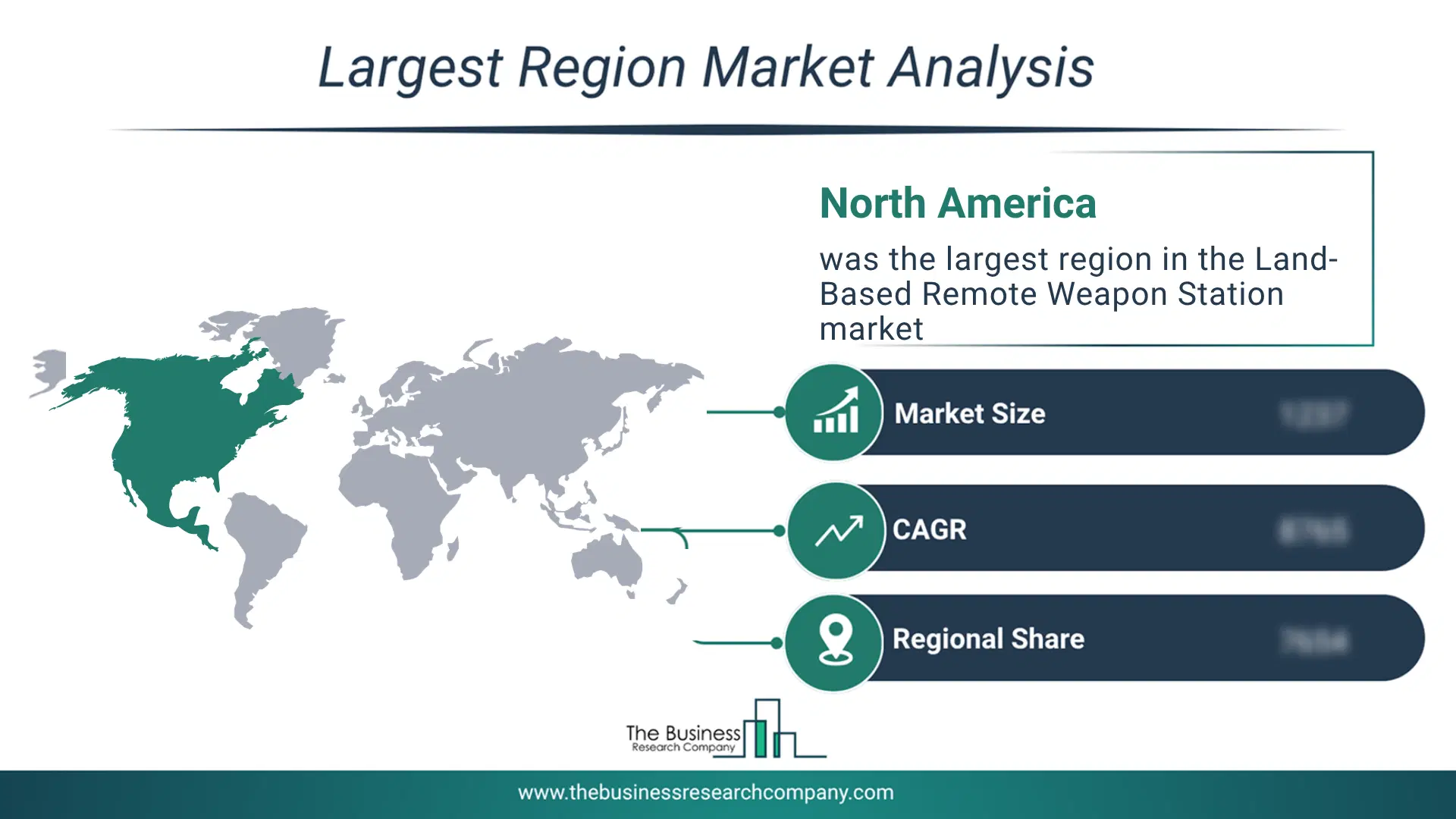
Regional Outlook
North America was the largest region in the land-based remote weapon station market in 2025. Asia-Pacific is expected to be the fastest-growing region in the forecast period. The regions covered in this market report are Asia-Pacific, South East Asia, Western Europe, Eastern Europe, North America, South America, Middle East, Africa The countries covered in this market report are Australia, Brazil, China, France, Germany, India, Indonesia, Japan, Taiwan, Russia, South Korea, UK, USA, Canada, Italy, Spain.What Defines the Land-Based Remote Weapon Station Market?
The land-based remote weapon station market consists of revenues earned by entities by providing services such as target tracking and identification, surveillance and reconnaissance, fire control, and weapon management. The market value includes the value of related goods sold by the service provider or included within the service offering. The land-based remote weapon station market also includes sales of stabilization systems, human-machine interfaces, communication systems, and power supply units. Values in this market are ‘factory gate’ values, that is, the value of goods sold by the manufacturers or creators of the goods, whether to other entities (including downstream manufacturers, wholesalers, distributors, and retailers) or directly to end customers. The value of goods in this market includes related services sold by the creators of the goods.How is Market Value Defined and Measured?
The market value is defined as the revenues that enterprises gain from the sale of goods and/or services within the specified market and geography through sales, grants, or donations in terms of the currency (in USD unless otherwise specified). The revenues for a specified geography are consumption values that are revenues generated by organizations in the specified geography within the market, irrespective of where they are produced. It does not include revenues from resales along the supply chain, either further along the supply chain or as part of other products.
This chart presents market attractiveness based on a quantitative evaluation of growth, competition, strategic alignment, and risk, offering a clear view of opportunity areas for decision-making. This chart is for illustrative purposes; the full report contains the complete analysis.

This chart highlights the Total Addressable Market (TAM) by estimating the maximum revenue opportunity using an assumption-driven approach, supporting strategic planning and opportunity sizing across markets. The chart is illustrative; the full report provides a more comprehensive analysis.
What Key Data and Analysis Are Included in the Land-Based Remote Weapon Station Market Report 2026?
The land-based remote weapon station market research report is one of a series of new reports from The Business Research Company that provides market statistics, including industry global market size, regional shares, competitors with the market share, detailed market segments, market trends and opportunities, and any further data you may need to thrive in the land-based remote weapon station industry. The market research report delivers a complete perspective of everything you need, with an in-depth analysis of the current and future state of the industry.Land Based Remote Weapon Station Market Report Forecast Analysis
| Report Attribute | Details |
|---|---|
| Market Size Value In 2026 | $5.06 billion |
| Revenue Forecast In 2030 | $6.71 billion |
| Base Year For Estimation | 2025 |
| Actual Estimates/Historical Data | 2020-2025 |
| Forecast Period | 2026 - 2030 |
| Market Representation | Revenue in USD Billion and CAGR from 2026 to 2030 |
| Segments Covered | Component, Platform, Application, End-User |
| Regional Scope | Asia-Pacific, Western Europe, Eastern Europe, North America, South America, Middle East, Africa |
| Key Companies Profiled | Kongsberg Gruppen ASA, Elbit Systems Ltd., Rafael Advanced Defense Systems Ltd., Rheinmetall AG, Aselsan A.S., BAE Systems plc, Leonardo S.p.A., Thales Group, Saab AB, Hanwha Systems Co., Ltd., Electro Optic Systems Holdings Limited, FN Herstal S.A., KNDS Deutschland GmbH & Co. KG, Denel Land Systems, Singapore Technologies Engineering Ltd., RTX Corporation, Lockheed Martin Corporation, Northrop Grumman Corporation, Israel Aerospace Industries Ltd., L3Harris Technologies Inc., Moog Inc., Hyundai Rotem Company, Norinco Group, Rosoboronexport, Otokar Otomotiv ve Savunma Sanayi A.S. |
| Customization Scope | Request for Customization |
| Pricing And Purchase Options | Explore Purchase Options |