
Land Mobile Radio Market Report 2026
Global Outlook – By Type ( Hand Portable, In-Vehicle (Mobile)), By Technology ( Analog, Digital), By Frequency ( 25-174 (VHF), 200-512 (UHF), 700 MHZ And Above), By Application ( Commercial, Public Safety, Mining, Oil and Gas, Energy, Defense, Transportation, Construction, Other Applications) – Market Size, Trends, Strategies, and Forecast to 2030
Land Mobile Radio Market Overview
• Land Mobile Radio market size has reached to $25.33 billion in 2025 • Expected to grow to $46.04 billion in 2030 at a compound annual growth rate (CAGR) of 12.6% • Growth Driver: Land Mobile Radio Market Surges Due To Natural Disasters • Market Trend: Strategic Collaborations Shape Growth In The Land Mobile Radio Market • North America was the largest region in 2025 and Asia-Pacific is the fastest growing region.Market Gains By 2030 – Top Opportunities By Segment
Market Gain identifies the most promising market opportunities by highlighting the segments or products expected to generate the highest incremental revenue growth over the next five years.
What Is Covered Under Land Mobile Radio Market?
Land mobile radio (LMR) is a wireless communications technology that is primarily utilized for vital communications by public safety groups such as police, firefighters, and other emergency response organizations. LMR systems are widely used in the commercial world, including industrial, transportation, utilities, security, logistics, and even the military, in addition to the public safety sector. It enables push-to-talk, two-way communication between radio transceivers. The main types of clothing styles of online clothing retail are western wear, ethnic wear, and others. Western wear clothing refers to clothing styles from Western countries such as the United States, Canada, or parts of Europe that derive their distinct style from clothing worn in the nineteenth-century American West. The various dress codes of online clothing rental are formal, casual, and traditional wear, which are available in the low, mid, and premium price ranges. The different types of end-users of online clothing rental are women, men, and kids.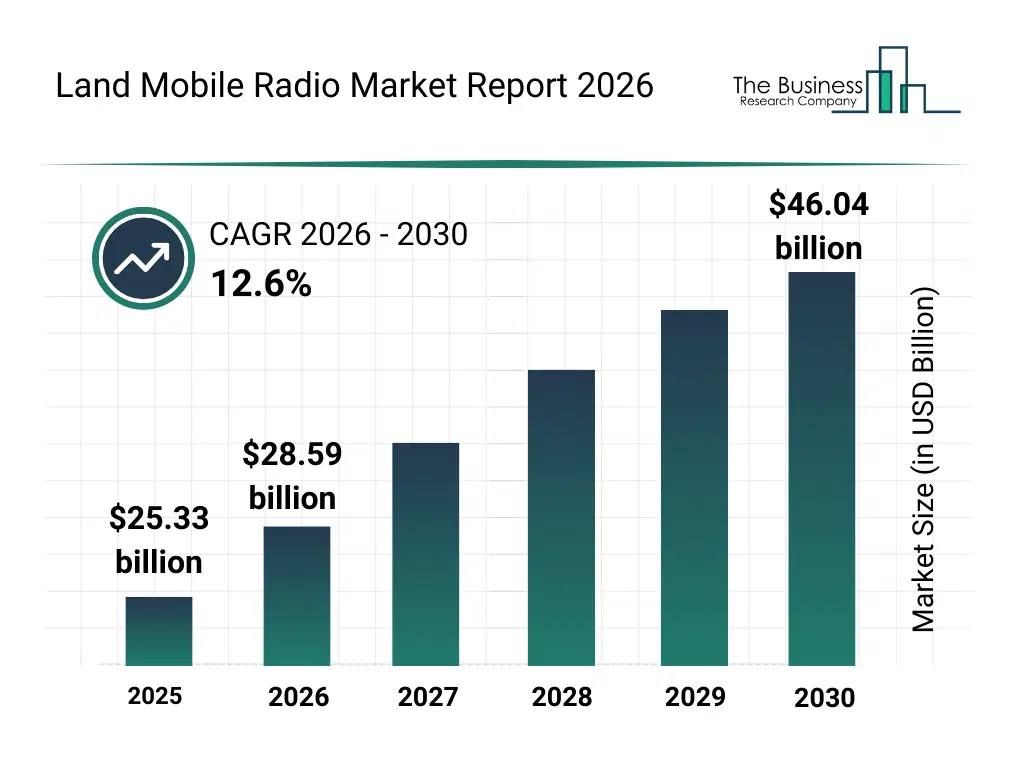
What Is The Land Mobile Radio Market Size 2026 And Growth Rate?
The land mobile radio market size has grown rapidly in recent years. It will grow from $25.33 billion in 2025 to $28.59 billion in 2026 at a compound annual growth rate (CAGR) of 12.9%. The growth in the historic period can be attributed to early deployment of lmr for public safety, initial adoption in commercial sectors, reliance on analog communication systems, growing use in transportation and logistics, integration in industrial operations.What Is The Land Mobile Radio Market Growth Forecast?
The land mobile radio market size is expected to see rapid growth in the next few years. It will grow to $46.04 billion in 2030 at a compound annual growth rate (CAGR) of 12.6%. The growth in the forecast period can be attributed to expansion of digital lmr solutions, increasing use of ip-based radio networks, adoption in energy and utility sectors, integration with cloud-based management, growth in emergency response communications. Major trends in the forecast period include integration of AI-enabled lmr systems, deployment of digital radio monitoring platforms, implementation of real-time communication management, adoption of smart spectrum optimization, expansion of connected public safety networks.
Global Land Mobile Radio Market Segmentation
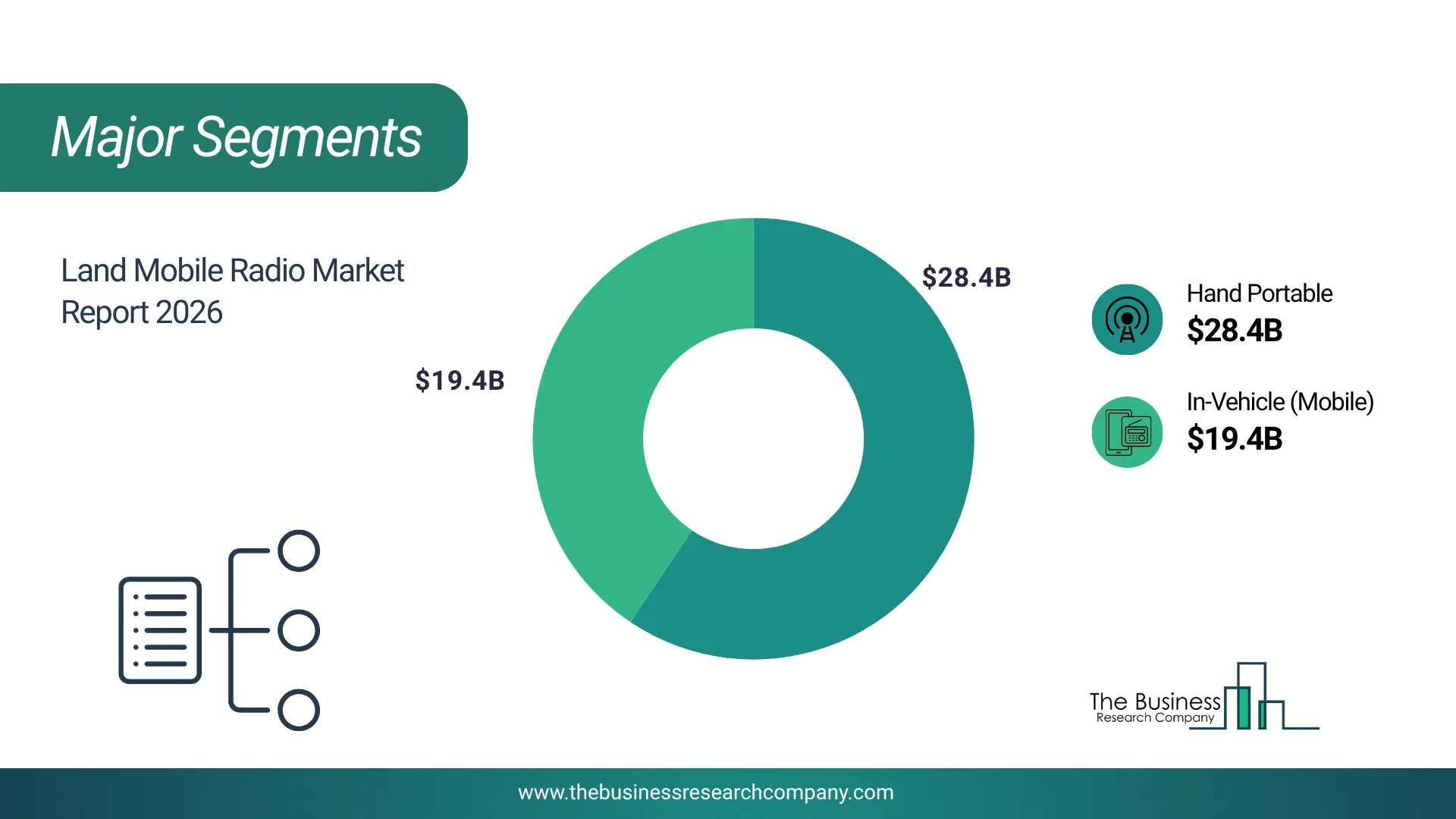
1) By Type: Hand Portable, In-Vehicle (Mobile) 2) By Technology: Analog, Digital 3) By Frequency: 25-174 (VHF), 200-512 (UHF), 700 MHZ And Above 4) By Application: Commercial, Public Safety, Mining, Oil and Gas, Energy, Defense, Transportation, Construction, Other Applications Subsegments: 1) By Hand Portable: Analog Handheld Radios, Digital Handheld Radios, TETRA Handheld Radios 2) By In-Vehicle (Mobile): Analog Mobile Radios, Digital Mobile Radios, TETRA Mobile Radios The top segments in the land mobile radio market will be: • Hand Portable will reach $28.36 billion by 2030. • In-Vehicle (Mobile) will reach $19.31 billion by 2030.What Is The Driver Of The Land Mobile Radio Market?
The rising cases of natural disasters are expected to propel the growth of the land mobile radio market going forward. Natural disasters refer to catastrophic events or phenomena that occur in the natural environment and can cause significant damage, destruction, and disruption to human life, property, and ecosystems. Land mobile radio systems are used in natural disasters due to their reliability, wide coverage, interoperability, and secure communication features. For instance, in April 2025, according to the Centre for Research on the Epidemiology of Disasters (CRED), a Belgium-based research organization, in 2024, the Emergency Events Database (EM-DAT) recorded 393 natural hazard-related disasters, which caused 16,753 fatalities, affected 167.2 million people, and resulted in economic losses totaling US$241.95 billion. Therefore, the rising cases of natural disasters are driving the growth of the land mobile radio industry.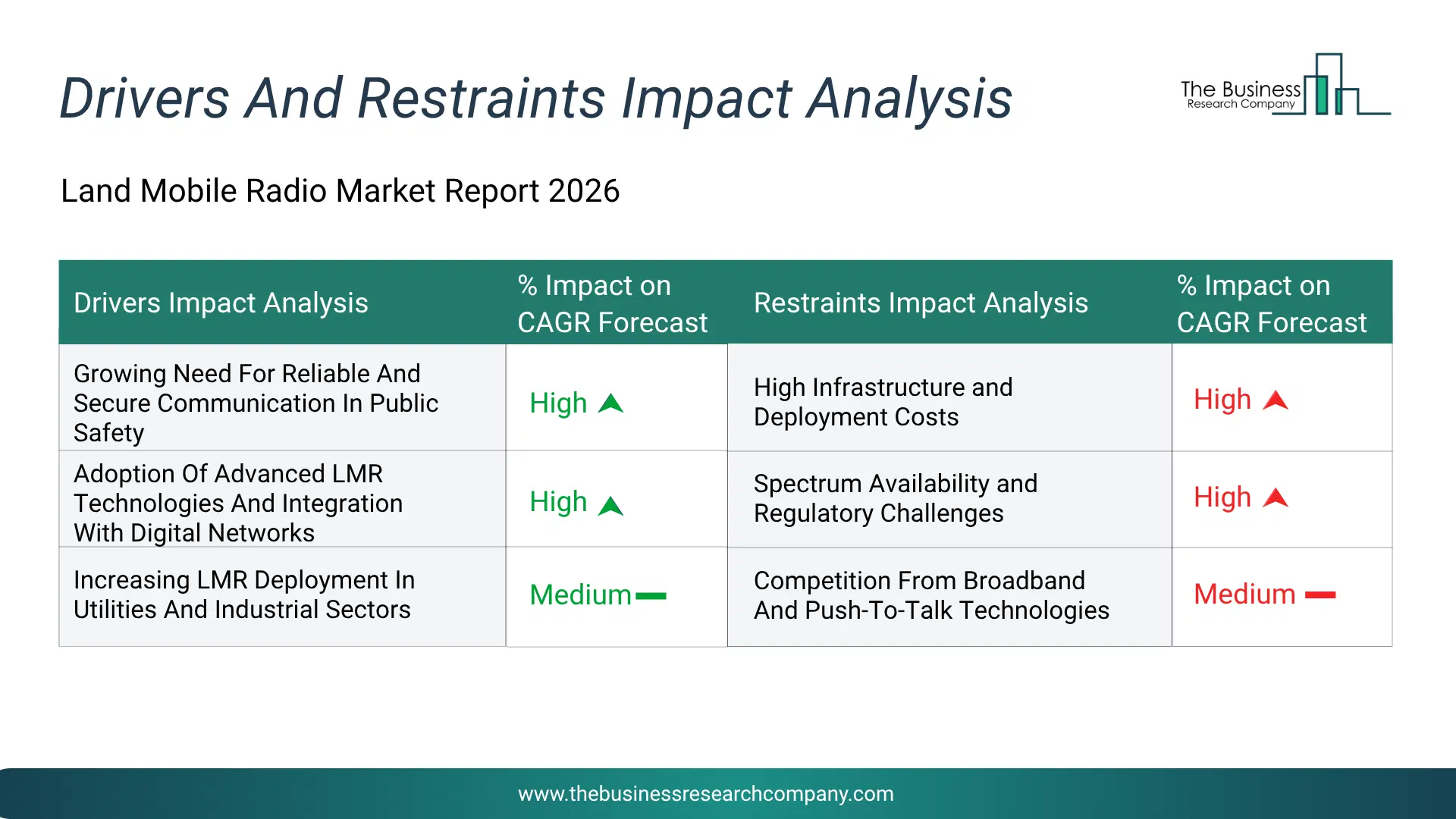
Infographic Chart Showing Key Market Drivers Analysis And Restraints For Land Mobile Radio Market
The chart presents an impact analysis of key drivers and restraints, quantifying their relative influence on the market's growth rate and helping assess the balance between growth enablers and limiting factors. This chart offers a high-level perspective; the full report contains more detailed insights.
How Will The Drivers Impact Growth In The Global Land Mobile Radio Market?
• Growing Need For Reliable And Secure Communication In Public Safety (High) – During the forecast period, the growing need for reliable and secure communication in public safety is expected to become a key growth driver for the land mobile radio market by 2030. Public safety organizations, including police, fire departments, and emergency medical services, rely heavily on land mobile radio systems for mission -critical communication. Lmr networks provide secure, resilient, and instant voice and data communication, which is essential during emergencies, disasters, and large public events. The increasing focus on enhancing first responder coordination, disaster preparedness, and emergency management is driving governments and municipal agencies to invest in modern lmr solutions. The need for reliable communication infrastructure in critical sectors acts as a strong growth driver for the lmr market. • Adoption Of Advanced LMR Technologies And Integration With Digital Networks (High) – During the forecast period, the adoption of advanced lmr technologies and integration with digital networks is expected to emerge as a major factor driving the expansion of the land mobile radio market by 2030. Modern lmr systems are increasingly digital, offering enhanced audio clarity, spectrum efficiency, and interoperability with broadband networks and next-generation communication platforms. Integration with lte, 5g, and ip-based networks allows seamless data transfer, location tracking, and remote management. Organizations across transportation, utilities, and logistics are upgrading to digital lmr solutions to support operational efficiency and real-time monitoring. Technological advancements and network modernization efforts are major drivers, as they improve system performance, scalability, and multi-agency coordination capabilities. • Increasing LMR Deployment In Utilities And Industrial Sectors (Medium) – During the forecast period, the increasing lmr deployment in utilities and industrial sectors is expected to act as a key growth catalyst for the land mobile radio market by 2030. Utilities, transportation, oil & gas, and manufacturing sectors depend on lmr systems for operational safety, asset monitoring, and field worker communication. Harsh environmental conditions, remote locations, and mission-critical operations require reliable radio communication, which lmr provides efficiently. The need to ensure worker safety, reduce downtime, and enhance operational productivity is driving adoption of lmr solutions in these industries. This expansion into industrial and commercial applications complements public safety usage, creating sustained demand growth for lmr systems globally.How Will The Restraints Impact Growth In The Global Land Mobile Radio Market?
• High Infrastructure and Deployment Costs (High) – During the forecast period, the implementing and maintaining lmr networks, including base stations, repeaters, antennas, and subscriber units, requires significant capital expenditure. Organizations, especially smaller utilities or municipalities, may find these costs prohibitive. Additionally, upgrading legacy analog systems to digital lmr networks involves substantial investment in hardware, software, and training. High infrastructure and deployment costs act as a key restraint on market growth, particularly in developing regions or cost-sensitive segments. • Spectrum Availability and Regulatory Challenges (High) – During the forecast period, the lmr systems operate on licensed frequency bands, which are tightly regulated and often limited in availability. Securing spectrum allocation and complying with regional regulations can be time-consuming and costly for operators. In some regions, frequency scarcity or high licensing fees may delay network expansion or limit deployment scale. Regulatory complexities and spectrum constraints act as a significant restraint, impacting the pace of adoption of lmr solutions, particularly in densely populated or heavily industrialized areas. • Competition From Broadband And Push-To-Talk Technologies (Medium) – During the forecast period, the advancements in broadband communication networks and push-to-talk cellular solutions are creating alternatives to traditional land mobile radio systems. Many organizations are evaluating newer communication platforms that offer enhanced data capabilities and broader coverage. This competitive pressure may reduce investment in conventional lmr infrastructure. Consequently, market growth could be constrained in certain end-user segments.Key Players In The Global Land Mobile Radio Market
Major companies operating in the land mobile radio market are Motorola Solutions Inc., Harris Corporation, Cartel Communication Systems Inc., BK Technologies Inc., TE Connectivity Ltd., Sepura Ltd., Simoco Telecommunications Ltd., JVC Kenwood Corporation, Thales Group, TTG Global Ltd., Codan Communications, Midland Radio Corporation, EF Johnson Technologies Inc., Airbus DS Communications, L3Harris Technologies Inc., Tait Communications Ltd., Hytera Communications Corp Ltd., Icom Inc., Raytheon Company, Relm Wireless Corporation, Vertex Standard LMR Inc., Zetron Inc., Daniels Electronics Ltd., PowerTrunk Inc., Alinco Incorporated, Yaesu Musen Co. Ltd., Axell Wireless Ltd., DAMM Cellular Systems A/S, Datron World Communications Inc., Cassidian Communications Inc., E-TECH Global Services, Schnoor Industrieelektronik, Iconet Services, Leonardo SpA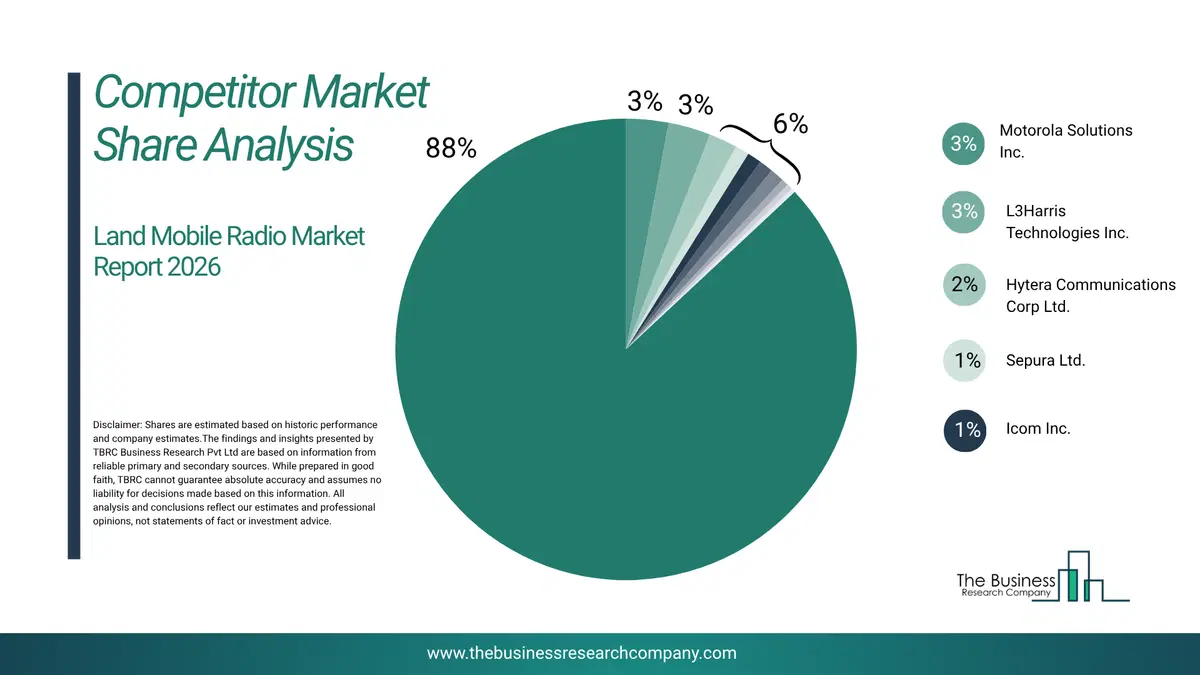
This chart is for illustrative purposes; the full report includes a detailed competitor analysis and comprehensive overview of the top 10 companies in the market.
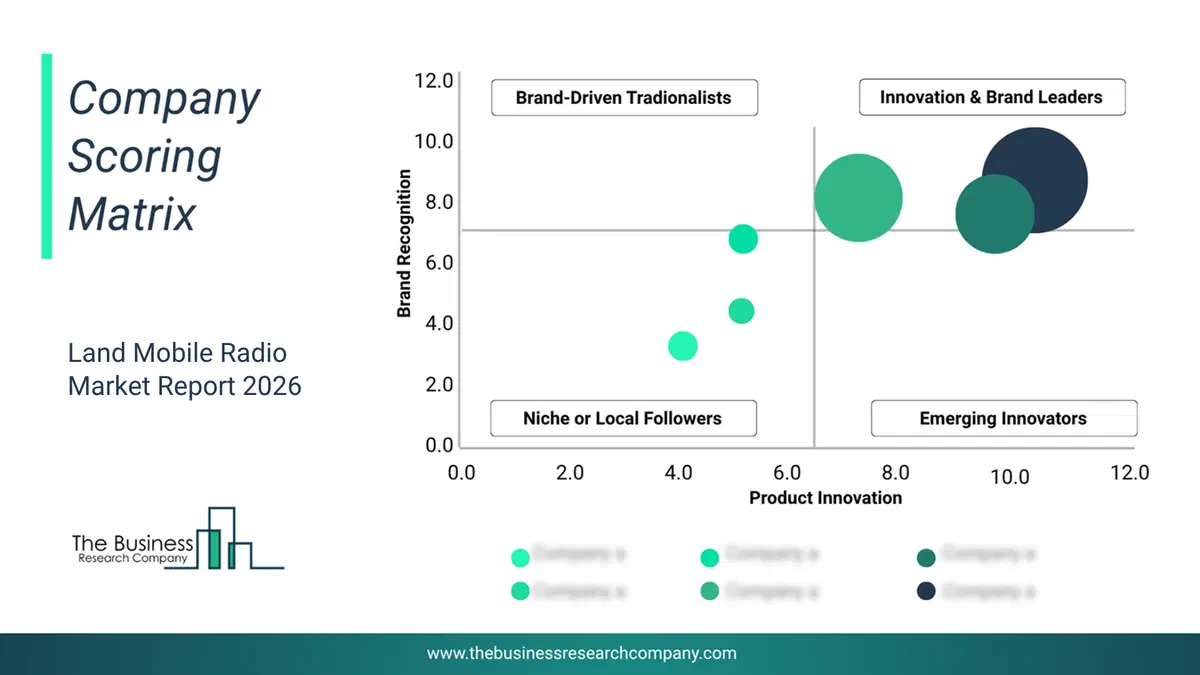
This chart maps companies by product innovation and brand strength, with bubble size indicating relative revenue, helping identify market leaders, challengers, and niche players. This is an illustrative chart; the full report provides a complete and accurate competitive analysis.
Global Land Mobile Radio Market Trends and Insights
Major companies operating in the land mobile radio market are adopting a strategic collaboration approach to enhance their offerings and expand their market presence. Strategic collaboration refers to a process in which companies leverage each other's strengths and resources to achieve mutual benefits and success. For instance, in April 2023, Southern Linc, a Georgia-based telecommunications company, collaborated with L3Harris Technologies, a US-based aerospace and defense company. This collaboration aims to enhance its telecommunications services, focusing on improving coverage and network reliability for its customers. This collaboration likely involves leveraging L3 Harris's expertise in advanced communication technologies, such as mission-critical communication systems, to support Southern Linc's operations in providing robust connectivity solutions, particularly in rural and underserved areas.What Are Latest Mergers And Acquisitions In The Land Mobile Radio Market?
In August 2025, Motorola Solutions, a Chicago, US-based provider of land mobile radio (LMR) systems, mission-critical communications infrastructure, and public-safety software, acquired Silvus Technologies Holding Inc. for an undisclosed amount. This acquisition expands Motorola Solutions’ portfolio with Silvus’ advanced MIMO mesh radio technology, enhancing broadband and tactical networking capabilities that complement traditional LMR systems, and strengthening its offerings for defense, public safety, and industrial users. Silvus Technologies is a US-based provider of tactical MIMO mesh radios and waveform software, delivering high-throughput, mobile, and self-healing wireless networking solutions for military, defense, and public-safety applications.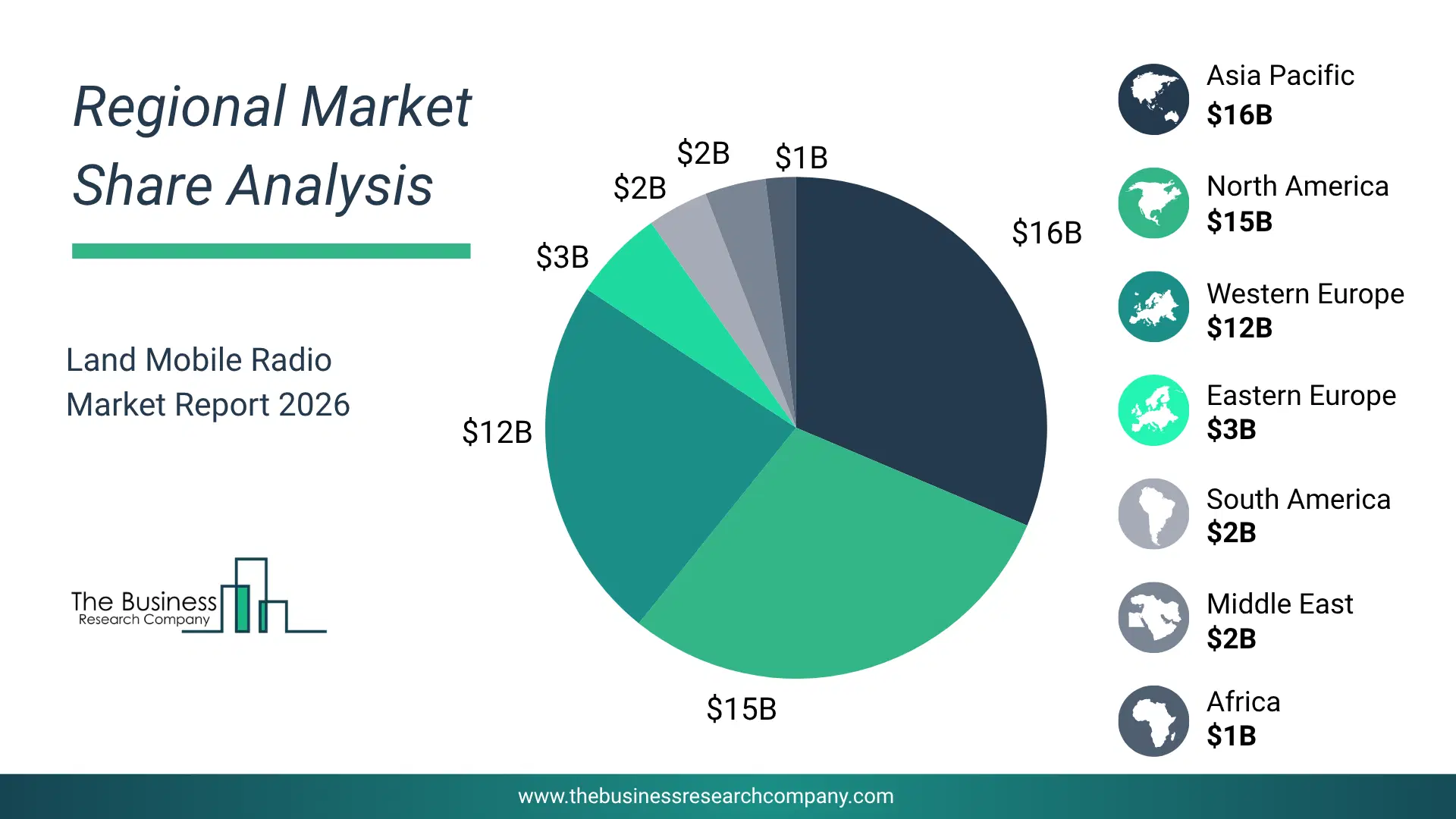
Regional Outlook
North America was the largest region in the land mobile radio market in 2025. Asia-Pacific is expected to be the fastest-growing region in the land mobile radio market share during the forecast period. The regions covered in this market report are Asia-Pacific, South East Asia, Western Europe, Eastern Europe, North America, South America, Middle East, Africa. The countries covered in this market report are Australia, Brazil, China, France, Germany, India, Indonesia, Japan, Taiwan, Russia, South Korea, UK, USA, Canada, Italy, Spain.What Defines the Land Mobile Radio Market?
The land mobile radio market consists of sales of handheld portable radios, vehicle mounted mobile radios, base stations audio receiver, and repeaters. Values in this market are ‘factory gate’ values, that is the value of goods sold by the manufacturers or creators of the goods, whether to other entities (including downstream manufacturers, wholesalers, distributors and retailers) or directly to end customers. The value of goods in this market includes related services sold by the creators of the goods.How is Market Value Defined and Measured?
The market value is defined as the revenues that enterprises gain from the sale of goods and/or services within the specified market and geography through sales, grants, or donations in terms of the currency (in USD unless otherwise specified). The revenues for a specified geography are consumption values that are revenues generated by organizations in the specified geography within the market, irrespective of where they are produced. It does not include revenues from resales along the supply chain, either further along the supply chain or as part of other products.
This chart presents market attractiveness based on a quantitative evaluation of growth, competition, strategic alignment, and risk, offering a clear view of opportunity areas for decision-making. This chart is for illustrative purposes; the full report contains the complete analysis.

This chart highlights the Total Addressable Market (TAM) by estimating the maximum revenue opportunity using an assumption-driven approach, supporting strategic planning and opportunity sizing across markets. The chart is illustrative; the full report provides a more comprehensive analysis.
What Key Data and Analysis Are Included in the Land Mobile Radio Market Report 2026?
The land mobile radio market research report is one of a series of new reports from The Business Research Company that provides market statistics, including industry global market size, regional shares, competitors with the market share, detailed market segments, market trends and opportunities, and any further data you may need to thrive in the land mobile radio industry. The market research report delivers a complete perspective of everything you need, with an in-depth analysis of the current and future state of the industry.Land Mobile Radio Market Report 2026 Market Report Forecast Analysis
| Report Attribute | Details |
|---|---|
| Market Size Value In 2026 | $28.59 billion |
| Revenue Forecast In 2030 | $46.04 billion |
| Growth Rate | CAGR of 12.6% from 2026 to 2030 |
| Base Year For Estimation | 2025 |
| Actual Estimates/Historical Data | 2020-2025 |
| Forecast Period | 2026 - 2030 |
| Market Representation | Revenue in USD Billion and CAGR from 2026 to 2030 |
| Segments Covered | Type, Technology, Frequency, Application |
| Regional Scope | Asia-Pacific, Western Europe, Eastern Europe, North America, South America, Middle East, Africa |
| Country Scope | The countries covered in the report are Australia, Brazil, China, France, Germany, India, ... |
| Key Companies Profiled | Motorola Solutions Inc., Harris Corporation, Cartel Communication Systems Inc., BK Technologies Inc., TE Connectivity Ltd., Sepura Ltd., Simoco Telecommunications Ltd., JVC Kenwood Corporation, Thales Group, TTG Global Ltd., Codan Communications, Midland Radio Corporation, EF Johnson Technologies Inc., Airbus DS Communications, L3Harris Technologies Inc., Tait Communications Ltd., Hytera Communications Corp Ltd., Icom Inc., Raytheon Company, Relm Wireless Corporation, Vertex Standard LMR Inc., Zetron Inc., Daniels Electronics Ltd., PowerTrunk Inc., Alinco Incorporated, Yaesu Musen Co. Ltd., Axell Wireless Ltd., DAMM Cellular Systems A/S, Datron World Communications Inc., Cassidian Communications Inc., E-TECH Global Services, Schnoor Industrieelektronik, Iconet Services, Leonardo SpA |
| Customization Scope | Request for Customization |
| Pricing And Purchase Options | Explore Purchase Options |