
Lane Keep Assist System Market Report 2026
Global Outlook – By Component (Vision Sensor Or Camera, Electronic Power-Assisted Steering (EPAS) Actuator, Electronic Control Unit, Other Components), By Function Type (Lane Keeping System, Lane Departure Warning), By Vehicle Type (Passenger Vehicles, Commercial Vehicles), By Propulsion (Internal Combustion Engines, Electric And Hybrid), By Sales Channel (Original Equipment Manufacturers (OEMs), Aftermarket) – Market Size, Trends, Strategies, and Forecast to 2030
Lane Keep Assist System Market Overview
• Lane Keep Assist System market size has reached to $12.44 billion in 2025 • Expected to grow to $31.44 billion in 2030 at a compound annual growth rate (CAGR) of 20.4% • Growth Driver: Surge In Automobile Demand Fuels Growth Of Lane-Keep Assist System Market • Market Trend: Advancements in Driver Assistance Systems Boosting Vehicle Safety • Europe was the largest region in 2025 and Asia-Pacific is the fastest growing region.What Is Covered Under Lane Keep Assist System Market?
The Lane Keep Assist System (LKAS) is a type of driver assistance technology made to aid drivers in keeping cars in lanes. It gives steering input to keep the vehicle in the middle of a detected lane and gives tactile and visual alerts if the car is seen to be drifting off the lane. The main types of components included in a lane keep assist system are a vision sensor or camera, an electronic power-assisted steering (EPAS) actuator, an electronic control unit, and others. A vision sensor or camera refers to a device that collects and processes visual data from the environment through optical imaging. It is used for various functions, including lane keeping system and lane departure warning, for passenger vehicles and commercial vehicles. It is used in various types of propulsion vehicles, including internal combustion engines, electric and hybrid. These are sold through several sales channels, including original equipment manufacturers (OEMs) and aftermarket.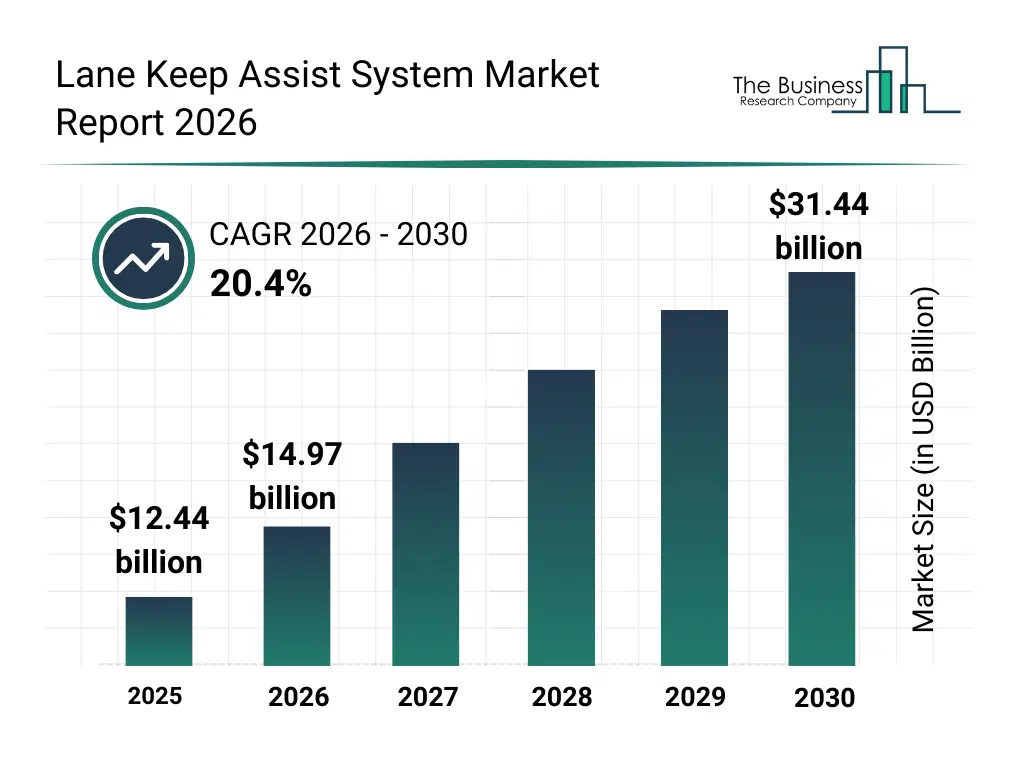
What Is The Lane Keep Assist System Market Size and Share 2026?
The lane keep assist system market size has grown exponentially in recent years. It will grow from $12.44 billion in 2025 to $14.97 billion in 2026 at a compound annual growth rate (CAGR) of 20.3%. The growth in the historic period can be attributed to rising road safety regulations, growth in passenger vehicle sales, adoption of basic adas features, improvements in camera technology, increasing consumer safety awareness.What Is The Lane Keep Assist System Market Growth Forecast?
The lane keep assist system market size is expected to see exponential growth in the next few years. It will grow to $31.44 billion in 2030 at a compound annual growth rate (CAGR) of 20.4%. The growth in the forecast period can be attributed to mandatory adas regulations, growth of electric vehicles, advancement in AI vision systems, demand for semi autonomous driving, expansion of premium vehicle segments. Major trends in the forecast period include advanced camera based lane detection, integration with adas platforms, electric power steering optimization, real time driver alert systems, sensor fusion based lane monitoring.
Global Lane Keep Assist System Market Segmentation
1) By Component: Vision Sensor Or Camera, Electronic Power-Assisted Steering (EPAS) Actuator, Electronic Control Unit, Other Components 2) By Function Type: Lane Keeping System, Lane Departure Warning 3) By Vehicle Type: Passenger Vehicles, Commercial Vehicles 4) By Propulsion: Internal Combustion Engines, Electric And Hybrid 5) By Sales Channel: Original Equipment Manufacturers (OEMs), Aftermarket Subsegments: 1) By Vision Sensor Or Camera: Mono Cameras, Stereo Cameras 2) By Electronic Power-Assisted Steering (EPAS) Actuator: Column-Mounted Actuators, Rack-Mounted Actuators 3) By Electronic Control Unit (ECU): Central Processing Unit (CPU), Application-Specific Integrated Circuits (ASICs) 4) By Other Components: Gyroscope Sensors, Radar Sensors, Wiring HarnessesWhat Is The Driver Of The Lane Keep Assist System Market?
The surge in demand for automobiles is expected to propel the growth of the lane-keep assist system market going forward. An automobile is an internal combustion-powered, four-wheeled, self-propelled vehicle intended for personal mobility. Automobiles with Lane Keep Assist (LKA) have a driver-assistance system that lets drivers stay in their lane while moving. LKAS provides steering input to keep the car in the middle of a detected lane, and it also gives tactile and visual alerts if the vehicle is seen to be veering off course. For instance, in 2023, according to the Organisation Internationale des Constructeurs d'Automobiles (OICA), a France-based international association of automobile manufacturers, the global automotive industry in 2023 experienced notable growth, with total vehicle production reaching 93546599 units, a significant increase from the 85016728 units produced in 2022. Therefore, the surge in demand for automobiles is driving the growth of the lane-keep assist market.Key Players In The Global Lane Keep Assist System Market
Major companies operating in the lane keep assist system market are Volkswagen AG; Mercedes-Benz Group AG; Robert Bosch GmbH; Panasonic Corporation; ZF Friedrichshafen AG; Denso Corporation; Continental AG; Mitsubishi Electric Corporation; HyundAI Mobis; Magna International Inc.; Aisin Seiki Co. Ltd; Nvidia Corporation; Valeo S.A.; Texas Instruments Incorporated; Aptiv PLC; Infineon Technologies AG; Hitachi Astemo Ltd.; JTEKT Corporation; Renesas Electronics Corporation; Autoliv Inc.; HELLA GmbH & Co.; Omron Corporation; Visteon Corporation; Gentex Corporation; Mobileye Global Inc.; Veoneer Inc.; Bendix Commercial Vehicle Systems LLC; Stoneridge Inc.
This chart is for illustrative purposes; the full report includes a detailed competitor analysis and comprehensive overview of the top 10 companies in the market.
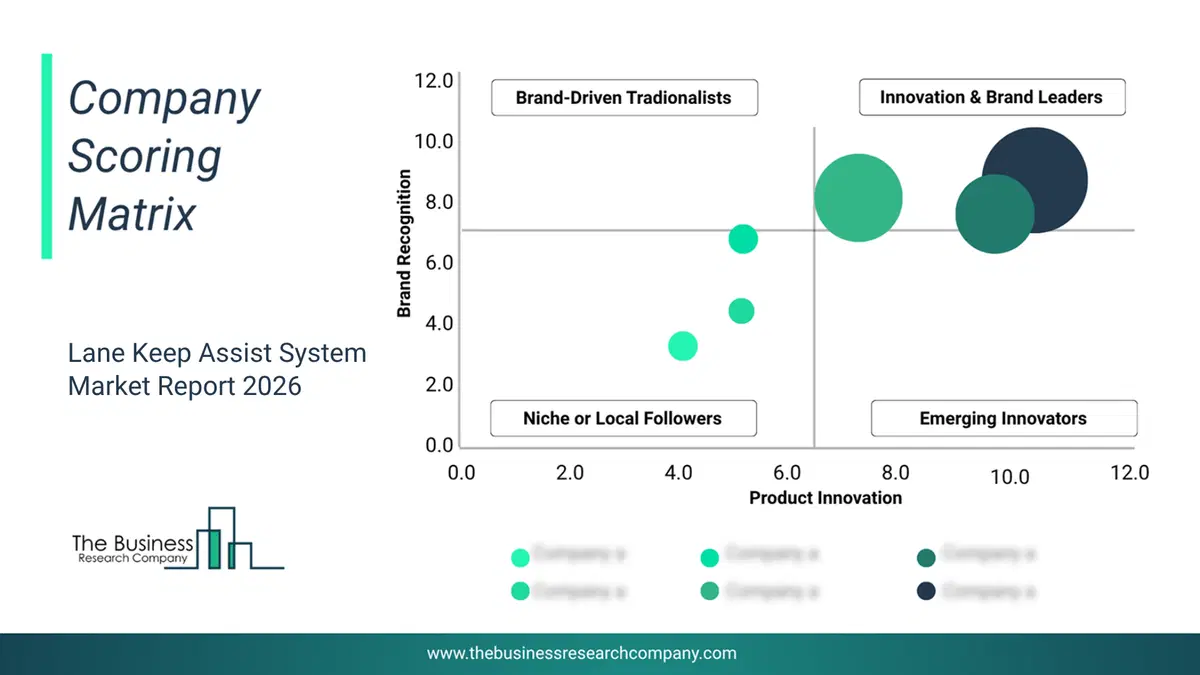
This chart maps companies by product innovation and brand strength, with bubble size indicating relative revenue, helping identify market leaders, challengers, and niche players. This is an illustrative chart; the full report provides a complete and accurate competitive analysis.
Global Lane Keep Assist System Market Trends and Insights
Major companies operating in the lane keep assist system market are focused on integration with advanced driver assistance systems to drive the revenues in the market. Integration with ADAS enhances the functionality and appeal of lane-keep assist systems by providing a collaborative and comprehensive safety framework, improving accuracy, and responding effectively to diverse driving scenarios. For instance, in June 2023, XPeng, a China-based electric vehicle manufacturer, launched the most advanced semi-autonomous driving system in Beijing, marking China's first Advanced Driver Assistance System (ADAS) available for urban driving on major ring roads and expressways. The beta version is accessible on select XPENG models in Beijing, including the XPENG G9 Max, P7i Max, and P5 P versions, through over-the-air updates.What Are Latest Mergers And Acquisitions In The Lane Keep Assist System Market?
In June 2023, Magna International Inc., a Canada-based parts manufacturer, acquired Veoneer for an undisclosed amount. With this purchase, Magna is projected to generate more than $3 billion in sales in 2024; the combined business builds a more comprehensive active safety portfolio across all relevant sensors, central computer systems, and software solutions for Magna in one of the fastest-growing market segments in automotive. Veoneer is an American-Swedish provider of automotive technology.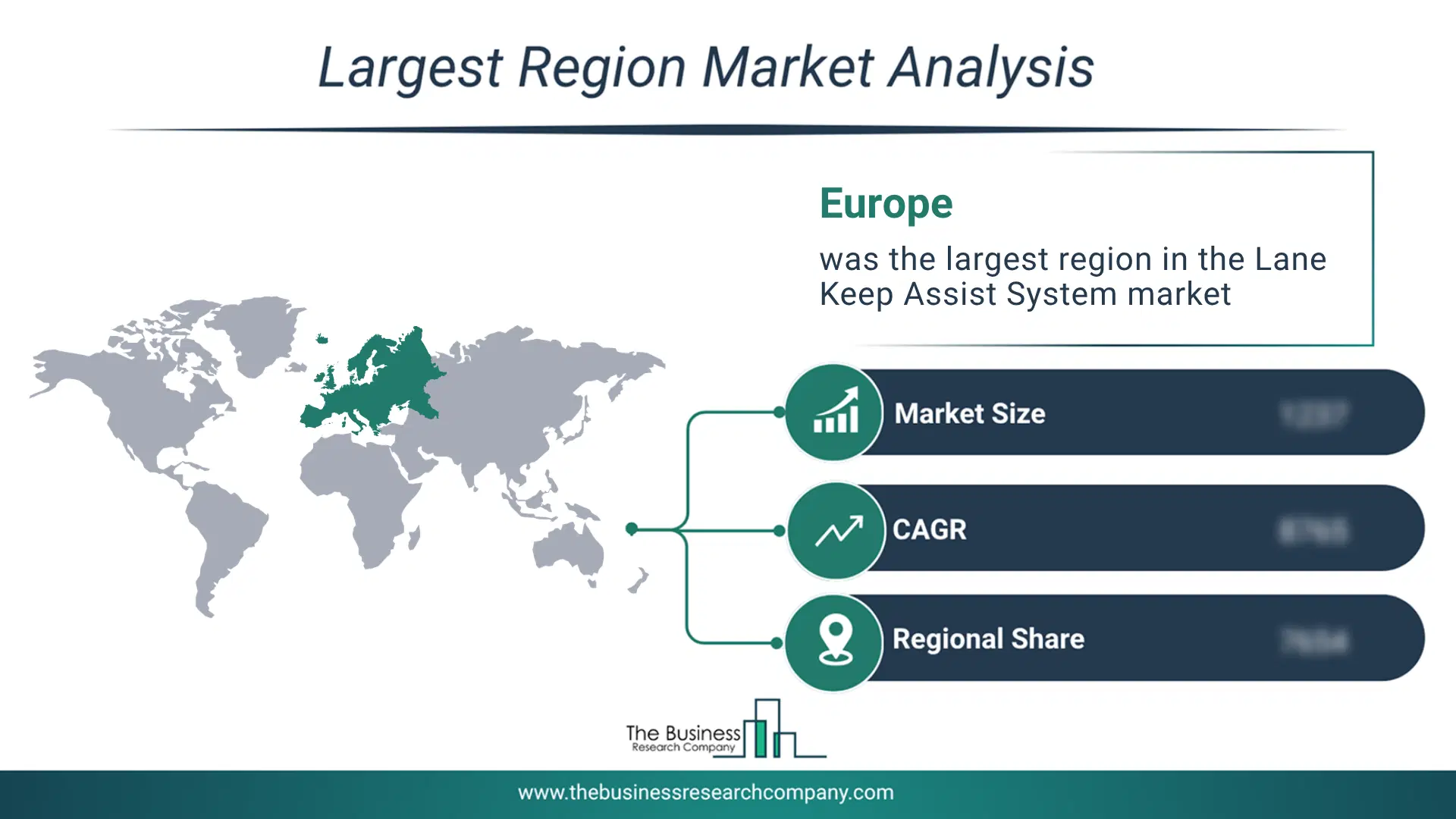
Regional Insights
Europe was the largest region in the lane keep assist system market in 2025. Asia-Pacific is expected to be the fastest-growing region in the forecast period. The regions covered in this market report are Asia-Pacific, South East Asia, Western Europe, Eastern Europe, North America, South America, Middle East, Africa. The countries covered in this market report are Australia, Brazil, China, France, Germany, India, Indonesia, Japan, Taiwan, Russia, South Korea, UK, USA, Canada, Italy, SpainWhat Defines the Lane Keep Assist System Market?
The lane keep assist system market includes revenues earned by entities through lane departure warning, adjustability and customization, and safety enhancement. The market value includes the value of related goods sold by the service provider or included within the service offering. The lane keep assist system market consists of sales of windshield-mounted cameras, image processing software, control setting switches or control indicators, direction displays, and instrument clusters. Values in this market are ‘factory gate’ values, that is the value of goods sold by the manufacturers or creators of the goods, whether to other entities (including downstream manufacturers, wholesalers, distributors and retailers) or directly to end customers. The value of goods in this market includes related services sold by the creators of the goods.How is Market Value Defined and Measured?
The market value is defined as the revenues that enterprises gain from the sale of goods and/or services within the specified market and geography through sales, grants, or donations in terms of the currency (in USD unless otherwise specified). The revenues for a specified geography are consumption values that are revenues generated by organizations in the specified geography within the market, irrespective of where they are produced. It does not include revenues from resales along the supply chain, either further along the supply chain or as part of other products.
This chart presents market attractiveness based on a quantitative evaluation of growth, competition, strategic alignment, and risk, offering a clear view of opportunity areas for decision-making. This chart is for illustrative purposes; the full report contains the complete analysis.

This chart highlights the Total Addressable Market (TAM) by estimating the maximum revenue opportunity using an assumption-driven approach, supporting strategic planning and opportunity sizing across markets. The chart is illustrative; the full report provides a more comprehensive analysis.
What Key Data and Analysis Are Included in the Lane Keep Assist System Market Report 2026?
The lane keep assist system market research report is one of a series of new reports from The Business Research Company that provides market statistics, including industry global market size, regional shares, competitors with the market share, detailed market segments, market trends and opportunities, and any further data you may need to thrive in the lane keep assist system industry. The market research report delivers a complete perspective of everything you need, with an in-depth analysis of the current and future state of the industry.Lane Keep Assist System Market Report Forecast Analysis
| Report Attribute | Details |
|---|---|
| Market Size Value In 2026 | $14.97 billion |
| Revenue Forecast In 2030 | $31.44 billion |
| Growth Rate | CAGR of 20.4% from 2026 to 2030 |
| Base Year For Estimation | 2025 |
| Actual Estimates/Historical Data | 2020-2025 |
| Forecast Period | 2026 - 2030 |
| Market Representation | Revenue in USD Billion and CAGR from 2026 to 2030 |
| Segments Covered | Component, Function Type, Vehicle Type, Propulsion, Sales Channel |
| Regional Scope | Asia-Pacific, Western Europe, Eastern Europe, North America, South America, Middle East, Africa |
| Country Scope | The Countries Covered In This Market Report Are Australia, Brazil, China, France, Germany, India, Indonesia, Japan, Taiwan, Russia, South Korea, Uk, Usa, Canada, Italy, Spain. |
| Key Companies Profiled | Volkswagen AG, Mercedes-Benz Group AG, Robert Bosch GmbH, Panasonic Corporation, ZF Friedrichshafen AG, Denso Corporation, Continental AG, Mitsubishi Electric Corporation, HyundAI Mobis, Magna International Inc., Aisin Seiki Co. Ltd, Nvidia Corporation, Valeo S.A., Texas Instruments Incorporated, Aptiv PLC, Infineon Technologies AG, Hitachi Astemo Ltd., JTEKT Corporation, Renesas Electronics Corporation, Autoliv Inc., HELLA GmbH & Co., Omron Corporation, Visteon Corporation, Gentex Corporation, Mobileye Global Inc., Veoneer Inc., Bendix Commercial Vehicle Systems LLC, Stoneridge Inc. |
| Customization Scope | Request for Customization |
| Pricing And Purchase Options | Explore Purchase Options |