

Large-Joint Reconstructive Implants Market Report 2026
Global Outlook – By Product Type (Hip Reconstruction Implants, Knee Reconstruction Implants, Shoulder Reconstruction Implants, Ankle Reconstruction Implants, Elbow Reconstruction Implants), By Material (Metallic, Natural, Ceramic, Polymers), By Application (Orthopedic Surgery, Trauma Surgery, Other Applications), By End Use (Hospitals, Ambulatory Surgical Centers, Orthopedic Clinics) – Market Size, Trends, Strategies, and Forecast to 2030
Large-Joint Reconstructive Implants Market Report 2026 Market Overview
• Large-Joint Reconstructive Implants Market Report 2026 market size has reached to $11.7 billion in 2025 • Expected to grow to $18.65 billion in 2030 at a compound annual growth rate (CAGR) of 9.7% • Growth Driver: Rising Obesity Rates Enhancing The Growth Of The Market Due To Increasing Musculoskeletal Disorders • Market Trend: Robotic-Assisted Surgery Enhances Precision In Joint Reconstruction Procedures • North America was the largest region in 2025 and Asia-Pacific is the fastest growing region.What Is Covered Under Large-Joint Reconstructive Implants Market?
Large-joint reconstructive implants are medical devices used to replace or restore damaged major joints in the body, to improve mobility, reduce pain, and restore joint function. These implants are commonly used in patients suffering from severe arthritis, trauma, degenerative joint diseases, or joint deformities, and are typically made from durable materials. The main product types of large-joint reconstructive implants include hip reconstruction implants, knee reconstruction implants, shoulder reconstruction implants, ankle reconstruction implants, and elbow reconstruction implants. Hip reconstruction implants refer to medical implant devices designed to restore joint function, stability, and mobility by replacing damaged or diseased hip structures. These implants are manufactured using materials such as metallic, natural, ceramic, and polymers. The various applications involved are orthopedic surgery, trauma surgery, and others and they are utilized by end uses including hospitals, ambulatory surgical centers, and orthopedic clinics.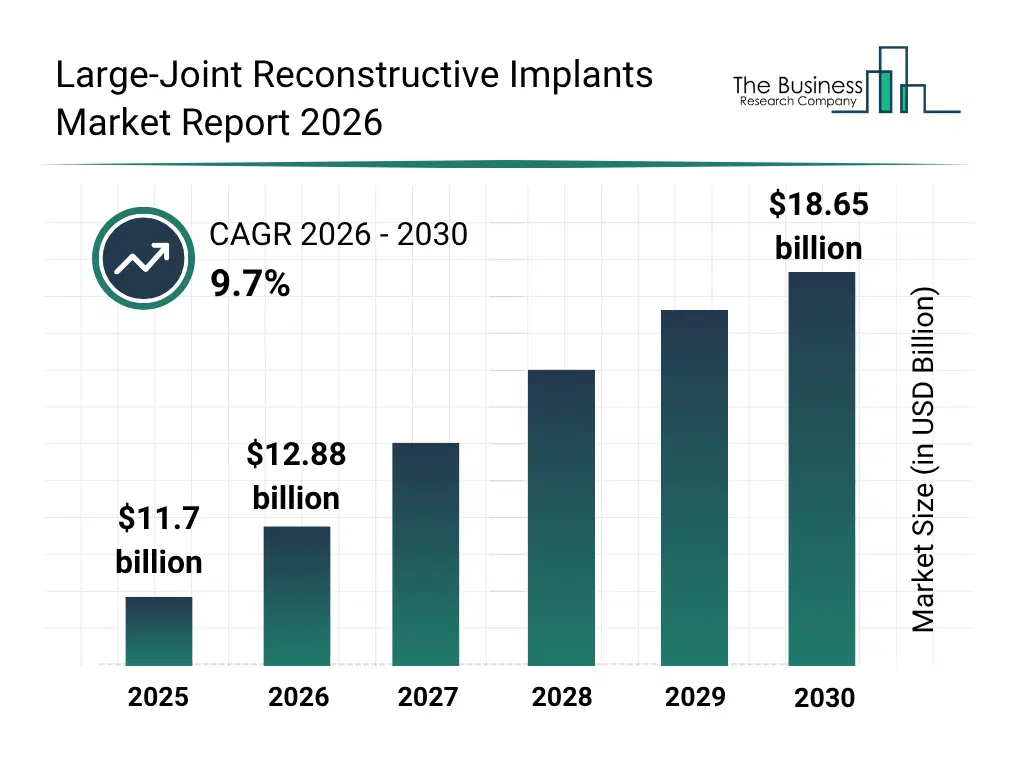
What Is The Large-Joint Reconstructive Implants Market Size and Share 2026?
The large-joint reconstructive implants market size has grown rapidly in recent years. It will grow from $11.7 billion in 2025 to $12.88 billion in 2026 at a compound annual growth rate (CAGR) of 10.1%. The growth in the historic period can be attributed to the rising global prevalence of degenerative joint disorders like osteoarthritis and rheumatoid arthritis, an expanding geriatric demographic prone to bone wear and tear, increasing volumes of primary hip and knee arthroplasty, growing sports-related joint injuries, and the expansion of specialized orthopedic hospital infrastructure.What Is The Large-Joint Reconstructive Implants Market Growth Forecast?
The large-joint reconstructive implants market size is expected to see strong growth in the next few years. It will grow to $18.65 billion in 2030 at a compound annual growth rate (CAGR) of 9.7%. The growth in the forecast period can be attributed to the rapid adoption of minimally invasive orthopedic procedures, rising clinical preference for cementless press-fit implants, expanding healthcare infrastructure and medical tourism in emerging markets, growing cases of joint degeneration linked to rising obesity rates, and favorable public and private insurance reimbursement frameworks for orthopedic surgeries. Major trends in the forecast period include the widespread integration of AI and robotic-assisted surgical systems for precise component placement, the expansion of patient-specific, 3D-printed custom implants that mirror individual anatomy, the development of highly durable advanced biomaterials (such as cross-linked polyethylene and ceramic coatings) to extend implant longevity, a shifting volume of uncomplicated surgeries toward Ambulatory Surgical Centers (ASCs), and a rising demand for specialized revision implants to address early hardware failures.
Global Large-Joint Reconstructive Implants Market Segmentation
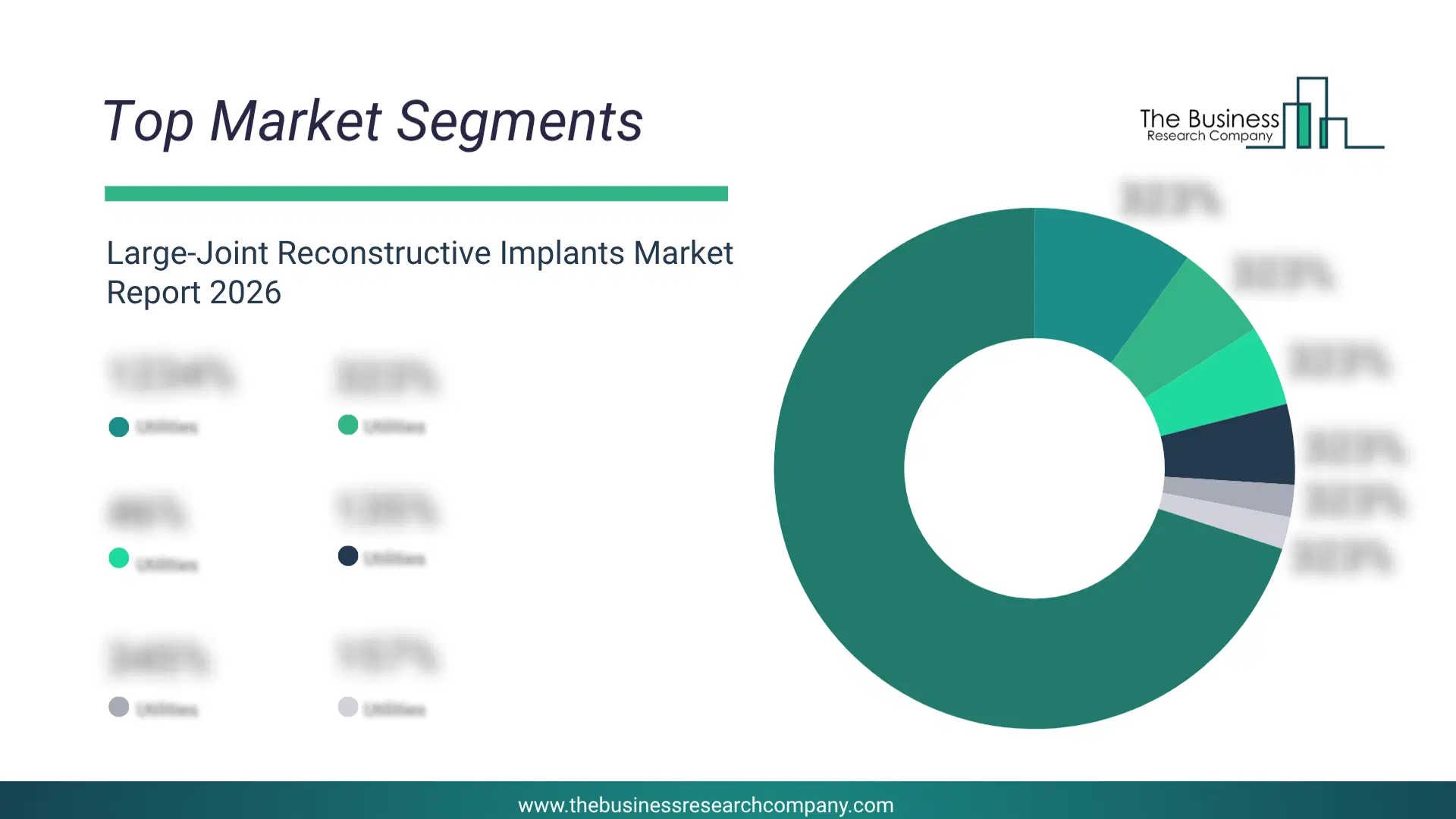
1) By Product Type: Hip Reconstruction Implants, Knee Reconstruction Implants, Shoulder Reconstruction Implants, Ankle Reconstruction Implants, Elbow Reconstruction Implants 2) By Material: Metallic, Natural, Ceramic, Polymers 3) By Application: Orthopedic Surgery, Trauma Surgery, Other Applications 4) By End Use: Hospitals, Ambulatory Surgical Centers, Orthopedic Clinics Subsegments: 1) By Hip Reconstruction Implants: Total Hip Replacement Implants, Partial Hip Replacement Implants, Revision Hip Implants, Cemented Hip Implants, Cementless Hip Implants, Dual Mobility Hip Implants 2) By Knee Reconstruction Implants: Total Knee Replacement Implants, Partial Knee Replacement Implants, Revision Knee Implants, Fixed Bearing Knee Implants, Mobile Bearing Knee Implants, Hinged Knee Implants 3) By Shoulder Reconstruction Implants: Total Shoulder Replacement Implants, Reverse Shoulder Implants, Partial Shoulder Implants, Revision Shoulder Implants, Stemless Shoulder Implants 4) By Ankle Reconstruction Implants: Total Ankle Replacement Implants, Revision Ankle Implants, Mobile Bearing Ankle Implants, Fixed Bearing Ankle Implants 5) By Elbow Reconstruction Implants: Total Elbow Replacement Implants, Partial Elbow Implants, Revision Elbow Implants, Linked Elbow Implants, Unlinked Elbow ImplantsWhat Is The Driver Of The Large-Joint Reconstructive Implants Market?
The rising obesity rates are expected to propel the growth of the large-joint reconstructive implants market going forward. Obesity refers to a chronic health condition that contributes to musculoskeletal disorders and progressive joint damage. Obesity rates are rising due to increasing consumption of calorie-dense processed foods. Large-joint reconstructive implants enable effective treatment for obesity-related musculoskeletal complications by replacing damaged joints and improving patient mobility. For instance, in March 2024, according to the Organisation for Economic Co-operation and Development, a France-based intergovernmental organization, 60% of adults aged 15 years and above across 13 OECD countries were overweight or obese in 2023, compared to nearly 56% reported in previous year. Therefore, the rising obesity rates are driving the growth of the large-joint reconstructive implants industry.Key Players In The Global Large-Joint Reconstructive Implants Market
Major companies operating in the large-joint reconstructive implants market report are Stryker Corporation, B. Braun Melsungen AG, Zimmer Biomet Holdings Inc., Smith & Nephew plc, Arthrex Inc., Enovis Corporation, CONMED Corporation, Medacta International SA, Exactech Inc., Corin Group, MicroPort Orthopedics Inc., United Orthopedic Corporation, Ortho Development Corporation, Baumer S.A., Sharma Orthopedic India Pvt. Ltd., Peter Brehm GmbH, GPC Medical Ltd., XLO India Limited, ImplanTec GmbH, Beznoska s.r.o., HEMC Ortho, Waldemar Link GmbH & Co. KG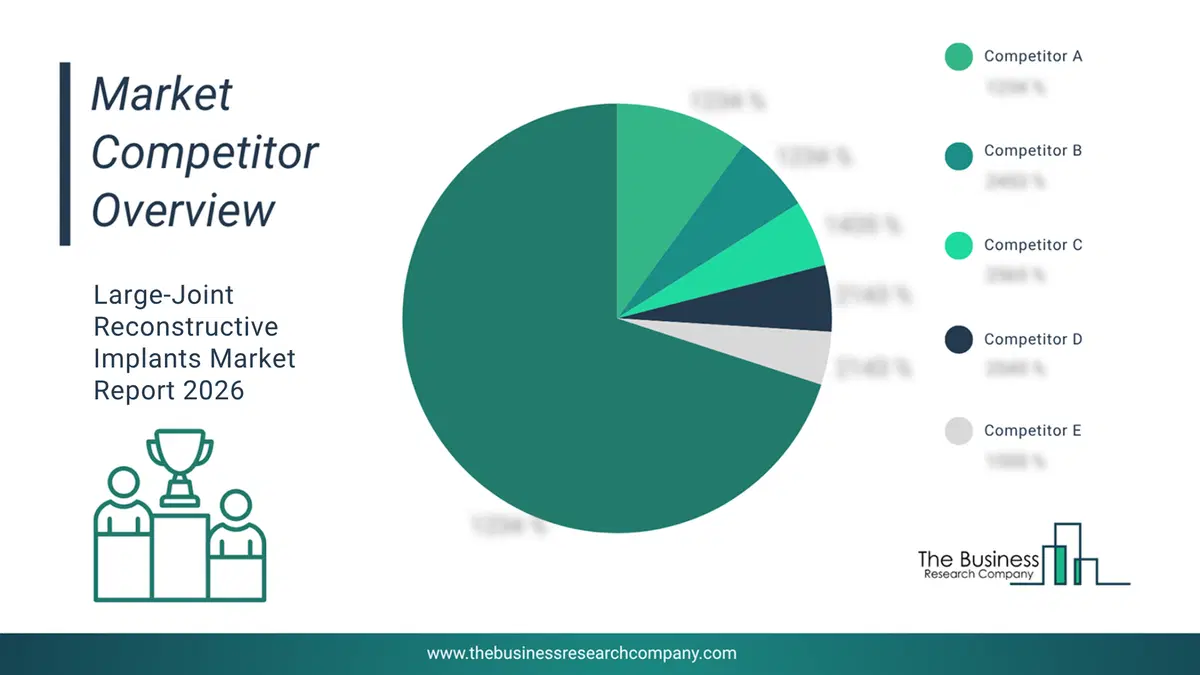
This chart is for illustrative purposes; the full report includes a detailed competitor analysis and comprehensive overview of the top 10 companies in the market.
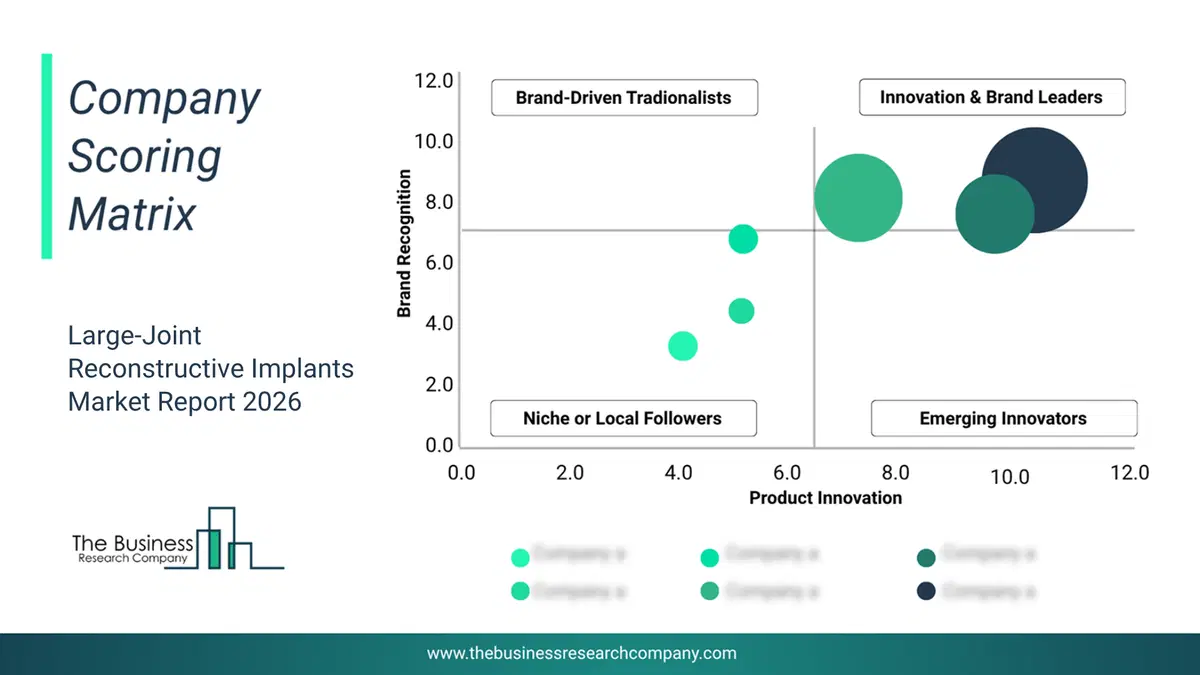
This chart maps companies by product innovation and brand strength, with bubble size indicating relative revenue, helping identify market leaders, challengers, and niche players. This is an illustrative chart; the full report provides a complete and accurate competitive analysis.
Global Large-Joint Reconstructive Implants Market Trends and Insights
Major companies operating in the large-joint reconstructive implants market are focusing on developing advanced solutions, such as robotic-assisted orthopedic surgery systems, to improve implant positioning accuracy, reduce surgical variability, and support faster patient recovery. Robotic-assisted orthopedic surgery systems refer to advanced surgical platforms that use robotic arms, real-time imaging, and data-driven surgical planning tools to assist surgeons during joint replacement procedures with improved precision and consistency. For instance, in March 2025, Stryker Corporation, a US-based medical technology company, introduced the fourth-generation Mako 4 SmartRobotics platform and expanded its Mako Total Hip application with Advanced Primary and Revision capabilities. The platform provides three-dimensional computed tomography-based surgical planning, intraoperative screw trajectory guidance, augment and screw planning features, and compatibility with Stryker’s revision hip implant portfolio to support improved workflow efficiency and precision in hip and joint reconstruction procedures.What Are Latest Mergers And Acquisitions In The Large-Joint Reconstructive Implants Market?
In March 2024, Stryker Corporation, a US-based provider of orthopedic implants, acquired SERF SAS for an undisclosed amount. With this acquisition, Stryker aimed to strengthen its large-joint reconstructive implants portfolio by expanding its hip replacement product offerings and enhancing its presence in the European orthopedic implant market through SERF SAS’s innovative dual mobility hip implant technologies. SERF SAS is a France-based manufacturer of large-joint reconstructive implants including hip and knee reconstruction implants.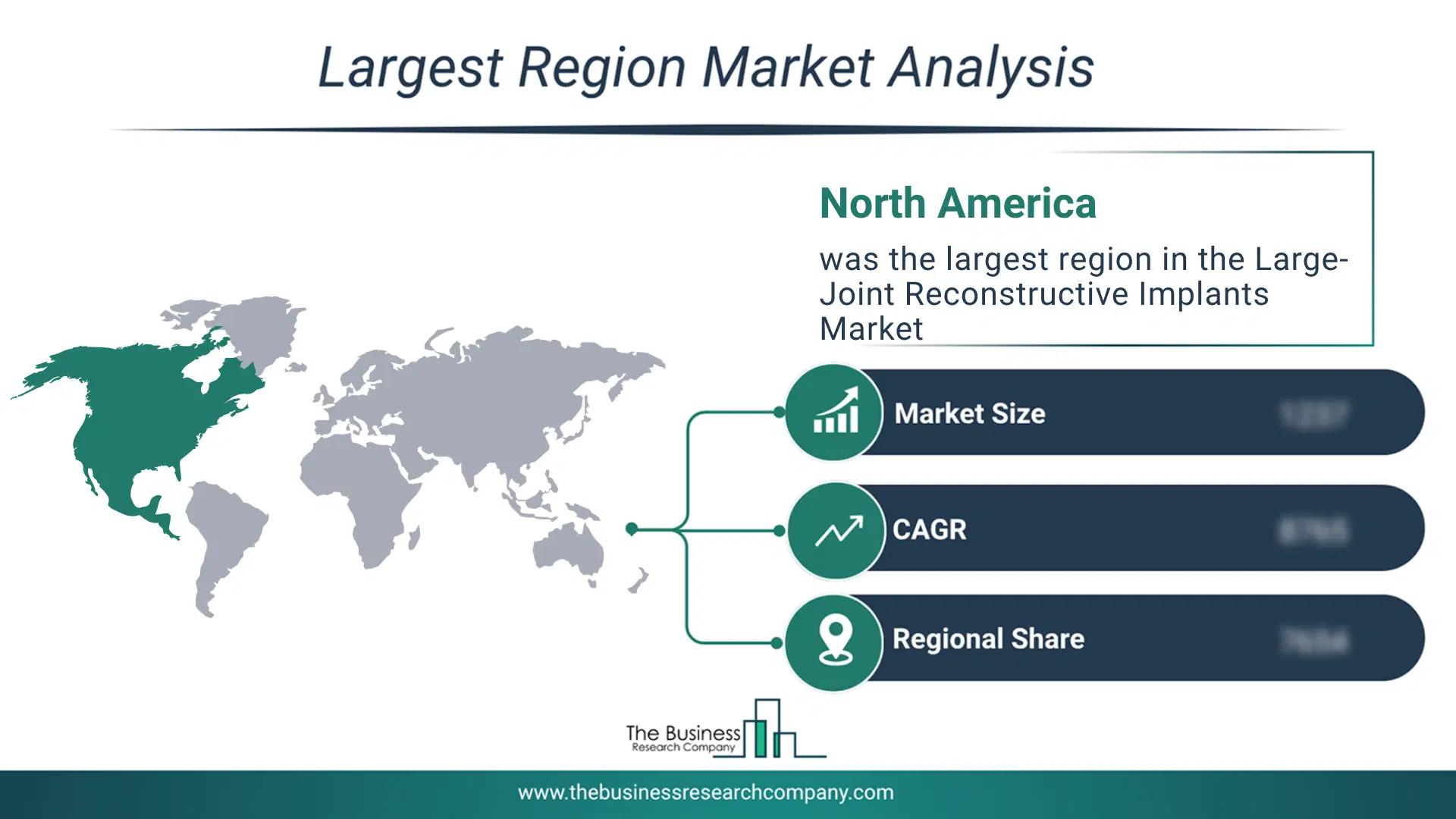
Regional Outlook
North America was the largest region in the large-joint reconstructive implants market in 2025. Asia-Pacific is expected to be the fastest-growing region in the forecast period. The regions covered in this market report are Asia-Pacific, South East Asia, Western Europe, Eastern Europe, North America, South America, Middle East, Africa. The countries covered in this market report are Australia, Brazil, China, France, Germany, India, Indonesia, Japan, Taiwan, Russia, South Korea, UK, USA, Canada, Italy, Spain.What Defines the Large-Joint Reconstructive Implants Market?
The large-joint reconstructive implants market consists of sales of revision joint implants, partial knee replacement systems, reverse shoulder arthroplasty systems, acetabular cup systems, and femoral stem implants. values in this market are ‘factory gate’ values, that is the value of goods sold by the manufacturers or creators of the goods, whether to other entities (including downstream manufacturers, wholesalers, distributors and retailers) or directly to end customers. The value of goods in this market includes related services sold by the creators0 of the goods.How is Market Value Defined and Measured?
The market value is defined as the revenues that enterprises gain from the sale of goods and/or services within the specified market and geography through sales, grants, or donations in terms of the currency (in USD unless otherwise specified). The revenues for a specified geography are consumption values that are revenues generated by organizations in the specified geography within the market, irrespective of where they are produced. It does not include revenues from resales along the supply chain, either further along the supply chain or as part of other products.
This chart presents market attractiveness based on a quantitative evaluation of growth, competition, strategic alignment, and risk, offering a clear view of opportunity areas for decision-making. This chart is for illustrative purposes; the full report contains the complete analysis.

This chart highlights the Total Addressable Market (TAM) by estimating the maximum revenue opportunity using an assumption-driven approach, supporting strategic planning and opportunity sizing across markets. The chart is illustrative; the full report provides a more comprehensive analysis.
What Key Data and Analysis Are Included in the Large-Joint Reconstructive Implants Market Report 2026?
The large-joint reconstructive implants market research report is one of a series of new reports from The Business Research Company that provides market statistics, including industry global market size, regional shares, competitors with the market share, detailed market segments, market trends and opportunities, and any further data you may need to thrive in the large-joint reconstructive implants industry. The market research report delivers a complete perspective of everything you need, with an in-depth analysis of the current and future state of the industry.Large-Joint Reconstructive Implants Market Report Forecast Analysis
| Report Attribute | Details |
|---|---|
| Market Size Value In 2026 | $12.88 billion |
| Revenue Forecast In 2030 | $18.65 billion |
| Growth Rate | CAGR of 9.7% from 2026 to 2030 |
| Base Year For Estimation | 2025 |
| Actual Estimates/Historical Data | 2020-2025 |
| Forecast Period | 2026 - 2030 |
| Market Representation | Revenue in USD Billion and CAGR from 2026 to 2030 |
| Segments Covered | Product Type, Material, Application, End Use |
| Regional Scope | Asia-Pacific, Western Europe, Eastern Europe, North America, South America, Middle East, Africa |
| Country Scope | The countries covered in the report are Australia, Brazil, China, France, Germany, India, Indonesia, Japan, Taiwan, Russia, South Korea, UK, USA, Canada, Italy, Spain. |
| Key Companies Profiled | Stryker Corporation, B. Braun Melsungen AG, Zimmer Biomet Holdings Inc., Smith & Nephew plc, Arthrex Inc., Enovis Corporation, CONMED Corporation, Medacta International SA, Exactech Inc., Corin Group, MicroPort Orthopedics Inc., United Orthopedic Corporation, Ortho Development Corporation, Baumer S.A., Sharma Orthopedic India Pvt. Ltd., Peter Brehm GmbH, GPC Medical Ltd., XLO India Limited, ImplanTec GmbH, Beznoska s.r.o., HEMC Ortho, Waldemar Link GmbH & Co. KG |
| Customization Scope | Request for Customization |
| Pricing And Purchase Options | Explore Purchase Options |