
Large Language Model (LLM) Market Report 2026
Global Outlook – By Model Size (Below 100 Billion Parameters, 100 Billion To 500 Billion Parameters, Above 500 Billion Parameters), By Architecture (Autoregressive Language Models, Autoencoding Language Models, Hybrid Language Models, Other Architectures), By Deployment (Cloud, On-Premises), By Industry (Healthcare, Finance, Retail And E-Commerce, Media And Entertainment, Other Industries) – Market Size, Trends, Strategies, and Forecast to 2030
Large Language Model (LLM) Market Overview
• Large Language Model (LLM) market size has reached to $8.33 billion in 2025 • Expected to grow to $32.5 billion in 2030 at a compound annual growth rate (CAGR) of 31.2% • Growth Driver: The Role Of Chatbots And Virtual Assistants In Driving The Growth Of The Large Language Model (LLM) Market • Market Trend: Innovative Solutions Are Transforming The LLM Market • North America was the largest region in 2025 and Asia-Pacific is the fastest growing region.Market Gains By 2030 – Top Opportunities By Segment
Market Gain identifies the most promising market opportunities by highlighting the segments or products expected to generate the highest incremental revenue growth over the next five years.
What Is Covered Under Large Language Model (LLM) Market?
A large language model (LLM) is an artificial intelligence algorithm that uses deep learning techniques and neural networks with many parameters to process and understand human language or text. They are utilized for a variety of natural language processing (NLP) tasks and applications due to their capacity to produce, comprehend, and modify human language. The main model size of the large language model (LLM) is below 100 billion parameters, 100 billion to 500 billion parameters, above 500 billion parameters, and other parameters. Language models with parameter sizes below 100 billion in the large language model market are suited for applications requiring moderate computational resources and efficiency in processing and understanding language data. The various architectures include autoregressive language models, autoencoding language models, hybrid language models, and other architectures through various deployment modes including cloud, and on-premises used by various industries such as healthcare, finance, retail and e-commerce, media and entertainment, and other industries.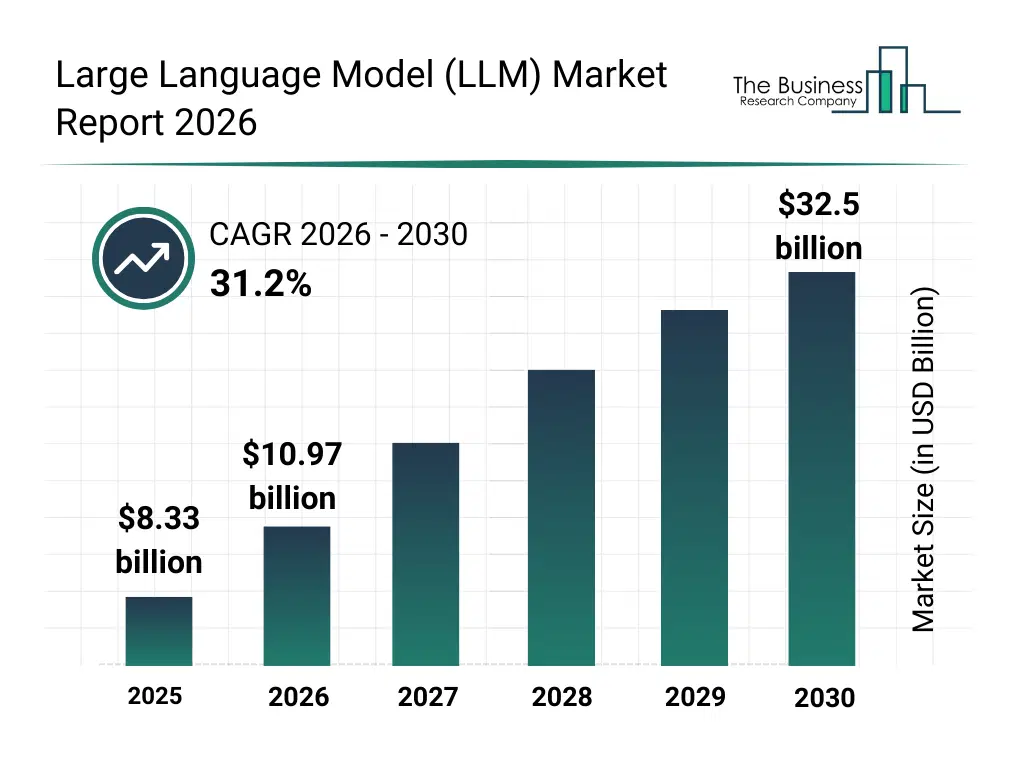
What Is The Large Language Model (LLM) Market Size and Share 2026?
The large language model (llm) market size has grown exponentially in recent years. It will grow from $8.33 billion in 2025 to $10.97 billion in 2026 at a compound annual growth rate (CAGR) of 31.8%. The growth in the historic period can be attributed to growth in NLP research activities, increasing availability of large-scale datasets, advancements in GPU and accelerator hardware, early enterprise adoption of AI-driven text analytics, expansion of cloud-based AI platforms.What Is The Large Language Model (LLM) Market Growth Forecast?
The large language model (llm) market size is expected to see exponential growth in the next few years. It will grow to $32.5 billion in 2030 at a compound annual growth rate (CAGR) of 31.2%. The growth in the forecast period can be attributed to increasing enterprise demand for generative AI solutions, rising investments in AI infrastructure, expansion of industry-specific language models, growing focus on explainable and responsible AI, continuous improvements in model compression techniques. Major trends in the forecast period include increasing adoption of large-scale transformer architectures, rising deployment of domain-specific llms, growing integration of multi-modal language models, expansion of enterprise-grade custom llms, enhanced focus on model efficiency and optimization.
Global Large Language Model (LLM) Market Segmentation
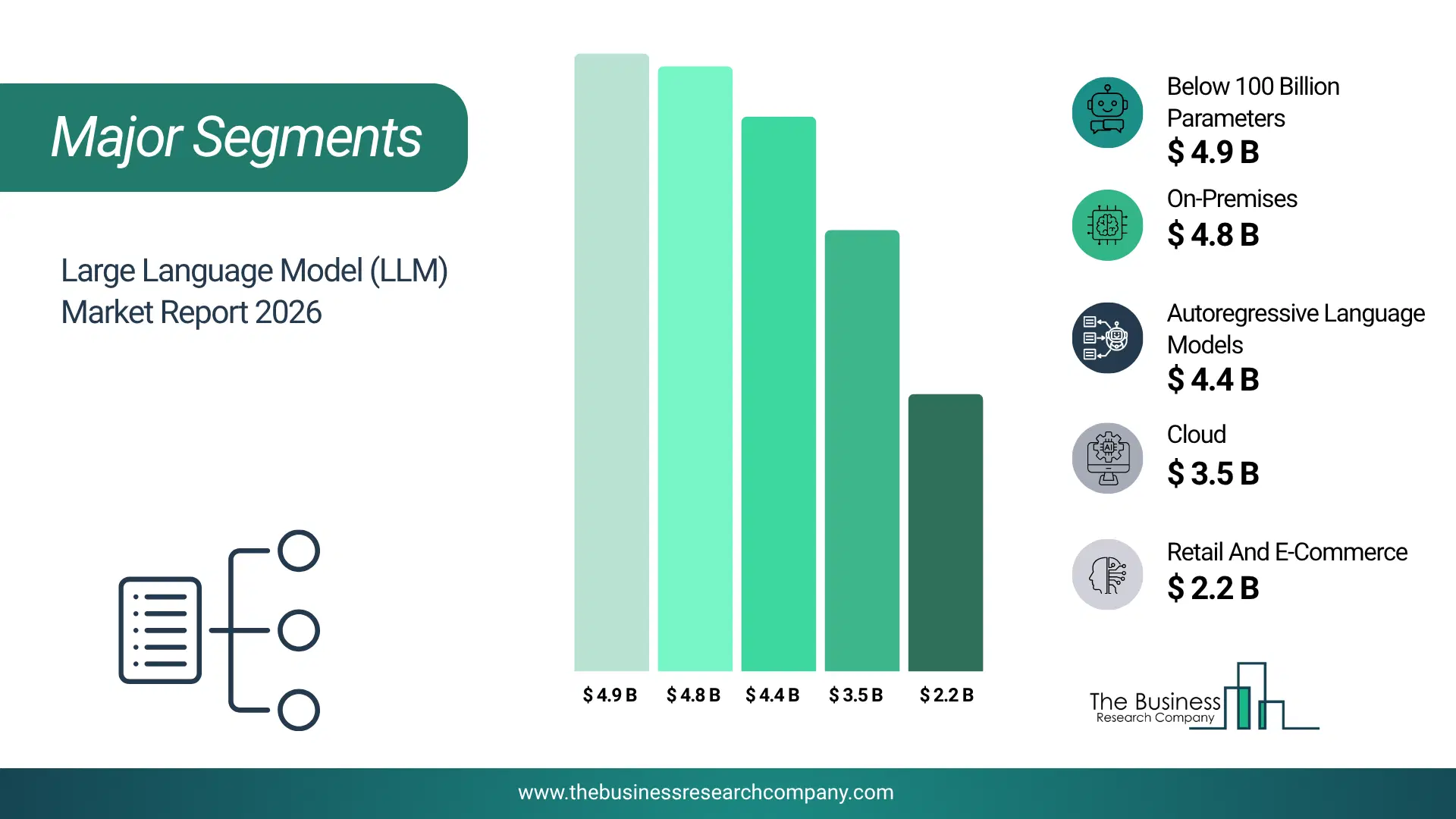
1) By Model Size: Below 100 Billion Parameters, 100 Billion To 500 Billion Parameters, Above 500 Billion Parameters 2) By Architecture: Autoregressive Language Models, Autoencoding Language Models, Hybrid Language Models, Other Architectures 3) By Deployment: Cloud, On-Premises 4) By Industry: Healthcare, Finance, Retail And E-Commerce, Media And Entertainment, Other Industries Subsegments: 1) By Below 100 Billion Parameters: Small-Scale LLMs, Domain-Specific LLMs, Lightweight Models For Embedded Systems 2) By 100 Billion To 500 Billion Parameters: Mid-Scale General-Purpose LLMs, Multi-Modal Models (Text, Image), Customizable Enterprise LLMs 3) By Above 500 Billion Parameters: Large-Scale General-Purpose LLMs, Cutting-Edge Models For NLP And AI Research, Highly Complex And Scalable Models For Industry Applications The top segments in the large language model (llm) market will be: • Below 100 Billion Parameters will reach $4980.77 Million by 2025. • On-Premises will reach $4815.03 Million by 2025. • Autoregressive Language Models will reach $4462.02 Million by 2025. • Cloud will reach $3534.92 Million by 2025. • Retail And E-Commerce will reach $2274.34 Million by 2025.What Is The Driver Of The Large Language Model (LLM) Market?
The growing demand for chatbots and virtual assistants is expected to propel the growth of the large language model (LLM) market going forward. Chatbots and virtual assistants are AI-powered software tools designed to interact with humans by understanding queries, providing responses, and performing tasks through natural language-based interfaces. The adoption of chatbots and virtual assistants is rising due to their ability to streamline processes, enhance user experiences, and support business growth across digital platforms. The large language model (LLM) market supports this rising adoption by enabling advanced conversational capabilities, allowing chatbots and virtual assistants to understand context, generate human-like text, and deliver more accurate and personalized interactions. For instance, in November 2024, according to the arxiv a US-based operates an open-access repository reported that AI conversational assistants leveraging data from 5,172 support agents boosted worker productivity by an average of 15% in issues resolved per hour. Therefore, the growing demand for chatbots and virtual assistants is driving the growth of the large language model (LLM) industry.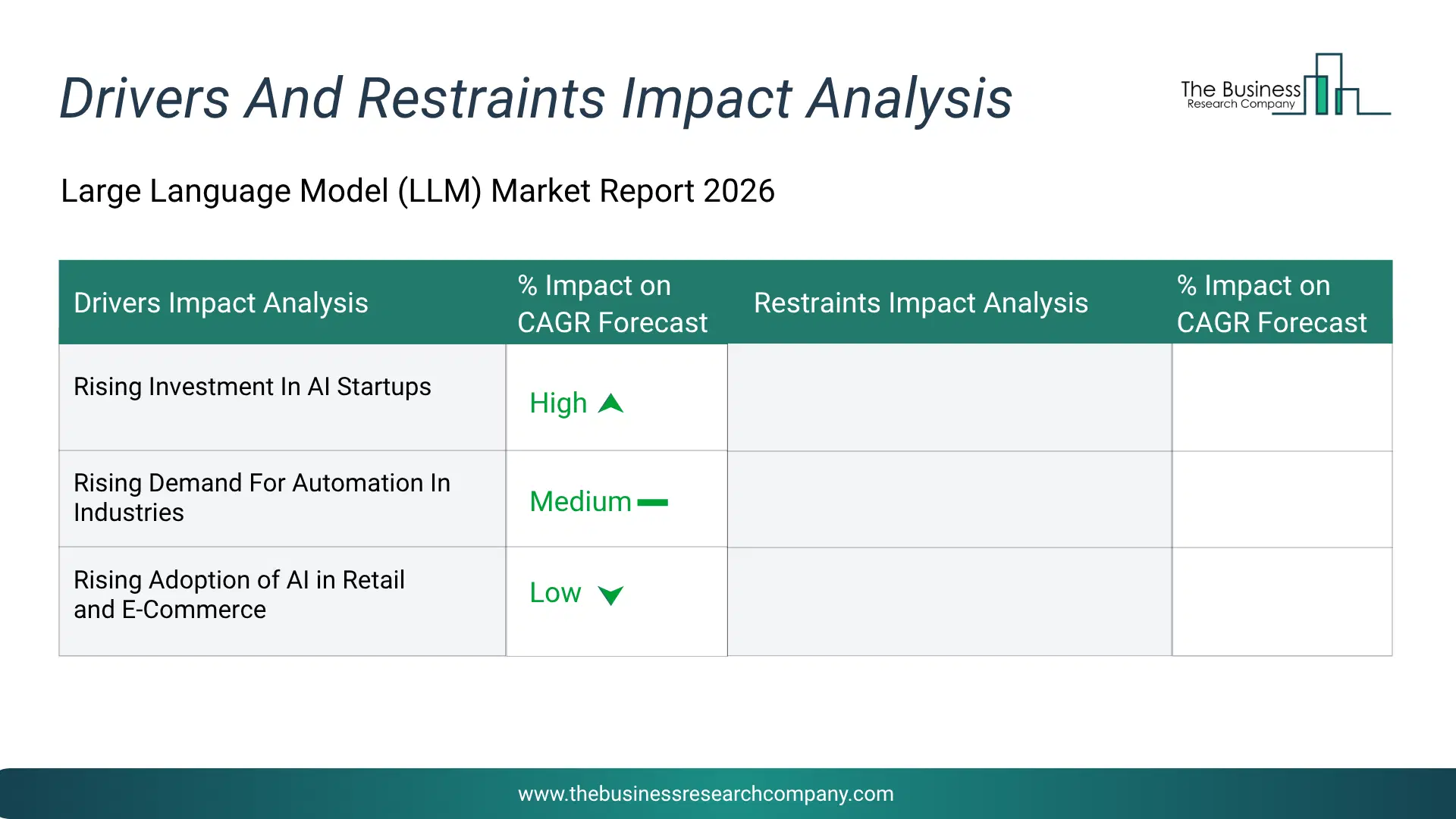
Infographic Chart Showing Key Market Drivers Analysis And Restraints For Large Language Model (Llm) Market
The chart presents an impact analysis of key drivers and restraints, quantifying their relative influence on the market's growth rate and helping assess the balance between growth enablers and limiting factors. This chart offers a high-level perspective; the full report contains more detailed insights.
How Will The Drivers Impact Growth In The Global Large Language Model (LLM) Market?
• Rising Investment In AI Startups (High) – The rising investment In artificial intelligence (AI) startups will become a key driver of growth in the large language model (LLM) market by 2030. Rising artificial intelligence (AI) investment is driving innovation, expanding research and accelerating large language model (LLM) development. Startups attract funding from venture capitalists and tech firms, enabling cost-efficient models and improving artificial intelligence (AI) accessibility. This fosters competition and market expansion as enterprises integrate artificial intelligence (AI) - driven solutions to enhance efficiency, automation and decision-making across industries. As a result, the rising investment in artificial intelligence (AI) startups is anticipated to contributing to annual growth in the market. • Rising Demand For Automation In Industries (Medium) – The rising demand for automation in industries will emerge as a major factor driving the expansion of the market by 2030. As businesses increasingly adopt artificial intelligence (AI) - driven solutions, large language model (LLM) adoption is set to accelerate, fostering market growth and innovation across various applications. Consequently, the rising demand for automation in industries is projected to contributing to annual growth in the market. • Rising Adoption of AI in Retail and E-Commerce (Low) – The rising adoption of artificial intelligence (AI) in retail and e-commerce will serve as a key growth catalyst for the market by 2030. Retailers use large language model (LLMs) for chatbots, virtual assistants and automated support, improving accuracy and reducing costs. E-commerce platforms leverage artificial intelligence (AI) for recommendations, dynamic pricing and sentiment analysis to boost sales. large language model (LLMs) also support fraud detection, supply chain optimization and multilingual services. As artificial intelligence (AI) adoption grows, demand for large language model (LLMs) will continue to expand. Therefore, this growing adoption of artificial intelligence (AI) in retail and e-commerce is projected to supporting to annual growth • Expansion of Digital Marketing and Content Creation (Low) – The expansion of digital marketing and content creation will become a significant driver contributing to the growth of the market by 2030. Digital marketing and content creation enable businesses to produce high-quality, scalable and personalized content efficiently. Marketers use large language model (LLMs) to automate ad copy, social media posts and emails, boosting engagement and conversions. artificial intelligence (AI) - driven tools streamline blog writing, SEO and video scripts while reducing costs. large language model (LLMs) also enhance audience targeting through predictive analytics and sentiment analysis, helping companies tailor campaigns to consumer behaviour. Consequently, the expansion of digital marketing and content creation is projected to contributing to annual growth in the market.How Will The Restraints Impact Growth In The Global Large Language Model (LLM) Market?
• Shortage Of AI Professionals And Data Scientists (Medium) – Shortage Of AI Professionals And Data Scientists will restrict the growth of the Large Language Model (LLM) market during the forecast period. LLM development and deployment require highly skilled professionals in AI, machine learning, and data science. The acute shortage of qualified AI talent limits the capacity of organizations to develop and implement LLM solutions. Talent gaps can lead to slow innovation, implementation challenges, and reduced competitiveness in the LLM market.Key Players In The Global Large Language Model (LLM) Market
Major companies operating in the large language model (llm) market are OpenAI, Google LLC, Microsoft Corporation, Meta Platforms Inc., Amazon Web Services, Alibaba Group, Tencent Holdings Ltd., Baidu Inc., Apple Inc., IBM, Oracle Corporation, SAP SE, Salesforce com Inc., Huawei Technologies Co. Ltd., NVIDIA Corporation, Anthropic, Cohere, Mistral AI, AI21 Labs, xAI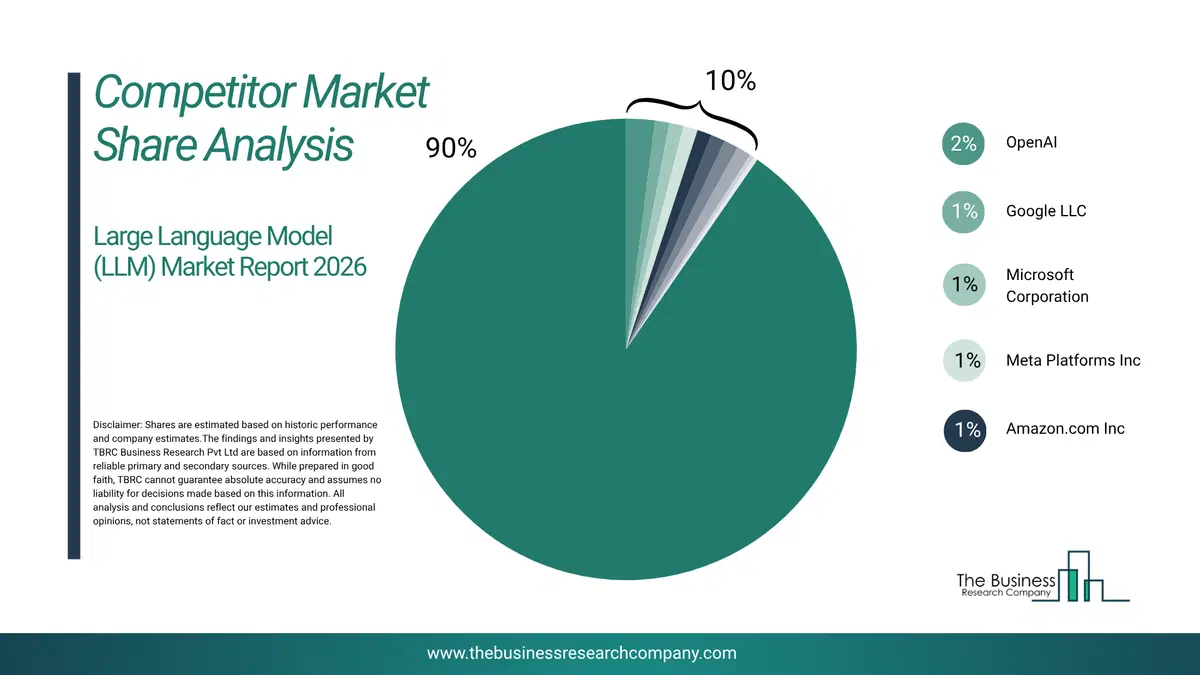
This chart is for illustrative purposes; the full report includes a detailed competitor analysis and comprehensive overview of the top 10 companies in the market.
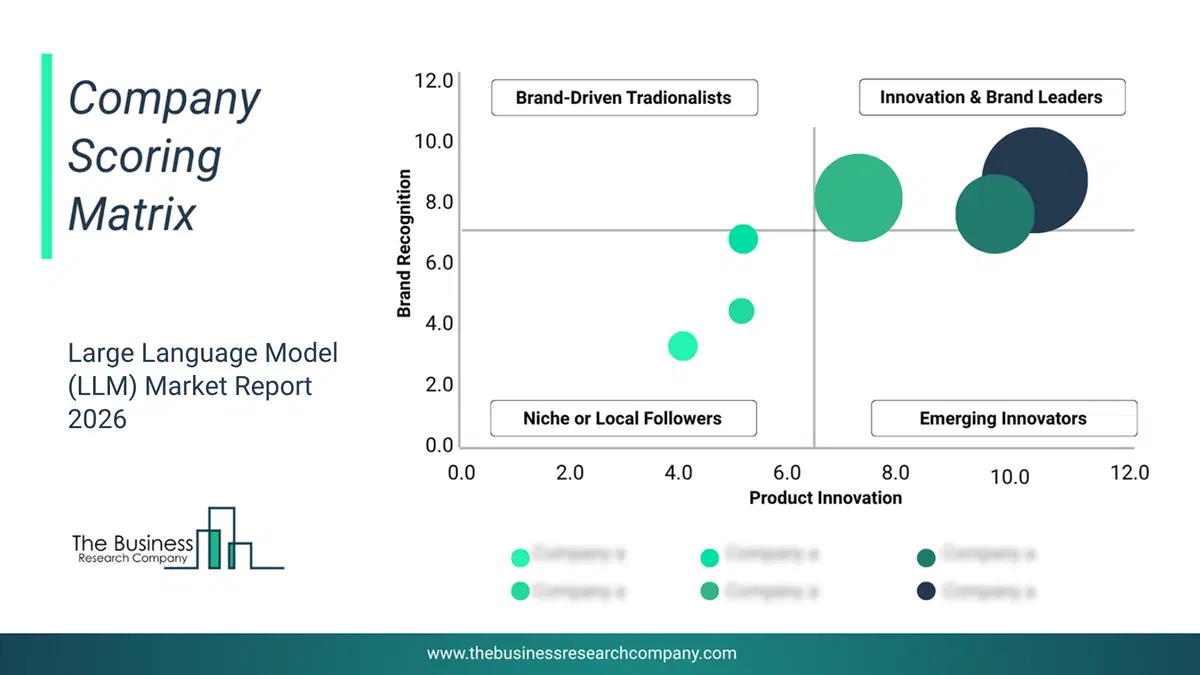
This chart maps companies by product innovation and brand strength, with bubble size indicating relative revenue, helping identify market leaders, challengers, and niche players. This is an illustrative chart; the full report provides a complete and accurate competitive analysis.
Global Large Language Model (LLM) Market Trends and Insights
Major companies operating in the large language model market are focusing on open and enterprise-grade LLMs, such as enterprise-optimized open-weight models, to provide customers with more transparent, efficient, and customizable AI capabilities. Enterprise-optimized open-weight models are large language models specifically designed for complex business workloads and released under permissive licenses that allow organizations to use, fine-tune, and deploy them without restrictions. For instance, in April 2024, Snowflake, a US-based cloud-based data platform company, launched Snowflake Arctic, a state-of-the-art large language model (LLM) that features a Mixture-of-Experts (MoE) architecture for high-efficiency performance at scale, fully open weights released under the Apache 2.0 license, and transparent research documentation, enabling unrestricted commercial, research, and personal use while setting a new standard for openness in enterprise AI.What Are Latest Mergers And Acquisitions In The Large Language Model (LLM) Market?
In January 2024, Protect AI, a US-based cybersecurity platform provider, acquired Laiyer AI for an undisclosed amount. This acquisition enhances Protect AI’s capabilities in the large language model (LLM) ecosystem by integrating Laiyer AI’s advanced model-training technologies into its AI-driven security solutions. The deal supports Protect AI’s strategy to strengthen its product portfolio, expand risk-management visibility across AI pipelines, and accelerate innovation in secure LLM development. Laiyer AI is a US-based provider of large language models and model-training software.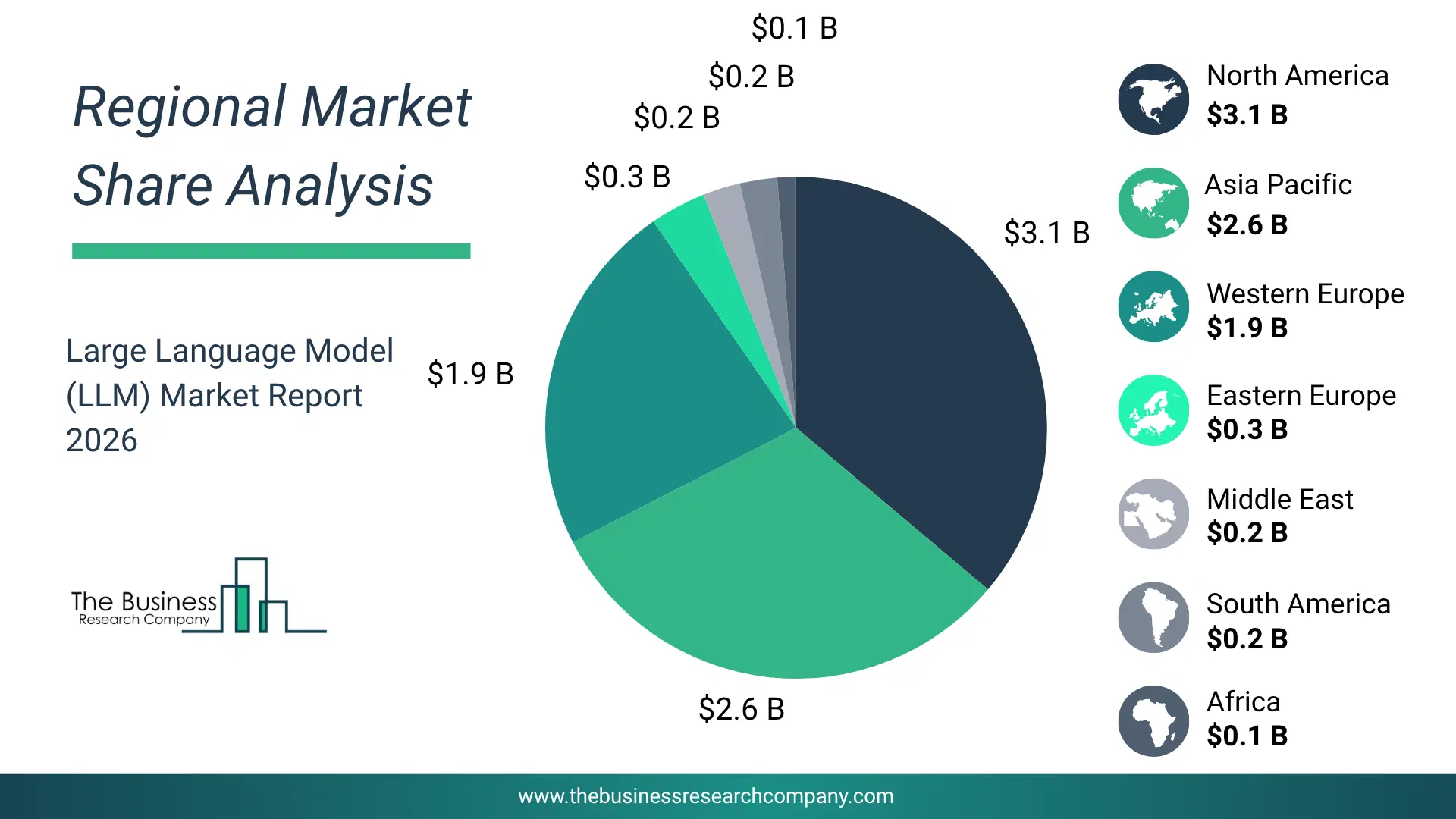
Regional Insights
North America was the largest region in the large language model (LLM) market in 2025. Asia-Pacific is expected to be the fastest-growing region in the forecast period. The regions covered in this market report are Asia-Pacific, South East Asia, Western Europe, Eastern Europe, North America, South America, Middle East, Africa. The countries covered in this market report are Australia, Brazil, China, France, Germany, India, Indonesia, Japan, Taiwan, Russia, South Korea, UK, USA, Canada, Italy, Spain.What Defines the Large Language Model (LLM) Market?
The large language model (LLM) market consists of revenues earned by entities by providing services such as natural language processing and chatbots, content generation and automation, language translation and localization, search and recommendation, and sentiment analysis. The market value includes the value of related goods sold by the service provider or included within the service offering. The large language model (LLM) market also includes sales of language translation tools, content generation platforms, code generation tools, and email response assistants. Values in this market are ‘factory gate’ values, that is the value of goods sold by the manufacturers or creators of the goods, whether to other entities (including downstream manufacturers, wholesalers, distributors and retailers) or directly to end customers. The value of goods in this market includes related services sold by the creators of the goods.How is Market Value Defined and Measured?
The market value is defined as the revenues that enterprises gain from the sale of goods and/or services within the specified market and geography through sales, grants, or donations in terms of the currency (in USD unless otherwise specified). The revenues for a specified geography are consumption values that are revenues generated by organizations in the specified geography within the market, irrespective of where they are produced. It does not include revenues from resales along the supply chain, either further along the supply chain or as part of other products.
This chart presents market attractiveness based on a quantitative evaluation of growth, competition, strategic alignment, and risk, offering a clear view of opportunity areas for decision-making. This chart is for illustrative purposes; the full report contains the complete analysis.

This chart highlights the Total Addressable Market (TAM) by estimating the maximum revenue opportunity using an assumption-driven approach, supporting strategic planning and opportunity sizing across markets. The chart is illustrative; the full report provides a more comprehensive analysis.
What Key Data and Analysis Are Included in the Large Language Model (LLM) Market Report 2026?
The large language model (llm) market research report is one of a series of new reports from The Business Research Company that provides market statistics, including industry global market size, regional shares, competitors with the market share, detailed market segments, market trends and opportunities, and any further data you may need to thrive in the large language model (llm) industry. The market research report delivers a complete perspective of everything you need, with an in-depth analysis of the current and future state of the industry.Large Language Model (LLM) Market Report Forecast Analysis
| Report Attribute | Details |
|---|---|
| Market Size Value In 2026 | $10.97 billion |
| Revenue Forecast In 2030 | $32.5 billion |
| Growth Rate | CAGR of 31.8% from 2026 to 2030 |
| Base Year For Estimation | 2025 |
| Actual Estimates/Historical Data | 2020-2025 |
| Forecast Period | 2026 - 2030 |
| Market Representation | Revenue in USD Billion and CAGR from 2026 to 2030 |
| Segments Covered | Model Size, Architecture, Deployment, Industry |
| Regional Scope | Asia-Pacific, Western Europe, Eastern Europe, North America, South America, Middle East, Africa |
| Country Scope | The countries covered in the report are Australia, Brazil, China, France, Germany, India, Indonesia, Japan, Taiwan, Russia, South Korea, UK, USA, Canada, Italy, Spain. |
| Key Companies Profiled | OpenAI, Google LLC, Microsoft Corporation, Meta Platforms Inc., Amazon Web Services, Alibaba Group, Tencent Holdings Ltd., Baidu Inc., Apple Inc., IBM, Oracle Corporation, SAP SE, Salesforce com Inc., Huawei Technologies Co. Ltd., NVIDIA Corporation, Anthropic, Cohere, Mistral AI, AI21 Labs, xAI |
| Customization Scope | Request for Customization |
| Pricing And Purchase Options | Explore Purchase Options |