Contact Us
  Search
The Business Research Company Logo
Large Language Model (LLM) Market 2025
Published :May 2025
Pages :362
Format :PDF
Delivery Time :2-3 Business Days
Why 2-3 days? We update the report with the latest data and news before delivery. Let us know if you need us to expedite.
Report Price :$4,490.00

Large Language Model (LLM) Market 2025

By Model Size (Below 100 Billion Parameters, 100 Billion To 500 Billion Parameters, Above 500 Billion Parameters), By Architecture (Autoregressive Language Models, Autoencoding Language Models, Hybrid Language Models, Other Architectures), By Deployment (Cloud, On-Premises), By Industry (Healthcare, Finance, Retail And E-Commerce, Media And Entertainment, Other Industries), And By Region, Opportunities And Strategies – Global Forecast To 2035

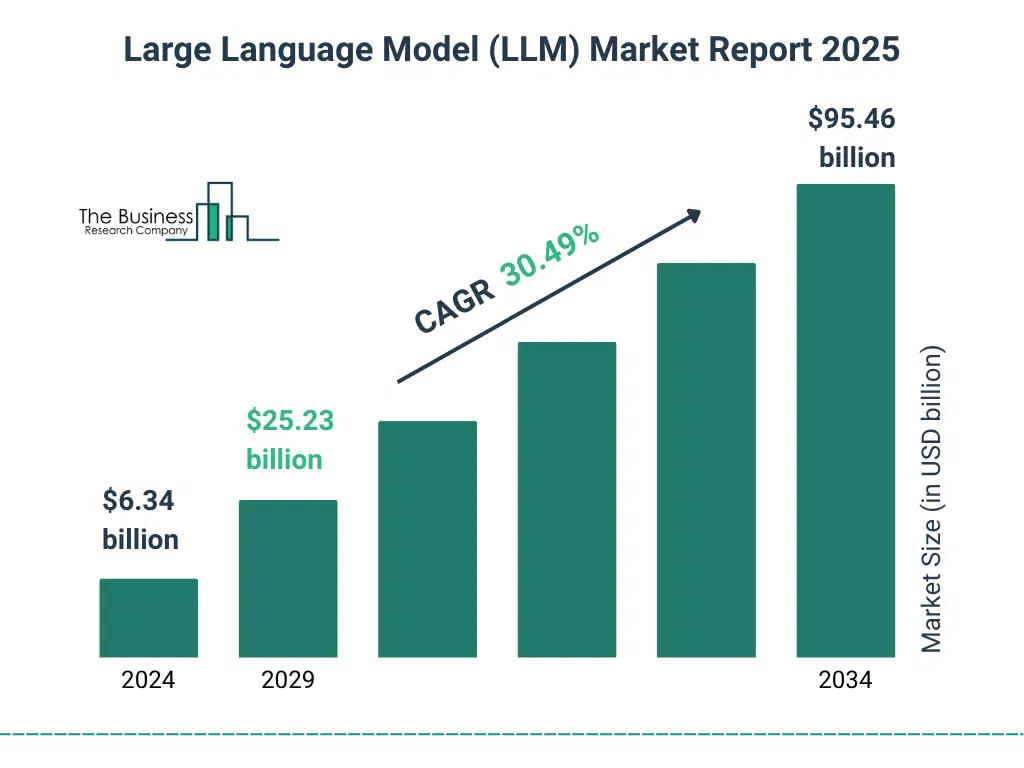
Large Language Model (LLM) Market Size and growth rate 2025 to 2029: Graph

Large language model (LLM)Market Definition

Large Language Model (LLM) refers to advanced artificial intelligence (AI) systems designed to understand, generate and process human language. LLMs are built using deep learning techniques, particularly transformer architectures, which enable them to handle vast amounts of text data and perform a variety of natural language processing (NLP) tasks. LLMs must meet specific performance and ethical standards to ensure accuracy, reliability and responsible usage in different applications without causing harm or bias in the output. The LLM market consists of sales, by entities (organizations, sole traders, or partnerships), of LLM-based solutions that encompass the development, deployment and distribution of models tailored to meet the specific requirements of industries such as technology, finance, healthcare, education and entertainment. LLMs are vital tools for various sectors due to their versatility, scalability and efficiency in automating tasks like content generation, customer support, data analysis and language translation. Users of LLMs range across industries and include tech companies, research institutions, government bodies and businesses looking to enhance productivity through AI-driven insights.
Research Expert

Book your 30 minutes free consultation with our research experts

Large language model (LLM) Market Size

The global large language model (LLM) market reached a value of nearly $6,336.10 million in 2024, having grown at a compound annual growth rate (CAGR) of 29.85% since 2019. The market is expected to grow from $6,336.10 million in 2024 to $25,226.37 million in 2029 at a rate of 31.83%. The market is then expected to grow at a CAGR of 30.49% from 2029 and reach $95,455.84 million in 2034. Growth in the historic period resulted from the rise in adoption of ai in healthcare and life sciences, increased cloud computing adoption, surge in remote work, increased investments in digital transformation and rise in use of AI in financial services. Factors that negatively affected growth in the historic period were security and data protection challenges. Going forward, rising investment in AI startups, rising demand for automation in industries, rising adoption of ai in retail and e-commerce, expansion of digital marketing and content creation, growing demand for chatbots and virtual assistants and favorable government initiatives will drive the growth. Factor that could hinder the large language model (LLM) market in the future include shortage of AI professionals and data scientists.

Large language model (LLM)s Market Drivers

The key drivers of the Large language model (LLM) market include: Rising Investment In AI Startups During the forecast period, the LLM market is expected to be driven by rising investment in artificial intelligence (AI) startups. Rising AI investment is driving innovation, expanding research and accelerating LLM development. Startups attract funding from venture capitalists and tech firms, enabling cost-efficient models and improving AI accessibility. This fosters competition and market expansion as enterprises integrate AI-driven solutions to enhance efficiency, automation and decision-making across industries. For example, in November 2024, according to AIM Research, a US-based AIM Research is the world's premier AI and data science market research firm and advisory council, in Quarter one, AI startups raised $12.2 billion across 1,166 deals, marking a 4% increase from the previous quarter. Moreover, in October 2024, it saw a record $22.33 billion in corporate-backed funding, a 134% rise from October 2023. This surge was fueled by multi-billion-dollar rounds for leading companies like OpenAI and Waymo, highlighting the emergence of megadeals that are transforming the AI sector. Additionally, in October 2024, according to Crunchbase, a US-based platform that provides in-depth company information and data, 23 private AI startups raised over $1 billion in equity financing, with five surpassing $6 billion. Generative AI remains the dominant space for funding, with OpenAI leading the way, securing $6.6 billion this month at a $157 billion valuation. Following OpenAI, Anthropic has raised $8.4 billion, while xAI has secured $6.4 billion. Therefore, rising investment in AI startups will contribute to the growth of the LLM market.

large language model (LLM) Market Restraints

The key restraints on the large language model (LLM) market include: Shortage Of AI Professionals And Data Scientists A shortage of AI professionals and data scientists is expected to restrict the growth of the large language model (LLM) market going forward. The shortage of AI professionals and data scientists limits skilled talent for LLM development, deployment and optimization. Demand exceeds supply, raising costs, slowing innovation and complicating integration. Inadequate expertise leads to inefficient training, bias issues and security risks, further hindering adoption. For instance, in November 2024, according to report published by Randstad, the Netherlands based human resources consulting firm that specializes in recruitment and HR (human resources) services, based on primary data collected from 12,429 respondents, while 75% of companies are adopting AI technologies, only 35% of employees received AI training in 2023. Moreover, in October 2024, according to Gartner, Inc., a US-based technological research and management consulting company, by 2027, 80% of software engineers must stay relevant in an AI-driven landscape. This shift has major implications for tech professionals, requiring adaptability and specialized expertise. As AI integrates further into development, the demand for advanced skills intensifies, reshaping career paths and industry standards. Therefore, the shortage of AI professionals and data scientists may hinder the growth of the large language model (LLM) market.


Need data on a specific region in this market?

Opportunities And Recommendations In The large language model (LLM) Market

Opportunities – The top opportunities in the large language model (LLM) markets segmented by model size will arise in the below 100 billion parameters segment, which will gain $11,860.85 million of global annual sales by 2029. The top opportunities in the large language model (LLM) markets segmented by architecture will arise in the autoregressive language models segment, which will gain $10,211.11 million of global annual sales by 2029. The top opportunities in the large language model (LLM) markets segmented by deployment will arise in the on-premises segment, which will gain $10,680.97 million of global annual sales by 2029. The top opportunities in the large language model (LLM) markets segmented by industry will arise in the retail and e-commerce segment, which will gain $5,213.21 million of global annual sales by 2029. The large language model (LLM) market size will gain the most in the USA at $5,619.05 million. Recommendations- To take advantage of the opportunities, The Business Research Company recommends the large language model (LLM) market companies to focus on strategic partnerships to accelerate adoption and innovation, focus on efficient scaling and cost-optimized training, focus on enterprise integration through secure and scalable ai solutions, focus on generative ai to improve wealth management efficiency, focus on regional language capabilities to drive adoption and scale, focus on ai-powered search to improve data accessibility and user experience, focus on lightweight models to enhance efficiency and expand enterprise adoption, focus on ai cloud solutions to scale deployment and lower costs, focus on above 500 billion parameters to capture high-growth opportunities, focus on hybrid language models to maximize growth potential, focus on cloud deployment to capture fastest growth in LLM market, expand in emerging markets, continue to focus on developed markets, provide competitively priced offerings, continue to use B2B promotions, focus on media and entertainment to capitalize on highest growth potential.
Chat with us