
Large SUVs Market Report 2026
Global Outlook – By Fuel Type (Petrol, Diesel, Electric, Other Fuel Types), By Vehicle Type (Body-on-Frame SUVs, Unibody Large SUVs, Luxury Large SUVs), By Price Range (Medium, Premium) – Market Size, Trends, Strategies, and Forecast to 2030
Large SUVs Market Overview
• Large SUVs market size has reached to $473.44 billion in 2025 • Expected to grow to $754.21 billion in 2030 at a compound annual growth rate (CAGR) of 9.8% • Growth Driver: The Growing Popularity Of Sports Utility Vehicles And Its Impact On The Large SUV Market • Market Trend: Innovation Accelerates The Shift Toward Advanced Electrified Full-Size Utility Vehicles • North America was the largest region in 2025 and Europe is the fastest growing region.What Is Covered Under Large SUVs Market?
Large SUVs refer to sport utility vehicles that are larger, with a seating capacity of 7-8 passengers, a larger cargo space, higher strength, and off-road capability. The large SUV are used by individuals for comfortable driving with extra seating and cargo space. The main fuel types of large SUVs are petrol, diesel, electric, and other fuels. Petrol refers to a type of mixture of flammable hydrocarbons that are derived from petroleum that is mainly used in internal combustion engines. The main types of SUV are sub-compact SUVs, crossovers, MPVs, and other SUVs. These are available in various price ranges, such as medium and premium.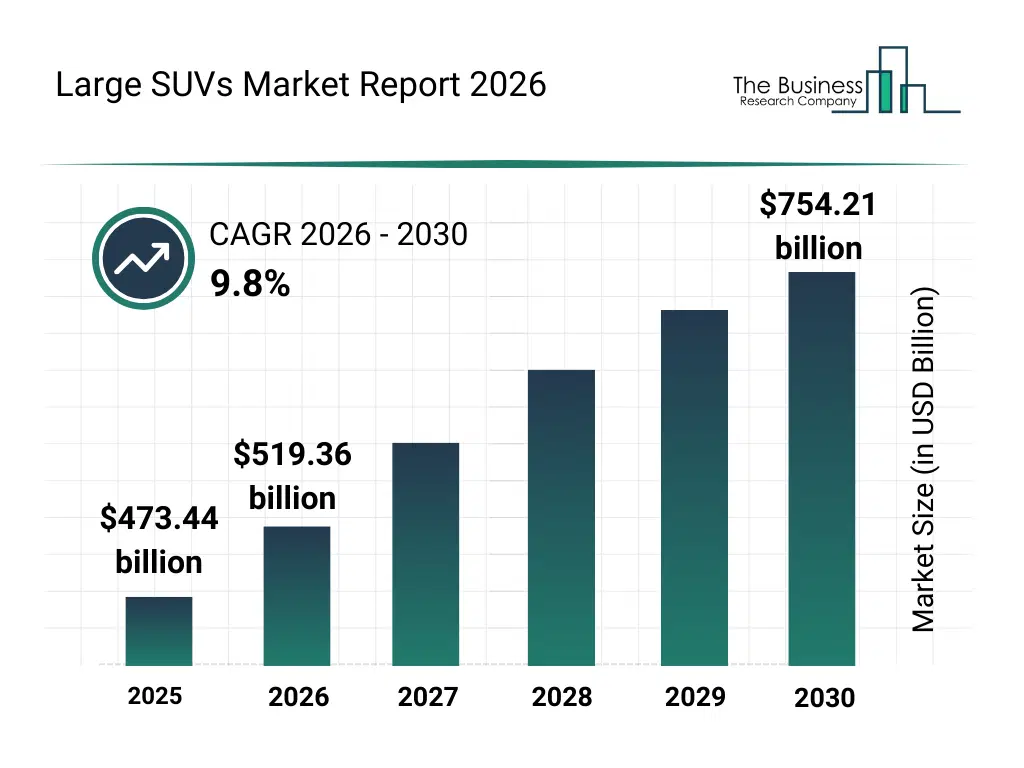
What Is The Large SUVs Market Size and Share 2026?
The large suvs market size has grown strongly in recent years. It will grow from $473.44 billion in 2025 to $519.36 billion in 2026 at a compound annual growth rate (CAGR) of 9.7%. The growth in the historic period can be attributed to rising disposable income, demand for family vehicles, fuel price stability periods, expansion of highway infrastructure, preference for larger vehicles.What Is The Large SUVs Market Growth Forecast?
The large suvs market size is expected to see strong growth in the next few years. It will grow to $754.21 billion in 2030 at a compound annual growth rate (CAGR) of 9.8%. The growth in the forecast period can be attributed to growth of electric suvs, premium vehicle demand, safety technology integration, urban to suburban mobility trends, lifestyle oriented vehicle purchases. Major trends in the forecast period include rising demand for premium spacious vehicles, growing adoption of electrified suv powertrains, increasing integration of advanced infotainment, expansion of off road capable models, higher focus on passenger comfort and safety.
Global Large SUVs Market Segmentation
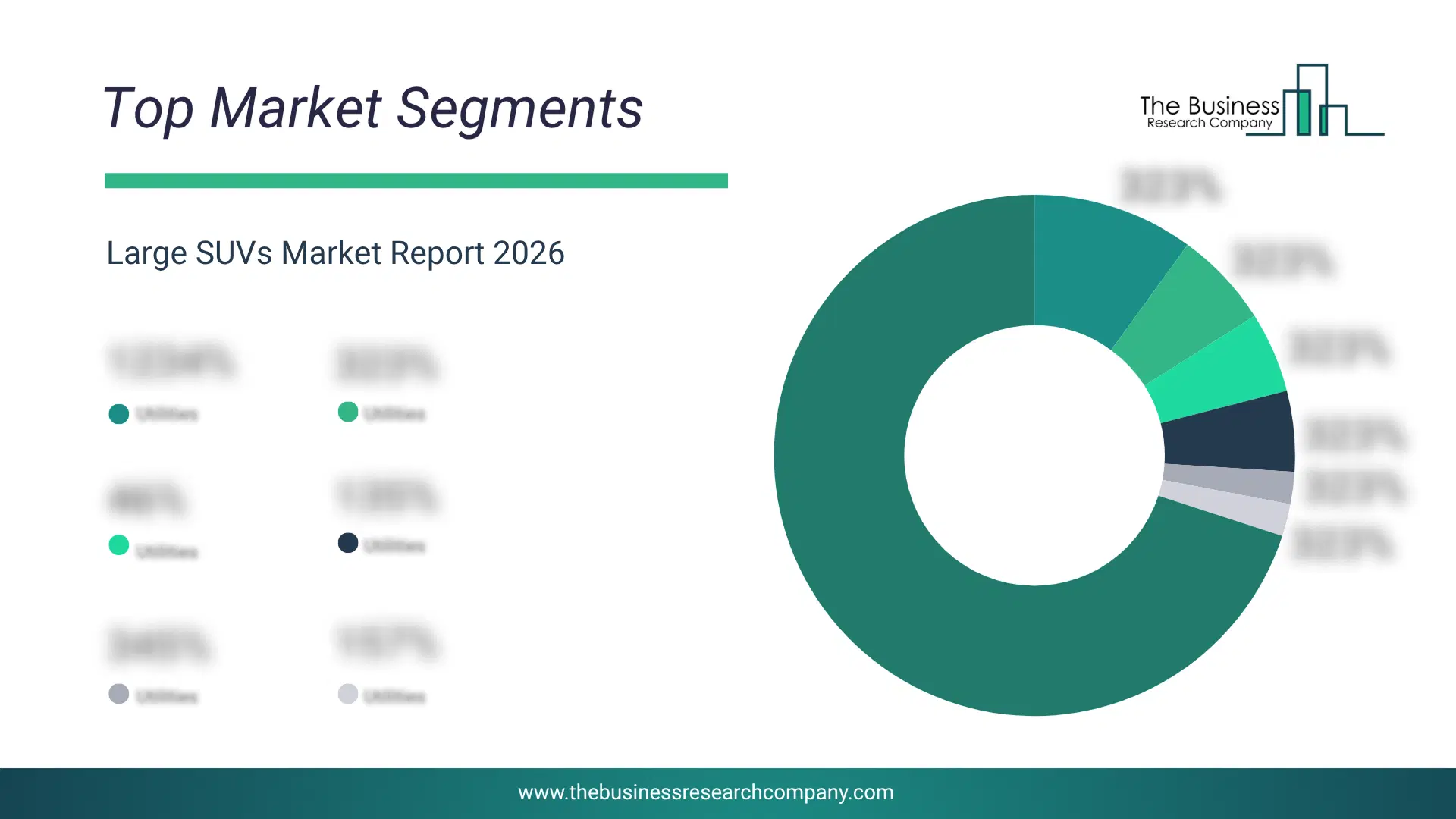
1) By Fuel Type: Petrol, Diesel, Electric, Other Fuel Types 2) By Vehicle Type: Body-on-Frame SUVs, Unibody Large SUVs, Luxury Large SUVs 3) By Price Range: Medium, Premium Subsegments: 1) By Petrol: Naturally Aspirated Petrol, Turbocharged Petrol 2) By Diesel: Standard Diesel, Turbocharged Diesel 3) By Electric: Battery Electric Vehicles (BEV), Plug-In Hybrid Electric Vehicles (PHEV) 4) By Other Fuel Types: Hybrid (Petrol-Diesel), Hydrogen Fuel Cell, Compressed Natural Gas (CNG)What Is The Driver Of The Large SUVs Market?
The rising popularity of sports utility vehicles among users is expected to propel the growth of the large SUV market going forward. A sport utility vehicle refers to a 4-wheeler vehicle that is powerful and can be driven over rough terrains. The rising popularity of sport utility vehicles is due to their safety features, availability of space, fuel efficiency, and various other reasons and this popularity helps large SUV manufacturers to come up with better and large SUVs to serve their customers. For instance, in May 2024, according to the data published by the International Energy Agency (IEA), a France-based intergovernmental organization, accounting for 48% of global car sales, SUVs reached a new record in 2023, further solidifying their popularity in the automotive market. Sales of SUVs in advanced economies surpassed 20 million in 2022, achieving a 50% market share for the first time, while over 360 million SUVs were on the roads worldwide. Therefore, the rising popularity of sports utility vehicles is driving the large SUVs industry.Key Players In The Global Large SUVs Market
Major companies operating in the large suvs market report include Stellantis NV, Toyota Motor Corporation, Volkswagen AG, Hyundai Motor Company, Ford Motor Company, General Motors Company, Nissan Motor Corporation, Kia Corporation, Mercedes-Benz, Bayerische Motoren Werke AG, Audi AG, Volvo Group, Jeep, Chevrolet, Cadillac Motor Company, Buick Motor Company, Lincoln National Corporation, Jaguar Land Rover Automotive plc, Acura, Lincoln Motor Company, Polestar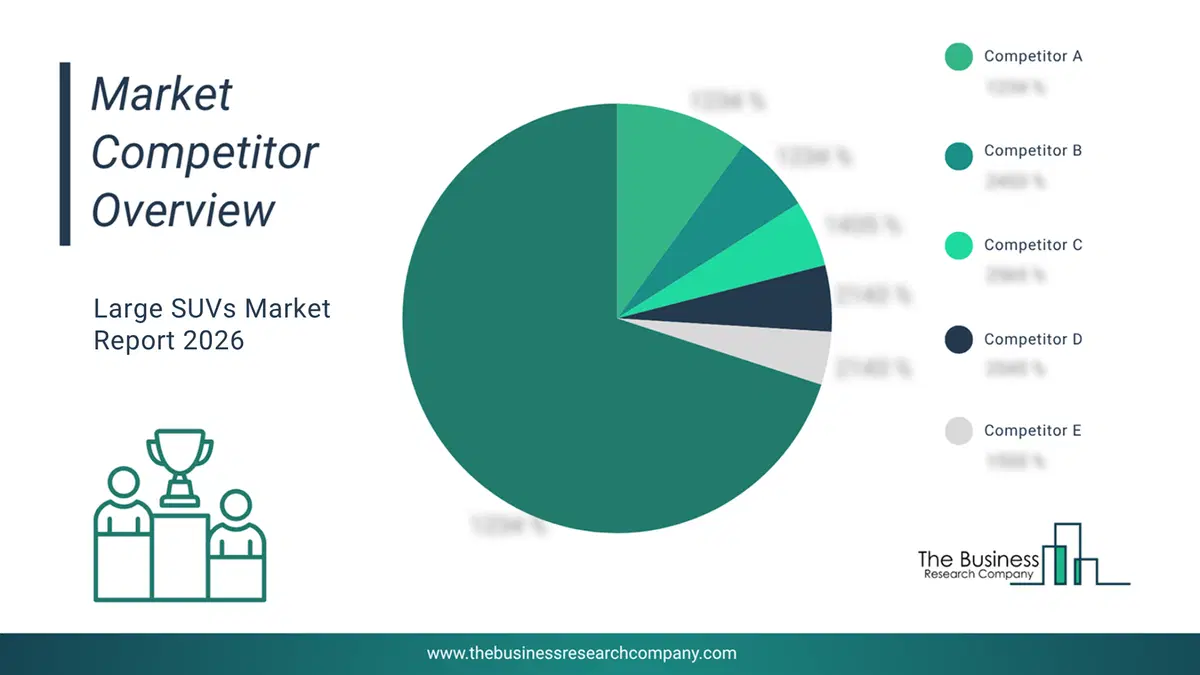
This chart is for illustrative purposes; the full report includes a detailed competitor analysis and comprehensive overview of the top 10 companies in the market.
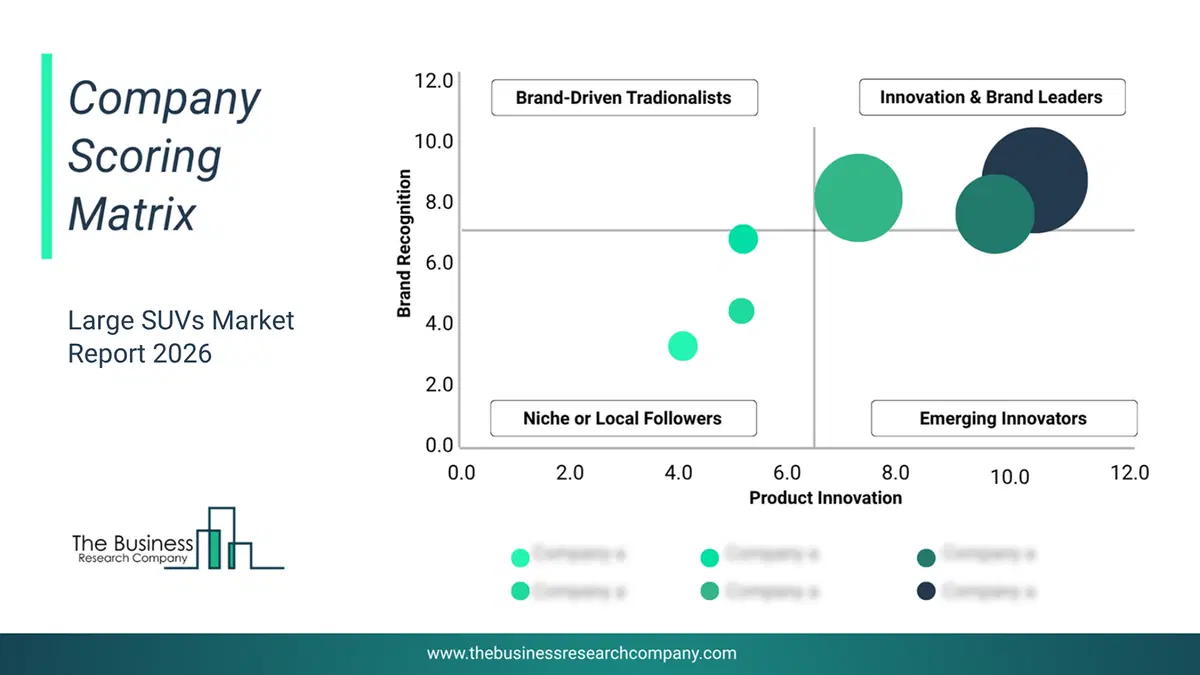
This chart maps companies by product innovation and brand strength, with bubble size indicating relative revenue, helping identify market leaders, challengers, and niche players. This is an illustrative chart; the full report provides a complete and accurate competitive analysis.
Global Large SUVs Market Trends and Insights
Major companies operating in the Large SUVs market are focusing on developing innovative solutions, such as electric powertrain technology, to meet the rising demand for environmentally friendly, high-performance vehicles with advanced connectivity and luxury features. Electric powertrain technology replaces traditional internal combustion engines with fully electric motors and high-capacity batteries, offering zero-emission driving, instant torque, and quieter operation compared to conventional engines. For instance, in August 2023, Cadillac, a U.S.-based luxury automotive company, launched the Escalade IQ, an all-electric full-size SUV designed to combine the brand’s signature luxury with cutting-edge EV technology. The Escalade IQ features a large Ultium battery pack, dual electric motors for all-wheel drive, and advanced driver-assistance systems. Its interior integrates a curved OLED display spanning the driver and passenger zones, providing a fully connected infotainment experience. Additionally, the SUV offers over 300 miles of estimated range, fast-charging capabilities, and customizable driving modes for enhanced performance and efficiency, making it a strong alternative to traditional gasoline-powered large SUVs.What Are Latest Mergers And Acquisitions In The Large SUVs Market?
In June 2024, Volkswagen AG, a German-based producer of cars and trucks, made a $5 billion investment in Rivian Automotive, Inc. The purpose of the partnership is to collaborate on electric vehicle architecture and software development, enabling Rivian to efficiently produce its R2 SUVs while allowing Volkswagen to enhance its software capabilities and reduce operational costs through shared resources. Rivian Automotive, Inc. is a US-based electric vehicle manufacturer and automotive technology.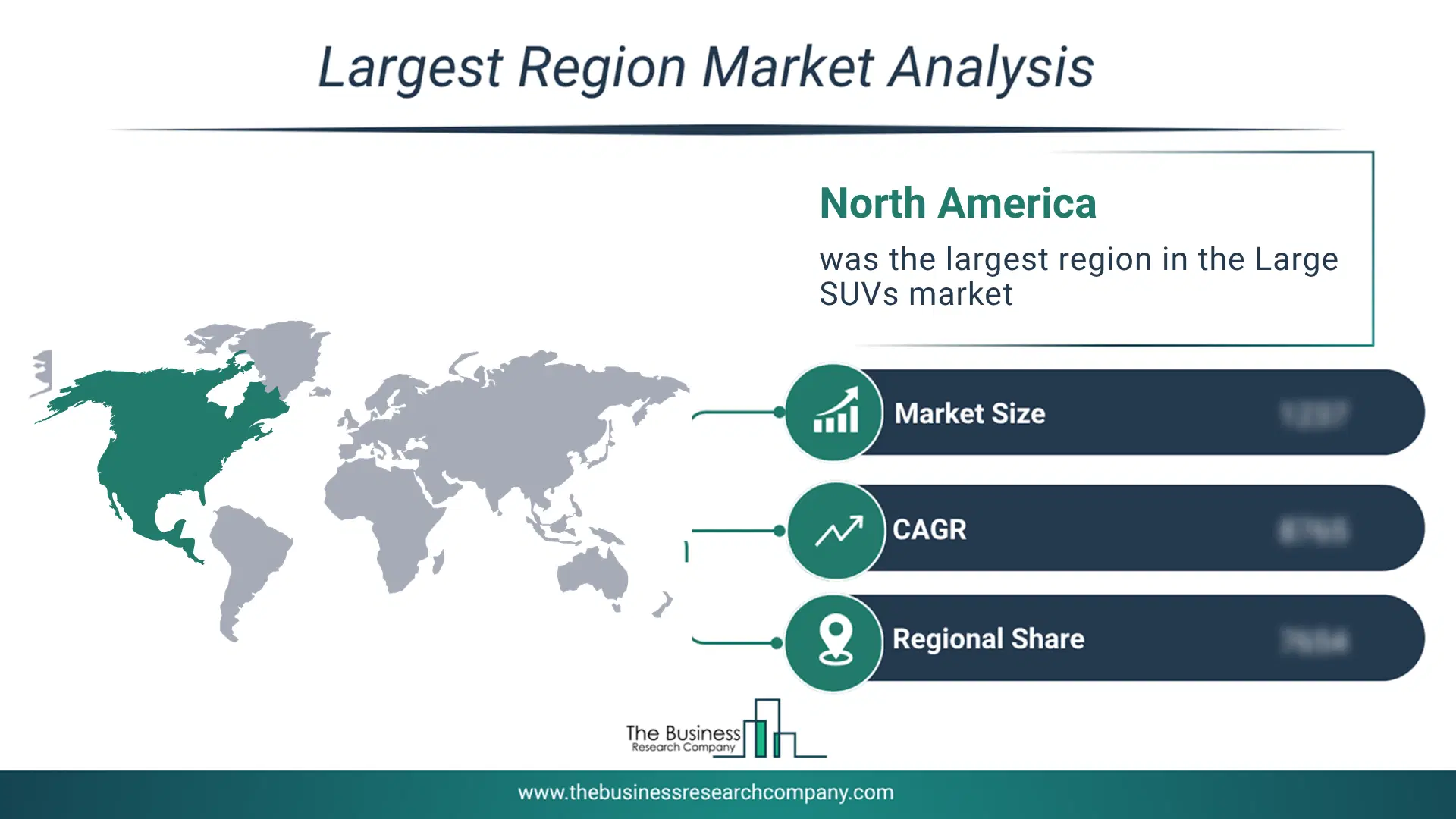
Regional Outlook
North America was the largest region in the large SUVs market in 2025.Europe is expected to be the fastest-growing region in the forecast period. The regions covered in this market report include Asia-Pacific, South East Asia, Western Europe, Eastern Europe, North America, South America, Middle East, Africa. The countries covered in this market report include Australia, Brazil, China, France, Germany, India, Indonesia, Japan, Taiwan, Russia, South Korea, UK, USA, Canada, Italy, SpainWhat Defines the Large SUVs Market?
The large SUVs market consists of sales of cars and vans. Values in this market are ‘factory gate’ values, that is the value of goods sold by the manufacturers or creators of the goods, whether to other entities (including downstream manufacturers, wholesalers, distributors and retailers) or directly to end customers. The value of goods in this market includes related services sold by the creators of the goods.How is Market Value Defined and Measured?
The market value is defined as the revenues that enterprises gain from the sale of goods and/or services within the specified market and geography through sales, grants, or donations in terms of the currency (in USD unless otherwise specified). The revenues for a specified geography are consumption values that are revenues generated by organizations in the specified geography within the market, irrespective of where they are produced. It does not include revenues from resales along the supply chain, either further along the supply chain or as part of other products.
This chart presents market attractiveness based on a quantitative evaluation of growth, competition, strategic alignment, and risk, offering a clear view of opportunity areas for decision-making. This chart is for illustrative purposes; the full report contains the complete analysis.

This chart highlights the Total Addressable Market (TAM) by estimating the maximum revenue opportunity using an assumption-driven approach, supporting strategic planning and opportunity sizing across markets. The chart is illustrative; the full report provides a more comprehensive analysis.
What Key Data and Analysis Are Included in the Large SUVs Market Report 2026?
The large suvs market research report is one of a series of new reports from The Business Research Company that provides market statistics, including industry global market size, regional shares, competitors with the market share, detailed market segments, market trends and opportunities, and any further data you may need to thrive in the large suvs industry. The market research report delivers a complete perspective of everything you need, with an in-depth analysis of the current and future state of the industry.Large SUVs Market Report Forecast Analysis
| Report Attribute | Details |
|---|---|
| Market Size Value In 2026 | $519.36 billion |
| Revenue Forecast In 2030 | $754.21 billion |
| Growth Rate | CAGR of 9.7% from 2026 to 2030 |
| Base Year For Estimation | 2025 |
| Actual Estimates/Historical Data | 2020-2025 |
| Forecast Period | 2026 - 2030 - 2030 |
| Market Representation | Revenue in USD Billion and CAGR from 2026 to 2030 |
| Segments Covered | Fuel Type, Vehicle Type, Price Range |
| Regional Scope | Asia-Pacific, Western Europe, Eastern Europe, North America, South America, Middle East, Africa |
| Country Scope | The countries covered in the report are Australia, Brazil, China, France, Germany, India, Indonesia, Japan, Taiwan, Russia, South Korea, UK, USA, Canada, Italy, Spain. |
| Key Companies Profiled | Stellantis NV, Toyota Motor Corporation, Volkswagen AG, Hyundai Motor Company, Ford Motor Company, General Motors Company, Nissan Motor Corporation, Kia Corporation, Mercedes-Benz, Bayerische Motoren Werke AG, Audi AG, Volvo Group, Jeep, Chevrolet, Cadillac Motor Company, Buick Motor Company, Lincoln National Corporation, Jaguar Land Rover Automotive plc, Acura, Lincoln Motor Company, Polestar |
| Customization Scope | Request for Customization |
| Pricing And Purchase Options | Explore Purchase Options |