
Laser Guide Star System Market Report 2026
Global Outlook – By Type (Rayleigh Guide Stars, Sodium Guide Stars), By Component (Laser Sources, Optical Components, Control Systems, Detection Systems), By Technology (Adaptive Optics Technology, Wavefront Sensing Technology, Photonics Technology, Control Software), By Application (Astronomy, Space Situational Awareness, Laser Communication, Other Applications), By End-User (Research Institutes, Defense And Military, Space Agencies, Other End-Users) – Market Size, Trends, Strategies, and Forecast to 2030
Laser Guide Star System Market Overview
• Laser Guide Star System market size has reached to $1.46 billion in 2025 • Expected to grow to $2.32 billion in 2030 at a compound annual growth rate (CAGR) of 9.7% • Growth Driver: Surge In Satellite Deployments Fueling The Growth Of The Market Due To Growing Communication Needs • Market Trend: Breakthrough Sodium LGS Designs Expand Sky Coverage And Imaging Precision • North America was the largest region in 2025 and Asia-Pacific is the fastest growing region.What Is Covered Under Laser Guide Star System Market?
A laser guide star system is an astronomical technology that projects a laser beam into the upper atmosphere to create an artificial reference star. This artificial star is used by adaptive optics systems on telescopes to measure and correct atmospheric distortions in real time, allowing astronomers to obtain much sharper and clearer images of celestial objects. The main types of laser guide star systems are rayleigh guide stars and sodium guide stars. Rayleigh guide stars are artificial light sources created by projecting a laser into the lower atmosphere to measure and correct atmospheric distortions in adaptive optics systems. The components in this are laser sources, optical components, control systems, and detection systems, using various technologies including adaptive optics technology, wavefront sensing technology, photonics technology, and control software, used in applications such as astronomy, space situational awareness, laser communication, and others, by end-users including research institutes, defense and military, space agencies, and others.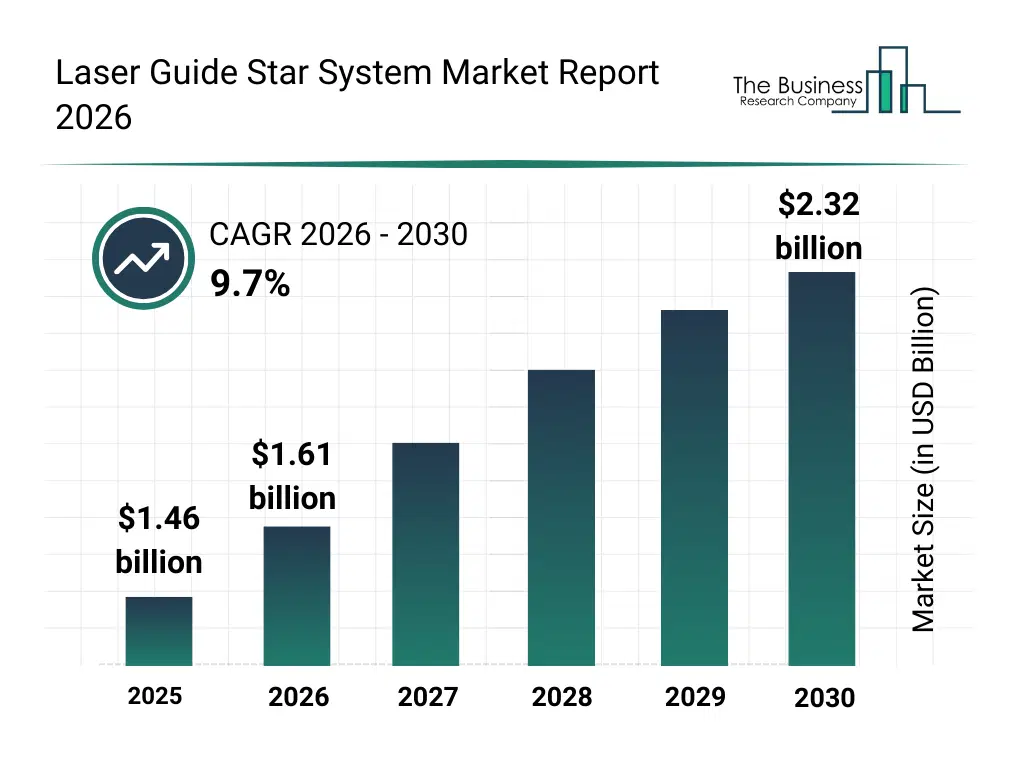
What Is The Laser Guide Star System Market Size and Share 2026?
The laser guide star system market size has grown strongly in recent years. It will grow from $1.46 billion in 2025 to $1.61 billion in 2026 at a compound annual growth rate (CAGR) of 9.9%. The growth in the historic period can be attributed to early implementation of high-power laser modules for adaptive optics, adoption of beam steering mechanisms in telescopes, development of wavefront sensors for atmospheric correction, initial integration of optical calibration tools, expansion of observatory installations using laser guide stars.What Is The Laser Guide Star System Market Growth Forecast?
The laser guide star system market size is expected to see strong growth in the next few years. It will grow to $2.32 billion in 2030 at a compound annual growth rate (CAGR) of 9.7%. The growth in the forecast period can be attributed to advancements in next-generation adaptive optics systems, rising demand for ultra-precise astronomical imaging, development of high-stability laser projection systems, increasing adoption of automated calibration and alignment tools, expansion of global astronomical research infrastructure. Major trends in the forecast period include enhanced laser power and beam quality, miniaturization of adaptive optics components, integration of real-time wavefront correction algorithms, expansion of space situational awareness applications, increasing demand for multi-wavelength guide star systems.
Global Laser Guide Star System Market Segmentation
1) By Type: Rayleigh Guide Stars, Sodium Guide Stars 2) By Component: Laser Sources, Optical Components, Control Systems, Detection Systems 3) By Technology: Adaptive Optics Technology, Wavefront Sensing Technology, Photonics Technology, Control Software 4) By Application: Astronomy, Space Situational Awareness, Laser Communication, Other Applications 5) By End-User: Research Institutes, Defense And Military, Space Agencies, Other End-Users Subsegments: 1) By Rayleigh Guide Stars: Low Altitude, High Altitude 2) By Sodium Guide Stars: Continuous Wave, Pulsed, HybridWhat Is Driver Of The Laser Guide Star System Market?
The rising number of operational satellites is expected to propel the growth of the laser guide star system market going forward. Operational satellites refer to actively functioning spacecraft that are fully deployed in orbit and performing their intended missions, such as communication, navigation, earth observation, scientific research, or defense activities, while transmitting data or services as planned. The rise in the number of operational satellites is driven by increasing demand for global connectivity, as more nations and companies launch satellites to expand broadband access and strengthen communication networks worldwide. Laser guide star systems support the growing number of operational satellites by enhancing ground-based tracking and monitoring. They enable clearer imaging and more precise navigation by effectively correcting atmospheric distortions. For instance, in May 2025, the Satellite Industry Association (SIA), a US-based trade association, reported in its 28th annual State of the Satellite Industry Report that 11,539 satellites were operational in Earth orbit by the end of 2024, driven by 259 launches deploying 2,695 satellites during the year. Therefore, the rising number of operational satellites is driving the growth of the laser guide star system industry.Key Players In The Global Laser Guide Star System Market
Major companies operating in the laser guide star system market are Northrop Grumman Corporation, Coherent Corp, Lumentum Operations LLC, Hamamatsu Photonics K.K., IPG Photonics Corporation, JENOPTIK AG, Thorlabs Inc., Edmund Optics Inc., Demcon Focal, TOPTICA Photonics AG, Bertin Technologies, MPB Communications Inc., EKSPLA, OptoSigma Corporation, Shanghai Optics, Laser Components, Holo/Or Ltd, Boston Micromachines Corporation, Imagine Optic, AeroDIODE.
This chart is for illustrative purposes; the full report includes a detailed competitor analysis and comprehensive overview of the top 10 companies in the market.
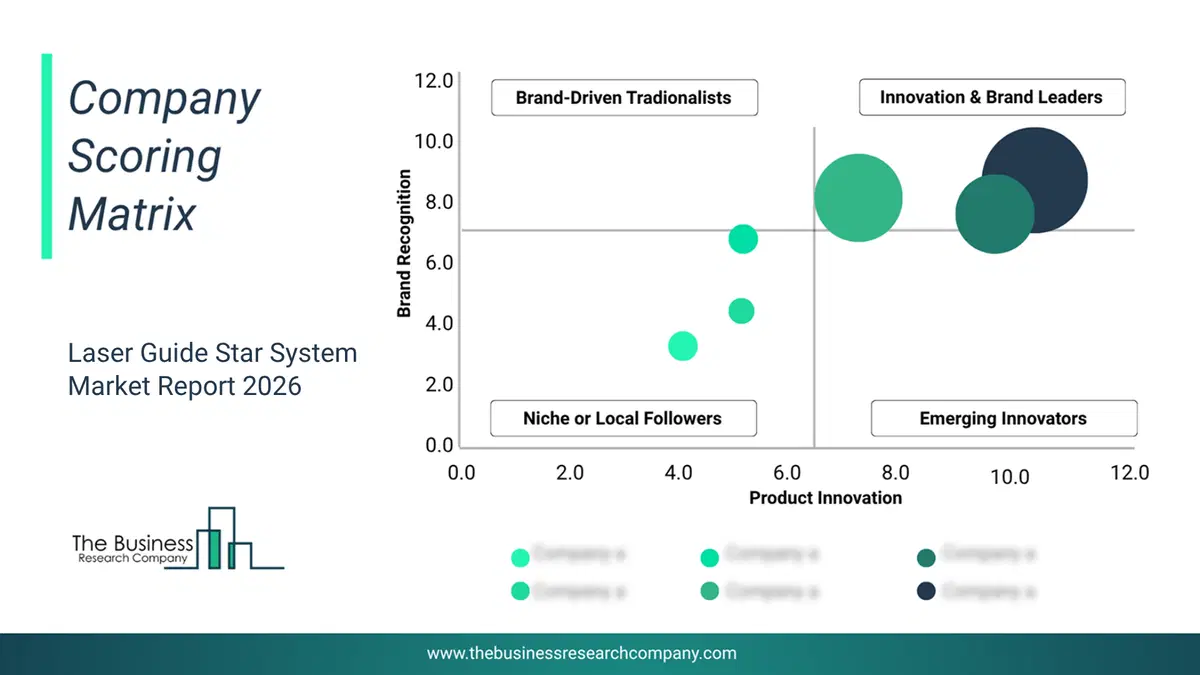
This chart maps companies by product innovation and brand strength, with bubble size indicating relative revenue, helping identify market leaders, challengers, and niche players. This is an illustrative chart; the full report provides a complete and accurate competitive analysis.
Global Laser Guide Star System Market Trends and Insights
Major companies operating in the laser guide star system market are focusing on developing innovative solutions, such as next-generation sodium laser guide star (LGS) systems, to meet the rising demand for higher-resolution adaptive optics in astronomy, space surveillance, and defense applications. Advanced LGS systems generate artificial reference stars in the upper atmosphere to correct atmospheric distortion, offering superior imaging performance compared with traditional ground-based optical systems that rely on natural stars and face limited sky coverage. For instance, in September 2025, Areté, a U.S.-based defense and advanced sensing technology company, announced its “SLGS” (Sodium Laser Guide Star) system, based on an Optically Pumped Semiconductor Laser (OPSL). This design is reportedly the first time OPSL technology is being applied for sodium guide-star generation. The system is more compact than traditional lasers and mounts directly on the telescope (eliminating need for a separate laser room), using a hollow-core photonic crystal fiber to send light to the launch telescope.What Are Latest Mergers And Acquisitions In The Laser Guide Star System Market? Bertin Technologies Acquired ALPAO To Strengthen European Photonics Leadership
In July 2024, Bertin Technologies, a France-based provider of high-end instrumentation for critical and scientific applications, acquired ALPAO for an undisclosed amount. With this acquisition, Bertin Technologies aims to strengthen its expertise in photonics, particularly in astronomy and space, and position itself as a European leader in advanced optical solutions. ALPAO is a France-based provider of adaptive optics systems and components that enhance image quality in demanding scientific and industrial environments.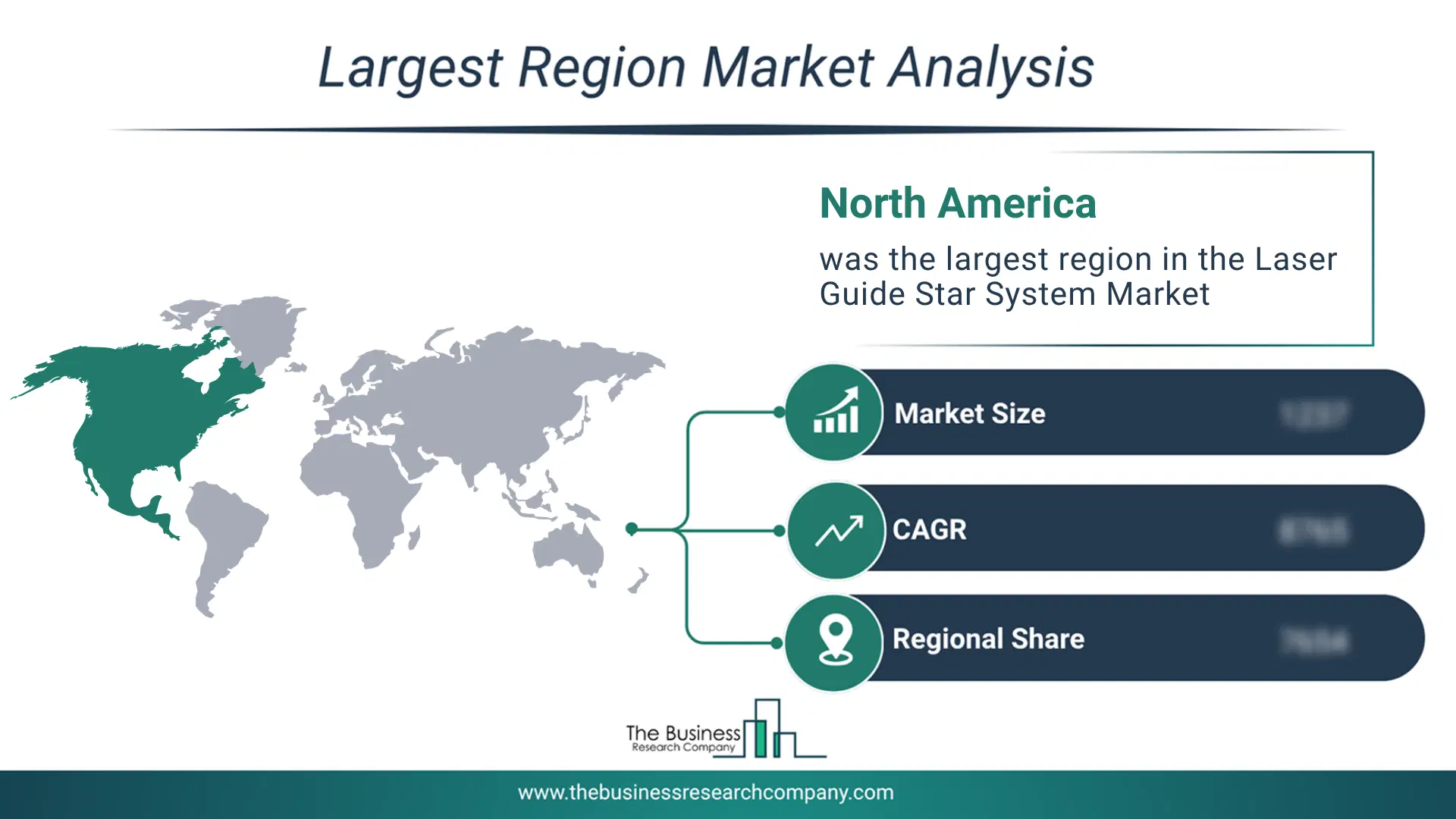
Regional Insights
North America was the largest region in the laser guide star system market in 2025. Asia-Pacific is expected to be the fastest-growing region in the forecast period. The regions covered in this market report are Asia-Pacific, South East Asia, Western Europe, Eastern Europe, North America, South America, Middle East, Africa. The countries covered in this market report are Australia, Brazil, China, France, Germany, India, Indonesia, Japan, Taiwan, Russia, South Korea, UK, USA, Canada, Italy, SpainWhat Defines the Laser Guide Star System Market?
The laser guide star system market consists of sales of adaptive optics systems, high-power laser modules, beam steering mechanisms, wavefront sensors, and optical calibration tools. Values in this market are ‘factory gate’ values, that is the value of goods sold by the manufacturers or creators of the goods, whether to other entities (including downstream manufacturers, wholesalers, distributors and retailers) or directly to end customers. The value of goods in this market includes related services sold by the creators of the goods.How is Market Value Defined and Measured?
The market value is defined as the revenues that enterprises gain from the sale of goods and/or services within the specified market and geography through sales, grants, or donations in terms of the currency (in USD unless otherwise specified). The revenues for a specified geography are consumption values that are revenues generated by organizations in the specified geography within the market, irrespective of where they are produced. It does not include revenues from resales along the supply chain, either further along the supply chain or as part of other products.
This chart presents market attractiveness based on a quantitative evaluation of growth, competition, strategic alignment, and risk, offering a clear view of opportunity areas for decision-making. This chart is for illustrative purposes; the full report contains the complete analysis.

This chart highlights the Total Addressable Market (TAM) by estimating the maximum revenue opportunity using an assumption-driven approach, supporting strategic planning and opportunity sizing across markets. The chart is illustrative; the full report provides a more comprehensive analysis.
What Key Data and Analysis Are Included in the Laser Guide Star System Market Report 2026?
The laser guide star system market research report is one of a series of new reports from The Business Research Company that provides market statistics, including industry global market size, regional shares, competitors with the market share, detailed market segments, market trends and opportunities, and any further data you may need to thrive in the laser guide star system industry. The market research report delivers a complete perspective of everything you need, with an in-depth analysis of the current and future state of the industry.Laser Guide Star System Market Report Forecast Analysis
| Report Attribute | Details |
|---|---|
| Market Size Value In 2026 | $1.61 billion |
| Revenue Forecast In 2030 | $2.32 billion |
| Growth Rate | CAGR of 9.7% from 2026 to 2030 |
| Base Year For Estimation | 2025 |
| Actual Estimates/Historical Data | 2020-2025 |
| Forecast Period | 2026 - 2030 |
| Market Representation | Revenue in USD Billion and CAGR from 2026 to 2030 |
| Segments Covered | Type, Component, Technology, Application, End-User |
| Regional Scope | Asia-Pacific, Western Europe, Eastern Europe, North America, South America, Middle East, Africa |
| Country Scope | The countries covered in the laser guide star system market report are Australia, Brazil, China, France, Germany, India, Indonesia, Japan, Taiwan, Russia, South Korea, UK, USA, Canada, Italy, Spain |
| Key Companies Profiled | Northrop Grumman Corporation, Coherent Corp, Lumentum Operations LLC, Hamamatsu Photonics K.K., IPG Photonics Corporation, JENOPTIK AG, Thorlabs Inc., Edmund Optics Inc., Demcon Focal, TOPTICA Photonics AG, Bertin Technologies, MPB Communications Inc., EKSPLA, OptoSigma Corporation, Shanghai Optics, Laser Components, Holo/Or Ltd, Boston Micromachines Corporation, Imagine Optic, AeroDIODE. |
| Customization Scope | Request for Customization |
| Pricing And Purchase Options | Explore Purchase Options |