

Laser Weed Control Robot Market Report 2026
Global Outlook – By Product Type (Autonomous Robots, Semi-Autonomous Robots), By Technology (Artificial Intelligence (AI)-Based, Vision-Based, Global Positioning System (GPS)-Guided, Other Technologies), By Weed Type (Broadleaf Weeds, Grass Weeds, Sedges, Other Weed Types), By Application (Agriculture, Horticulture, Commercial Landscaping, Other Applications), By End-User (Large Farms, Small And Medium Farms, Research Institutes, Other End-Users) – Market Size, Trends, Strategies, and Forecast to 2030
Laser Weed Control Robot Market Overview
• Laser Weed Control Robot market size has reached to $0.42 billion in 2025 • Expected to grow to $1.38 billion in 2030 at a compound annual growth rate (CAGR) of 26.7% • Growth Driver: Rising Emphasis On Sustainable Farming Practices Driving The Market Growth Due To Increasing Consumer Demand, Government Initiatives, And Environmental Awareness • Market Trend: AI-Powered Laser Weed Control Robots Revolutionize Precision Farming Efficiency • North America was the largest region in 2025 and Asia-Pacific is the fastest growing region.What Is Covered Under Laser Weed Control Robot Market?
A laser weed control robot is an automated machine that identifies and eliminates unwanted plants using focused laser beams. It employs advanced sensors, cameras, and computer vision algorithms to accurately distinguish weeds from crops, analyzing plant shape, size, and growth patterns to target only the unwanted vegetation. It offers a chemical-free, highly efficient, and environmentally sustainable method for weed management, reducing labor, minimizing soil disturbance, and preventing the negative impacts associated with traditional herbicides. The main product types of laser weed control robots are autonomous robots and semi-autonomous robots. Autonomous robots are self-operating machines that use sensors and AI to detect and eliminate weeds with precision and efficiency. They integrate technologies such as artificial intelligence (AI)-based systems, vision-based systems, and global positioning system (GPS)-guided mechanisms, along with others. These robots are designed to target various weed types, including broadleaf weeds, grass weeds, sedges, and other weed types. They are used for various applications such as agriculture, horticulture, and commercial landscaping, and others, and are utilized by different end-users, including large farms, small and medium farms, research institutes, and others.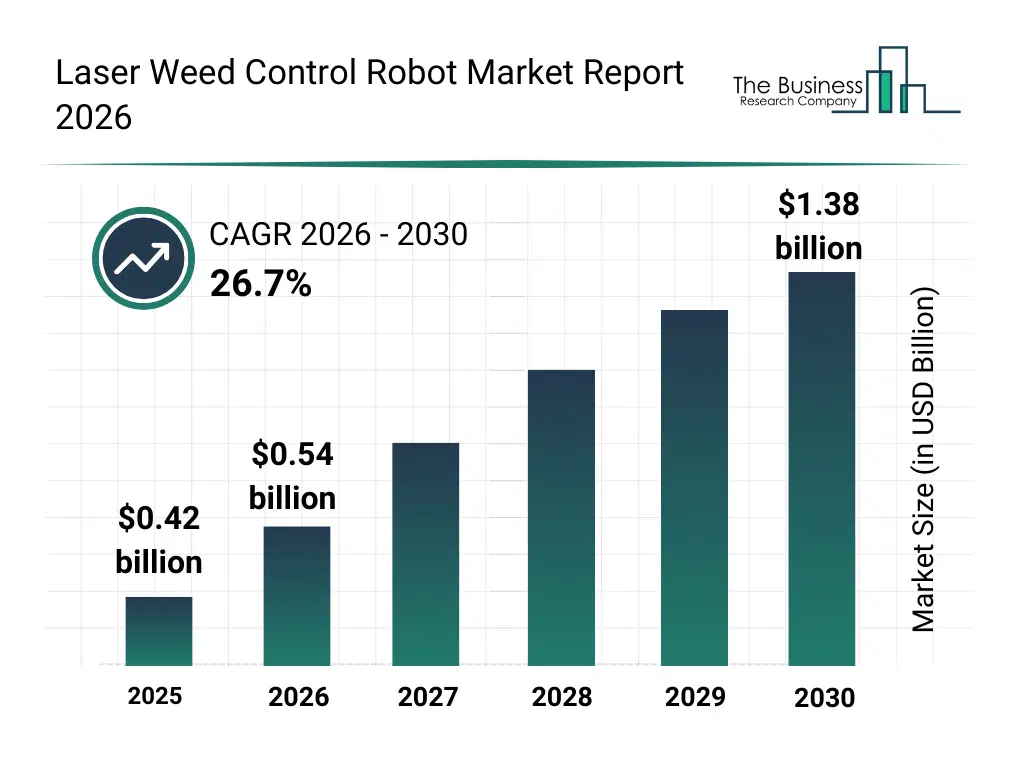
What Is The Laser Weed Control Robot Market Size and Share 2026?
The laser weed control robot market size has grown exponentially in recent years. It will grow from $0.42 billion in 2025 to $0.54 billion in 2026 at a compound annual growth rate (CAGR) of 27.0%. The growth in the historic period can be attributed to rising herbicide resistance in weeds, increasing labor shortages, early adoption of precision farming tools, heightened demand for sustainable weed management, rising operational costs of manual weeding.What Is The Laser Weed Control Robot Market Growth Forecast?
The laser weed control robot market size is expected to see exponential growth in the next few years. It will grow to $1.38 billion in 2030 at a compound annual growth rate (CAGR) of 26.7%. The growth in the forecast period can be attributed to growing shift toward autonomous farming systems, increasing integration of AI-based recognition models, rising need for chemical-free weed control, expanding application across small and medium farms, accelerated adoption of robotics in large-scale agriculture. Major trends in the forecast period include rising adoption of chemical-free weed management, expansion of precision laser targeting capabilities, increased demand for high-accuracy weed identification, growth in multi-crop laser weed removal solutions, advancements in on-field safety and compliance features.
Global Laser Weed Control Robot Market Segmentation
1) By Product Type: Autonomous Robots, Semi-Autonomous Robots 2) By Technology: Artificial Intelligence (AI)-Based, Vision-Based, Global Positioning System (GPS)-Guided, Other Technologies 3) By Weed Type: Broadleaf Weeds, Grass Weeds, Sedges, Other Weed Types 4) By Application: Agriculture, Horticulture, Commercial Landscaping, Other Applications 5) By End-User: Large Farms, Small And Medium Farms, Research Institutes, Other End-Users Subsegments: 1) By Autonomous Robots: Artificial Intelligence (AI)-Powered Autonomous Laser Weed Control Robots, Vision-Guided Autonomous Laser Weed Control Robots, GPS (Global Positioning System)-Enabled Autonomous Laser Weed Control Robots, Multi-Row Autonomous Laser Weed Control Robots 2) By Semi-Autonomous Robots: Remote-Controlled Semi-Autonomous Laser Weed Control Robots, Sensor-Assisted Semi-Autonomous Laser Weed Control Robots, Camera-Guided Semi-Autonomous Laser Weed Control Robots, Compact Semi-Autonomous Laser Weed Control RobotsWhat Is Driver Of The Laser Weed Control Robot Market?
The rising emphasis on sustainable farming practices is expected to propel the growth of the laser weed control robot market going forward. Sustainable farming practices refer to agricultural methods that prioritize environmental protection, soil health, and resource conservation while maintaining long-term productivity. The emphasis on sustainable farming practices is rising due to increasing consumer demand for environmentally friendly food production, which is driving farmers to adopt methods that reduce chemical inputs and minimize environmental impact. Sustainable farming practices support laser weed control robot adoption, as these automated systems enable precise weed elimination without chemical herbicides, aligning with organic and conservation agriculture standards. For instance, in May 2025, according to the Department for Environment, Food and Rural Affairs (DEFRA), a UK-based government department, in 2024, the UK had 503,000 hectares of land under organic farming, marking a 1.0% increase from 2023. Therefore, the rising emphasis on sustainable farming practices is driving the growth of the laser weed control robot industry.Key Players In The Global Laser Weed Control Robot Market
Major companies operating in the laser weed control robot market are Carbon Robotics, FarmWise Labs, Inc., Ecorobotix AG, Naïo Technologies, SwarmFarm Robotics Pty Ltd, AGROINTELLI, Robotnik Automation, Farmdroid ApS, XMACHINES, Fdata Robot, BOPA-Precision Agriculture, AgJunction, AgXeed B.V., Terra Robotics Ltd., Escarda Technologies GmbH, Verdan Robotics SAS, Harvested Robotics Ltd., Aigen Inc., Luxeed Robotics S.A.S., Trabotyx B.V., Weedbot SIA, Seedspider, Earth Rover Ltd., Solinftec (Solix Ag Robotics), EcoRobotics SAS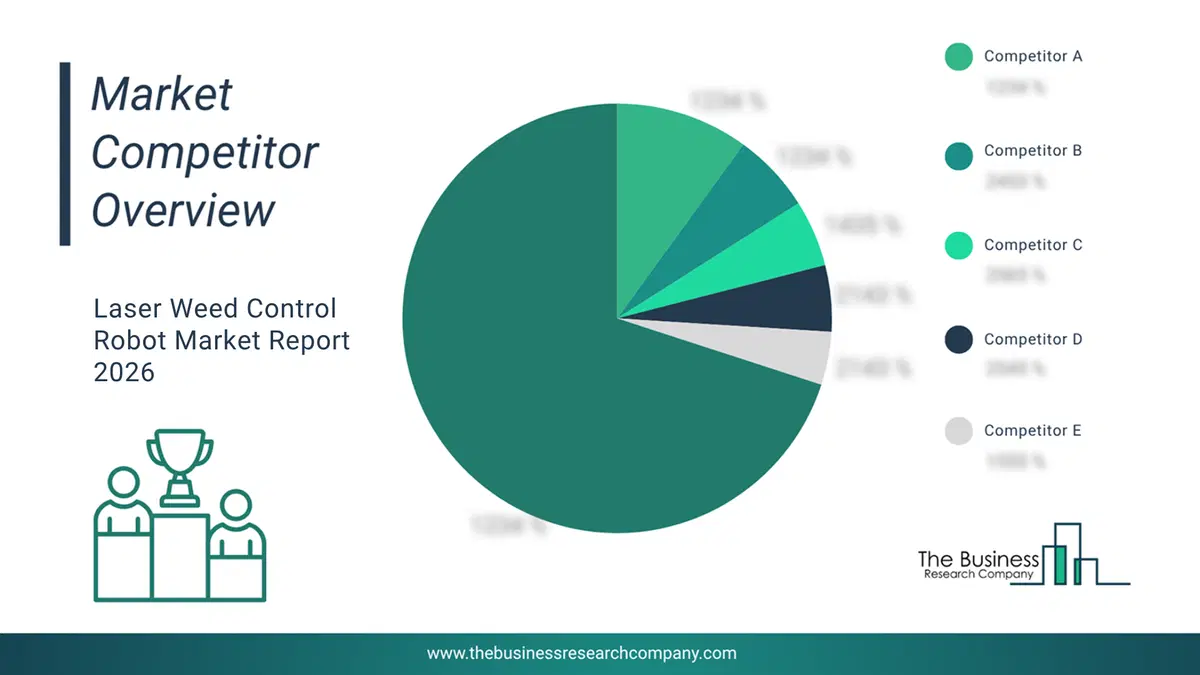
This chart is for illustrative purposes; the full report includes a detailed competitor analysis and comprehensive overview of the top 10 companies in the market.
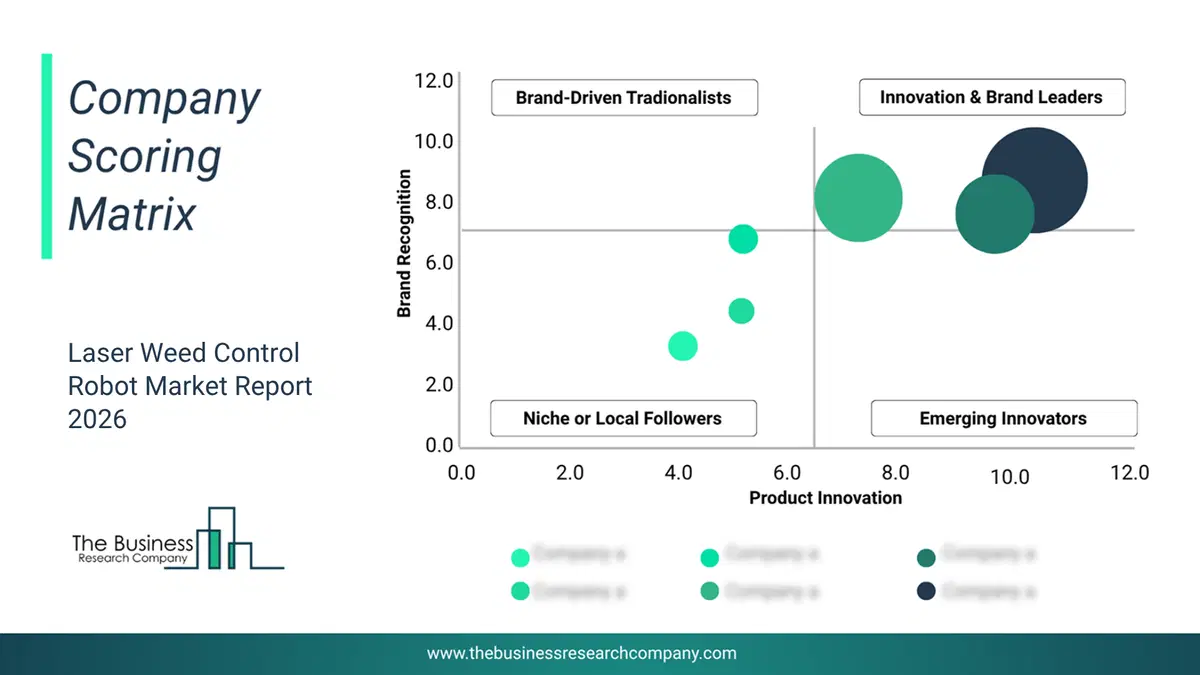
This chart maps companies by product innovation and brand strength, with bubble size indicating relative revenue, helping identify market leaders, challengers, and niche players. This is an illustrative chart; the full report provides a complete and accurate competitive analysis.
Global Laser Weed Control Robot Market Trends and Insights
Major companies operating in the laser weed control robot market are focusing on leveraging innovative technologies such as artificial intelligence (AI)-based plant detection to increase weeding efficiency, reduce costs, and improve crop yields. Artificial Intelligence (AI)-based plant detection is a technology that uses machine learning and computer vision to identify and distinguish crops from weeds automatically, helping precisely target weeds, reduce herbicide use and labor costs, and increase crop yield and efficiency. For instance, in Februar 2025, Carbon Autonomous Robotics Systems Inc., a US-based agricultural technology company, launched the LaserWeeder G2 product line, an innovative solution in the laser weed control robot segment. The LaserWeeder G2 incorporates modular robotics, computer vision, high-powered laser emission, and AI-based weed detection to target weeds with submillimeter precision while leaving crops and soil undisturbed. The system uses self-contained weeding modules that include dual 240 W diode lasers, multiple high-resolution cameras, NVIDIA GPUs, and a liquid-cooled architecture, enabling widths from 6.6 to 60 feet to suit different farm sizes. Its key features include real time plant recognition via deep learning Carbon AI, high throughput weeding (claiming up to twice the speed of the previous generation), a lighter overall machine to reduce soil compaction, and a modular design that fits various crop types and field layouts.What Are Latest Mergers And Acquisitions In The Laser Weed Control Robot Market? Partnership Between Escarda Technologies GmbH And STECOMAT SARL To Introduce Laser Weeding Technology In France
In March 2025, Escarda Technologies GmbH, a Germany-based agri-tech company, partnered with STECOMAT SARL to bring its innovative laser-based weeding system to farmers in France. With this partnership, Escarda Technologies GmbH and STECOMAT SARL aim to provide French farmers with access to Escarda’s advanced, chemical-free laser weeding technology, supported by comprehensive local sales, service, and technical assistance. STECOMAT SARL is a France-based agricultural machinery dealer offering innovative and environmentally friendly weeding solutions.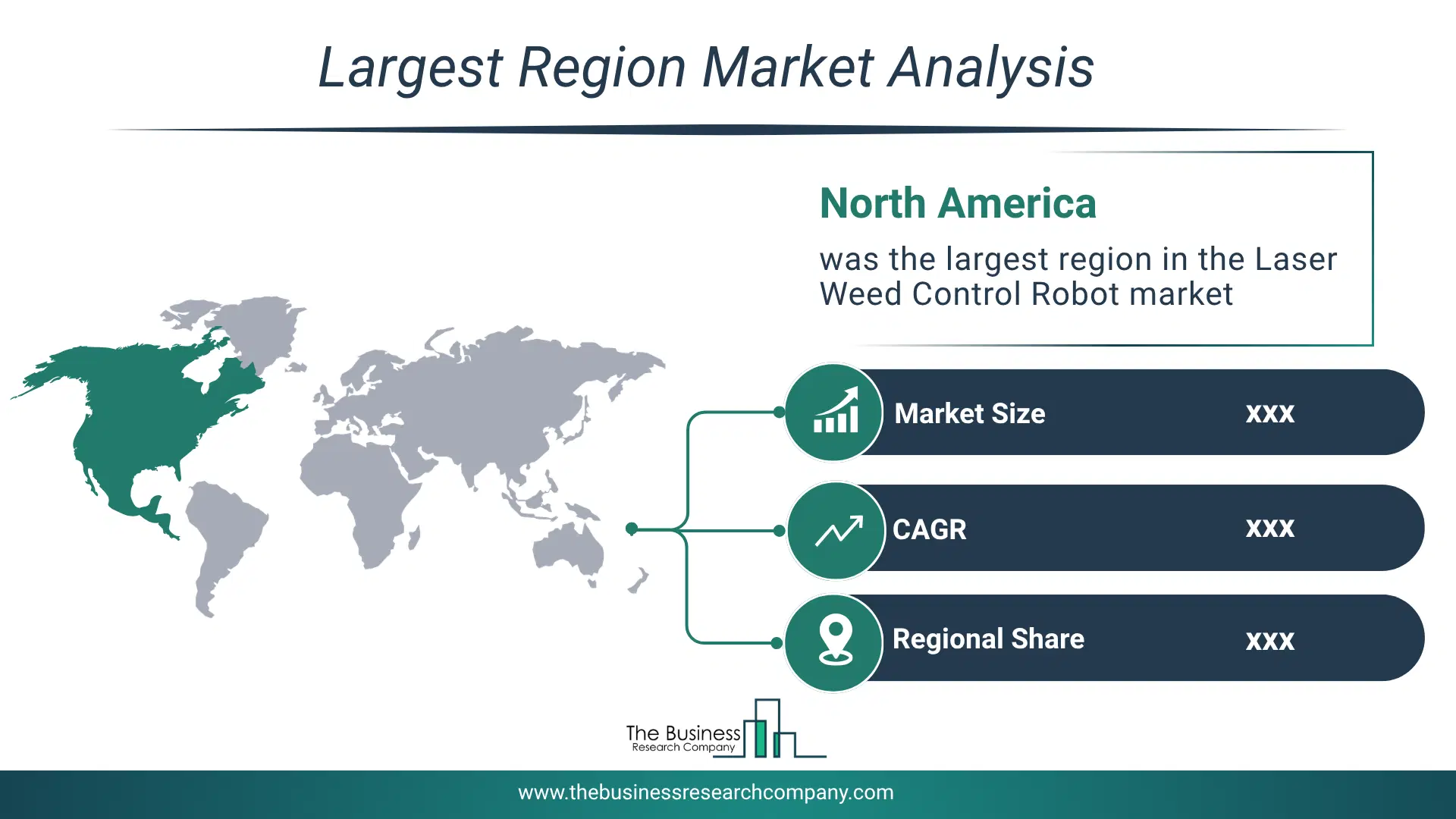
Regional Outlook
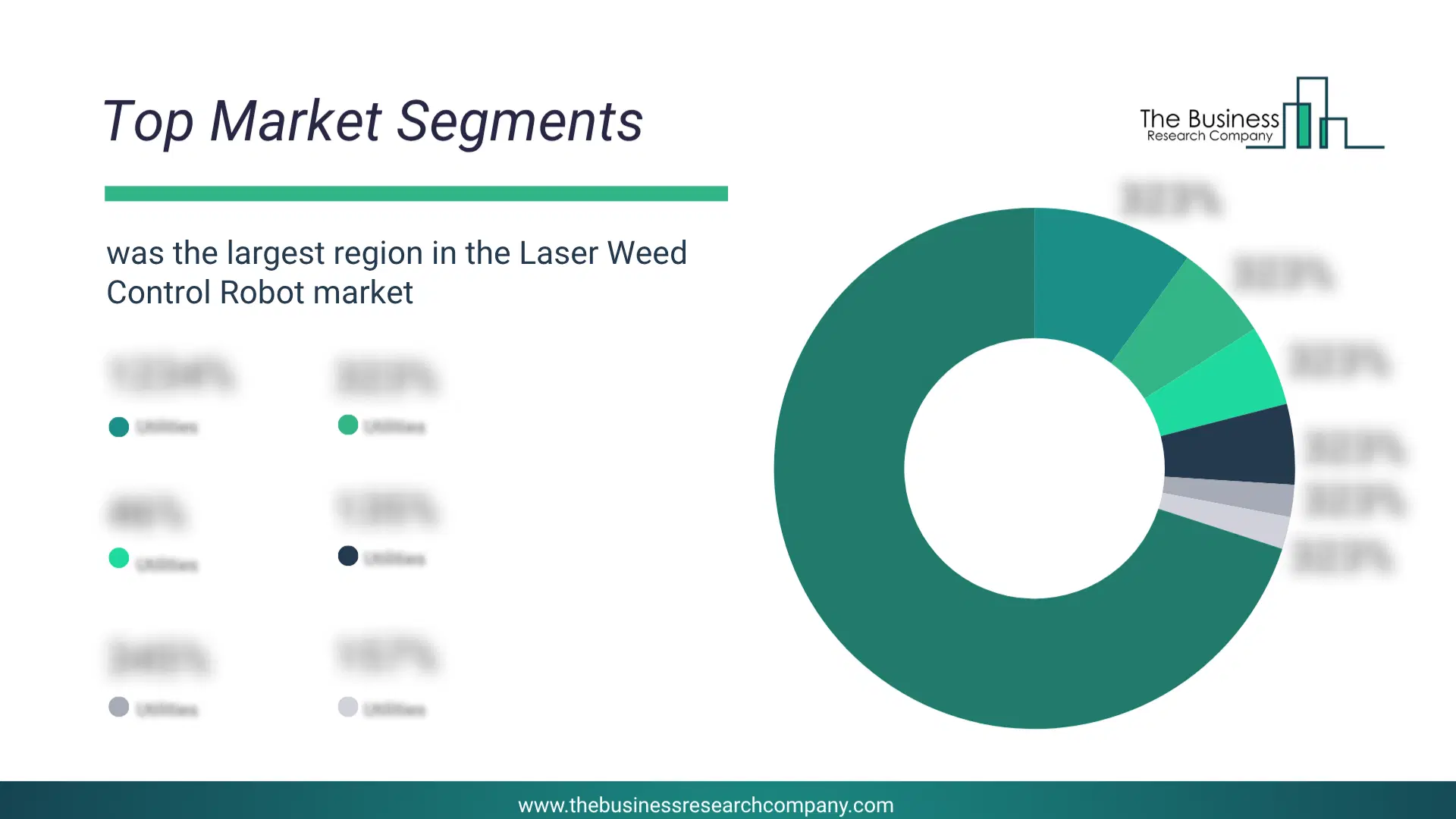
North America was the largest region in the laser weed control robot market in 2025. Asia-Pacific is expected to be the fastest-growing region in the forecast period. The regions covered in this market report are Asia-Pacific, South East Asia, Western Europe, Eastern Europe, North America, South America, Middle East, Africa. The countries covered in this market report are Australia, Brazil, China, France, Germany, India, Indonesia, Japan, Taiwan, Russia, South Korea, UK, USA, Canada, Italy, SpainWhat Defines the Laser Weed Control Robot Market?
The laser weed control robot market consists of revenues earned by entities by providing services such as installation, maintenance, technical support, equipment training, field demonstration, software updates, remote monitoring. The market value includes the value of related goods sold by the service provider or included within the service offering. The laser weed control robot market also includes sales of laser weeding robot, robotic platform, tractor-mounted laser weeding systems, handheld laser weeding devices, and supporting hardware. Values in this market are ‘factory gate’ values, that is the value of goods sold by the manufacturers or creators of the goods, whether to other entities (including downstream manufacturers, wholesalers, distributors and retailers) or directly to end customers. The value of goods in this market includes related services sold by the creators of the goods.How is Market Value Defined and Measured?
The market value is defined as the revenues that enterprises gain from the sale of goods and/or services within the specified market and geography through sales, grants, or donations in terms of the currency (in USD unless otherwise specified). The revenues for a specified geography are consumption values that are revenues generated by organizations in the specified geography within the market, irrespective of where they are produced. It does not include revenues from resales along the supply chain, either further along the supply chain or as part of other products.
This chart presents market attractiveness based on a quantitative evaluation of growth, competition, strategic alignment, and risk, offering a clear view of opportunity areas for decision-making. This chart is for illustrative purposes; the full report contains the complete analysis.

This chart highlights the Total Addressable Market (TAM) by estimating the maximum revenue opportunity using an assumption-driven approach, supporting strategic planning and opportunity sizing across markets. The chart is illustrative; the full report provides a more comprehensive analysis.
What Key Data and Analysis Are Included in the Laser Weed Control Robot Market Report 2026?
The laser weed control robot market research report is one of a series of new reports from The Business Research Company that provides market statistics, including industry global market size, regional shares, competitors with the market share, detailed market segments, market trends and opportunities, and any further data you may need to thrive in the laser weed control robot industry. The market research report delivers a complete perspective of everything you need, with an in-depth analysis of the current and future state of the industry.Laser Weed Control Robot Market Report Forecast Analysis
| Report Attribute | Details |
|---|---|
| Market Size Value In 2026 | $0.54 billion |
| Revenue Forecast In 2030 | $1.38 billion |
| Growth Rate | CAGR of 26.7% from 2026 to 2030 |
| Base Year For Estimation | 2025 |
| Actual Estimates/Historical Data | 2020-2025 |
| Forecast Period | 2026 - 2030 |
| Market Representation | Revenue in USD Billion and CAGR from 2026 to 2030 |
| Segments Covered | Product Type, Technology, Weed Type, Application, End-User |
| Regional Scope | Asia-Pacific, Western Europe, Eastern Europe, North America, South America, Middle East, Africa |
| Country Scope | The countries covered in the report are Australia, Brazil, China, France, Germany, India, Indonesia, Japan, Taiwan, Russia, South Korea, UK, USA, Canada, Italy, Spain |
| Key Companies Profiled | Carbon Robotics, FarmWise Labs, Inc., Ecorobotix AG, Naïo Technologies, SwarmFarm Robotics Pty Ltd, AGROINTELLI, Robotnik Automation, Farmdroid ApS, XMACHINES, Fdata Robot, BOPA-Precision Agriculture, AgJunction, AgXeed B.V., Terra Robotics Ltd., Escarda Technologies GmbH, Verdan Robotics SAS, Harvested Robotics Ltd., Aigen Inc., Luxeed Robotics S.A.S., Trabotyx B.V., Weedbot SIA, Seedspider, Earth Rover Ltd., Solinftec (Solix Ag Robotics), EcoRobotics SAS |
| Customization Scope | Request for Customization |
| Pricing And Purchase Options | Explore Purchase Options |