

Last-Mile Delivery Vehicles Market Report 2026
Global Outlook – By Vehicle Type (Two Wheeler, Three Wheeler, Four Wheeler, Drones, Autonomous Vehicles, Other Vehicle Types), By Propulsion Type (Electric, Gasoline, Diesel, Hybrid, Other Propulsion Types), By Payload Capacity (Low Payload Vehicles, Medium Payload Vehicles, High Payload Vehicles), By Application (E Commerce, Retail, Food Delivery, Postal Services, Grocery Delivery, Other Applications), By End User (Business To Business, Business To Consumer, Consumer To Consumer) – Market Size, Trends, Strategies, and Forecast to 2030
Last-Mile Delivery Vehicles Market Overview
• Last-Mile Delivery Vehicles market size has reached to $107.26 billion in 2025 • Expected to grow to $188.46 billion in 2030 at a compound annual growth rate (CAGR) of 11.8% • Growth Driver: Increasing E-commerce Order Volumes Fueling The Growth Of The Market Due To Rising Demand For Fast And Efficient Order Fulfillment • Market Trend: Innovation In Electric Cargo Mobility Supports Greener Deliveries Through Advanced Vehicle Technologies And Sustainable Transportation Solutions • Asia-Pacific was the largest region and fastest growing region.What Is Covered Under Last-Mile Delivery Vehicles Market?
Last-mile delivery vehicles refer to specialized transportation vehicles designed to support the final stage of the delivery process, where goods are transported from distribution centers or local hubs to their final destinations. These vehicles are developed to enable efficient, flexible, and timely delivery operations by improving accessibility, reducing delivery times, and supporting short-distance transportation requirements. They are designed with features such as optimized cargo capacity, maneuverability, and operational efficiency to enhance delivery performance. The main vehicle types of last-mile delivery vehicles include two wheeler, three wheeler, four wheeler, drones, autonomous vehicles, and other vehicle types. Two wheeler refers to vehicles with two wheels used for transporting goods over short distances, particularly in urban and congested areas. These vehicles use electric, gasoline, diesel, hybrid, and other propulsion types and are available as low payload vehicles, medium payload vehicles, and high payload vehicles. The key applications include e commerce, retail, food delivery, postal services, grocery delivery, and others, while the end-users include business to business, business to consumer, and consumer to consumer.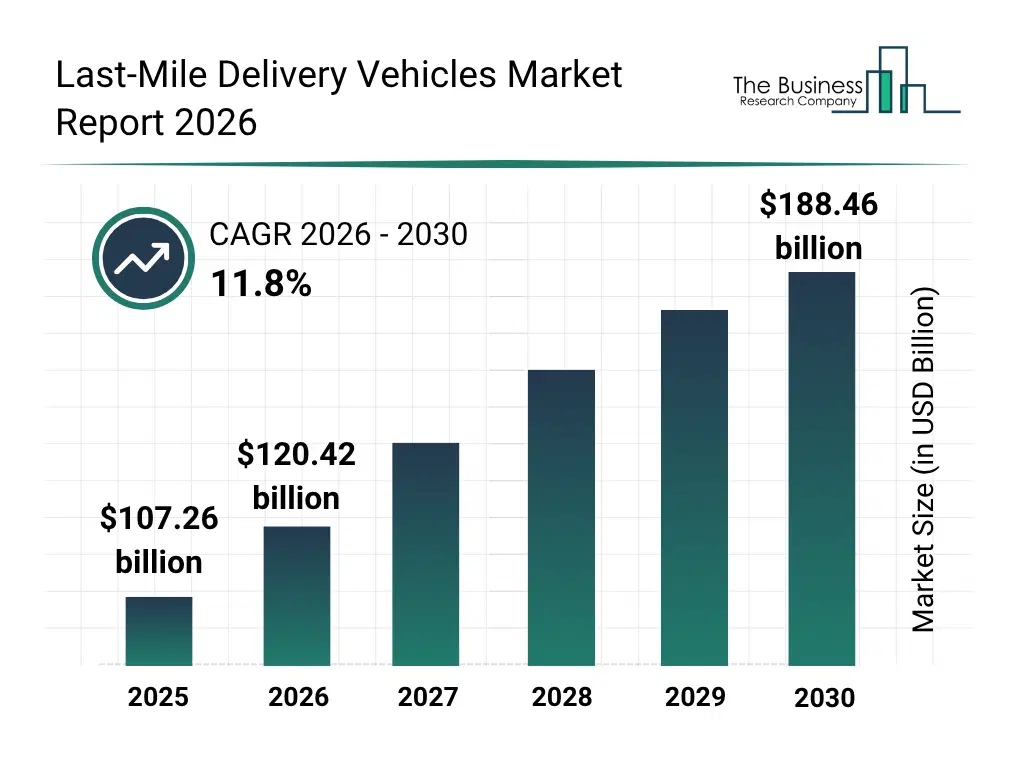
What Is The Last-Mile Delivery Vehicles Market Size and Share 2026?
The last-mile delivery vehicles market size has grown rapidly in recent years. It will grow from $107.26 billion in 2025 to $120.42 billion in 2026 at a compound annual growth rate (CAGR) of 12.3%. The growth in the historic period can be attributed to increasing growth of e-commerce deliveries, rising urbanization and last-mile delivery demand, growing expansion of local distribution hubs, increasing demand for faster delivery times, rising adoption of on-demand delivery services.What Is The Last-Mile Delivery Vehicles Market Growth Forecast?
The last-mile delivery vehicles market size is expected to see rapid growth in the next few years. It will grow to $188.46 billion in 2030 at a compound annual growth rate (CAGR) of 11.8%. The growth in the forecast period can be attributed to growing demand for micro-delivery vehicle fleets, increasing deployment of modular cargo configurations, rising demand for low-maintenance delivery vehicles, growing adoption of lightweight vehicle designs, increasing need for scalable urban delivery capacity. Major trends in the forecast period include increasing adoption of compact and maneuverable delivery vehicles, growing demand for optimized cargo capacity, rising preference for flexible short-distance delivery vehicles, increasing adoption of purpose-built urban delivery vehicles, growing demand for efficient vehicle designs for frequent delivery operations.
Global Last-Mile Delivery Vehicles Market Segmentation
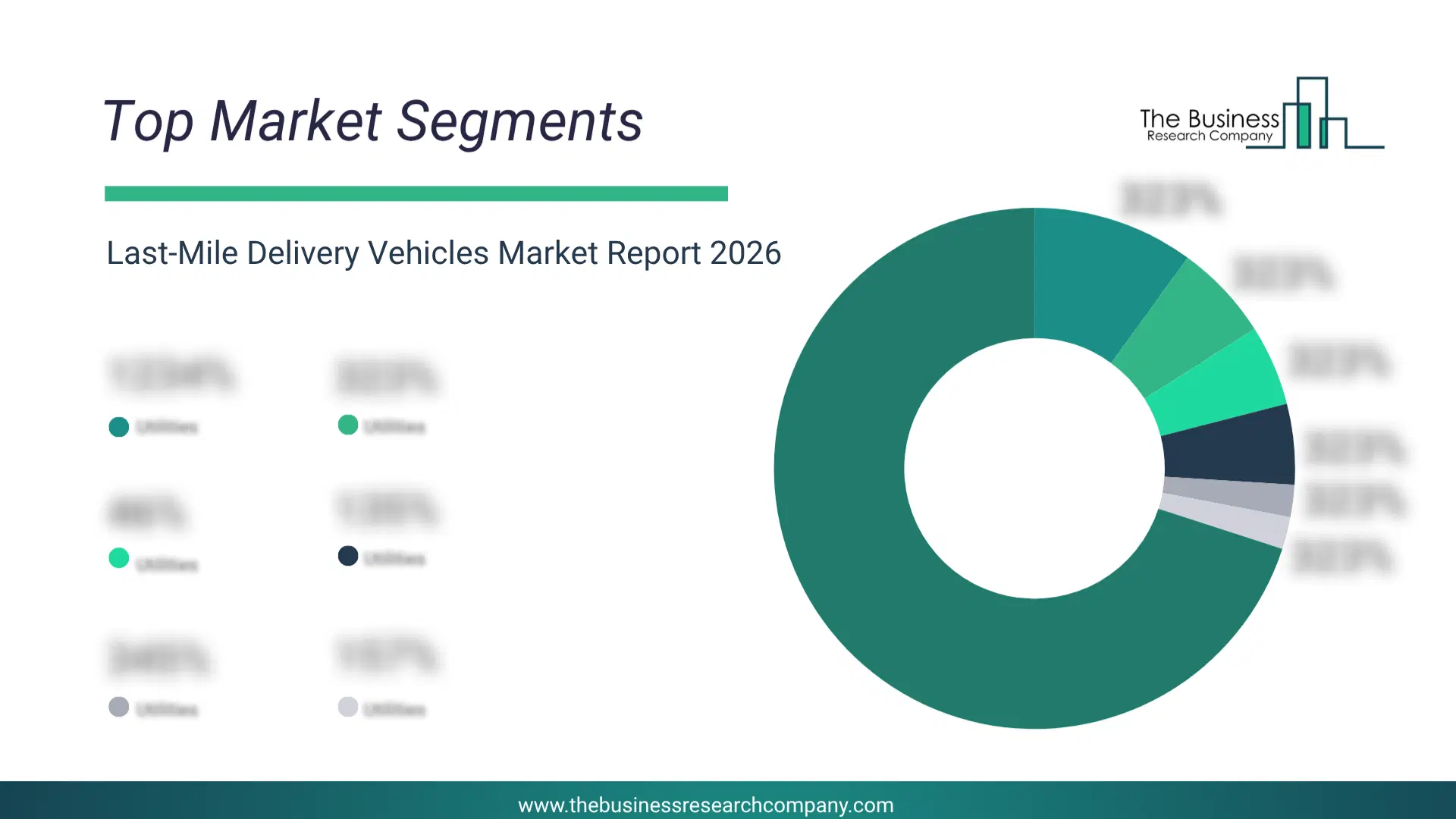
1) By Vehicle Type: Two Wheeler, Three Wheeler, Four Wheeler, Drones, Autonomous Vehicles, Other Vehicle Types 2) By Propulsion Type: Electric, Gasoline, Diesel, Hybrid, Other Propulsion Types 3) By Payload Capacity: Low Payload Vehicles, Medium Payload Vehicles, High Payload Vehicles 4) By Application: E Commerce, Retail, Food Delivery, Postal Services, Grocery Delivery, Other Applications 5) By End User: Business To Business, Business To Consumer, Consumer To Consumer Subsegments: 1) By Two Wheeler: Electric Scooters, Electric Motorcycles, Cargo Motorcycles, Delivery Bicycles, Passenger Motorcycles 2) By Three Wheeler: Electric Three Wheelers, Cargo Three Wheelers, Auto Rickshaws, Light Commercial Three Wheelers, Refrigerated Three Wheelers 3) By Four Wheeler: Electric Vans, Light Commercial Vehicles, Mini Trucks, Pickup Trucks, Delivery Trucks 4) By Drones: Multirotor Drones, Fixed Wing Drones, Hybrid Drones, Cargo Drones, Delivery Drones 5) By Autonomous Vehicles: Autonomous Delivery Robots, Self Driving Delivery Vans, Autonomous Ground Vehicles, Autonomous Mobile Robots, Driverless Delivery Vehicles 6) By Other Vehicle Types: Electric Carts, Cargo Bicycles, Specialized Delivery Vehicles, Refrigerated Delivery Vehicles, Heavy Commercial VehiclesWhat Is The Driver Of The Last-Mile Delivery Vehicles Market?
The increasing e-commerce order volumes is expected to propel the growth of the last-mile delivery vehicles market going forward. E-commerce order volumes refer to the total number of transactions placed through digital retail platforms where consumers purchase goods online for home or designated delivery fulfillment. The e-commerce order volumes are rising due to the increasing consumer preference for the convenience of online shopping and home delivery, as customers increasingly choose digital platforms to purchase products quickly, easily, and from the comfort of their homes. E-commerce order volumes are driving the growth of last-mile delivery vehicles by increasing the demand for faster, more efficient, and reliable delivery solutions, encouraging logistics providers to expand their fleets, adopt advanced technologies, and optimize urban delivery networks to meet the rising expectations of online consumers. For instance, in February 2025, according to the U.S. Census Bureau, a US-based government statistical agency, total U.S. retail e-commerce sales reached 1.192.6 billion in 2024, representing an 8.1% increase from 2023. Therefore, the increasing e-commerce order volumes is driving the growth of the last-mile delivery vehicles industry.Key Players In The Global Last-Mile Delivery Vehicles Market
Major companies operating in the last-mile delivery vehicles market are Toyota Motor Corporation, Volkswagen AG, Ford Motor Company, Mercedes-Benz Group AG, Honda Motor Co. Ltd., Nissan Motor Co. Ltd., Stellantis N.V., Renault Group, Hyundai Motor Company, Daimler Truck Holding AG, Tata Motors Limited, Isuzu Motors Limited, IVECO Group N.V., Mahindra & Mahindra Limited, Ashok Leyland Limited, General Motors Company, Rivian Automotive Inc., TVS Motor Company Limited, Piaggio & C. S.p.A., GreenPower Motor Company Inc., Xos Inc., Workhorse Group Inc., EKA Mobility Private Limited, Kinetic Green Energy & Power Solutions Limited, Nuro Inc., Euler Motors Private Limited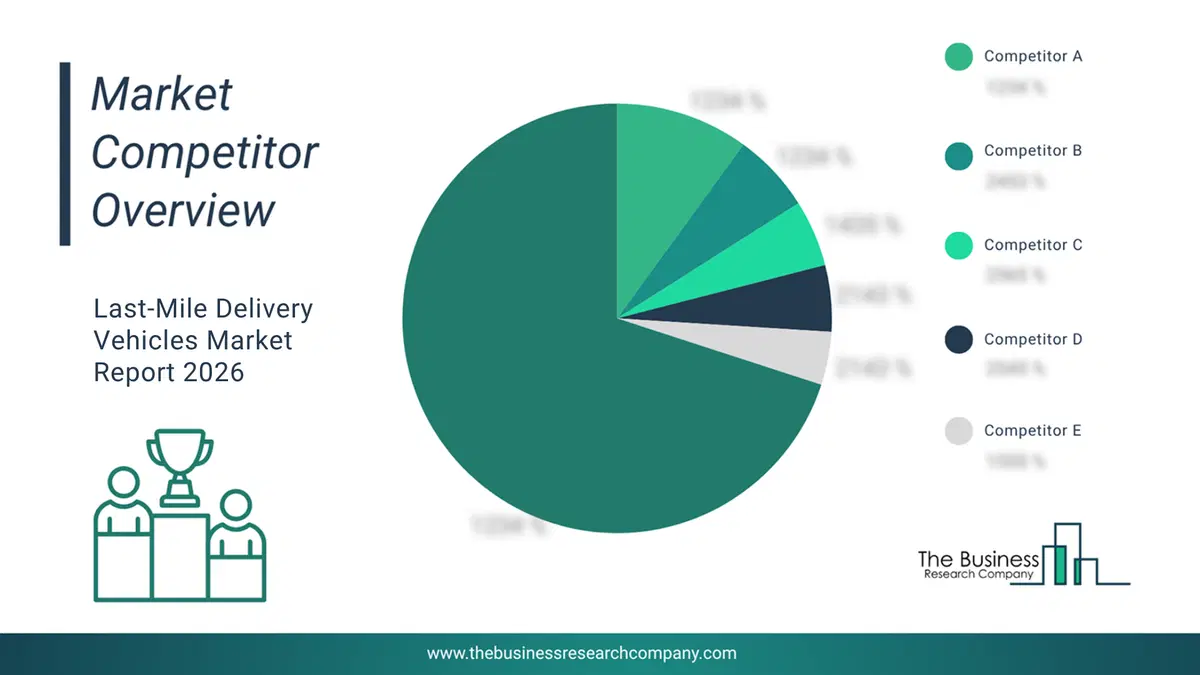
This chart is for illustrative purposes; the full report includes a detailed competitor analysis and comprehensive overview of the top 10 companies in the market.
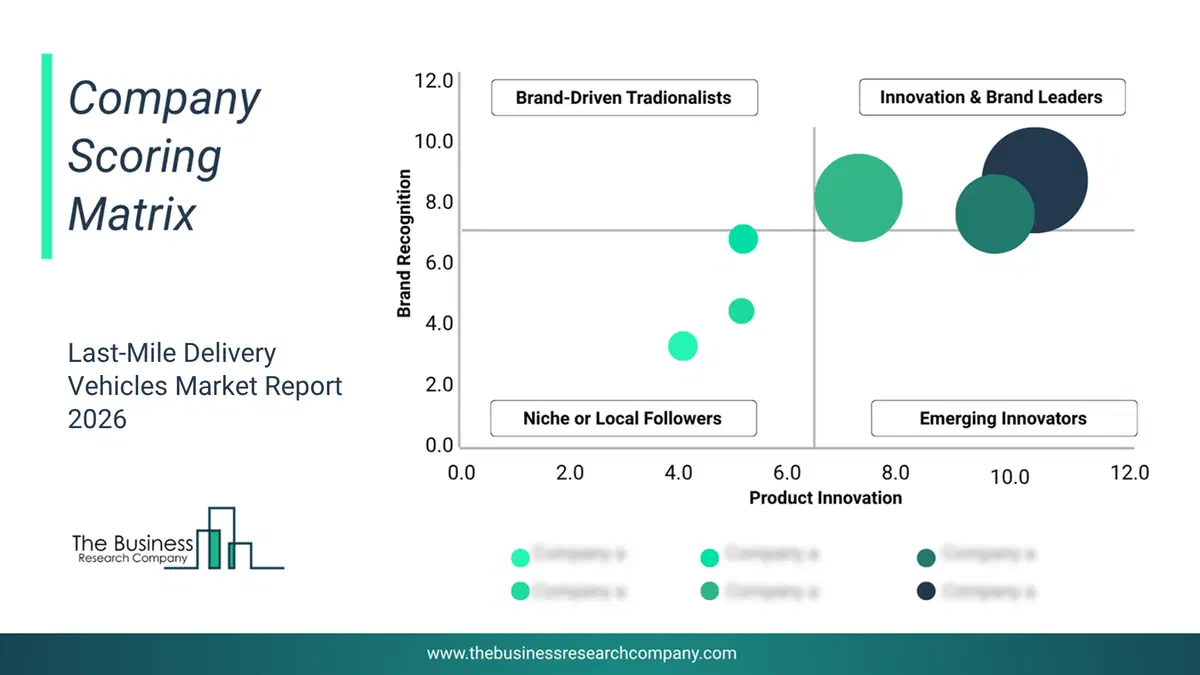
This chart maps companies by product innovation and brand strength, with bubble size indicating relative revenue, helping identify market leaders, challengers, and niche players. This is an illustrative chart; the full report provides a complete and accurate competitive analysis.
Global Last-Mile Delivery Vehicles Market Trends and Insights
Major companies operating in the last-mile delivery vehicles market are focusing on developing advanced products such as, electric cargo three-wheelers to enhance sustainable transportation, delivery efficiency, operational cost savings, and urban logistics capabilities. Electric cargo three-wheelers are battery-powered commercial vehicles designed for transporting goods over short distances, offering lower operating costs, reduced emissions, and improved maneuverability compared with conventional internal combustion engine-based delivery vehicles. For instance, in September 2023, Greaves Electric Mobility Private Limited, an India-based electric mobility company, launched Greaves Eltra, an electric cargo three-wheeler designed to transform last-mile logistics operations. The vehicle is powered by a 10.8 kWh battery pack and delivers a range of over 100 km per charge, enabling efficient and reliable cargo transportation. It features a 140 cubic feet factory-fitted delivery box, a peak power capability of 9.5 kW, and advanced technologies including geolocation, geofencing, vehicle and driver performance management, fleet management, and remote diagnostics. The vehicle also includes a digital cluster with Bluetooth and navigation capabilities, providing improved fleet visibility and operational control for businesses.What Are Latest Mergers And Acquisitions In The Last-Mile Delivery Vehicles Market?
In December 2025, Workhorse Group Inc., a US-based manufacturer of zero-emission commercial vehicles that specializes in providing last-mile delivery vehicles, merged with Motiv Electric Trucks Inc., to create a leading North American medium-duty electric vehicle manufacturer. Through this merger, Workhorse Group Inc. and Motiv Electric Trucks, Inc. aim to combine scalable manufacturing capabilities, advanced electric vehicle technologies, and commercial fleet expertise to expand their portfolio of electric trucks and buses, reduce production costs, accelerate market adoption, and strengthen their position in the commercial electric vehicle market. Motiv Electric Trucks, Inc. is a US-based company specializing in medium-duty electric truck and bus platforms for commercial fleet applications.
Regional Outlook
Asia-Pacific was the largest region in the last-mile delivery vehicles market in 2025. Asia-Pacific is expected to be the fastest-growing region in the forecast period. The regions covered in this market report are Asia-Pacific, South East Asia, Western Europe, Eastern Europe, North America, South America, Middle East, Africa. The countries covered in this market report are Australia, Brazil, China, France, Germany, India, Indonesia, Japan, Taiwan, Russia, South Korea, UK, USA, Canada, Italy, Spain.What Defines the Last-Mile Delivery Vehicles Market?
The last-mile delivery vehicles market consists of sales of cargo vans, light commercial vehicles (LCVs), cargo bikes, electric two-wheelers, and autonomous vehicles. Values in this market are ‘factory gate’ values, that is the value of goods sold by the manufacturers or creators of the goods, whether to other entities (including downstream manufacturers, wholesalers, distributors and retailers) or directly to end customers. The value of goods in this market includes related services sold by the creators of the goods.How is Market Value Defined and Measured?
The market value is defined as the revenues that enterprises gain from the sale of goods and/or services within the specified market and geography through sales, grants, or donations in terms of the currency (in USD unless otherwise specified). The revenues for a specified geography are consumption values that are revenues generated by organizations in the specified geography within the market, irrespective of where they are produced. It does not include revenues from resales along the supply chain, either further along the supply chain or as part of other products.
This chart presents market attractiveness based on a quantitative evaluation of growth, competition, strategic alignment, and risk, offering a clear view of opportunity areas for decision-making. This chart is for illustrative purposes; the full report contains the complete analysis.

This chart highlights the Total Addressable Market (TAM) by estimating the maximum revenue opportunity using an assumption-driven approach, supporting strategic planning and opportunity sizing across markets. The chart is illustrative; the full report provides a more comprehensive analysis.
What Key Data and Analysis Are Included in the Last-Mile Delivery Vehicles Market Report 2026?
The last-mile delivery vehicles market research report is one of a series of new reports from The Business Research Company that provides market statistics, including industry global market size, regional shares, competitors with the market share, detailed market segments, market trends and opportunities, and any further data you may need to thrive in the last-mile delivery vehicles industry. The market research report delivers a complete perspective of everything you need, with an in-depth analysis of the current and future state of the industry.Last-Mile Delivery Vehicles Market Report Forecast Analysis
| Report Attribute | Details |
|---|---|
| Market Size Value In 2026 | $120.42 billion |
| Revenue Forecast In 2030 | $188.46 billion |
| Growth Rate | CAGR of 11.8% from 2026 to 2030 |
| Base Year For Estimation | 2025 |
| Actual Estimates/Historical Data | 2020-2025 |
| Forecast Period | 2026 - 2030 |
| Market Representation | Revenue in USD Billion and CAGR from 2026 to 2030 |
| Segments Covered | Vehicle Type, Propulsion Type, Payload Capacity, Application, End User |
| Regional Scope | Asia-Pacific, Western Europe, Eastern Europe, North America, South America, Middle East, Africa |
| Country Scope | The countries covered in the report are Australia, Brazil, China, France, Germany, India, Indonesia, Japan, Taiwan, Russia, South Korea, UK, USA, Canada, Italy, Spain. |
| Key Companies Profiled | Toyota Motor Corporation, Volkswagen AG, Ford Motor Company, Mercedes-Benz Group AG, Honda Motor Co. Ltd., Nissan Motor Co. Ltd., Stellantis N.V., Renault Group, Hyundai Motor Company, Daimler Truck Holding AG, Tata Motors Limited, Isuzu Motors Limited, IVECO Group N.V., Mahindra & Mahindra Limited, Ashok Leyland Limited, General Motors Company, Rivian Automotive Inc., TVS Motor Company Limited, Piaggio & C. S.p.A., GreenPower Motor Company Inc., Xos Inc., Workhorse Group Inc., EKA Mobility Private Limited, Kinetic Green Energy & Power Solutions Limited, Nuro Inc., Euler Motors Private Limited |
| Customization Scope | Request for Customization |
| Pricing And Purchase Options | Explore Purchase Options |