
Lattice Generation Software Market Report 2026
Global Outlook – By Component (Software Platforms, Plugins And Add-Ons, Services), By Type (On-Premise, Cloud), By Lattice Type (Stochastic Lattices, Periodic Lattices, Hybrid Or Functionally Graded Lattices), By Application (Automotive, Aerospace, Manufacturing, Construction, Other Applications), By End-User (Small And Medium-Sized Enterprises (SMEs), Large Enterprises) – Market Size, Trends, Strategies, and Forecast to 2035
Lattice Generation Software Market Overview
• Lattice Generation Software market size has reached to $0.69 billion in 2025 • Expected to grow to $1.17 billion in 2030 at a compound annual growth rate (CAGR) of 11.1% • Growth Driver: Increasing Adoption Of 3D Printing Technology Driving The Market Growth Due To Rising Demand For Optimized And Lightweight 3D-Printed Designs • Market Trend: Advancements In Implicit Modeling For Enhanced Design And Manufacturing Workflows • North America was the largest region in 2025 and Asia-Pacific is the fastest growing region.What Is Covered Under Lattice Generation Software Market?
Lattice generation software is a type of program designed to create complex, interconnected geometric structures within a 3D model. It automates the design of internal frameworks to optimize strength, reduce weight, or enhance material efficiency. These tools are commonly used in additive manufacturing and engineering applications to produce lightweight and structurally robust components. The main components of lattice generation software are software platforms, plugins and add-ons, and services. Software platforms provide the core tools and interfaces for designing, analyzing, and simulating lattice structures. Multiple types include on-premise and cloud, comes in different lattice types including stochastic lattices, periodic lattices, and hybrid or functionally graded lattices, and are used in applications like automotive, aerospace, manufacturing, construction, and others by end users such as small and medium-sized enterprises (SMEs) and large enterprises.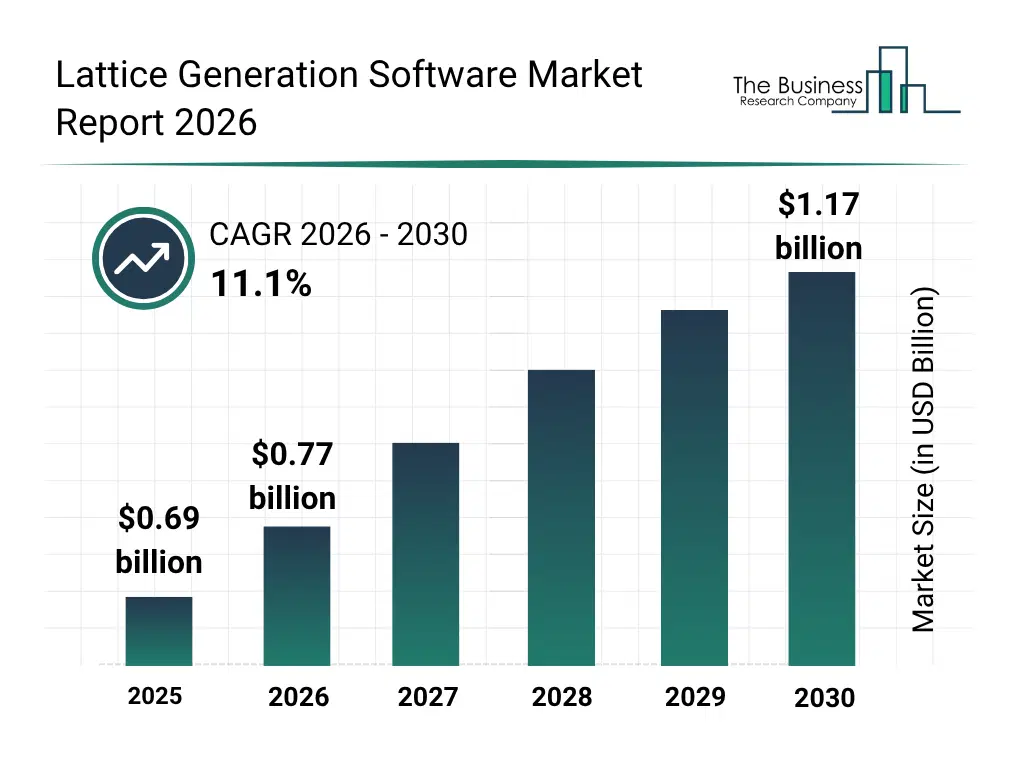
What Is The Lattice Generation Software Market Size and Share 2026?
The lattice generation software market size has grown rapidly in recent years. It will grow from $0.69 billion in 2025 to $0.77 billion in 2026 at a compound annual growth rate (CAGR) of 10.9%. The growth in the historic period can be attributed to growth in additive manufacturing adoption, demand for lightweight components in aerospace and automotive, increasing use of cad and simulation tools, rise in precision engineering projects, focus on material efficiency and structural optimization.What Is The Lattice Generation Software Market Growth Forecast?
The lattice generation software market size is expected to see rapid growth in the next few years. It will grow to $1.17 billion by 2030 at a compound annual growth rate (CAGR) of 11.1%. The growth in the forecast period can be attributed to increasing integration of ai in lattice design, adoption of cloud-based and hybrid lattice platforms, expansion of automotive and aerospace applications, rising investment in r&d for advanced lattice structures, growing demand for sustainable and resource-efficient designs. Major trends in the forecast period include adoption of cloud-based lattice generation software, integration of lattice design with cad and simulation tools, increased use of functionally graded and hybrid lattices, rising demand for lightweight and material-efficient structures, expansion of lattice software services including training and consulting.
Global Lattice Generation Software Market Segmentation
1) By Component: Software Platforms, Plugins And Add-Ons, Services 2) By Type: On-Premise, Cloud 3) By Lattice Type: Stochastic Lattices, Periodic Lattices, Hybrid Or Functionally Graded Lattices 4) By Application: Automotive, Aerospace, Manufacturing, Construction, Other Applications 5) By End-User: Small And Medium-Sized Enterprises (SMEs), Large Enterprises Subsegments: 1) By Software Platforms: Standalone Lattice Generation Software Platforms, Cloud-Based Lattice Generation Software Platforms, Simulation-Integrated Lattice Generation Platforms, Computer-Aided Design (CAD) Integrated Lattice Generation Software Platforms 2) By Plugins And Add-Ons: Computer-Aided Design (CAD) Plugins For Lattice Generation, Simulation Software Add-Ons, Rendering And Visualization Add-Ons, Custom Lattice Design Plugins 3) By Services: Implementation and Integration Services, Training And Education Services, Technical Support And Troubleshooting Services, Consulting And Optimization ServicesWhat Is The Driver Of The Lattice Generation Software Market?
The increasing adoption of 3D printing technology is expected to propel the growth of the lattice generation software market going forward. 3D printing technology refers to a manufacturing process that creates three-dimensional objects layer by layer from digital designs, allowing precise and customizable production. The adoption of 3D printing technology is rising due to its ability to reduce production time, enabling manufacturers to quickly create prototypes and finished parts with greater efficiency. 3D printing technology enhances the use of lattice generation software by enabling designers to create complex, lightweight internal structures that are critical for producing strong, efficient, and material-optimized 3D-printed parts. For instance, according to the 2024 edition of Protolabs Network's annual survey by the Protolabs Inc., a US-based manufacturing company, the use of 3D printing for end-use parts rose to 21% in 2023 from 20% in 2022, driven by faster lead times, with 47% of respondents cited as their primary reason for choosing 3D printing, up from 44% compared to 2022. Therefore, the increasing adoption of 3D printing technology is driving the growth of the lattice generation software industry.Key Players In The Global Lattice Generation Software Market
Major companies operating in the lattice generation software market are market are Siemens AG, Altair Engineering Inc., Dassault Systèmes SE, Ansys Inc., Autodesk Inc., PTC Inc., Renishaw plc, Materialise NV, Carbon Inc., FIT Additive Manufacturing Group, Dyndrite Corporation, nTopology Inc., Hyperganic Technologies AG, Synera GmbH, General Lattice Inc., Metafold 3D Inc., Anisoprint S.A., ParaMatters Inc., STL Lattice Generator, OptFuture.Global Lattice Generation Software Market Trends and Insights
Major companies operating in the lattice generation software market are focusing on leveraging innovative technologies such as, implicit modeling technology to create complex, lightweight, and high-performance lattice structures more efficiently than traditional CAD methods. Implicit modeling technology is a design approach that uses mathematical functions to define shapes and lattice structures, allowing for highly complex geometries, smooth transitions, and optimized material distribution, which helps engineers quickly create lightweight, high-performance designs that are difficult to achieve with traditional explicit CAD modeling. For instance, in June 2024, nTopology Inc., a United States based engineering design software company, launched nTop 5, an advanced computational design platform built on next generation implicit modeling that enhances interoperability and design capabilities across simulation and manufacturing workflows. nTop 5 introduces a powerful new modeling kernel that accelerates design operations, supports complex lattice and topological structures with greater precision, and integrates with tools from partners such as Materialise, Autodesk, Hexagon, Intact Solutions, and cloudfluid to streamline transitions from design to production. The software’s unique features include seamless compatibility with CAD, simulation, and additive manufacturing tools, reduced design cycle times, and the ability to automate intricate lattice generation that would be difficult or time consuming with traditional CAD software.What Are Latest Mergers And Acquisitions In The Lattice Generation Software Market?
In November 2025, Hubb Global Holdings Inc., a US-based technology investment company, acquired Oqton Inc. for an undisclosed amount. With this acquisition, Hubb Global Holdings, Inc. aims to strengthen its position in the additive manufacturing software market by enhancing AI-driven, printer-agnostic capabilities and accelerating the adoption of metal 3D printing across industries. Oqton Inc. is a US-based technology company that specializes in providing lattice generation software.Regional Insights
North America was the largest region in the lattice generation software market in 2025. Asia-Pacific is expected to be the fastest-growing region in the forecast period. The regions covered in this market report are Asia-Pacific, South East Asia, Western Europe, Eastern Europe, North America, South America, Middle East, Africa. The countries covered in this market report are Australia, Brazil, China, France, Germany, India, Indonesia, Japan, Taiwan, Russia, South Korea, UK, USA, Canada, Italy, Spain.What Defines the Lattice Generation Software Market?
The lattice generation software market consists of revenues earned by entities by providing services such as software licensing and subscription, cloud-based design and simulation, customization and integration with existing workflows, technical support and maintenance, consulting and training, and data analysis and optimization of lattice structures. The market value includes the value of related goods sold by the service provider or included within the service offering. The lattice generation software market also includes sales of standalone lattice generation platforms, and parametric and generative design tools. Values in this market are ‘factory gate’ values, that is the value of goods sold by the manufacturers or creators of the goods, whether to other entities (including downstream manufacturers, wholesalers, distributors and retailers) or directly to end customers. The value of goods in this market includes related services sold by the creators of the goods.How is Market Value Defined and Measured?
The market value is defined as the revenues that enterprises gain from the sale of goods and/or services within the specified market and geography through sales, grants, or donations in terms of the currency (in USD unless otherwise specified). The revenues for a specified geography are consumption values that are revenues generated by organizations in the specified geography within the market, irrespective of where they are produced. It does not include revenues from resales along the supply chain, either further along the supply chain or as part of other products.What Key Data and Analysis Are Included in the Lattice Generation Software Market Report 2026?
The lattice generation software market research report is one of a series of new reports from The Business Research Company that provides market statistics, including industry global market size, regional shares, competitors with the market share, detailed market segments, market trends and opportunities, and any further data you may need to thrive in the lattice generation software industry. The market research report delivers a complete perspective of everything you need, with an in-depth analysis of the current and future state of the industry.Lattice Generation Software Market Report Forecast Analysis
| Report Attribute | Details |
|---|---|
| Market Size Value In 2026 | $0.77 billion |
| Revenue Forecast In 2035 | $1.17 billion |
| Growth Rate | CAGR of 10.9% from 2026 to 2035 |
| Base Year For Estimation | 2025 |
| Actual Estimates/Historical Data | 2020-2025 |
| Forecast Period | 2026 - 2030 - 2035 |
| Market Representation | Revenue in USD Billion and CAGR from 2026 to 2035 |
| Segments Covered | Component, Type, Lattice Type, Application, End-User |
| Regional Scope | Asia-Pacific, Western Europe, Eastern Europe, North America, South America, Middle East, Africa |
| Country Scope | The countries covered in the report are Australia, Brazil, China, France, Germany, India, ... |
| Key Companies Profiled | Siemens AG, Altair Engineering Inc., Dassault Systèmes SE, Ansys Inc., Autodesk Inc., PTC Inc., Renishaw plc, Materialise NV, Carbon Inc., FIT Additive Manufacturing Group, Dyndrite Corporation, nTopology Inc., Hyperganic Technologies AG, Synera GmbH, General Lattice Inc., Metafold 3D Inc., Anisoprint S.A., ParaMatters Inc., STL Lattice Generator, OptFuture. |
| Customization Scope | Request for Customization |
| Pricing And Purchase Options | Explore Purchase Options |