
Launch Azimuth Analysis Software Market Report 2026
Global Outlook – By Component (Software, Services), By Deployment Mode (On-Premises, Cloud-Based), By Application (Aerospace And Defense, Space Exploration, Satellite Communication, Missile Guidance, Other Applications), By End-User (Government And Military, Commercial, Research Institutes, Other End-Users) – Market Size, Trends, Strategies, and Forecast to 2030
Launch Azimuth Analysis Software Market Overview
• Launch Azimuth Analysis Software market size has reached to $1.25 billion in 2025 • Expected to grow to $2.02 billion in 2030 at a compound annual growth rate (CAGR) of 10.1% • Growth Driver: The Increasing Number Of Space Launches Is Driving The Market Due To Rising Satellite Communication Demand • Market Trend: Real-Time Trajectory Simulation Transforms Accuracy And Efficiency In Launch Azimuth Analysis • North America was the largest region in 2025.What Is Covered Under Launch Azimuth Analysis Software Market?
Launch azimuth analysis software is a specialized tool used to calculate the optimal launch direction (azimuth) for space missions. It evaluates trajectory, orbital mechanics, and safety constraints to determine the most efficient flight path. The software helps minimize fuel consumption, maximize payload capacity, and ensure compliance with range safety requirements. The main components of launch azimuth analysis software are software and services. Launch azimuth analysis software is a specialized tool that calculates and optimizes the launch trajectory of rockets or spacecraft to ensure accurate orbital insertion while minimizing risks and fuel consumption. These are deployed in on-premises and cloud-based modes. It serves applications such as aerospace, defense, satellite communication, missile guidance, and research, with end-users including governments, military agencies, commercial companies, and research institutions.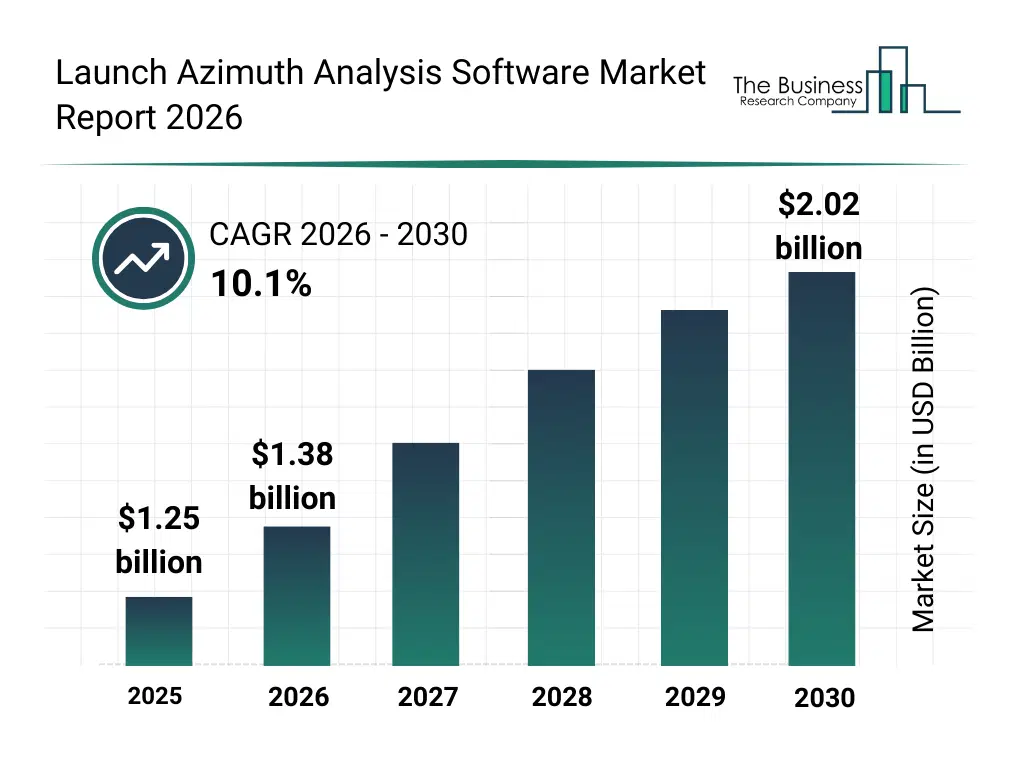
What Is The Launch Azimuth Analysis Software Market Size and Share 2026?
The launch azimuth analysis software market size has grown rapidly in recent years. It will grow from $1.25 billion in 2025 to $1.38 billion in 2026 at a compound annual growth rate (CAGR) of 10.4%. The growth in the historic period can be attributed to initial adoption in early space missions for trajectory optimization, integration of geospatial data for accurate launch calculations, development of real-time monitoring and safety compliance modules, growth of model tuning and simulation services, implementation of orbital debris risk mitigation services.What Is The Launch Azimuth Analysis Software Market Growth Forecast?
The launch azimuth analysis software market size is expected to see rapid growth in the next few years. It will grow to $2.02 billion in 2030 at a compound annual growth rate (CAGR) of 10.1%. The growth in the forecast period can be attributed to expansion of AI-driven trajectory and orbital analysis tools, integration with environmental and regulatory compliance modules, increasing adoption in commercial space launch programs, development of cloud-based launch planning platforms, growth in predictive risk assessment and optimization services. Major trends in the forecast period include real-time launch monitoring and adjustment, orbital debris risk mitigation integration, geospatial data and environmental compliance services, advanced trajectory simulation and safety analysis, customization and upgradation of launch software,.
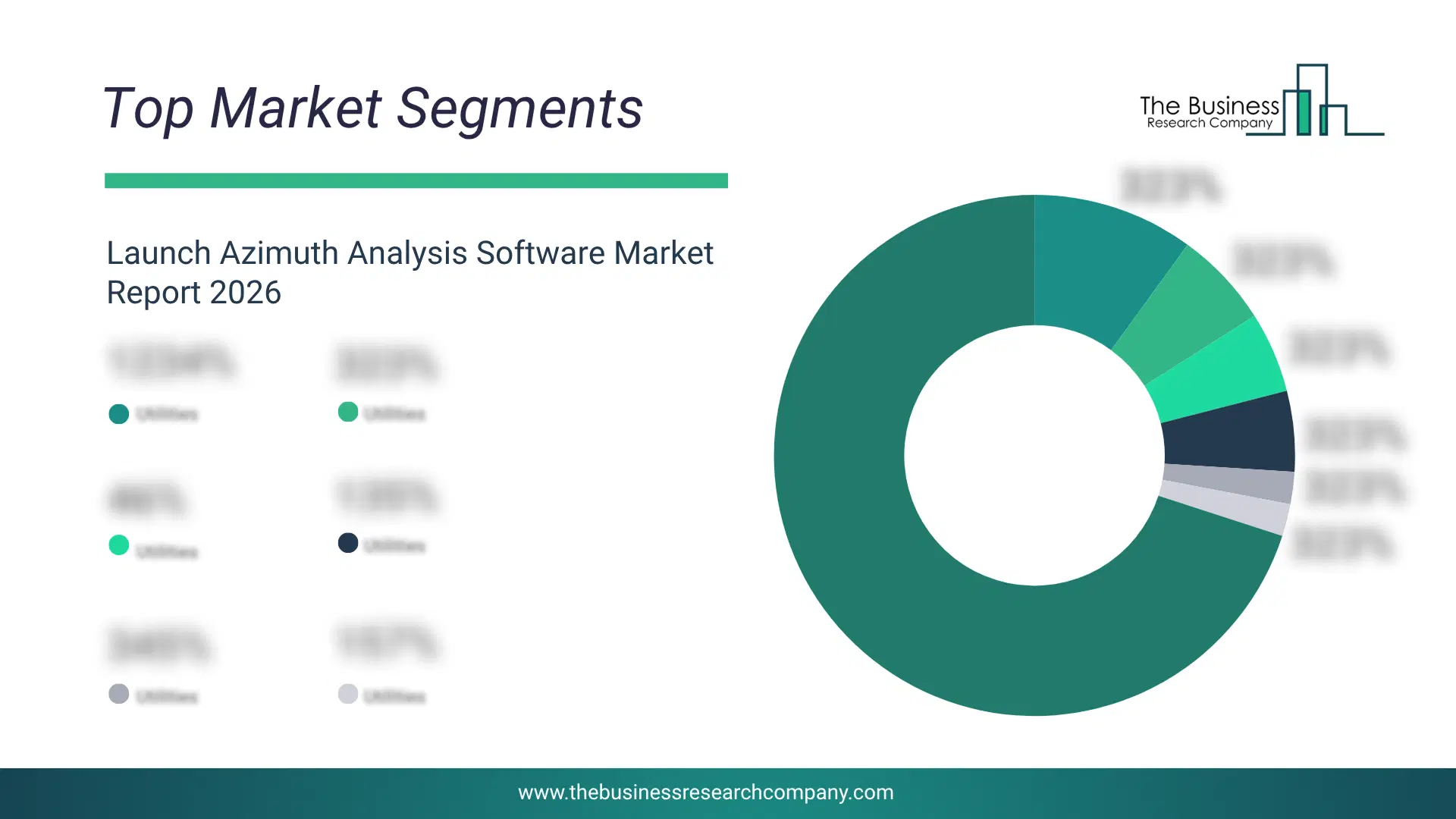
Global Launch Azimuth Analysis Software Market Segmentation
1) By Component: Software, Services 2) By Deployment Mode: On-Premises, Cloud-Based 3) By Application: Aerospace And Defense, Space Exploration, Satellite Communication, Missile Guidance, Other Applications 4) By End-User: Government And Military, Commercial, Research Institutes, Other End-Users Subsegments: 1) By Software: Trajectory Simulation Software, Flight Path Optimization Software, Mission Planning And Scheduling Software, Risk Assessment And Safety Analysis Software, Real Time Data Processing Software 2) By Services: Consulting And Advisory Services, Integration And Implementation Services, Training And Certification Services, Maintenance And Support Services, Upgradation And Customization ServicesWhat Is Driver Of The Launch Azimuth Analysis Software Market?
The increasing number of space launches is expected to propel the growth of the launch azimuth analysis software market going forward. Space launches refer to the process of sending satellites, spacecraft, or payloads into space using rockets or other launch vehicles. The number of space launches is increasing due to rising demand for satellite-based communication and connectivity. This dependence on satellites requires more frequent launches to expand and maintain global networks. Launch azimuth analysis software optimizes flight paths for safety, efficiency, and regulatory compliance, enabling more frequent missions without orbital conflicts. For instance, in May 2024, the Satellite Industry Association (SIA), a US-based trade association, recorded 259 launches in 2024, placing 2,172 tons of payload and 2,695 satellites into Earth orbit, increasing the US launch market share to 65% and bringing the total number of operational satellites to 11,539 by the end of 2024. Therefore, the increasing number of space launches is driving the growth of the launch azimuth analysis software industry.Key Players In The Global Launch Azimuth Analysis Software Market
Major companies operating in the launch azimuth analysis software market are Airbus SE, Lockheed Martin Corporation, Northrop Grumman, Thales Group, Aerospace Corporation, Sierra Nevada Corporation, Rogers Aeroscience, Arianespace, a.i. solutions, Loft Orbital, Odyssey Space Research, AIKO, Bright Ascension, Sidus Space, B612 Foundation, IENAI SPACE, SpaceFlightSolutions, Apogee Components, Astos Solutions, Cognitive Space, Epsilon3, SpaceCAD, Kayhan Space, Nyx Space.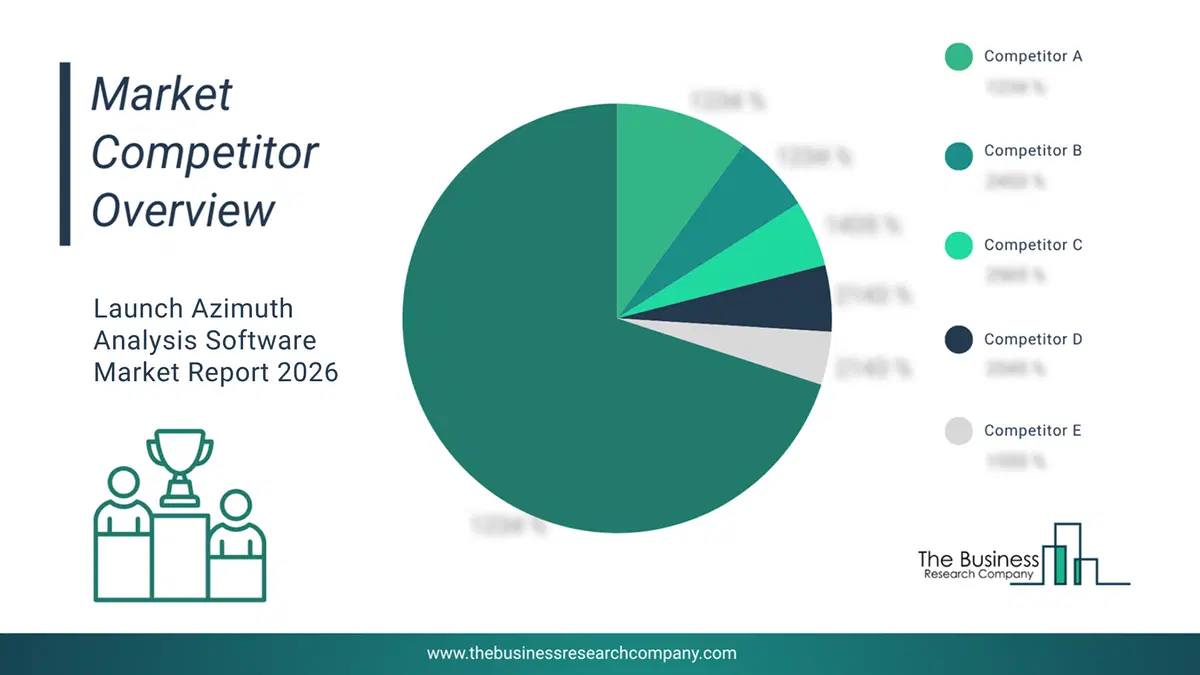
This chart is for illustrative purposes; the full report includes a detailed competitor analysis and comprehensive overview of the top 10 companies in the market.
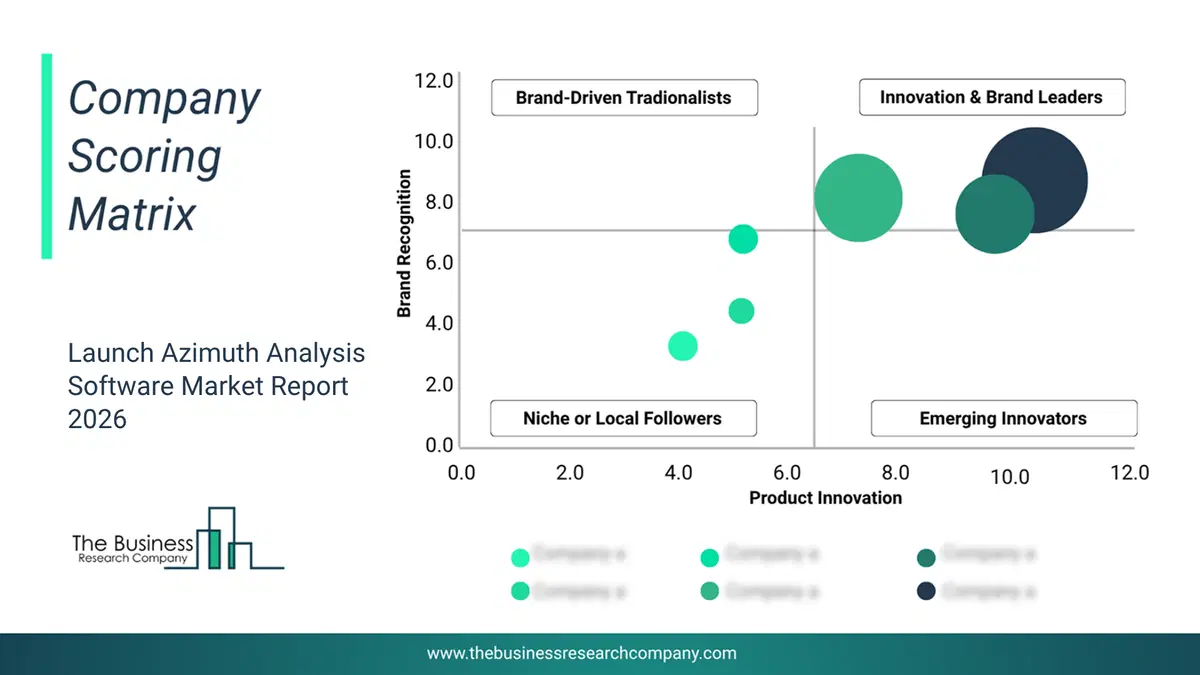
This chart maps companies by product innovation and brand strength, with bubble size indicating relative revenue, helping identify market leaders, challengers, and niche players. This is an illustrative chart; the full report provides a complete and accurate competitive analysis.
Global Launch Azimuth Analysis Software Market Trends and Insights
Major companies operating in the launch azimuth analysis software market are focusing on developing technological developments, such as advanced real-time trajectory simulation, to enhance mission accuracy, reduce planning time, and optimize launch windows for diverse satellite and space exploration missions. Advanced real-time trajectory simulation refers to the use of high-speed computing and dynamic modeling tools to replicate and analyze spacecraft flight paths under changing mission conditions. It enables mission teams to test multiple scenarios instantly, ensuring precise launch azimuth calculations and optimal trajectory planning. For instance, in August 2024, Ascending Node Technologies (ANT), a US-based aerospace software company, announced the commercial launch of its Spaceline 3D mission visualization software. This software is currently used for NASA’s $20 million Aspera small-satellite ultraviolet astrophysics mission. The web-based platform integrates real-time simulation, trajectory optimization, and collaborative data analysis to improve the accuracy and efficiency of mission planning. By automating manual calculations, enabling ultra-high-resolution renderings, and providing secure, real-time results, Spaceline offers a next-generation approach to launch azimuth analysis software. It streamlines trajectory planning and operational decision-making for complex satellite missions in a dynamic space environment.What Are Latest Mergers And Acquisitions In The Launch Azimuth Analysis Software Market? Synopsys Acquires Ansys To Enhance AI-Driven System Design Capabilities
In July 2025, Synopsys, Inc., a US-based electronic design automation (EDA) company, acquired Ansys for $35 billion. This deal aims to create a unified platform for silicon-to-systems innovation, enhancing Synopsys' capabilities in AI-powered product development across various industries, including automotive, aerospace, and industrial sectors. Ansys, Inc. is a US-based engineering simulation software company, providing space mission simulation software.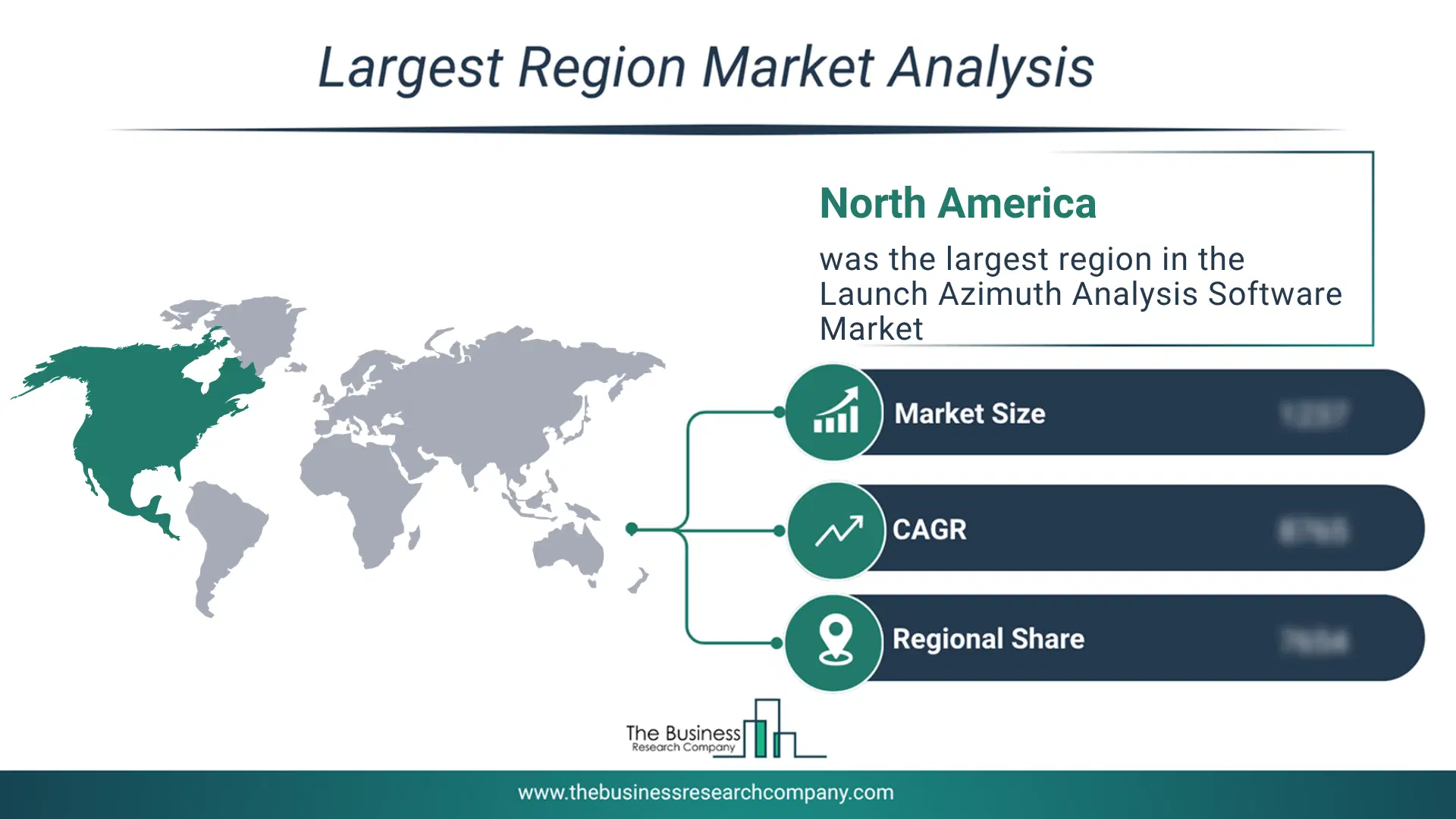
Regional Insights
North America was the largest region in the launch azimuth analysis software market in 2025. The regions covered in this market report are Asia-Pacific, South East Asia, Western Europe, Eastern Europe, North America, South America, Middle East, Africa. The countries covered in this market report are Australia, Brazil, China, France, Germany, India, Indonesia, Japan, Taiwan, Russia, South Korea, UK, USA, Canada, Italy, SpainWhat Defines the Launch Azimuth Analysis Software Market?
The launch azimuth analysis software market consists of revenues earned by entities by providing services such as model tuning services, geospatial data integration services, real-time launch monitoring services, orbital debris risk mitigation services, and environmental compliance assessment services. The market value includes the value of related goods sold by the service provider or included within the service offering. Only goods and services traded between entities or sold to end consumers are included.How is Market Value Defined and Measured?
The market value is defined as the revenues that enterprises gain from the sale of goods and/or services within the specified market and geography through sales, grants, or donations in terms of the currency (in USD unless otherwise specified). The revenues for a specified geography are consumption values that are revenues generated by organizations in the specified geography within the market, irrespective of where they are produced. It does not include revenues from resales along the supply chain, either further along the supply chain or as part of other products.
This chart presents market attractiveness based on a quantitative evaluation of growth, competition, strategic alignment, and risk, offering a clear view of opportunity areas for decision-making. This chart is for illustrative purposes; the full report contains the complete analysis.

This chart highlights the Total Addressable Market (TAM) by estimating the maximum revenue opportunity using an assumption-driven approach, supporting strategic planning and opportunity sizing across markets. The chart is illustrative; the full report provides a more comprehensive analysis.
What Key Data and Analysis Are Included in the Launch Azimuth Analysis Software Market Report 2026?
The launch azimuth analysis software market research report is one of a series of new reports from The Business Research Company that provides market statistics, including industry global market size, regional shares, competitors with the market share, detailed market segments, market trends and opportunities, and any further data you may need to thrive in the launch azimuth analysis software industry. The market research report delivers a complete perspective of everything you need, with an in-depth analysis of the current and future state of the industry.Launch Azimuth Analysis Software Market Report Forecast Analysis
| Report Attribute | Details |
|---|---|
| Market Size Value In 2026 | $1.38 billion |
| Revenue Forecast In 2030 | $2.02 billion |
| Growth Rate | CAGR of 10.1% from 2026 to 2030 |
| Base Year For Estimation | 2025 |
| Actual Estimates/Historical Data | 2020-2025 |
| Forecast Period | 2026 - 2030 |
| Market Representation | Revenue in USD Billion and CAGR from 2026 to 2030 |
| Segments Covered | Component, Deployment Mode, Application, End-User |
| Regional Scope | Asia-Pacific, Western Europe, Eastern Europe, North America, South America, Middle East, Africa |
| Country Scope | The countries covered in the launch azimuth analysis software market report are Australia, Brazil, China, France, Germany, India, Indonesia, Japan, Taiwan, Russia, South Korea, UK, USA, Canada, Italy, Spain |
| Key Companies Profiled | Airbus SE, Lockheed Martin Corporation, Northrop Grumman, Thales Group, Aerospace Corporation, Sierra Nevada Corporation, Rogers Aeroscience, Arianespace, a.i. solutions, Loft Orbital, Odyssey Space Research, AIKO, Bright Ascension, Sidus Space, B612 Foundation, IENAI SPACE, SpaceFlightSolutions, Apogee Components, Astos Solutions, Cognitive Space, Epsilon3, SpaceCAD, Kayhan Space, Nyx Space. |
| Customization Scope | Request for Customization |
| Pricing And Purchase Options | Explore Purchase Options |