
Lean Energy Management Market Report 2026
Global Outlook – By Component (Hardware, Software, Services), By Deployment Mode (Cloud-Based, On-Premises, Hybrid Models), By Application (Manufacturing, Power And Energy, Commercial Buildings, Information Technology And Telecom, Healthcare, Other Applications), By End-User (Industrial, Commercial Buildings, Utilities, Government, Healthcare, Other End-Users) – Market Size, Trends, Strategies, and Forecast to 2035
Lean Energy Management Market Overview
• Lean Energy Management market size has reached to $13.46 billion in 2025 • Expected to grow to $23.39 billion in 2030 at a compound annual growth rate (CAGR) of 11.7% • Growth Driver: Surge In Energy Efficiency Driving The Growth Of The Market Due To Rising Energy Costs And Increasing Energy Productivity • Market Trend: Advancing Decarbonization Strategy Through Integrated Energy Services Expansion • Asia-Pacific was the largest region in 2025 and North America is the fastest growing region.What Is Covered Under Lean Energy Management Market?
Lean energy management is a systematic approach to planning, monitoring, and optimizing energy consumption with the objective of minimizing waste while maintaining operational efficiency. It focuses on eliminating non-value-added energy use across processes, improving energy productivity, and aligning energy consumption with actual demand through continuous measurement, analysis, and incremental improvement. The main components of lean energy management include hardware, software, and services. Hardware refers to physical monitoring and control devices used to optimize energy consumption and improve operational efficiency in industrial and commercial environments. These systems are deployed through cloud-based, on-premises, and hybrid models. The key applications of manufacturing, power and energy, commercial buildings, information technology and telecom, healthcare, and others and serving end user such as industrial, commercial buildings, utilities, government, healthcare and others.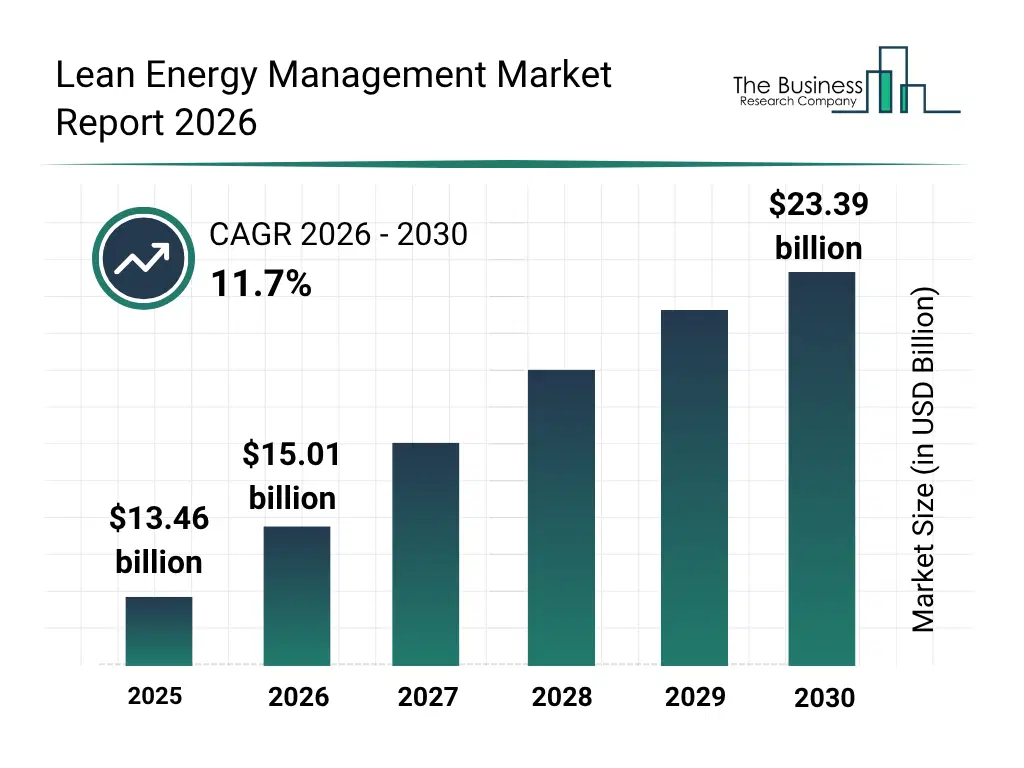
What Is The Lean Energy Management Market Size and Share 2026?
The lean energy management market size has grown rapidly in recent years. It will grow from $13.46 billion in 2025 to $15.01 billion in 2026 at a compound annual growth rate (CAGR) of 11.5%. The growth in the historic period can be attributed to rising industrial energy consumption across manufacturing sectors, increasing fuel and electricity costs driving efficiency needs, regulatory pressure for energy conservation in industries, early adoption of basic energy monitoring systems in large enterprises, growth in awareness of operational cost optimization.What Is The Lean Energy Management Market Growth Forecast?
The lean energy management market size is expected to see rapid growth in the next few years. It will grow to $23.39 billion in 2030 at a compound annual growth rate (CAGR) of 11.7%. The growth in the forecast period can be attributed to stringent carbon emission reduction mandates, increasing adoption of smart manufacturing and industry 4.0 solutions, expansion of iot-enabled energy monitoring infrastructure, rising integration of AI-based predictive optimization tools, growing corporate sustainability and net-zero commitments. Major trends in the forecast period include real-time energy consumption monitoring and optimization in industrial systems, integration of AI-driven predictive energy analytics for demand forecasting, deployment of iot-enabled smart meters and sensors for energy tracking, adoption of cloud-based energy management platforms for centralized control, implementation of carbon footprint tracking and reporting within enterprise energy systems.
Global Lean Energy Management Market Segmentation
1) By Component: Hardware, Software, Services 2) By Deployment Mode: Cloud-Based, On-Premises, Hybrid Models 3) By Application: Manufacturing, Power And Energy, Commercial Buildings, Information Technology And Telecom, Healthcare, Other Applications 4) By End-User: Industrial, Commercial Buildings, Utilities, Government, Healthcare, Other End-Users Subsegments: 1) By Hardware: Sensors And Meters, Control Systems, Energy Measurement Devices, Industrial Equipment Monitoring Devices, Communication And Networking Devices 2) By Software: Energy Management Platforms, Data Analytics And Visualization Tools, Energy Optimization Software, Carbon Management Software, Reporting And Compliance Software 3) By Services: Energy Consulting Services, System Integration Services, Maintenance And Support Services, Energy Auditing Services, Training And Advisory ServicesWhat Are The Drivers Of The Lean Energy Management Market?
The rising demand for energy efficiency is expected to propel the growth of the lean energy management market going forward. Energy efficiency refers to the use of less energy to perform the same task or produce the same output while minimizing energy waste and improving overall performance. The rise in the prevalence of energy efficiency is driven by cost savings, as it reduces energy consumption and lowers operational expenses, enabling organizations and consumers to achieve long-term financial benefits. Lean energy management helps improve energy efficiency by systematically identifying and eliminating energy waste, optimizing resource usage, and ensuring continuous monitoring for sustained performance improvements. For instance, in November 2025, according to the International Energy Agency, a France-based intergovernmental organization, global primary energy intensity improved by 1.8% in 2025, up from approximately 1% in the previous year. Therefore, the rising demand for energy efficiency is driving the growth of the lean energy management industry. The growing demand for cloud-based adoption is expected to propel the growth of the lean energy management market going forward. Cloud-based adoption refers to using internet-based platforms to manage data and applications for scalable and remote access. The rise in cloud-based adoption is driven by scalability, as it enables organizations to easily expand resources based on demand without significant upfront infrastructure investment. Lean energy management supports cloud-based adoption by optimizing energy usage in data centers and cloud infrastructure, reducing operational costs while improving efficiency and sustainability. For instance, in March 2025, according to the Office for National Statistics, a UK-based government agency, in 2023, artificial intelligence (AI) was adopted by 9% of firms, while cloud-based computing systems and applications were adopted by 69% of firms in the UK. Therefore, the growing demand for cloud-based adoption is driving the growth of the lean energy management industry.Key Players In The Global Lean Energy Management Market
Major companies operating in the lean energy management market are Siemens AG, IBM Corporation, General Electric Company, Schneider Electric SE, Honeywell International Inc., SAP SE, ABB Ltd., Johnson Controls International plc, Ameresco Inc., ista International GmbH, Willdan Group Inc., Enel X S.r.l., ENGIE Impact LLC, NORESCO LLC, Arcadia Inc., Emporia Energy Inc., Smart Joules Private Limited, GridBeyond Ltd., Econoler Inc., EcoFactor Inc., EnergyCAP LLC, Franklin Energy Services LLC, Edison Next S.p.A., Radix IoT LLC, Energy Elephant Ltd., Fabric IoT Inc., Sealed Inc.Global Lean Energy Management Market Trends and Insights
Major companies operating in the lean energy management market are focusing on integration across the energy value chain, driven by a strong decarbonization emphasis to lower carbon emissions, improve energy efficiency, and support long-term sustainability objectives. Strong decarbonization focus refers to a strategic commitment by organizations or governments to significantly reduce carbon emissions through energy efficiency, renewable adoption, and sustainable operational practices. For instance, in March 2025, ENGIE SA, a France-based energy and services company. launched its Supply and Energy Management activities in India, establishing a dedicated branch to connect renewable energy assets to customers and markets. The new structure delivers tailored solutions, including manufacturing, commercial real estate, and industrial operations, optimizing energy procurement, reducing costs, and driving sustainability. Leveraging ENGIE’s 30-year presence in India and a 2.3 GW solar and wind portfolio, the expansion aims to support the country’s transition to a carbon-neutral economy while exploring new technologies such as batteries, storage, and hybrid renewables. It emphasizes asset optimization, risk management, and decarbonization solutions, offering businesses reliable, cost-effective, and sustainable energy outcomes. By integrating generation, supply, and energy management capabilities.Regional Outlook/Insights
Asia-Pacific was the largest region in the lean energy management market in 2025. North America is expected to be the fastest-growing region in the forecast period. The regions covered in this market report are Asia-Pacific, South East Asia, Western Europe, Eastern Europe, North America, South America, Middle East, Africa. The countries covered in this market report are Australia, Brazil, China, France, Germany, India, Indonesia, Japan, Taiwan, Russia, South Korea, UK, USA, Canada, Italy, Spain.What Defines the Lean Energy Management Market?
The lean energy management market consists of revenues earned by entities by providing services such as energy consumption assessment, energy auditing, energy benchmarking, demand-side management support, and carbon emission analysis. The market value includes the value of related goods sold by the service provider or included within the service offering. The lean energy management market also includes sales of smart energy meters, sub-metering systems, power quality analyzers, energy monitoring sensors, programmable logic controllers, and variable frequency drives. Values in this market are ‘factory gate’ values, that is the value of goods sold by the manufacturers or creators of the goods, whether to other entities (including downstream manufacturers, wholesalers, distributors and retailers) or directly to end customers. The value of goods in this market includes related services sold by the creators of the goods.How is Market Value Defined and Measured?
The market value is defined as the revenues that enterprises gain from the sale of goods and/or services within the specified market and geography through sales, grants, or donations in terms of the currency (in USD unless otherwise specified). The revenues for a specified geography are consumption values that are revenues generated by organizations in the specified geography within the market, irrespective of where they are produced. It does not include revenues from resales along the supply chain, either further along the supply chain or as part of other products.What Key Data and Analysis Are Included in the Lean Energy Management Market Report 2026?
The lean energy management market research report is one of a series of new reports from The Business Research Company that provides market statistics, including industry global market size, regional shares, competitors with the market share, detailed market segments, market trends and opportunities, and any further data you may need to thrive in the lean energy management industry. The market research report delivers a complete perspective of everything you need, with an in-depth analysis of the current and future state of the industry.Lean Energy Management Market Report Forecast Analysis
| Report Attribute | Details |
|---|---|
| Market Size Value In 2026 | $15.01 billion |
| Revenue Forecast In 2035 | $23.39 billion |
| Growth Rate | CAGR of 11.7% from 2026 to 2035 |
| Base Year For Estimation | 2025 |
| Actual Estimates/Historical Data | 2020-2025 |
| Forecast Period | 2026 - 2030 - 2035 |
| Market Representation | Revenue in USD Billion and CAGR from 2026 to 2035 |
| Segments Covered | Component, Deployment Mode, Application, End-User |
| Regional Scope | Asia-Pacific, Western Europe, Eastern Europe, North America, South America, Middle East, Africa |
| Country Scope | The countries covered in the report are Australia, Brazil, China, France, Germany, India, Indonesia, Japan, Taiwan, Russia, South Korea, UK, USA, Canada, Italy, Spain. |
| Key Companies Profiled | Siemens AG, IBM Corporation, General Electric Company, Schneider Electric SE, Honeywell International Inc., SAP SE, ABB Ltd., Johnson Controls International plc, Ameresco Inc., ista International GmbH, Willdan Group Inc., Enel X S.r.l., ENGIE Impact LLC, NORESCO LLC, Arcadia Inc., Emporia Energy Inc., Smart Joules Private Limited, GridBeyond Ltd., Econoler Inc., EcoFactor Inc., EnergyCAP LLC, Franklin Energy Services LLC, Edison Next S.p.A., Radix IoT LLC, Energy Elephant Ltd., Fabric IoT Inc., Sealed Inc. |
| Customization Scope | Request for Customization |
| Pricing And Purchase Options | Explore Purchase Options |