

Leather Chemicals Market 2025
By Product (Biocides, Surfactants, Chromium Sulfate, Polyurethane Resins, Sodium Bicarbonate), By Process (Beamhouse, Tanning And Dyeing, Finishing Chemicals), By Application (Footwear, Upholstery, Leather Goods, Garments), And By Region, Opportunities And Strategies – Global Forecast To 2035
Leather Chemicals Market Definition
Leather chemicals are specialized chemical substances used at various stages of leather processing to convert raw animal hides or skins into finished leather with desired properties such as softness, durability, color and resistance. The primary purpose of leather chemicals is to enhance the quality, appearance and functionality of leather for end-use in footwear, apparel, upholstery, automotive and accessories. They ensure process efficiency, improve sustainability through cleaner formulations and help manufacturers achieve consistent and high-performance leather products. The leather chemicals market consists of sales by entities (organizations, sole traders, or partnerships) that are engaged in producing and supplying leather chemicals. These chemicals are primarily used by tanneries, leather processors and manufacturers of leather-based products such as footwear, furniture, garments and accessories.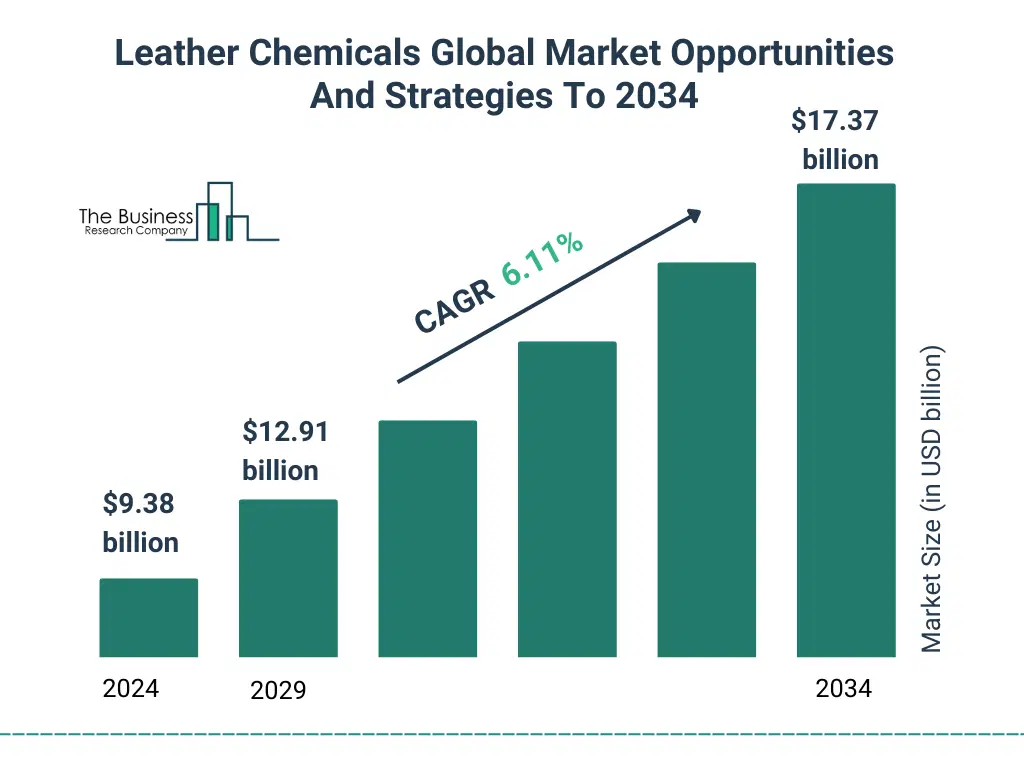
Leather Chemicals Market Size
The global man-made cellulosic fibers market reached a value of nearly $10,823.22 million The global leather chemicals market reached a value of nearly $9,382.89 million in 2024, having grown at a compound annual growth rate (CAGR) of 5.88% since 2019. The market is expected to grow from $9,382.89 million in 2024 to $12,907.81 million in 2029 at a rate of 6.59%. The market is then expected to grow at a CAGR of 6.11% from 2029 and reach $17,365.65 million in 2034. Growth in the historic period resulted from government initiatives supporting export-oriented tanneries, expansion in luxury automotive interiors, rising global leather exports and growth of the furniture and upholstery industry. Factors that negatively affected growth in the historic period were high water and energy consumption in leather manufacturing and rising popularity of leather alternatives. Going forward, growth in the footwear industry, expansion of leather manufacturing and processing facilities, growth in sports activities and growth in luxury and premium leather products will drive growth. Factors that could hinder the growth of the leather chemicals market in the future include stringent environmental regulations on leather processing, volatility in raw material prices for leather chemicals and impact of trade war and tariff.Leather Chemicals Market Drivers
The key drivers of the leather chemicals market include: Growth In The Footwear Industry Growth in the footwear industry is expected to be a key driver of the growth of the leather chemicals market in the forecast period. The footwear segment is the largest consumer of finished leather, requiring chemicals at every stage of processing, from tanning for durability, re-tanning for flexibility, dyeing for aesthetics, to finishing for abrasion and water resistance. As global demand for casual shoes, sportswear and premium footwear rises, manufacturers are investing in advanced chemical formulations to improve comfort, style and longevity. Moreover, global brands are increasingly outsourcing production to Asia and other emerging regions, where new tanneries and contract manufacturing facilities adopt chemical-intensive processes to meet export quality standards. This expansion not only increases the volume of chemicals consumed but also accelerates the shift toward eco-friendly and high-performance leather chemicals that align with sustainability commitments of international footwear brands. The growth in the footwear industry growth contribution during the forecast period in 2024 is 1.82%.Leather Chemicals Market Restraints
The key restraints on the leather chemicals market include: Stringent Environmental Regulations On Leather Processing Stringent environmental regulations on leather processing is restricting the growth of the leather chemicals market during the forecast period. It is often criticized for its heavy use of water, energy and chemicals like chromium salts. Governments and international agencies continue to tighten regulations around effluent, air emissions and hazardous waste disposal. These stricter norms increase operational costs for tanneries and chemical suppliers, as they must invest in costly wastewater treatment systems and switch to eco-friendly alternatives. While beneficial for sustainability, such regulations can slow down production capacity and limit smaller players from competing, creating barriers to growth in the leather chemicals market. Growth affected by stringent environmental regulations across regions during the forecast period in 2024 is -2.50%.Leather Chemicals Market Trends
Major trends shaping the leather chemicals market include: Rise Of Chrome-Free Tanning Alternatives Key players operating in the leather chemicals market are increasingly reducing reliance on chromium sulfate tanning, instead investing in chrome-free synthetic, aldehyde, or vegetable tanning agents to address environmental and regulatory pressures. These innovations are designed to ensure compliance with stricter effluent and discharge regulations, reduce environmental impact (toxicity, heavy metal pollution), while still maintaining the durability, heat stability and desirable physical properties of finished leather. For instance, in March 2024, Muirhead, a Scotland-based high-performance leather manufacturer, unveiled its FreeTan tanning solution with free FR technology, a fully chrome and heavy‐metal‐free system that replaces traditional chrome salts and glutaraldehyde, uses compostable technology and still meets demanding performance standards for aviation leather. Shift Toward Eco-Friendly And Sustainable Leathe Major companies in the leather chemicals market are focusing on developing eco-friendly and sustainable chemical solutions, including chrome-free tanning agents, bio-based fatliquors and water-based coatings, to address rising regulatory and consumer concerns. These innovations aim to reduce environmental impact, ensure compliance with global chemical safety standards and deliver high-quality leather with improved biodegradability and reduced toxic residues. For instance, in October 2023, Trumpler, a Germany-based global supplier for products and services to the leather industry, partnered with Archroma to introduce the DyTan process. This is an eco-friendly tanning method free from metal salts (like chromium) and reactive aldehydes, using bio-based fatliquors and re-tanning agents from hydrolyzed shavings. The innovation is meant to reduce energy, water usage, process time and CO₂ emissions up to 23%, while delivering high performance in terms of shavability, color depth, abrasion 0r migration resistance. Archroma is a Switzerland-based global diversified provider of specialty chemicals serving.Opportunities And Recommendations In The Leather Chemicals Market
Opportunities – The top opportunities in the leather chemicals market segmented by product will arise in the polyurethane resins segment, which will gain $1,375.69 million of global annual sales by 2029. The top opportunities in the leather chemicals market segmented by process will arise in the tanning and dyeing segment, which will gain $1,930.70 million of global annual sales by 2029. The top opportunities in the leather chemicals market segmented by application will arise in the footwear segment, which will gain $1,655.80 million of global annual sales by 2029. The leather chemicals market size will gain the most in China at $712.22 million. Recommendations- To take advantage of the opportunities, The Business Research Company recommends the leather chemicals companies to focus on expanding sustainable tanning solutions, focus on advancing eco-friendly leather chemicals, focus on expanding eco-friendly biocide solutions, focus on surfactants as the fastest-growing leather chemicals segment, focus on beamhouse chemicals for high-growth leather processing focus on beamhouse chemicals for high-growth leather processing, expand in emerging markets, focus on expanding and diversifying distribution channels, focus on competitive and value-based pricing strategies, focus on strengthening brand visibility and awareness, focus on targeted customer engagement and retention, focus on upholstery segment for high-growth leather applications.
Leather Chemicals Market Segmentation
The leather chemicals market is segmented by product, by process and by application.By Product –
The leather chemicals market is segmented by product into:
- a) Biocides
- b) Surfactants
- c) Chromium Sulfate
- d) Polyurethane Resins
- e) Sodium Bicarbonate
By Process –
The leather chemicals market is segmented by process into:
- a) Beamhouse
- b) Tanning And Dyeing
- c) Tanning And Dyeing
By Applications –
The leather chemicals market is segmented by applications into:
- a) Footwear
- b) Upholstery
- c) Leather Goods
- d) Garments
By Geography - The leather chemicals market is segmented by geography into:
- • China
- • India
- • Japan
- • Australia
- • Indonesia
- • South Korea
- • USA
- • Canada
- • Brazil
- • France
- • Germany
- • UK
- • Italy
- • Spain
- • Russia
-
o Asia Pacific
o Africa