

Leather Processing Chemical Market Report 2026
Global Outlook – By Product Type (Beamhouse Chemicals, Tanning Chemicals, Retanning Chemicals, Dyeing Chemicals, Fatliquors, Finishing Chemicals), By Form (Liquid, Powder, Paste), By Chemical Type (Chromium-Based Chemicals, Synthetic Tanning Agents, Vegetable Tanning Agents, Aldehyde Tanning Agents, Polymer-Based Chemicals, Enzymes), By Application (Footwear, Automotive Upholstery, Furniture Upholstery, Garments, Bags And Luggage, Sports Goods, Other Applications), By End User (Tanneries, Leather Goods Manufacturers, Footwear Manufacturers, Automotive Manufacturers, Furniture Manufacturers) – Market Size, Trends, Strategies, and Forecast to 2030
Leather Processing Chemical Market Overview
• Leather Processing Chemical market size has reached to $5.64 billion in 2025 • Expected to grow to $6.89 billion in 2030 at a compound annual growth rate (CAGR) of 4% • Growth Driver: Surge In Demand From The Footwear Industry Fueling The Growth Of The Market Due To Increasing Footwear Production • Market Trend: Innovations In Wet-End Leather Processing Chemicals Enhance Sustainability And Processing Efficiency • Asia-Pacific was the largest region and fastest growing region.What Is Covered Under Leather Processing Chemical Market?
Leather processing chemicals are specialized formulations used to transform raw hides and skins into finished leather through various processing stages. They facilitate essential operations such as preservation, soaking, liming, tanning, dyeing, fatliquoring, and finishing while enhancing the leather's durability, softness, appearance, and overall performance. Leather processing chemicals also improve production efficiency, ensure consistent product quality, and support compliance with environmental and regulatory standards. The main product types of leather processing chemicals include beamhouse chemicals, tanning chemicals, retanning chemicals, dyeing chemicals, fatliquors, and finishing chemicals. Beamhouse chemicals refer to chemicals used during the initial processing of hides and skins to remove unwanted materials, prepare the collagen structure, and make the hides suitable for tanning. These chemicals are available in liquid, powder, and paste forms, and include chromium-based chemicals, synthetic tanning agents, vegetable tanning agents, aldehyde tanning agents, polymer-based chemicals, and enzymes. The key applications include footwear, automotive upholstery, furniture upholstery, garments, bags and luggage, sports goods, and others, while the end users include tanneries, leather goods manufacturers, footwear manufacturers, automotive manufacturers, and furniture manufacturers.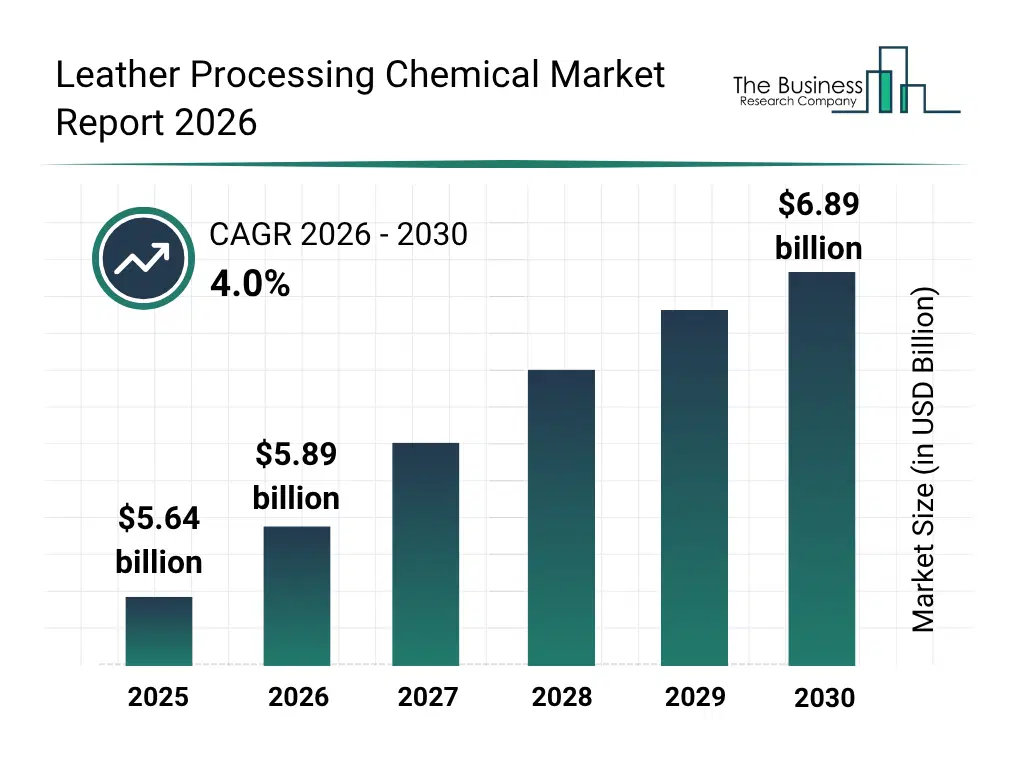
What Is The Leather Processing Chemical Market Size and Share 2026?
The leather processing chemical market size has grown steadily in recent years. It will grow from $5.64 billion in 2025 to $5.89 billion in 2026 at a compound annual growth rate (CAGR) of 4.4%. The growth in the historic period can be attributed to growth in global leather footwear production, expansion of automotive leather upholstery, increasing demand for furniture upholstery leather, rising production of leather garments and accessories, growth in commercial tanning activities.What Is The Leather Processing Chemical Market Growth Forecast?
The leather processing chemical market size is expected to see steady growth in the next few years. It will grow to $6.89 billion in 2030 at a compound annual growth rate (CAGR) of 4.0%. The growth in the forecast period can be attributed to increasing demand for chrome-free tanning chemicals, rising adoption of bio-based leather processing chemicals, growing demand for high-performance finishing formulations, expansion of premium leather goods manufacturing, increasing focus on water-efficient leather processing. Major trends in the forecast period include low-chromium and chrome-free tanning formulations, high-performance retanning agents for leather quality enhancement, advanced leather dyeing and color-matching chemicals, bio-based fatliquors and natural oil formulations, water-efficient and low-chemical leather processing methods.Tariff Impact On Leather Processing Chemical Market
Tariffs are impacting the leather processing chemicals market by increasing the cost of imported tanning agents, dyes, fatliquors, finishing chemicals, specialty additives, and chemical processing equipment required for leather production. This is increasing production costs and creating supply chain pressures, particularly in regions dependent on imported chemical inputs such as Asia-Pacific and Europe. Tanning chemicals, dyeing chemicals, and finishing chemicals are most affected due to their reliance on specialized chemical ingredients and international supply chains, while footwear, automotive upholstery, furniture, and leather goods manufacturers may also face higher material costs. However, tariffs are also encouraging local chemical production, regional supplier diversification, and increased investment in domestic manufacturing capabilities, creating long-term resilience in the market.
Global Leather Processing Chemical Market Segmentation
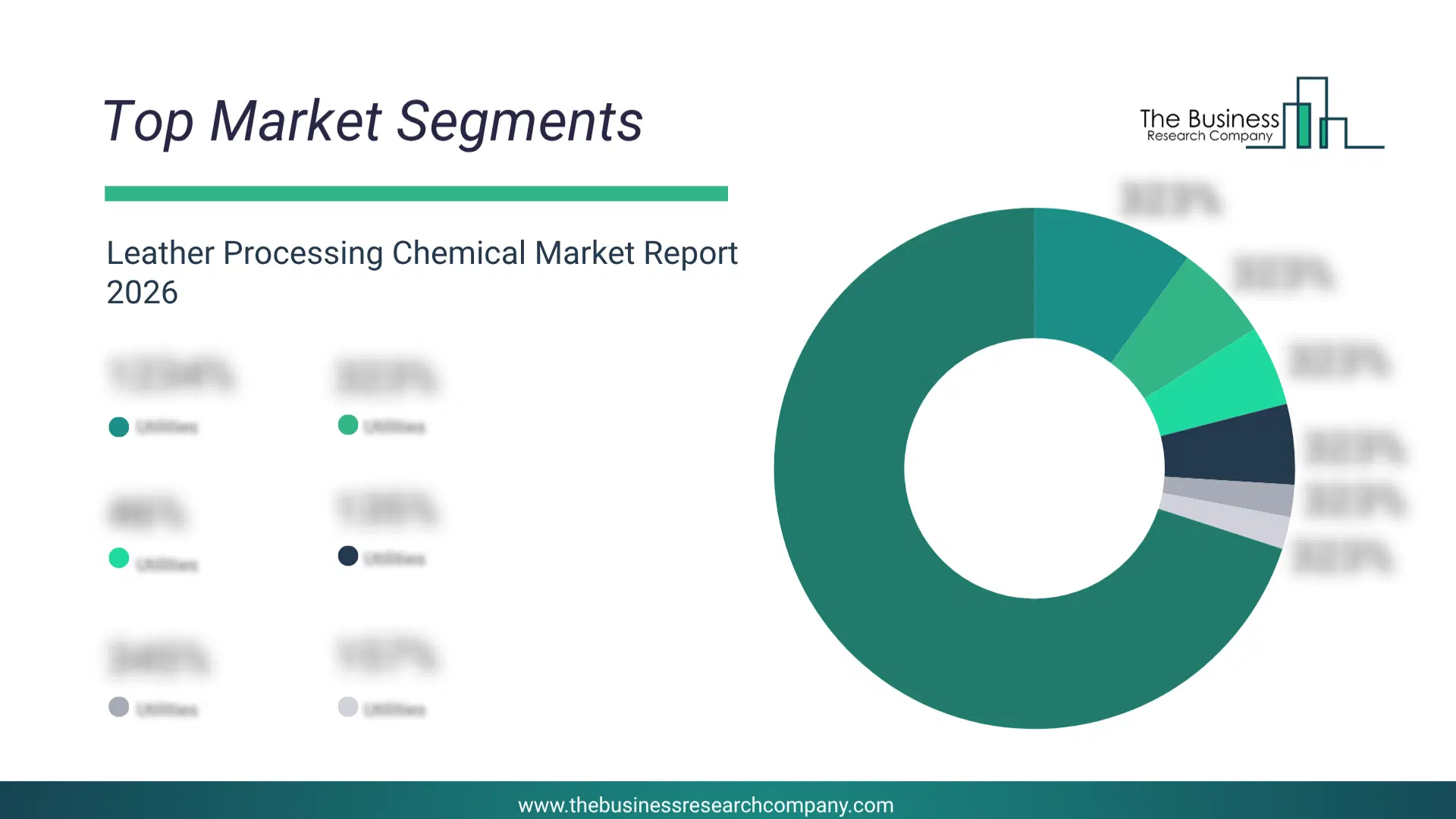
1) By Product Type: Beamhouse Chemicals, Tanning Chemicals, Retanning Chemicals, Dyeing Chemicals, Fatliquors, Finishing Chemicals 2) By Form: Liquid, Powder, Paste 3) By Chemical Type: Chromium-Based Chemicals, Synthetic Tanning Agents, Vegetable Tanning Agents, Aldehyde Tanning Agents, Polymer-Based Chemicals, Enzymes 4) By Application: Footwear, Automotive Upholstery, Furniture Upholstery, Garments, Bags And Luggage, Sports Goods, Other Applications 5) By End User: Tanneries, Leather Goods Manufacturers, Footwear Manufacturers, Automotive Manufacturers, Furniture Manufacturers Subsegments: 1) By Beamhouse Chemicals: Soaking Chemicals, Liming Chemicals, Deliming Chemicals, Bating Chemicals, Pickling Chemicals, Degreasing Chemicals 2) By Tanning Chemicals: Chromium Tanning Chemicals, Vegetable Tanning Chemicals, Aldehyde Tanning Chemicals, Synthetic Tanning Chemicals, Mineral Tanning Chemicals, Combination Tanning Chemicals 3) By Retanning Chemicals: Synthetic Retanning Agents, Vegetable Retanning Agents, Resin Retanning Agents, Polymer Retanning Agents, Protein Retanning Agents, Mineral Retanning Agents 4) By Dyeing Chemicals: Anionic Dyes, Cationic Dyes, Acid Dyes, Direct Dyes, Metal Complex Dyes, Natural Dyes 5) By Fatliquors: Sulfited Fatliquors, Sulfated Fatliquors, Synthetic Fatliquors, Natural Oil Fatliquors, Lecithin Fatliquors, Polymer Fatliquors 6) By Finishing Chemicals: Binders, Top Coats, Lacquers, Waxes, Protein Finishes, Polyurethane FinishesWhat Is The Driver Of The Leather Processing Chemical Market?
The growing demand from the footwear industry is expected to propel the growth of the leather processing chemicals market going forward. The footwear industry refers to the sector involved in the design, manufacturing, distribution, and retail of footwear products, including athletic, casual, formal, and safety shoes. The growing demand from the footwear industry is driven by increasing footwear production, which boosts the need for leather processing chemicals to produce durable, high-quality, and aesthetically appealing leather. The growing footwear industry supports the leather processing chemicals by increasing the demand for specialized chemicals used in tanning, dyeing, fatliquoring, finishing, and surface treatment processes to enhance the durability, flexibility, appearance, and performance of leather used in footwear manufacturing. For instance, in May 2025, according to the Australian Bureau of Statistics, an Australia-based government department, Australia's footwear and other personal accessory retailing increased by 0.6% ($5.6 million), contributing to a 0.3% ($8.1 million) rise in clothing, footwear, and personal accessory retailing. Therefore, the growing demand from the footwear industry is driving the growth of the leather processing chemicals industry.Key Players In The Global Leather Processing Chemical Market
Major companies operating in the leather processing chemical market are Pidilite Industries Limited, Zschimmer & Schwarz GmbH & Co. KG Chemiefabriken, Zhejiang Brother Enterprises Holding Co. Ltd., Stahl Holdings B.V., Balmer Lawrie & Co. Ltd., Pulcra Chemicals GmbH, Schill + Seilacher GmbH, TFL Ledertechnik GmbH, Roda Chimica S.p.A., Royal Smit & Zoon B.V., Indofil Industries Limited, Silvateam S.p.A., Syntans Ethox Chemicals Private Limited, Trumpler GmbH & Co. KG, Chromogenia Units S.A., Chemtan Company Inc., Tecnochimica S.p.A., TEXAPEL S.L., KLF Tecnokimica S.p.A.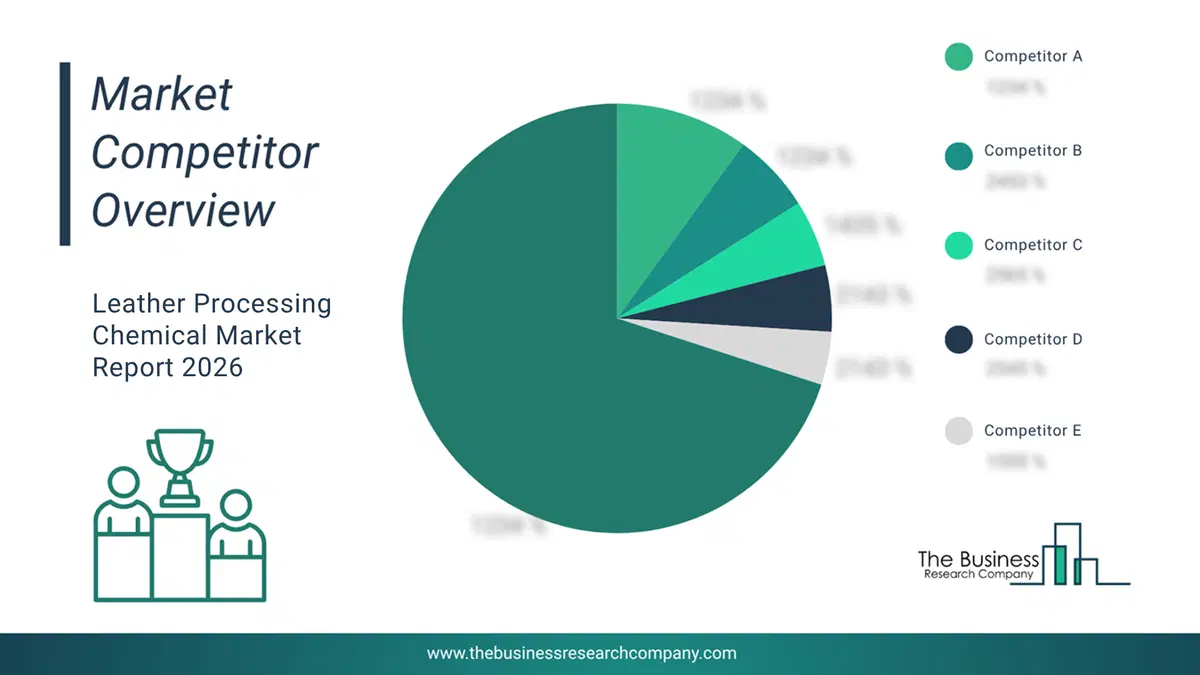
This chart is for illustrative purposes; the full report includes a detailed competitor analysis and comprehensive overview of the top 10 companies in the market.
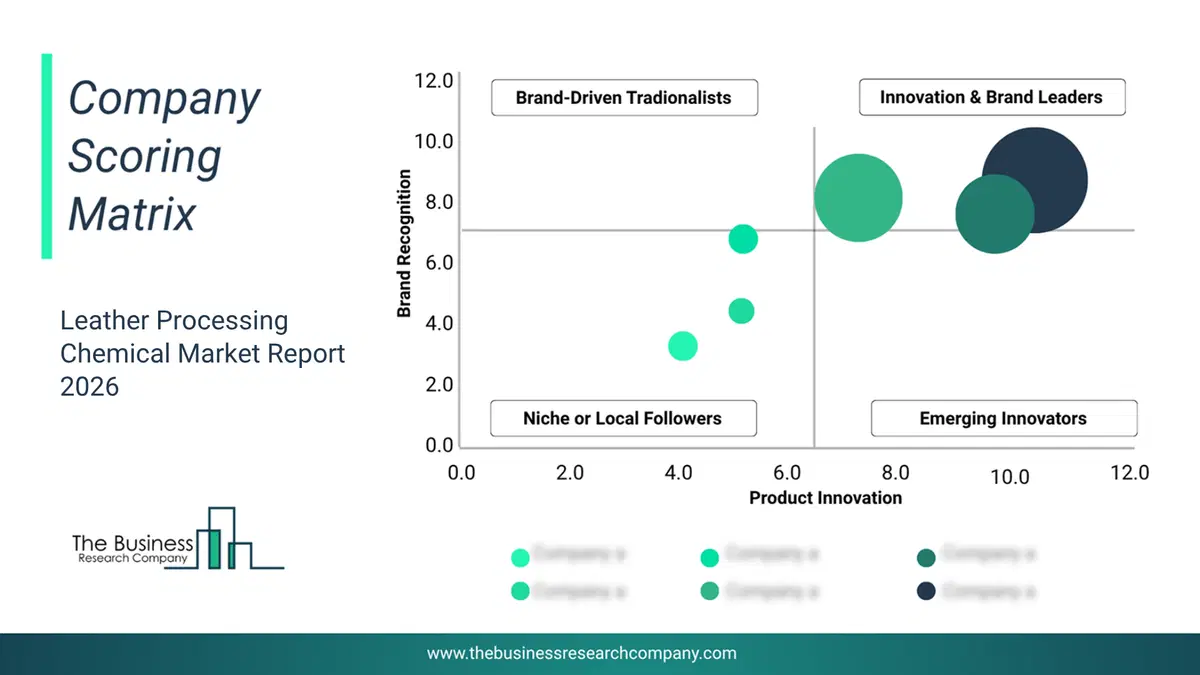
This chart maps companies by product innovation and brand strength, with bubble size indicating relative revenue, helping identify market leaders, challengers, and niche players. This is an illustrative chart; the full report provides a complete and accurate competitive analysis.
Global Leather Processing Chemical Market Trends and Insights
Major companies operating in the leather processing chemical market are focusing on developing advanced wet-end leather chemical facilities to improve sustainability, processing efficiency, and leather quality. A wet-end leather-chemicals facility is a manufacturing and research facility that develops and produces specialized chemicals used in tanning, retanning, dyeing, and fatliquoring to enhance leather quality, durability, and processing efficiency. For instance, in January 2026, Muno, an Italy-based leather processing chemicals company, launched as an independent business following the carve-out of Stahl’s wet-end leather chemicals division. The company introduced a comprehensive portfolio of wet-end leather processing chemicals supported by advanced research and development capabilities, global application laboratories, and production facilities in Italy and India. The new company aims to accelerate innovation, strengthen sustainability initiatives, and provide advanced chemical solutions for leather manufacturers across the footwear, automotive, upholstery, and leather goods industries.What Are Latest Mergers And Acquisitions In The Leather Processing Chemical Market?
In July 2025, Pritzker Private Capital, a US-based family-oriented investment firm, acquired Buckman for an undisclosed amount. Through this acquisition, Pritzker Private Capital aims to strengthen Buckman’s specialty chemicals business, enhance its global growth capabilities, and expand its portfolio of innovative solutions, including leather processing chemicals, for diverse industrial applications. Buckman is a US-based specialty chemicals company that develops and supplies chemical solutions for the leather industry.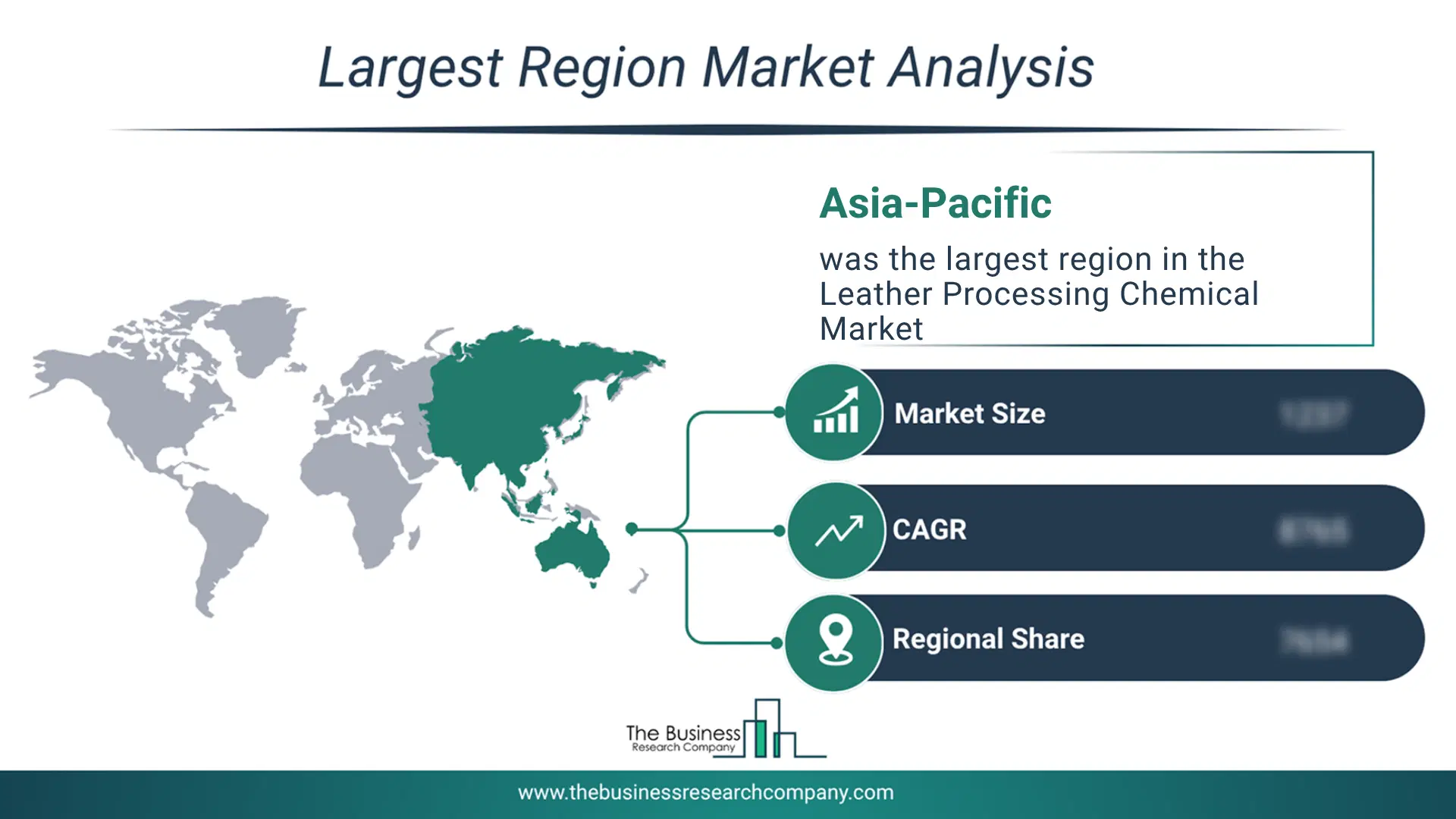
Regional Outlook
Asia-Pacific was the largest region in the leather processing chemical market in 2025. Asia-Pacific is expected to be the fastest-growing region in the forecast period. The regions covered in this market report are Asia-Pacific, South East Asia, Western Europe, Eastern Europe, North America, South America, Middle East, Africa. The countries covered in this market report are Australia, Brazil, China, France, Germany, India, Indonesia, Japan, Taiwan, Russia, South Korea, UK, USA, Canada, Italy, Spain.What Defines the Leather Processing Chemical Market?
The leather processing chemicals market consists of sales of fatliquor emulsion, silicone softener, polyurethane binder, and casein binder. Values in this market are ‘factory gate’ values, that is, the value of goods sold by the manufacturers or creators of the goods, whether to other entities (including downstream manufacturers, wholesalers, distributors, and retailers) or directly to end customers. The value of goods in this market includes related services sold by the creators of the goods.How is Market Value Defined and Measured?
The market value is defined as the revenues that enterprises gain from the sale of goods and/or services within the specified market and geography through sales, grants, or donations in terms of the currency (in USD unless otherwise specified). The revenues for a specified geography are consumption values that are revenues generated by organizations in the specified geography within the market, irrespective of where they are produced. It does not include revenues from resales along the supply chain, either further along the supply chain or as part of other products.
This chart presents market attractiveness based on a quantitative evaluation of growth, competition, strategic alignment, and risk, offering a clear view of opportunity areas for decision-making. This chart is for illustrative purposes; the full report contains the complete analysis.

This chart highlights the Total Addressable Market (TAM) by estimating the maximum revenue opportunity using an assumption-driven approach, supporting strategic planning and opportunity sizing across markets. The chart is illustrative; the full report provides a more comprehensive analysis.
What Key Data and Analysis Are Included in the Leather Processing Chemical Market Report 2026?
The leather processing chemical market research report is one of a series of new reports from The Business Research Company that provides market statistics, including industry global market size, regional shares, competitors with the market share, detailed market segments, market trends and opportunities, and any further data you may need to thrive in the leather processing chemical industry. The market research report delivers a complete perspective of everything you need, with an in-depth analysis of the current and future state of the industry.Leather Processing Chemical Market Report Forecast Analysis
| Report Attribute | Details |
|---|---|
| Market Size Value In 2026 | $5.89 billion |
| Revenue Forecast In 2030 | $6.89 billion |
| Growth Rate | CAGR of 4.0% from 2026 to 2030 |
| Base Year For Estimation | 2025 |
| Actual Estimates/Historical Data | 2020-2025 |
| Forecast Period | 2026 - 2030 |
| Market Representation | Revenue in USD Billion and CAGR from 2026 to 2030 |
| Segments Covered | Product Type, Form, Chemical Type, Application, End User |
| Regional Scope | Asia-Pacific, Western Europe, Eastern Europe, North America, South America, Middle East, Africa |
| Country Scope | The countries covered in the report are Australia, Brazil, China, France, Germany, India, Indonesia, Japan, Taiwan, Russia, South Korea, UK, USA, Canada, Italy, Spain. |
| Key Companies Profiled | Pidilite Industries Limited, Zschimmer & Schwarz GmbH & Co. KG Chemiefabriken, Zhejiang Brother Enterprises Holding Co. Ltd., Stahl Holdings B.V., Balmer Lawrie & Co. Ltd., Pulcra Chemicals GmbH, Schill + Seilacher GmbH, TFL Ledertechnik GmbH, Roda Chimica S.p.A., Royal Smit & Zoon B.V., Indofil Industries Limited, Silvateam S.p.A., Syntans Ethox Chemicals Private Limited, Trumpler GmbH & Co. KG, Chromogenia Units S.A., Chemtan Company Inc., Tecnochimica S.p.A., TEXAPEL S.L., KLF Tecnokimica S.p.A. |
| Customization Scope | Request for Customization |
| Pricing And Purchase Options | Explore Purchase Options |