
Legacy Application Modernization Market Report 2026
Global Outlook – By Service Type (Application Re-Platforming, Application Re-Hosting (Lift And Shift), Application Re-Architecting, Application Re-Engineering, Other Service Type), By Technology (Artificial Intelligence (AI) And Machine Learning (ML), Robotic Process Automation (RPA), Cloud Computing, Internet Of Things (IoT)), By Organization Size (Small And Medium-Sized Enterprises (SMEs), Large Enterprises), By Application Type (Cloud Applications, On-Premise Applications, Mobile Applications, Web Applications), By End-User Industry (Banking, Financial Services, And Insurance (BFSI), Healthcare And Life Sciences, Information Technology (IT) And Telecom, Retail And E-Commerce, Other End-User Industry) – Market Size, Trends, Strategies, and Forecast to 2030
Legacy Application Modernization Market Overview
• Legacy Application Modernization market size has reached to $19.16 billion in 2025 • Expected to grow to $37.33 billion in 2030 at a compound annual growth rate (CAGR) of 14.2% • Growth Driver: The Increasing Government Digital Transformation Initiatives Is Fueling The Growth Of The Market Due To Policy Mandates To Modernize Legacy Systems And Deliver Secure Online Public Services • Market Trend: Artificial Intelligence Powered Comprehensive Modernization Portfolios Reduce Technical Debt and Accelerate Innovation • North America was the largest region in 2025 and Asia-Pacific is the fastest growing region.What Is Covered Under Legacy Application Modernization Market?
Legacy application modernization is the process of updating or transforming older software systems to align with current technologies, architectures, and practices. It enhances performance, scalability, and maintainability while preserving core business logic and functionality. This approach helps organizations reduce technical debt, lower operational risks, and improve long-term adaptability. The main types of legacy application modernization are application re-platforming, application re-hosting (lift and shift), application re-architecting, application re-engineering and other supporting service types. Application re-platforming refers to moving an existing application to a new runtime or cloud platform with minimal, targeted changes so it can use modern services, scale better, and run more efficiently. The modernization uses technologies such as artificial intelligence (AI) and machine learning (ML), robotic process automation (RPA), cloud computing, big data and analytics, internet of things (IoT) and blockchain also with the organization size that include small and medium-sized enterprises (SMEs) and large enterprises. These are used in various applications including cloud applications, on-premise applications, mobile applications and web applications and also used by end users such as banking, financial services, and insurance (BFSI), healthcare and life sciences, information technology (IT) and telecom and retail and e-commerce and others.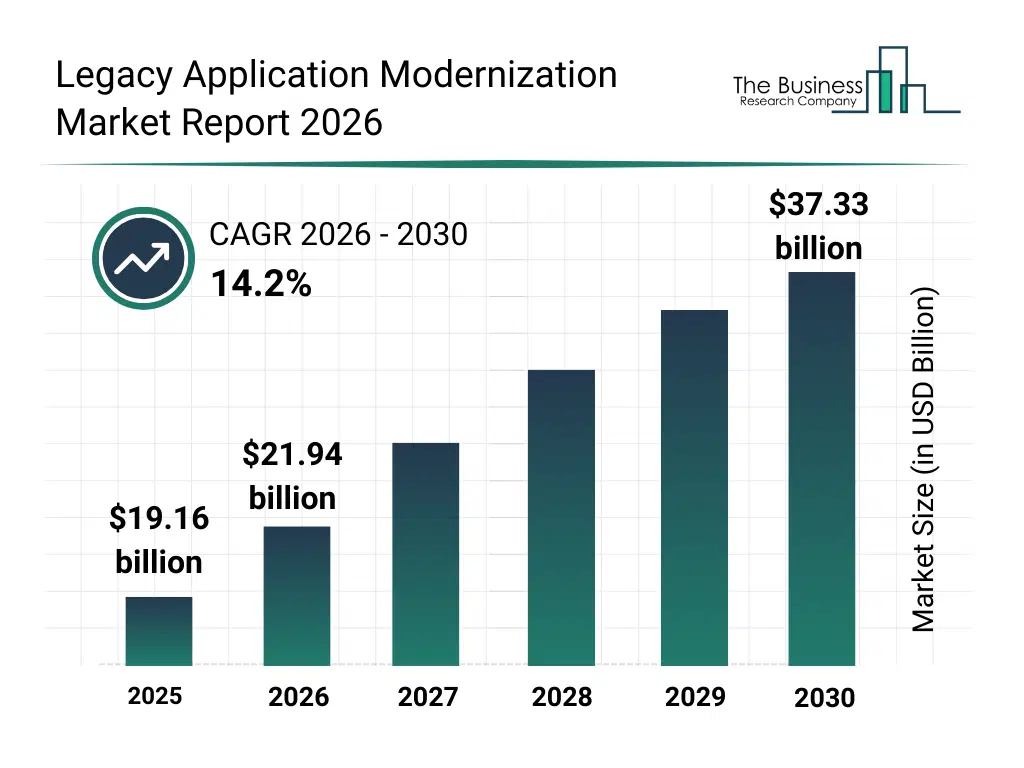
What Is The Legacy Application Modernization Market Size and Share 2026?
The legacy application modernization market size has grown rapidly in recent years. It will grow from $19.16 billion in 2025 to $21.94 billion in 2026 at a compound annual growth rate (CAGR) of 14.5%. The growth in the historic period can be attributed to aging application portfolios and technical debt, data center exit initiatives, demand for faster release cycles, shortage of legacy skillsets, increasing security and compliance requirements.What Is The Legacy Application Modernization Market Growth Forecast?
The legacy application modernization market size is expected to see rapid growth in the next few years. It will grow to $37.33 billion in 2030 at a compound annual growth rate (CAGR) of 14.2%. The growth in the forecast period can be attributed to migration to cloud-native architectures, adoption of event-driven integration, increased use of automation for code conversion, modernization driven by AI-assisted development, growth of hybrid integration and platform engineering. Major trends in the forecast period include microservices refactoring programs, containerization and kubernetes migration, api-first integration modernization, low-code assisted modernization, devsecops and automated testing adoption.
Global Legacy Application Modernization Market Segmentation
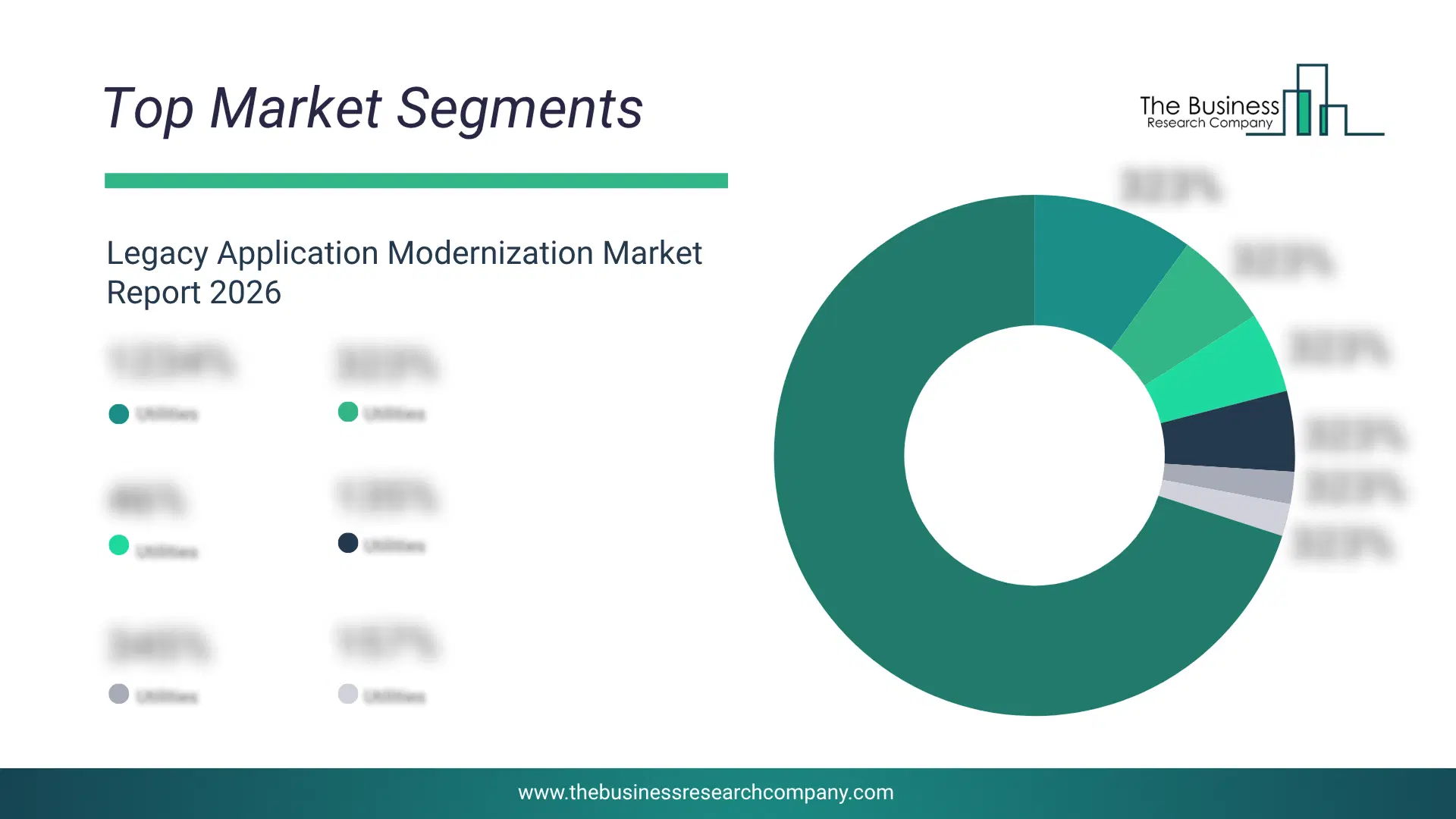
1) By Service Type: Application Re-Platforming, Application Re-Hosting (Lift And Shift), Application Re-Architecting, Application Re-Engineering, Other Service Type 2) By Technology: Artificial Intelligence (AI) And Machine Learning (ML), Robotic Process Automation (RPA), Cloud Computing, Internet Of Things (IoT) 3) By Organization Size: Small And Medium-Sized Enterprises (SMEs), Large Enterprises 4) By Application Type: Cloud Applications, On-Premise Applications, Mobile Applications, Web Applications 5) By End-User Industry: Banking, Financial Services, And Insurance (BFSI), Healthcare And Life Sciences, Information Technology (IT) And Telecom, Retail And E-Commerce, Other End-User Industry Subsegments: 1) By Application Re-Platforming: Database Platform Migration, Containerization And Orchestration, Runtime And Middleware Upgrade, Managed Service Adoption, Operating System Migration 2) By Application Re-Hosting (Lift And Shift): Virtual Machine Migration, Storage And Backup Migration, Network And Security Configuration Migration, Mainframe To Cloud Rehosting, Data Center Exit Programs 3) By Application Re-Architecting: Monolith To Microservices Decomposition, Event Driven Architecture Adoption, Domain Driven Design Refactoring, Serverless Architecture Design, Application Programming Interface First Design 4) By Application Re-Engineering: Code Refactoring And Optimization, User Interface And User Experience Modernization, Database Schema Redesign, Test Automation And Quality Improvement, Performance And Security Hardening 5) By Other Service Type: Application Portfolio Assessment, Legacy System Discovery And Mapping, Application Programming Interface Enablement And Integration, Development And Operations Enablement, Managed Services And Operations, Training And Change ManagementWhat Is The Driver Of The Legacy Application Modernization Market?
The increase in government digital transformation initiatives is expected to propel the growth of the legacy application modernization market going forward. Government digital transformation initiatives are coordinated public-sector programmes to digitize services and operations by upgrading legacy systems, adopting cloud platforms, standardizing identity and payments, and improving user experience and security. The rise in government digital transformation initiatives is due to policy mandates to consolidate and modernize legacy systems to deliver secure, scalable online public services. Legacy application modernization equips agencies to rebuild or replatform outdated systems, expose data and functions through application programming interfaces, and connect them to shared identity, payments, and cloud platforms, converting policy directives into live, resilient digital public services delivered faster. For instance, in August 2023, according to GOV.UK, a UK-based federal government agency, GOV.UK Pay onboarded 163 services in the previous 12 months and processed 23 million payments in the last financial year-clear evidence of accelerating adoption of government digital platforms. Therefore, the increasing government digital transformation initiatives are driving the growth of the legacy application modernization industry.Key Players In The Global Legacy Application Modernization Market
Major companies operating in the legacy application modernization market are Microsoft Corporation, Deloitte Consulting LLP, Accenture plc, International Business Machines Corporation, Tata Consultancy Services Limited, Fujitsu Limited, Capgemini SE, Cognizant Technology Solutions Corporation, Infosys Limited, HCL Technologies Limited, DXC Technology Company, Atos SE, Wipro Limited, Tech Mahindra Limited, Bell Integrator LLC, Blu Age SAS, EvolveWare Inc., The Software Revolution Inc., Semantic Designs Inc., Expersolve Inc.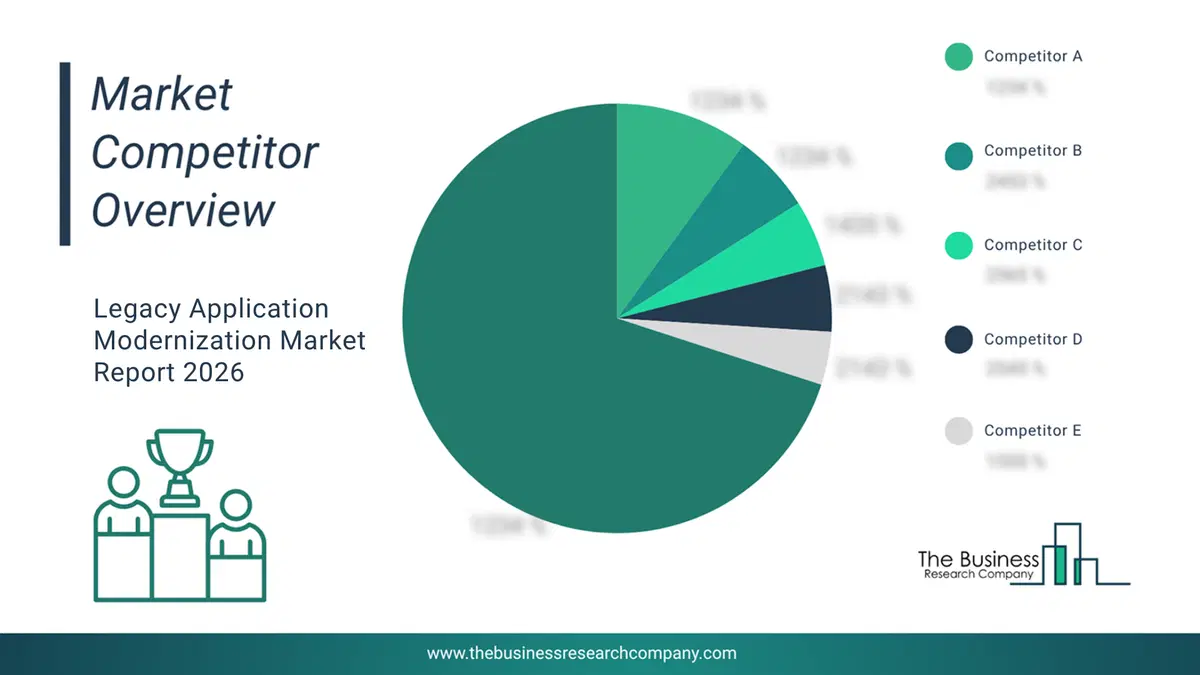
This chart is for illustrative purposes; the full report includes a detailed competitor analysis and comprehensive overview of the top 10 companies in the market.
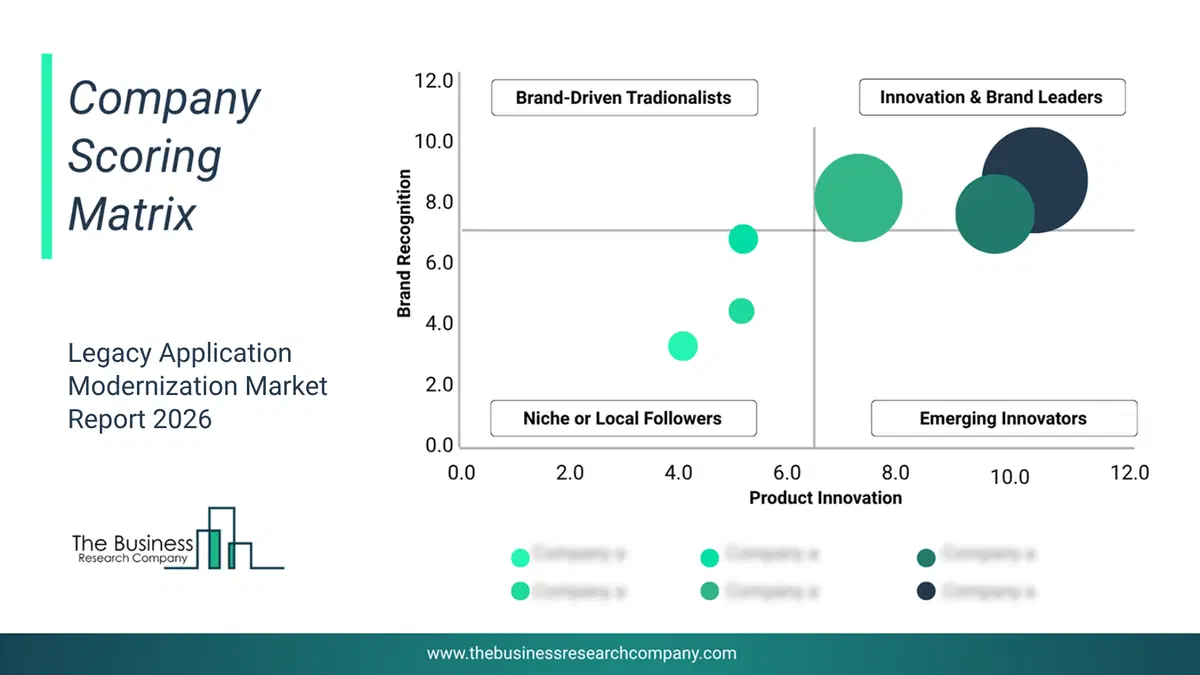
This chart maps companies by product innovation and brand strength, with bubble size indicating relative revenue, helping identify market leaders, challengers, and niche players. This is an illustrative chart; the full report provides a complete and accurate competitive analysis.
Global Legacy Application Modernization Market Trends and Insights
Major companies operating in the legal application modernization market are focusing on innovation, such as comprehensive modernization portfolios that provide end-to-end solutions for updating legacy systems, integrating advanced technologies, enhancing compliance, and improving efficiency in legal processes. Comprehensive modernization portfolios refer to a complete set of tools and services designed to upgrade, transform, and optimise legacy applications and systems. For instance, in September 2025, MongoDB, Inc., a US-based software company that develops and provides a modern, general-purpose database platform, launched the AI-Powered Application Modernization Platform to Reduce Technical Debt and Speed Innovation. The platform combines AI-driven tools, a proven delivery framework, and expert engineers to accelerate code transformation and overall modernization projects. Legacy applications often hinder innovation and pose security and compliance risks due to rigid data foundations and outdated architectures. MongoDB AMP addresses these challenges by enabling full-stack modernization, reducing technical debt, improving speed-to-market, and supporting innovation while lowering costs.What Are Latest Mergers And Acquisitions In The Legacy Application Modernization Market?
In January 2023, OpenText Corporation, a Canada-based information management software company, acquired Micro Focus International plc for an undisclosed amount. With this acquisition, OpenText sought to expand its legacy application modernization capabilities by adding long-standing strengths in COBOL tooling, host connectivity, testing, and mainframe modernization to help customers move from aging platforms to more secure, scalable, and cloud-ready architectures at greater speed and lower risk. Micro Focus International plc is a UK-based enterprise software company.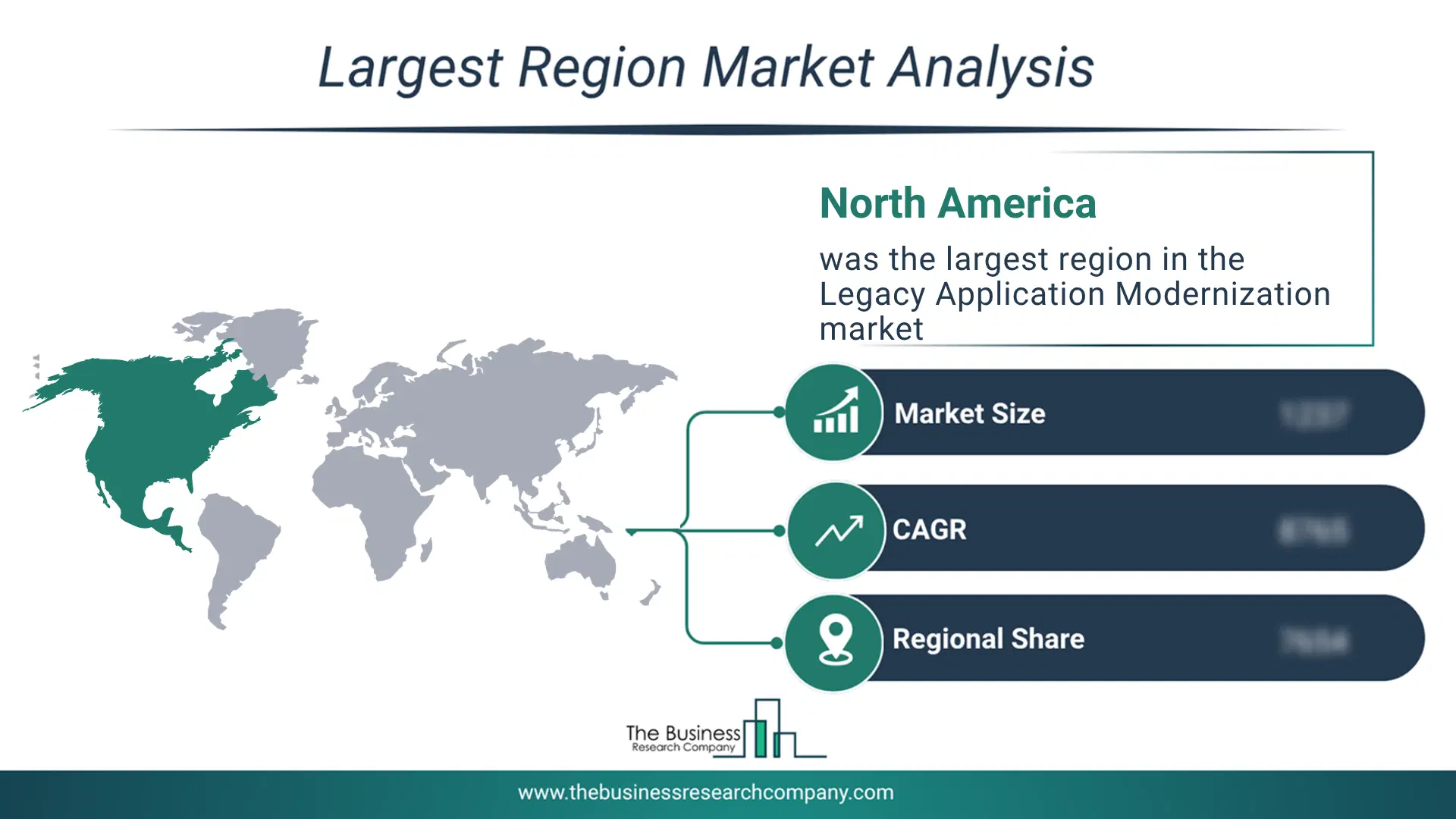
Regional Insights
North America was the largest region in the legal application modernization market in 2025. Asia-Pacific is expected to be the fastest-growing region in the forecast period. The regions covered in this market report are Asia-Pacific, South East Asia, Western Europe, Eastern Europe, North America, South America, Middle East, Africa. The countries covered in this market report are Australia, Brazil, China, France, Germany, India, Indonesia, Japan, Taiwan, Russia, South Korea, UK, USA, Canada, Italy, Spain.What Defines the Legacy Application Modernization Market?
The legacy application modernization market includes revenues earned by entities by providing services such as application portfolio assessment and road-mapping, rehosting (lift-and-shift), replatforming, refactoring or recoding, rearchitecting to microservices and containers, application programming interface enablement and systems integration. The market value includes the value of related goods sold by the service provider or included within the service offering. Only goods and services traded between entities or sold to end consumers are included.How is Market Value Defined and Measured?
The market value is defined as the revenues that enterprises gain from the sale of goods and/or services within the specified market and geography through sales, grants, or donations in terms of the currency (in USD unless otherwise specified). The revenues for a specified geography are consumption values that are revenues generated by organizations in the specified geography within the market, irrespective of where they are produced. It does not include revenues from resales along the supply chain, either further along the supply chain or as part of other products.
This chart presents market attractiveness based on a quantitative evaluation of growth, competition, strategic alignment, and risk, offering a clear view of opportunity areas for decision-making. This chart is for illustrative purposes; the full report contains the complete analysis.

This chart highlights the Total Addressable Market (TAM) by estimating the maximum revenue opportunity using an assumption-driven approach, supporting strategic planning and opportunity sizing across markets. The chart is illustrative; the full report provides a more comprehensive analysis.
What Key Data and Analysis Are Included in the Legacy Application Modernization Market Report 2026?
The legacy application modernization market research report is one of a series of new reports from The Business Research Company that provides market statistics, including industry global market size, regional shares, competitors with the market share, detailed market segments, market trends and opportunities, and any further data you may need to thrive in the legacy application modernization industry. The market research report delivers a complete perspective of everything you need, with an in-depth analysis of the current and future state of the industry.Legacy Application Modernization Market Report Forecast Analysis
| Report Attribute | Details |
|---|---|
| Market Size Value In 2026 | $21.94 billion |
| Revenue Forecast In 2030 | $37.33 billion |
| Growth Rate | CAGR of 14.2% from 2026 to 2030 |
| Base Year For Estimation | 2025 |
| Actual Estimates/Historical Data | 2020-2025 |
| Forecast Period | 2026 - 2030 |
| Market Representation | Revenue in USD Billion and CAGR from 2026 to 2030 |
| Segments Covered | Service Type, Technology, Organization Size, Application Type, End-User Industry |
| Regional Scope | Asia-Pacific, Western Europe, Eastern Europe, North America, South America, Middle East, Africa |
| Country Scope | The Countries Covered In This Market Report Are Australia, Brazil, China, France, Germany, India, Indonesia, Japan, Taiwan, Russia, South Korea, Uk, Usa, Canada, Italy, Spain. |
| Key Companies Profiled | Microsoft Corporation, Deloitte Consulting LLP, Accenture plc, International Business Machines Corporation, Tata Consultancy Services Limited, Fujitsu Limited, Capgemini SE, Cognizant Technology Solutions Corporation, Infosys Limited, HCL Technologies Limited, DXC Technology Company, Atos SE, Wipro Limited, Tech Mahindra Limited, Bell Integrator LLC, Blu Age SAS, EvolveWare Inc., The Software Revolution Inc., Semantic Designs Inc., Expersolve Inc. |
| Customization Scope | Request for Customization |
| Pricing And Purchase Options | Explore Purchase Options |