
Legacy Software Modernization Market Report 2026
Global Outlook – By Service Type (Application Modernization, Cloud Migration, Code Refactoring, Re-Platforming, Database Modernization, User Interface Modernization, Other Service Types), By Deployment Mode (On-Premises, Cloud-Based, Hybrid), By Organization Size (Large Enterprises, Small And Medium Enterprises), By Industry Vertical (Banking, Financial Services, And Insurance (BFSI), Healthcare, Government, Manufacturing, Retail, Telecommunications, Transportation And Logistics, Other Industry Verticals) – Market Size, Trends, Strategies, and Forecast to 2030
Legacy Software Modernization Market Overview
• Legacy Software Modernization market size has reached to $15.14 billion in 2025 • Expected to grow to $31.59 billion in 2030 at a compound annual growth rate (CAGR) of 15.8% • Growth Driver: Surge In Cloud Computing Adoption Fueling Market Growth Due To Scalability And Cost Efficiency • Market Trend: AI-Driven Modernization Apps Accelerating Legacy Software Transformation • North America was the largest region in 2025 and Asia-Pacific is the fastest growing region.What Is Covered Under Legacy Software Modernization Market?
Legacy software modernization service refers to the process of updating or transforming outdated software systems to meet current technological standards and business needs. It involves reengineering, replatforming, or migrating existing applications to improve performance, scalability, and security. This service helps organizations reduce maintenance costs, enhance efficiency, and ensure compatibility with modern digital infrastructures. The main types of legacy software modernization services are application modernization, cloud migration, code refactoring, re-platforming, database modernization, user interface modernization, and other related service types. Application modernization refers to the structured reengineering of legacy applications to enhance scalability, performance, security, and maintainability by updating architectures, decoupling monoliths, adopting modular patterns, introducing automated testing, and aligning functionality with current business requirements while minimizing disruption. The deployment modes include on-premises, cloud-based, and hybrid models, serving large enterprises and small and medium enterprises across banking, financial services and insurance, healthcare, government, manufacturing, retail, telecommunications, transportation and logistics, and other industry verticals.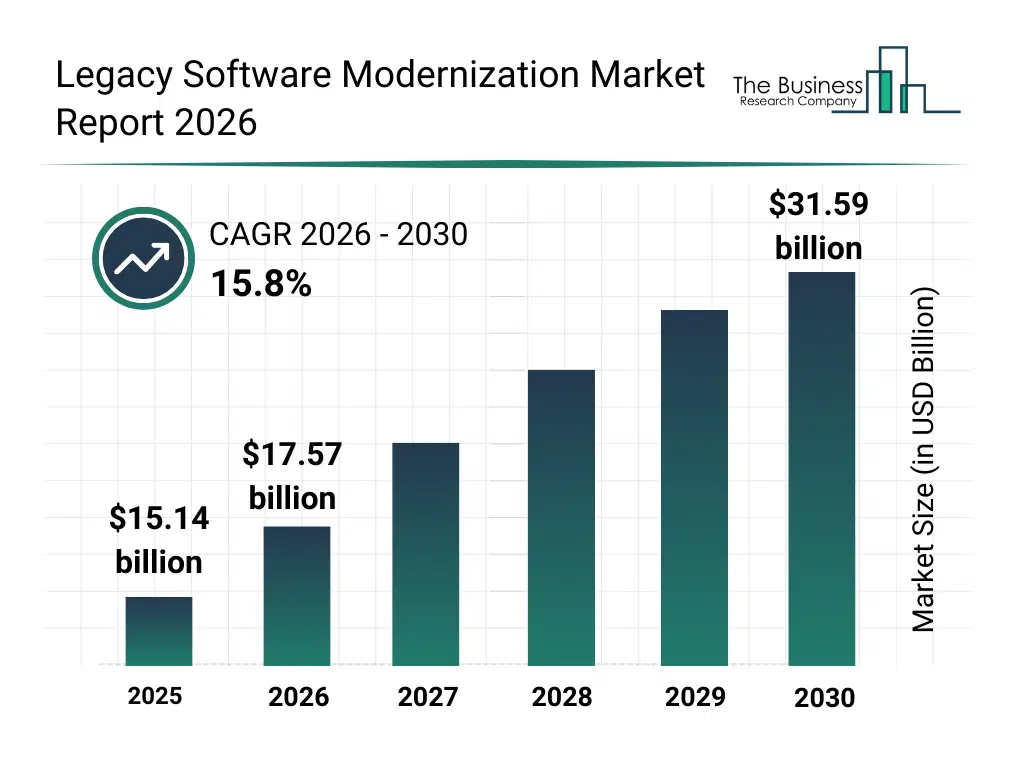
What Is The Legacy Software Modernization Market Size and Share 2026?
The legacy software modernization market size has grown rapidly in recent years. It will grow from $15.14 billion in 2025 to $17.57 billion in 2026 at a compound annual growth rate (CAGR) of 16.1%. The growth in the historic period can be attributed to rising maintenance costs of legacy systems, increasing cybersecurity threats to outdated platforms, demand for better scalability and uptime, shift toward hybrid and cloud deployments, need for modernization to support new digital channels.What Is The Legacy Software Modernization Market Growth Forecast?
The legacy software modernization market size is expected to see rapid growth in the next few years. It will grow to $31.59 billion in 2030 at a compound annual growth rate (CAGR) of 15.8%. The growth in the forecast period can be attributed to adoption of cloud-based modernization services, increased use of container platforms, modernization driven by compliance audits, AI-assisted refactoring and testing, growth of managed modernization and support services. Major trends in the forecast period include database and middleware modernization, user interface and experience redesign, hybrid modernization roadmaps, security hardening for legacy apps, modernization with progressive refactoring.
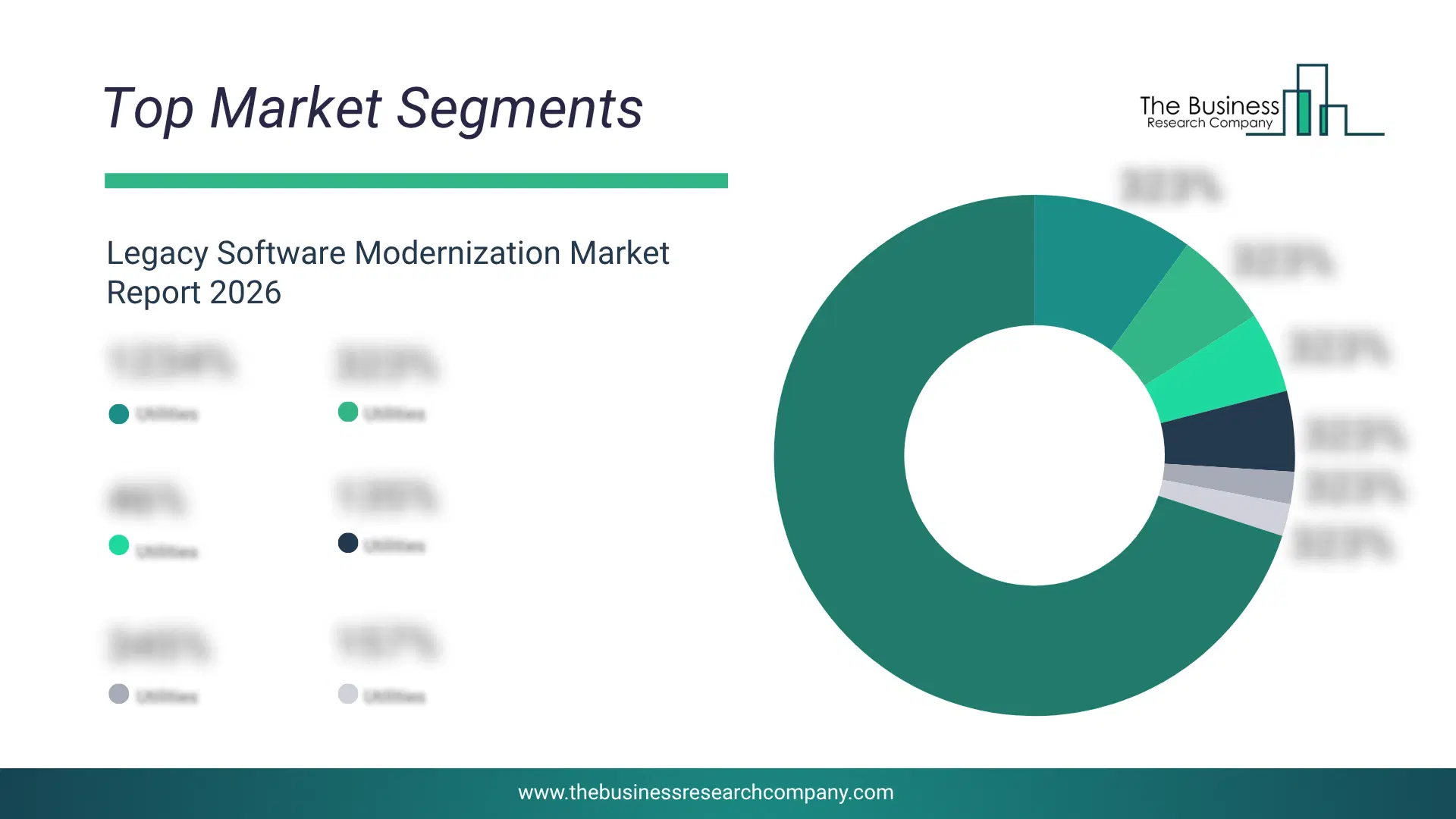
Global Legacy Software Modernization Market Segmentation
1) By Service Type: Application Modernization, Cloud Migration, Code Refactoring, Re-Platforming, Database Modernization, User Interface Modernization, Other Service Types 2) By Deployment Mode: On-Premises, Cloud-Based, Hybrid 3) By Organization Size: Large Enterprises, Small And Medium Enterprises 4) By Industry Vertical: Banking, Financial Services, And Insurance (BFSI), Healthcare, Government, Manufacturing, Retail, Telecommunications, Transportation And Logistics, Other Industry Verticals Subsegments: 1) By Application Modernization: Application Reengineering, Microservices Transformation, Containerization, Legacy Code Replacement, Application Portfolio Rationalization 2) By Cloud Migration: Public Cloud Migration, Private Cloud Migration, Hybrid Cloud Migration, Infrastructure As A Service Migration, Platform As A Service Migration, Software As A Service Migration 3) By Code Refactoring: Language Modernization, Code Optimization, Monolith To Microservices Refactoring, Dependency Modernization, Dead Code Elimination, Test Coverage Improvement 4) By Re-Platforming: Rehosting Lift And Shift, Platform Reengineering, Middleware Modernization, Operating System Upgrade, Runtime Environment Modernization 5) By Database Modernization: Database Migration, Schema Modernization, Database Consolidation, Data Warehouse Modernization, Mainframe Data Offloading 6) By User Interface Modernization: Responsive Web Redesign, Accessibility Remediation, Design System Implementation, Front End Framework Upgrade, Progressive Web Application Enablement, Mobile First Modernization 7) By Other Service Types: Application Programming Interface Modernization, Development And Operations Transformation, Quality Assurance And Testing Modernization, Security Hardening And Compliance Modernization, Legacy System Assessment And Roadmapping, Training And Change Management, Support And Maintenance Modernization, Project Management And GovernanceWhat Is The Driver Of The Legacy Software Modernization Market?
The growing adoption of cloud-based platforms is expected to propel the growth of the legacy software modernization service market going forward. Cloud-based platforms refer to online infrastructures and services that deliver computing resources, storage, and applications over the internet instead of on local servers or devices. The adoption of cloud-based platforms is growing due to their scalability, enabling flexible resource management and cost efficiency. Legacy software modernization services support cloud adoption by transforming outdated systems into cloud-ready, scalable architectures that seamlessly integrate with modern cloud platforms to enhance performance, flexibility, and business agility. For instance, in January 2025, according to AAG IT, a UK-based IT services company, an estimated 63% of small and medium-sized business (SMB) workloads and 62% of SMB data were expected to be hosted in public clouds by 2023, up from 57% of workloads and 56% of data in 2022. Therefore, the growing adoption of cloud-based platforms is driving the growth of the legacy software modernization service market.Key Players In The Global Legacy Software Modernization Market
Major companies operating in the legacy software modernization market are Accenture plc, HCL Technologies Limited, ValueLabs LLP, Damco Solutions, ScienceSoft USA Corporation, Rishabh Software Pvt. Ltd., OpenXcell Technolabs Pvt. Ltd., ITRex Group, Merixstudio Sp. z o.o., instinctools GmbH, Langate Inc., Integrio Systems Inc., Euristiq Sp. z o.o., Syberry Corporation, Nexus Software Systems LLC, Mangosoft Ltd., Oxagile LLC, DICEUS LLC, Praxent Inc., 8base Inc.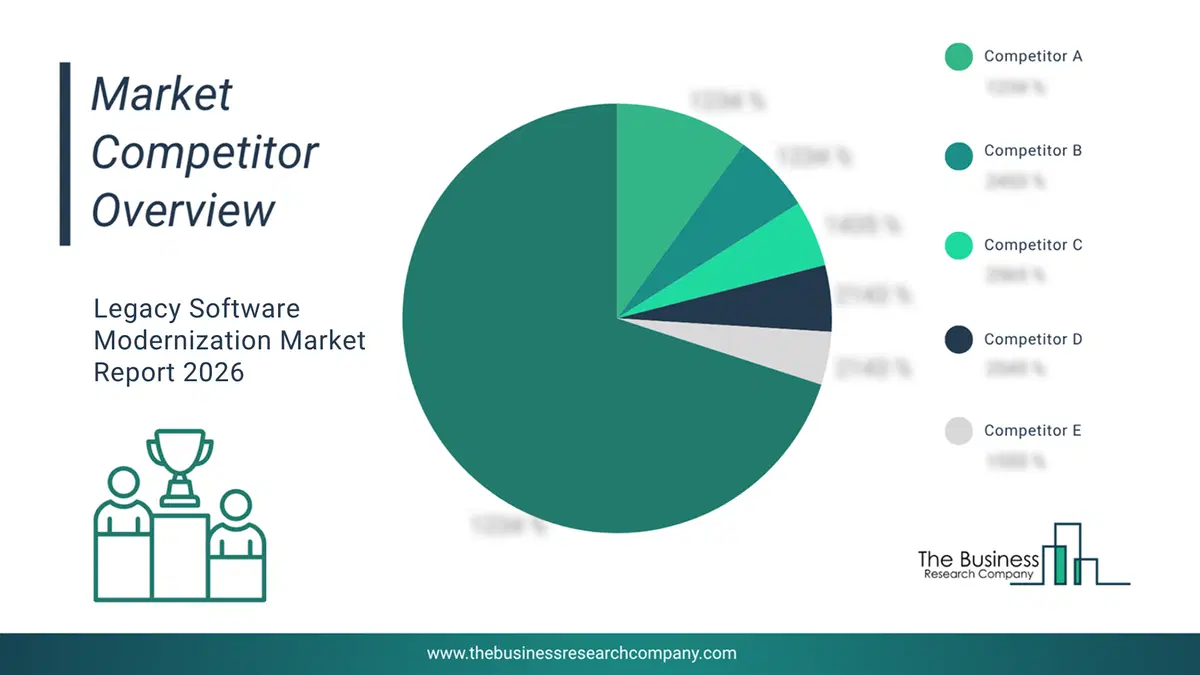
This chart is for illustrative purposes; the full report includes a detailed competitor analysis and comprehensive overview of the top 10 companies in the market.
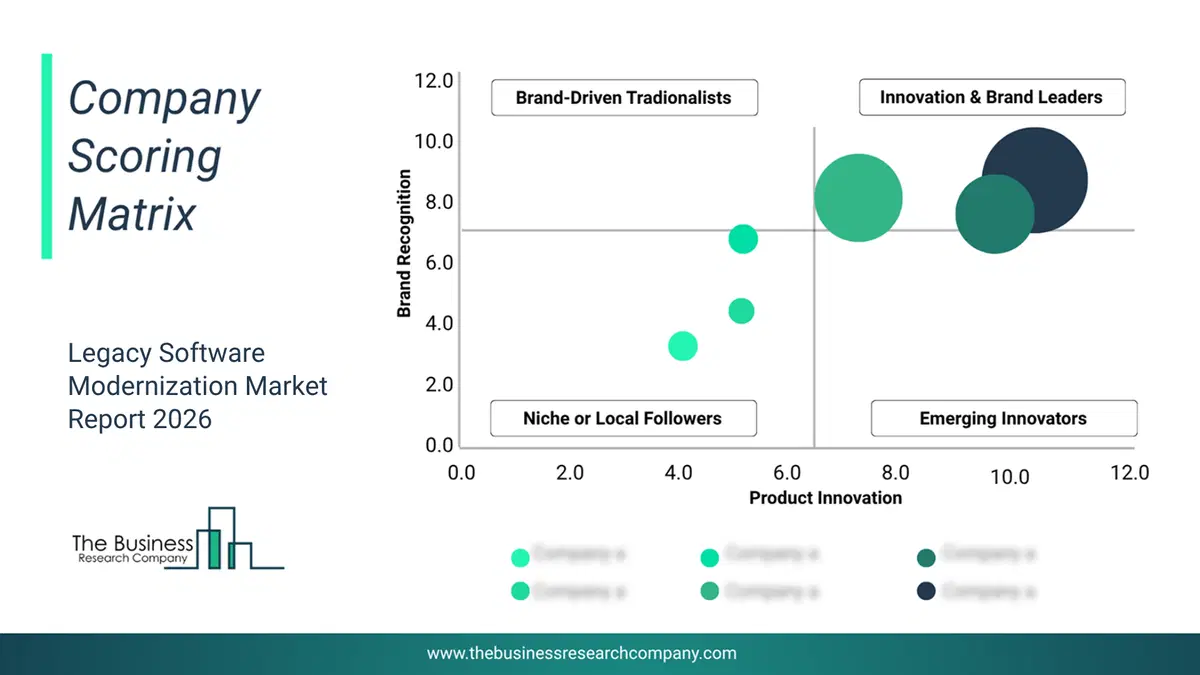
This chart maps companies by product innovation and brand strength, with bubble size indicating relative revenue, helping identify market leaders, challengers, and niche players. This is an illustrative chart; the full report provides a complete and accurate competitive analysis.
Global Legacy Software Modernization Market Trends and Insights
Major companies operating in the legacy software modernization services market are focusing on developing AI-driven modernization apps to enable seamless migration of legacy systems to cloud-native architectures, improve operational efficiency, enhance scalability, and support digital transformation initiatives. AI-driven modernization apps are software solutions that leverage artificial intelligence to analyze, refactor, and transform legacy systems, enabling faster migration to modern platforms, improved efficiency, and seamless integration with cloud and digital technologies. For instance, in October 2025, Red Hat, a US-based software company introduced AI-powered tools designed to accelerate application modernization, particularly for enterprises managing legacy codebases. These tools integrate with Red Hat’s Migration Toolkit for Applications (MTA) to provide automated code analysis, refactoring suggestions, and guidance for migrating applications to cloud-native environments. Developers can reduce manual effort, improve workflow efficiency, and modernize applications faster while ensuring compatibility with modern platforms and architectures.What Are Latest Mergers And Acquisitions In The Legacy Software Modernization Market?
In May 2024, Rocket Software, a US-based provider of enterprise software solutions, acquired OpenText’s Application Modernization and Connectivity (AMC) business for $2.275 billion. With this acquisition, Rocket Software aimed to strengthen its legacy software modernization offerings, expand its capabilities in mainframe and legacy application modernization, and enhance support for enterprise clients worldwide. OpenText’s AMC business is a US-based company that offers legacy software modernization services.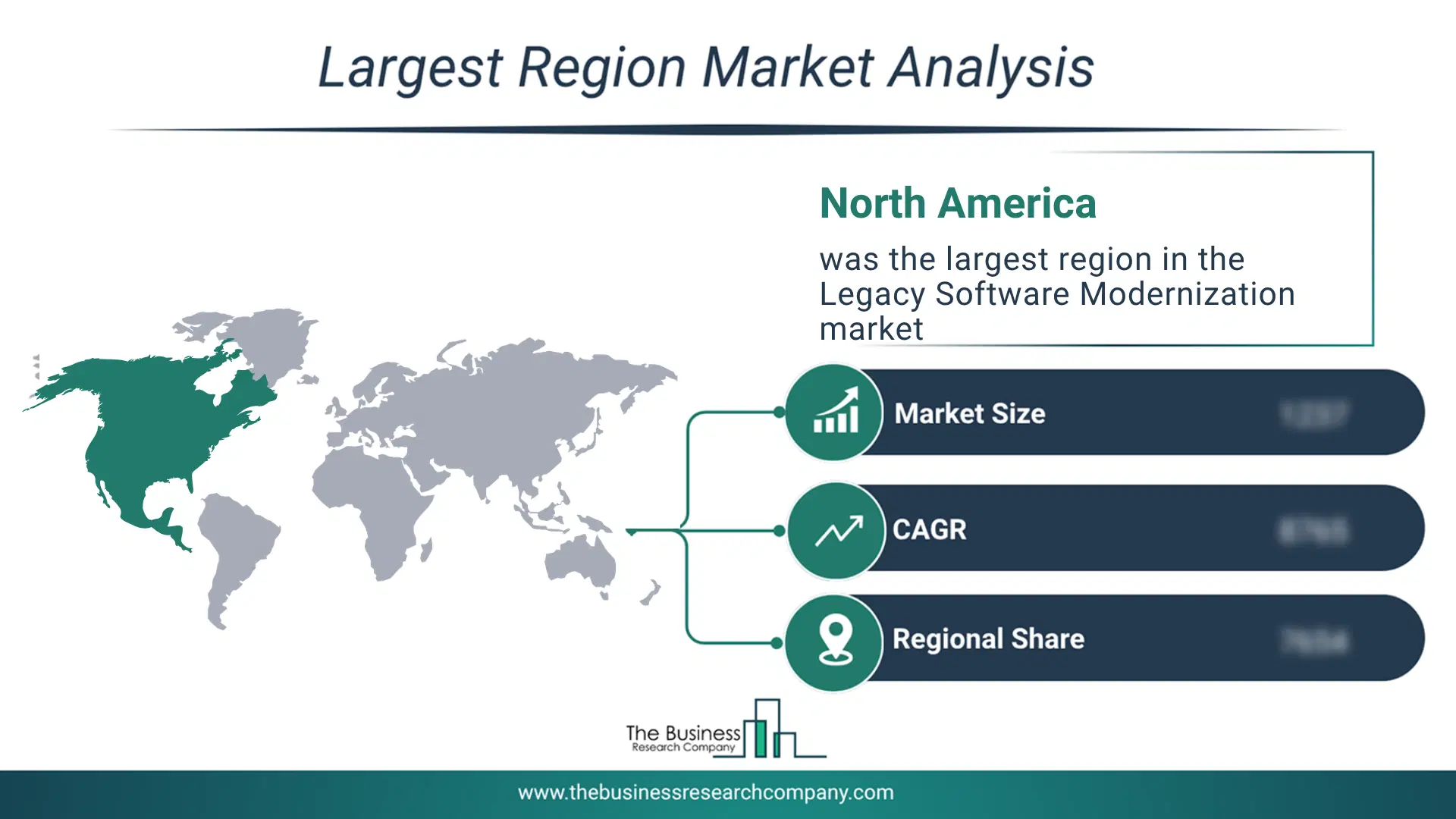
Regional Insights
North America was the largest region in the legacy software modernization service market in 2025. Asia-Pacific is expected to be the fastest-growing region in the forecast period. The regions covered in this market report are Asia-Pacific, South East Asia, Western Europe, Eastern Europe, North America, South America, Middle East, Africa. The countries covered in this market report are Australia, Brazil, China, France, Germany, India, Indonesia, Japan, Taiwan, Russia, South Korea, UK, USA, Canada, Italy, Spain.What Defines the Legacy Software Modernization Market?
The legacy software modernization service market includes revenues earned by entities by providing services such as application re-engineering, platform replatforming, system integration, legacy system assessment, database modernization, user interface modernization and application maintenance. The market value includes the value of related goods sold by the service provider or included within the service offering. Only goods and services traded between entities or sold to end consumers are included.How is Market Value Defined and Measured?
The market value is defined as the revenues that enterprises gain from the sale of goods and/or services within the specified market and geography through sales, grants, or donations in terms of the currency (in USD unless otherwise specified). The revenues for a specified geography are consumption values that are revenues generated by organizations in the specified geography within the market, irrespective of where they are produced. It does not include revenues from resales along the supply chain, either further along the supply chain or as part of other products.
This chart presents market attractiveness based on a quantitative evaluation of growth, competition, strategic alignment, and risk, offering a clear view of opportunity areas for decision-making. This chart is for illustrative purposes; the full report contains the complete analysis.

This chart highlights the Total Addressable Market (TAM) by estimating the maximum revenue opportunity using an assumption-driven approach, supporting strategic planning and opportunity sizing across markets. The chart is illustrative; the full report provides a more comprehensive analysis.
What Key Data and Analysis Are Included in the Legacy Software Modernization Market Report 2026?
The legacy software modernization market research report is one of a series of new reports from The Business Research Company that provides market statistics, including industry global market size, regional shares, competitors with the market share, detailed market segments, market trends and opportunities, and any further data you may need to thrive in the legacy software modernization industry. The market research report delivers a complete perspective of everything you need, with an in-depth analysis of the current and future state of the industry.Legacy Software Modernization Market Report Forecast Analysis
| Report Attribute | Details |
|---|---|
| Market Size Value In 2026 | $17.57 billion |
| Revenue Forecast In 2030 | $31.59 billion |
| Growth Rate | CAGR of 15.8% from 2026 to 2030 |
| Base Year For Estimation | 2025 |
| Actual Estimates/Historical Data | 2020-2025 |
| Forecast Period | 2026 - 2030 |
| Market Representation | Revenue in USD Billion and CAGR from 2026 to 2030 |
| Segments Covered | Service Type, Deployment Mode, Organization Size, Industry Vertical |
| Regional Scope | Asia-Pacific, Western Europe, Eastern Europe, North America, South America, Middle East, Africa |
| Country Scope | The Countries Covered In This Market Report Are Australia, Brazil, China, France, Germany, India, Indonesia, Japan, Taiwan, Russia, South Korea, Uk, Usa, Canada, Italy, Spain. |
| Key Companies Profiled | Accenture plc, HCL Technologies Limited, ValueLabs LLP, Damco Solutions, ScienceSoft USA Corporation, Rishabh Software Pvt. Ltd., OpenXcell Technolabs Pvt. Ltd., ITRex Group, Merixstudio Sp. z o.o., instinctools GmbH, Langate Inc., Integrio Systems Inc., Euristiq Sp. z o.o., Syberry Corporation, Nexus Software Systems LLC, Mangosoft Ltd., Oxagile LLC, DICEUS LLC, Praxent Inc., 8base Inc. |
| Customization Scope | Request for Customization |
| Pricing And Purchase Options | Explore Purchase Options |