

Lidar Software Market Report 2026
Global Outlook – By Product Type (Simulation Software, Mapping Software, Processing Software), By Sensor Technology (Mechanical, Solid State), By Deployment (Airborne, Terrestrial), By Application (Forestry And Environmental, Survey And Mapping, Automotive, Construction And Infrastructure, Other Applications) – Market Size, Trends, Strategies, and Forecast to 2030
Lidar Software Market Overview
• Lidar Software market size has reached to $0.5 billion in 2025 • Expected to grow to $1.22 billion in 2030 at a compound annual growth rate (CAGR) of 19.2% • Growth Driver: Automated Vehicles And Intelligent Transportation Systems Fueling Lidar Software Market Growth • Market Trend: Advancing Security Automation With 3D Lidar-Based Perception Technology • North America was the largest region in 2025.Market Gains By 2030 – Top Opportunities By Segment
Market Gain identifies the most promising market opportunities by highlighting the segments or products expected to generate the highest incremental revenue growth over the next five years.
What Is Covered Under Lidar Software Market?
Light detection and ranging (lidar) software is software that processes data collected by lidar sensors, which use laser light to measure distances and create three-dimensional representations of the environment. It provides a longer-range alternative to vision-based systems for fully autonomous vehicles, helping them detect road markings, traffic signs, pedestrians, and other vehicles. The main product types of lidar software are simulation software, mapping software, and processing software. Simulation software refers to computer programs or applications that replicate real-world processes, systems, or phenomena to model their behavior, interactions, or outcomes. The various technology types are mechanical and solid-state. The various deployments are airborne and terrestrial and used by various applications such as forestry and environmental, survey and mapping, automotive, construction and infrastructure, and other applications.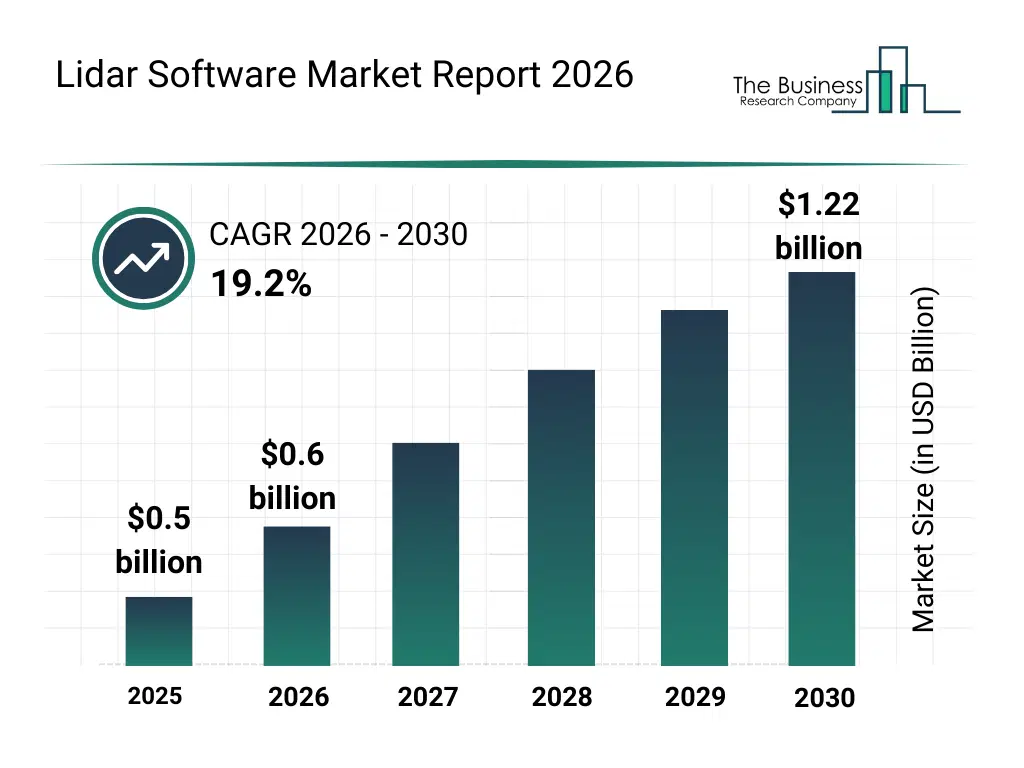
What Is The Lidar Software Market Size and Share 2026?
The lidar software market size has grown rapidly in recent years. It will grow from $0.5 billion in 2025 to $0.6 billion in 2026 at a compound annual growth rate (CAGR) of 19.8%. The growth in the historic period can be attributed to high cost of lidar hardware, limited computing capabilities, low adoption in automotive, early-stage software algorithms, fragmented mapping solutions.What Is The Lidar Software Market Growth Forecast?
The lidar software market size is expected to see rapid growth in the next few years. It will grow to $1.22 billion in 2030 at a compound annual growth rate (CAGR) of 19.2%. The growth in the forecast period can be attributed to growth in autonomous vehicles, expansion of smart city projects, demand for accurate 3D mapping, adoption in forestry and construction, integration with ai-based sensor fusion. Major trends in the forecast period include real-time point cloud processing, lidar-based environmental monitoring, advanced feature extraction algorithms, 3D terrain and urban mapping, lidar data visualization tools.
Global Lidar Software Market Segmentation
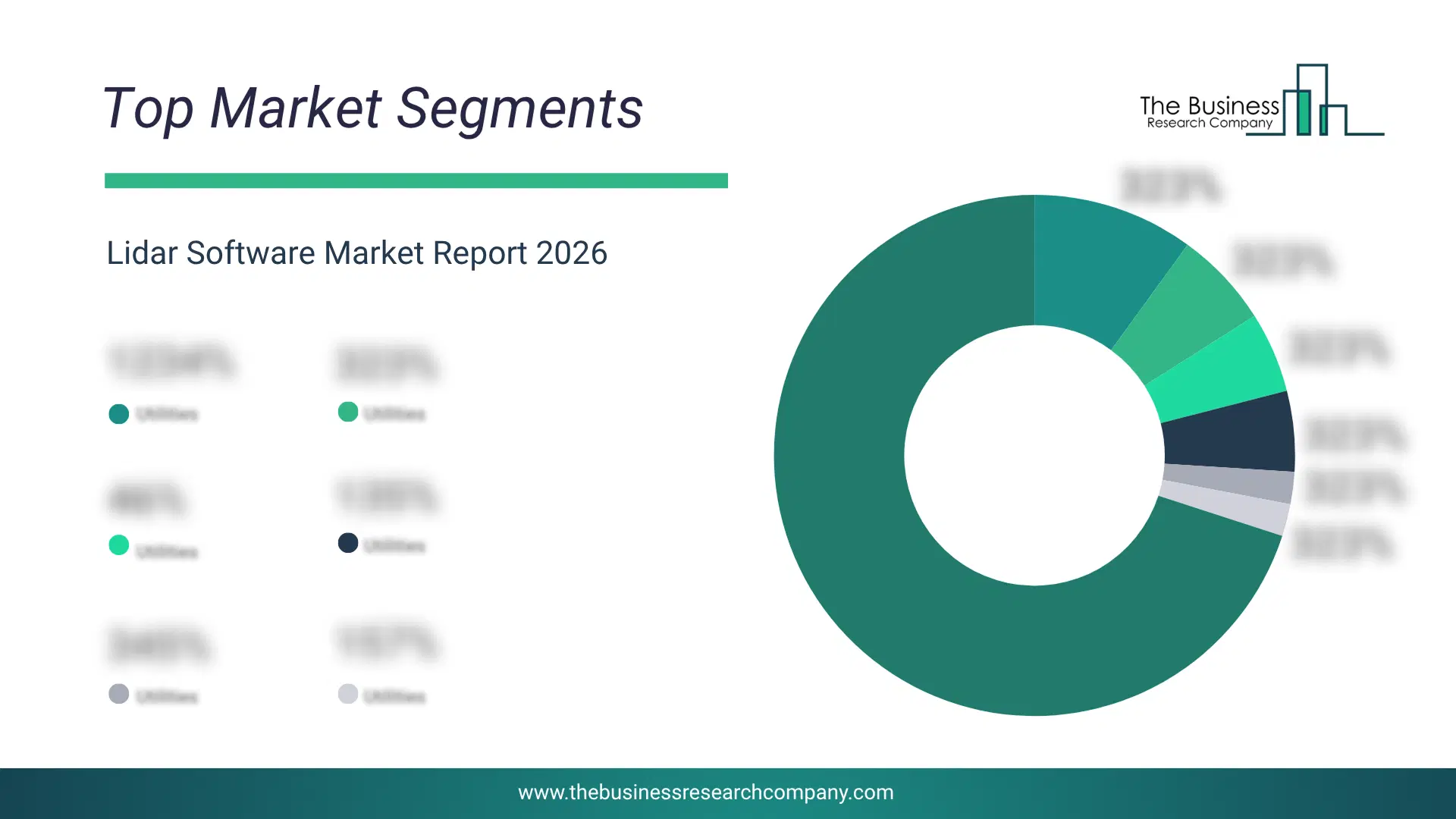
1) By Product Type: Simulation Software, Mapping Software, Processing Software 2) By Sensor Technology: Mechanical, Solid State 3) By Deployment: Airborne, Terrestrial 4) By Application: Forestry And Environmental, Survey And Mapping, Automotive, Construction And Infrastructure, Other Applications Subsegments: 1) By Simulation Software: Flight Simulation, Sensor Simulation, Environmental Simulation 2) By Mapping Software: 2D Mapping, 3D Mapping, Topographic Mapping, Bathymetric Mapping 3) By Processing Software: Data Processing And Analysis, Point Cloud Processing, Feature Extraction, Data Visualization The top segments in the lidar software market will be: • Processing Software will reach $0.55 Billion by 2030. • Mapping Software will reach $0.36 Billion by 2030. • Simulation Software will reach $0.31 Billion by 2030.What Is The Driver Of The Lidar Software Market?
The rise in automated vehicles and intelligent transportation systems is expected to propel the growth of the lidar software market going forward. An automated vehicle, also known as a self-driving car or autonomous vehicle, is a motor vehicle designed and constructed to move autonomously for certain periods without continuous driver supervision. Intelligent transportation refers to the use of advanced technologies to improve transportation systems' safety, efficiency, and sustainability. Lidar sensors offer high-resolution, 3D point cloud data, enabling automated vehicles to accurately detect and track objects such as vehicles, pedestrians, cyclists, and obstacles, ensuring a precise environmental representation for informed decision-making and the safety of occupants. For instance, in September 2023, according to the UK Parliament, a UK-based organisation, in February 2023 the government announced £81 million in grants to help roll out commercial use self-driving vehicles across the UK from 2025. Therefore, the rise in automated vehicles and intelligent transportation systems is driving the growth of the lidar software industry.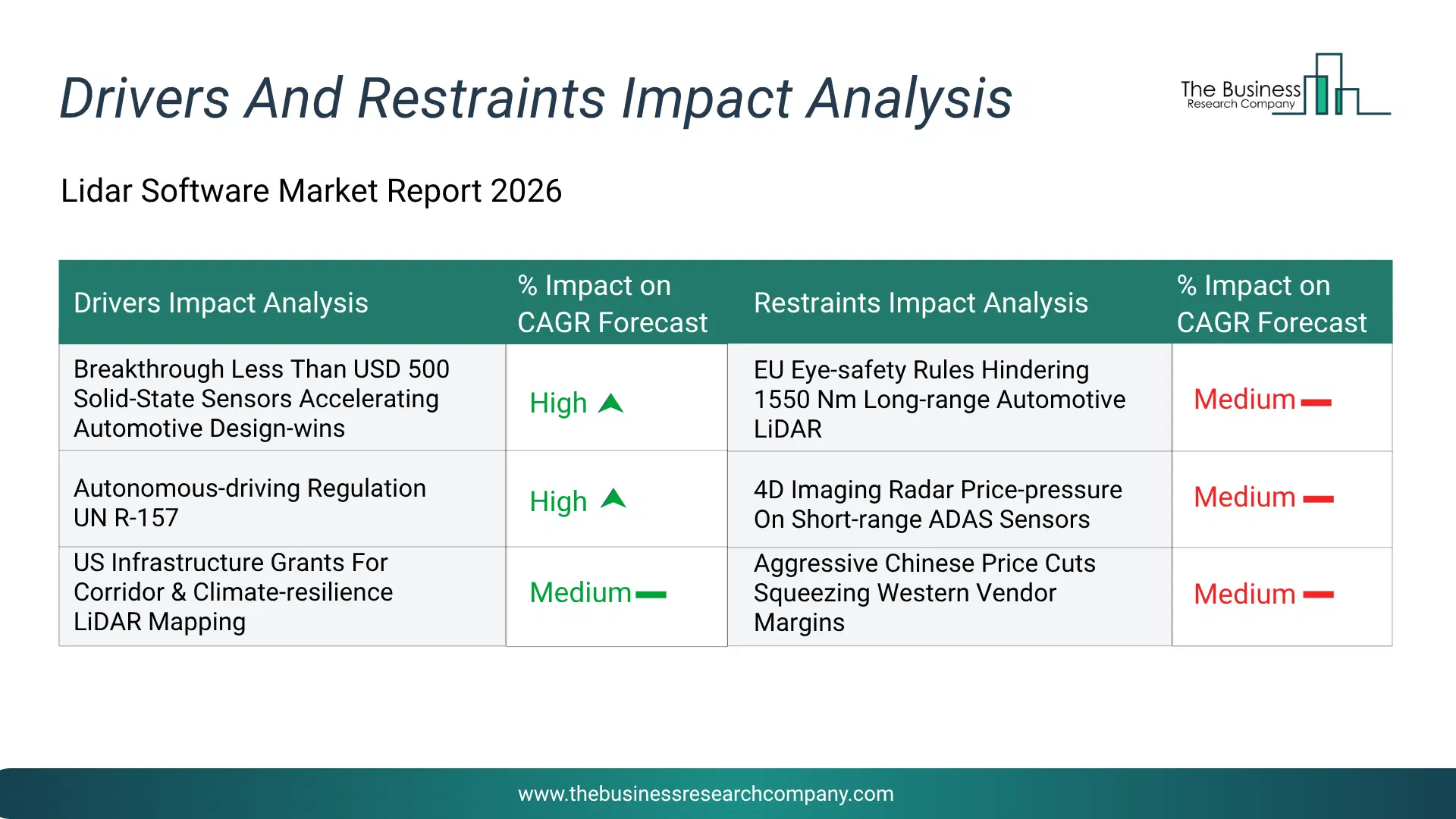
Infographic Chart Showing Key Market Drivers Analysis And Restraints For Lidar Software Market
The chart presents an impact analysis of key drivers and restraints, quantifying their relative influence on the market's growth rate and helping assess the balance between growth enablers and limiting factors. This chart offers a high-level perspective; the full report contains more detailed insights.
How Will The Drivers Impact Growth In The Global Lidar Software Market?
• Breakthrough Less Than USD 500 Solid-State Sensors Accelerating Automotive Design-wins (High) – During the forecast period, the breakthrough of solid-state lidar sensors priced below USD 500 is expected to become a key growth driver for the lidar software market by 2030. Lower sensor costs are making lidar technology commercially viable for a broader range of passenger and commercial vehicle platforms, accelerating deployment in advanced driver assistance and autonomous driving applications. As sensor adoption expands, demand for software capable of processing, visualizing, and interpreting increasingly large volumes of lidar-generated data is rising significantly. Software providers are therefore enhancing analytics, object detection, and real-time perception capabilities to support next-generation mobility systems. • Autonomous-driving Regulation UN R-157 (High) – During the forecast period, the adoption of autonomous-driving regulation UN R-157 is expected to emerge as a major factor driving the expansion of the lidar software market by 2030. The regulatory framework is encouraging broader deployment of automated driving technologies by establishing operational and safety requirements for autonomous vehicle systems. Compliance with these standards requires advanced software platforms capable of validating sensor performance, supporting simulation environments, and enabling reliable perception functions. The growing need for regulatory validation and operational safety is increasing investment in lidar software solutions throughout the autonomous mobility value chain. • US Infrastructure Grants For Corridor & Climate-resilience LiDAR Mapping (Medium) – During the forecast period, the expansion of US infrastructure grants supporting corridor and climate-resilience lidar mapping is expected to act as a key growth catalyst for the lidar software market by 2030. Public sector investments in transportation modernization, flood-risk assessment, environmental monitoring, and infrastructure resilience are increasing the collection and utilization of high-resolution geospatial data. These projects require sophisticated software platforms for terrain modeling, change detection, asset inspection, and large-scale mapping analysis. As government-funded mapping initiatives continue to expand, demand for advanced lidar data management and analytics solutions is expected to strengthen.How Will The Restraints Impact Growth In The Global Lidar Software Market?
• EU Eye-safety Rules Hindering 1550 Nm Long-range Automotive LiDAR (High) – During the forecast period, the strict eye-safety regulations in the European Union pose significant challenges for the deployment of 1550 nm LiDAR systems, which are typically used for long-range detection. These rules limit the permissible power levels of laser emissions, restricting the performance capabilities of such systems. As a result, manufacturers face difficulties in achieving the desired range and accuracy while remaining compliant. This creates additional R&D costs and delays in product commercialization. Furthermore, companies may need to redesign systems or shift to alternative wavelengths, increasing complexity and cost. The regulatory burden slows down innovation and adoption, especially in safety-critical automotive applications. Therefore, these rules act as a restraint by limiting technological advancement and market scalability. • 4D Imaging Radar Price-pressure On Short-range ADAS Sensors (High) – During the forecast period, the emergence of 4D imaging radar as a cost-effective alternative is putting significant pricing pressure on traditional short-range ADAS sensors, including LiDAR. These radar systems offer competitive performance in terms of object detection and environmental perception, often at a lower cost. As automakers prioritize cost optimization, they may favor radar over more expensive sensor technologies. This substitution effect reduces demand for short-range LiDAR solutions, impacting revenue growth for sensor manufacturers. Additionally, increased competition forces companies to lower prices, squeezing profit margins. The growing preference for radar-based systems limits the expansion of LiDAR in certain applications. Hence, this trend acts as a restraint by intensifying competition and reducing market share. • Aggressive Chinese Price Cuts Squeezing Western Vendor Margins (Medium) – During the forecast period, the chinese manufacturers are increasingly offering LiDAR and sensor technologies at significantly lower prices, creating intense competitive pressure on Western vendors. These aggressive pricing strategies are often supported by government incentives and large-scale production capabilities. As a result, Western companies struggle to maintain their margins while staying competitive in global markets. This leads to reduced profitability and may limit investment in research and development. Additionally, price wars can commoditize the market, reducing differentiation among products. Smaller players may find it difficult to sustain operations under such pressure. Consequently, this dynamic acts as a restraint by weakening financial stability and slowing innovation in the market.Key Players In The Global Lidar Software Market
Major companies operating in the lidar software market are Jabil Inc.; Aptiv PLC; Trimble Inc.; Geo-Plus; Leica Geosystems AG; Faro Technologies Inc.; ShanghAI Huace Navigation Technology Ltd.; Teledyne Optech; Velodyne LiDAR Inc.; Luminar Technologies Inc.; Blickfeld GmbH; Seoul Robotics; LeddarTech Inc.; GreenValley International; Innoviz Technologies Ltd; Cepton Technologies Inc.; GeoCue Group Inc.; Quanergy Systems Inc.; YellowScan; Routescene; Terrasolid Ltd.; Aeva Inc.; MatrixSpace; Neuvition Inc.; Outsight SA; Phoenix LiDAR Systems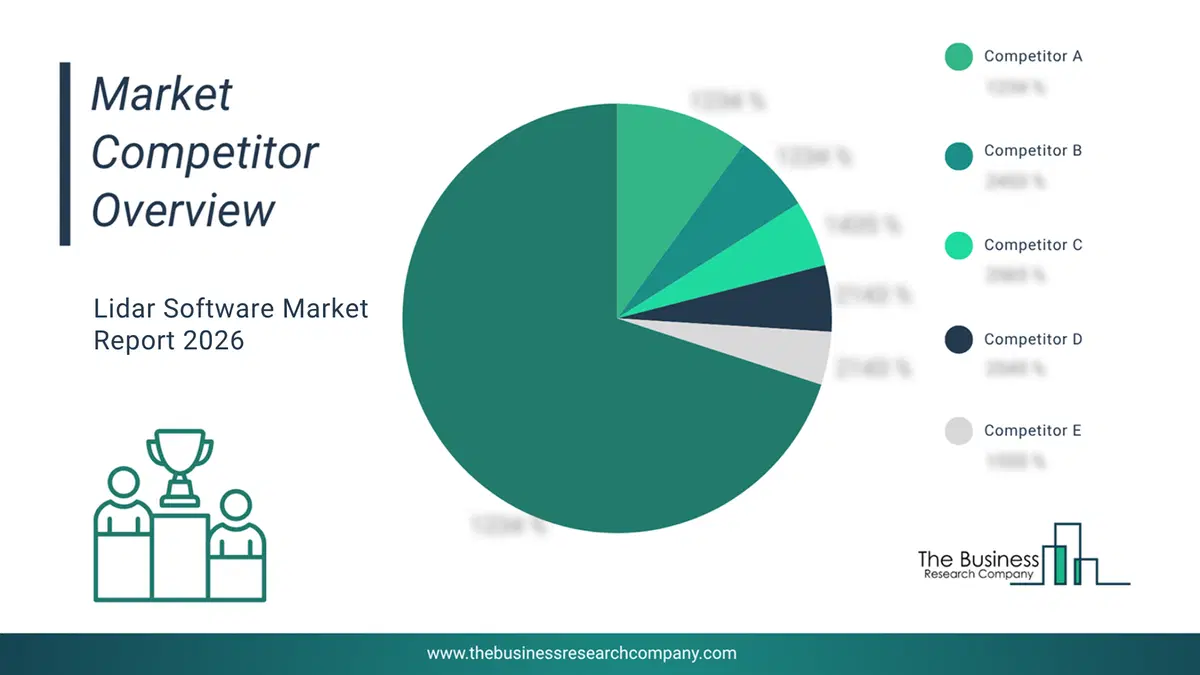
This chart is for illustrative purposes; the full report includes a detailed competitor analysis and comprehensive overview of the top 10 companies in the market.
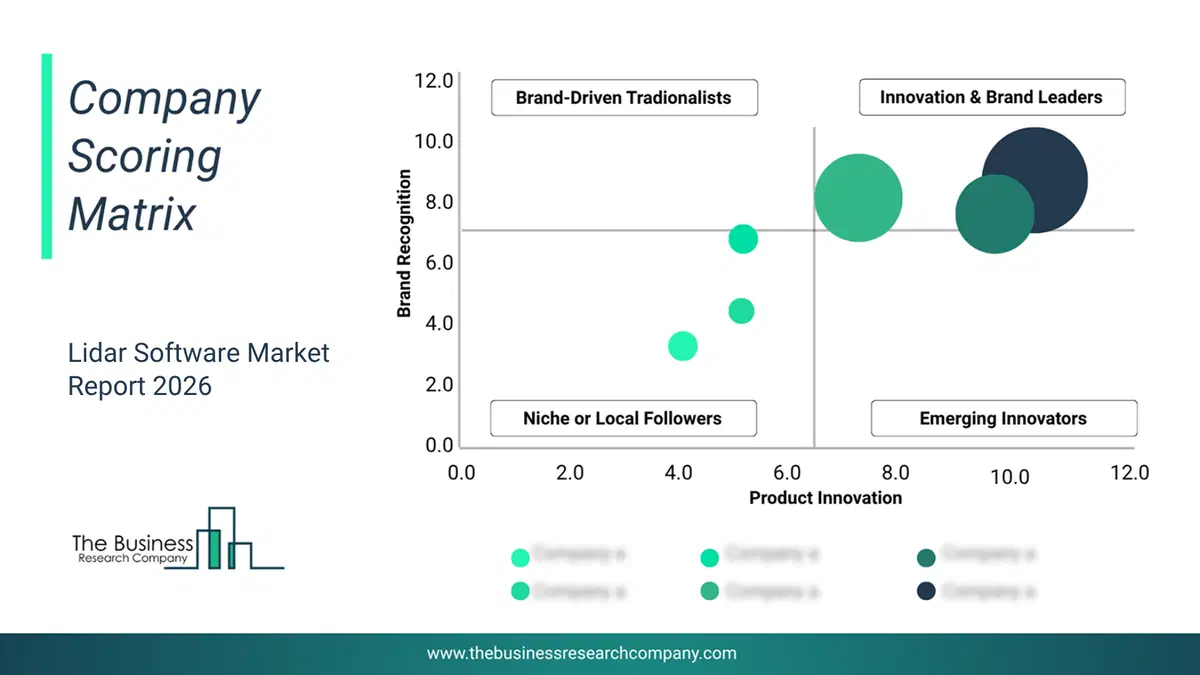
This chart maps companies by product innovation and brand strength, with bubble size indicating relative revenue, helping identify market leaders, challengers, and niche players. This is an illustrative chart; the full report provides a complete and accurate competitive analysis.
Global Lidar Software Market Trends and Insights
Major companies operating in the LiDAR software market are focusing on incorporating advanced security analytics such as 3D LiDAR-based perception technology to enhance accuracy, monitoring, and access-control automation. 3D LiDAR-based perception technology uses laser-based depth sensing combined with AI-driven detection algorithms to create real-time volumetric views of people and objects, enabling capabilities such as precise object classification, real-time tracking, and high-accuracy intrusion detection. For instance, in January 2023, Quanergy Systems, a United States-based provider of 3D LiDAR sensors and perception software, launched its LiDAR-based Hyper-Accurate Mantrap Tailgating Solution, a 3D perception technology designed to prevent unauthorized entry in secure facilities by detecting tailgating attempts with high precision. The system features real-time 3D people tracking, volumetric sensing for accurate occupancy counting, and automated alerts for access-control violations. This solution improves security automation, reduces false alarms, and enhances decision-making in high-security environments.What Are Latest Mergers And Acquisitions In The Lidar Software Market?
In January 2023, Luminar Technologies Inc., a US-based technology company, acquired Civil Maps for an undisclosed amount. With this acquisition, Luminar is set to incorporate highly detailed and automatically updating 3D maps of diverse cities into its portfolio, aligning with its vision to actualize fully autonomous vehicles. Civil Maps is a US-based company provider of lidar software that offers a pipeline and sensor-neutral cognitive platform that allows for localization, edge mapping, and high-definition 3D mapping at the city scale.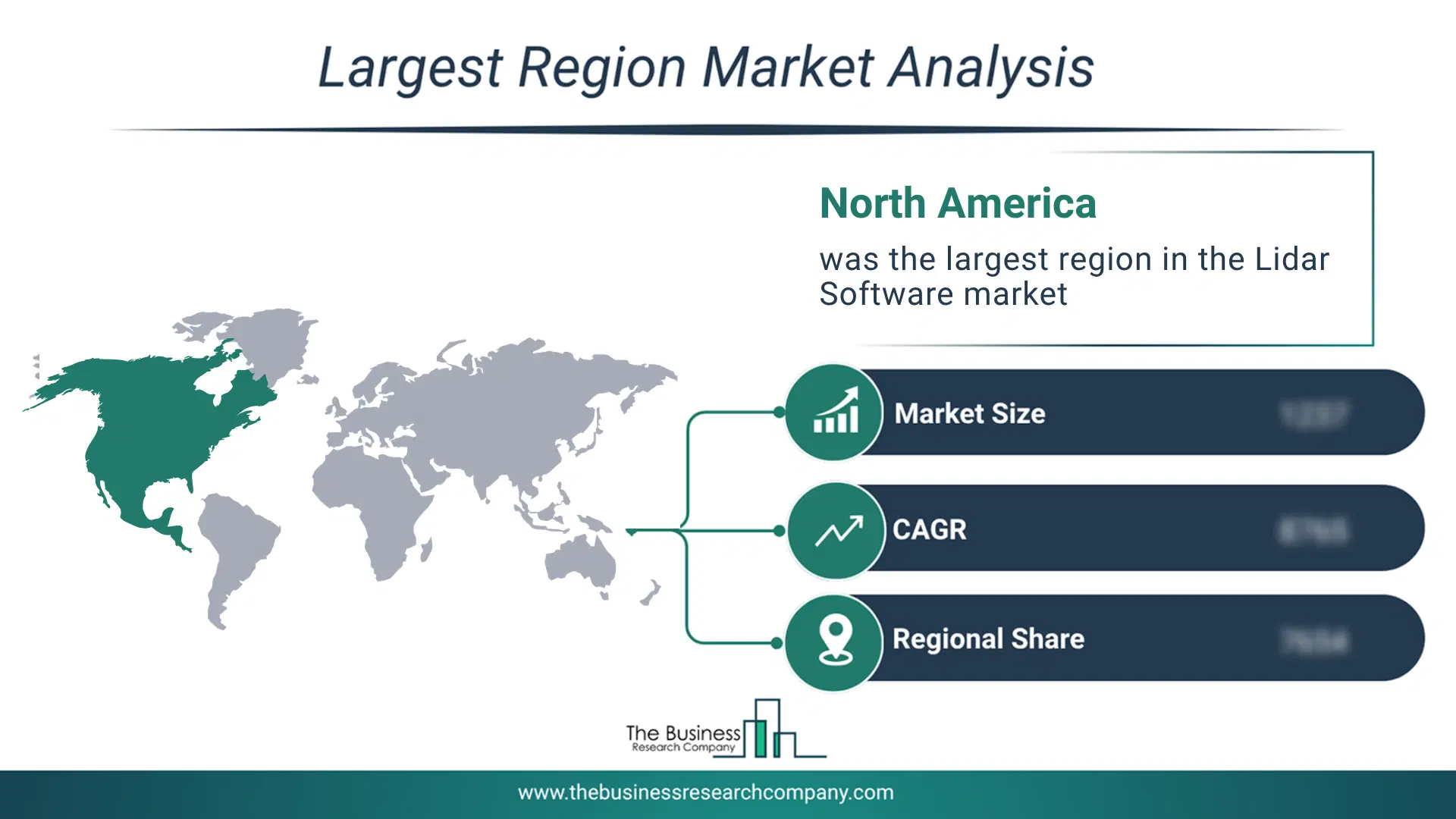
Regional Insights
North America was the largest region in the lidar software market in 2025. The regions covered in this market report are Asia-Pacific, South East Asia, Western Europe, Eastern Europe, North America, South America, Middle East, Africa. The countries covered in this market report are Australia, Brazil, China, France, Germany, India, Indonesia, Japan, Taiwan, Russia, South Korea, UK, USA, Canada, Italy, SpainWhat Defines the Lidar Software Market?
The light detection and ranging (lidar) software market includes revenues earned by entities by providing services such as driver assistance, data import, data processing, and vehicle flow monitoring. The market value includes the value of related goods sold by the service provider or included within the service offering. Only goods and services traded between entities or sold to end consumers are included. The light detection and ranging (lidar) software market also consists of sales of surround lidar, solid-state lidar, lidar software infrastructure, and lidar sensors. Values in this market are ‘factory gate’ values, that is the value of goods sold by the manufacturers or creators of the goods, whether to other entities (including downstream manufacturers, wholesalers, distributors and retailers) or directly to end customers. The value of goods in this market includes related services sold by the creators of the goods.How is Market Value Defined and Measured?
The market value is defined as the revenues that enterprises gain from the sale of goods and/or services within the specified market and geography through sales, grants, or donations in terms of the currency (in USD unless otherwise specified). The revenues for a specified geography are consumption values that are revenues generated by organizations in the specified geography within the market, irrespective of where they are produced. It does not include revenues from resales along the supply chain, either further along the supply chain or as part of other products.
This chart presents market attractiveness based on a quantitative evaluation of growth, competition, strategic alignment, and risk, offering a clear view of opportunity areas for decision-making. This chart is for illustrative purposes; the full report contains the complete analysis.

This chart highlights the Total Addressable Market (TAM) by estimating the maximum revenue opportunity using an assumption-driven approach, supporting strategic planning and opportunity sizing across markets. The chart is illustrative; the full report provides a more comprehensive analysis.
What Key Data and Analysis Are Included in the Lidar Software Market Report 2026?
The lidar software market research report is one of a series of new reports from The Business Research Company that provides market statistics, including industry global market size, regional shares, competitors with the market share, detailed market segments, market trends and opportunities, and any further data you may need to thrive in the lidar software industry. The market research report delivers a complete perspective of everything you need, with an in-depth analysis of the current and future state of the industry.Lidar Software Market Report Forecast Analysis
| Report Attribute | Details |
|---|---|
| Market Size Value In 2026 | $0.6 billion |
| Revenue Forecast In 2030 | $1.22 billion |
| Growth Rate | CAGR of 19.8% from 2026 to 2030 |
| Base Year For Estimation | 2025 |
| Actual Estimates/Historical Data | 2020-2025 |
| Forecast Period | 2026 - 2030 |
| Market Representation | Revenue in USD Billion and CAGR from 2026 to 2030 |
| Segments Covered | Product Type, Sensor Technology, Deployment, Application |
| Regional Scope | Asia-Pacific, Western Europe, Eastern Europe, North America, South America, Middle East, Africa |
| Country Scope | The countries covered in the report are Australia, Brazil, China, France, Germany, India, Indonesia, Japan, Taiwan, Russia, South Korea, UK, USA, Canada, Italy, Spain. |
| Key Companies Profiled | Jabil Inc.; Aptiv PLC; Trimble Inc.; Geo-Plus; Leica Geosystems AG; Faro Technologies Inc.; ShanghAI Huace Navigation Technology Ltd.; Teledyne Optech; Velodyne LiDAR Inc.; Luminar Technologies Inc.; Blickfeld GmbH; Seoul Robotics; LeddarTech Inc.; GreenValley International; Innoviz Technologies Ltd; Cepton Technologies Inc.; GeoCue Group Inc.; Quanergy Systems Inc.; YellowScan; Routescene; Terrasolid Ltd.; Aeva Inc.; MatrixSpace; Neuvition Inc.; Outsight SA; Phoenix LiDAR Systems |
| Customization Scope | Request for Customization |
| Pricing And Purchase Options | Explore Purchase Options |