
Life Science Instrumentation Market Report 2026
Global Outlook – By Technology (Spectroscopy, Chromatography, Polymerase Chain Reaction, Liquid Handling), By Application (Research Applications, Clinical And Diagnostic Applications, Other Applications), By End User (Hospitals And Diagnostic Laboratories, Pharmaceutical And Biotechnology Companies, Academic And Research Institutes, Agriculture And Food Industries, Environmental Testing Labs, Clinical Research Organizations, Other End-Users) - Market Size, Trends, Strategies, and Forecast to 2030
Life Science Instrumentation Market Overview
• Life Science Instrumentation market size has reached to $70.86 billion in 2025 • Expected to grow to $97.89 billion in 2030 at a compound annual growth rate (CAGR) of 6.6% • Growth Driver: Rising Incidence Of Genetic Disorders Boosts Life Science Instrumentation Market • Market Trend: Innovations In Analytical Instrumentation Enhance Data Quality And Workflow Speed • North America was the largest region in 2025.What Is Covered Under Life Science Instrumentation Market?
Life science instrumentation refers to a range of tools and devices used for research and analysis in the biological and medical sciences. These instruments allow scientists to examine the structure, function, and interactions of biological molecules, cells, and organisms. They are commonly used in applications such as genomics, proteomics, cell analysis, and drug discovery. The main types of life science instrumentation are spectroscopy, chromatography, polymerase chain reaction, immunoassays, lyophilization, liquid handling, clinical chemistry analyzers, microscopy, flow cytometry, and others. Spectroscopy is a technique used to measure the interaction between light and matter, providing information about the composition, structure, and properties of substances. It involves analyzing the spectrum of light emitted, absorbed, or scattered by materials. These instruments are applied in various fields such as research, clinical and diagnostic applications, and others. End users include hospitals and diagnostic laboratories, pharmaceutical and biotechnology companies, academic and research institutes, agriculture and food industries, environmental testing labs, clinical research organizations, and others.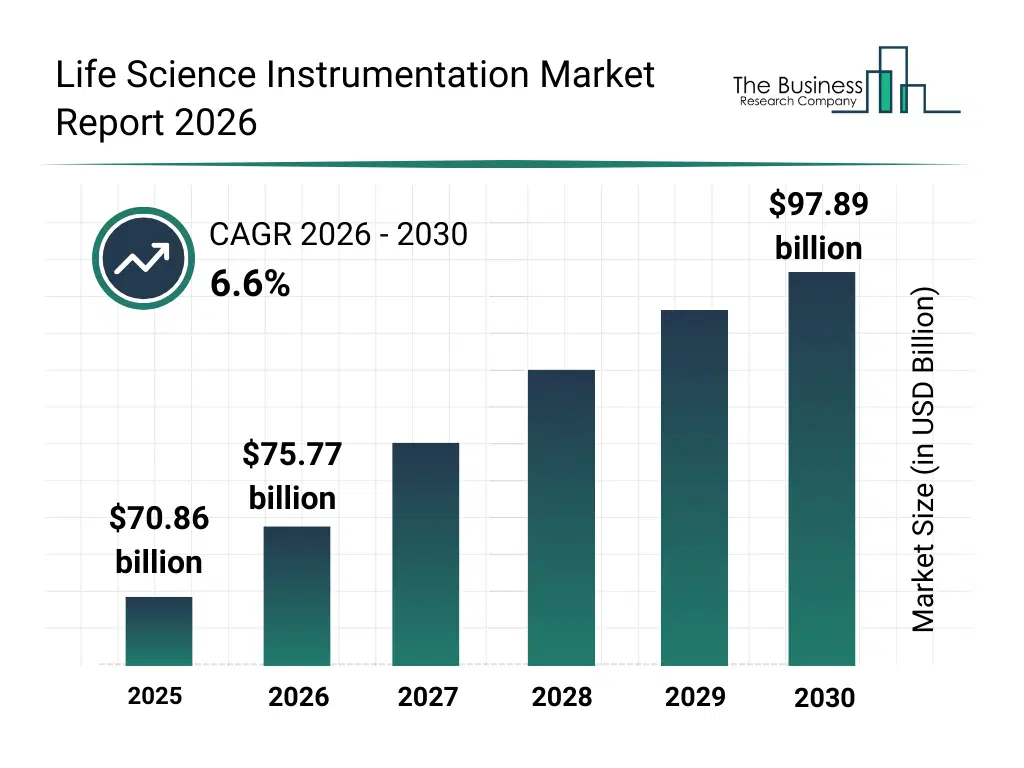
What Is The Life Science Instrumentation Market Size and Share 2026?
The life science instrumentation market size has grown strongly in recent years. It will grow from $70.86 billion in 2025 to $75.77 billion in 2026 at a compound annual growth rate (CAGR) of 6.9%. The growth in the historic period can be attributed to expansion of pharmaceutical and biotechnology research activities, increasing investments in laboratory infrastructure, growth in genomics and proteomics research, adoption of advanced diagnostic instruments, rising demand for accurate analytical results.What Is The Life Science Instrumentation Market Growth Forecast?
The life science instrumentation market size is expected to see strong growth in the next few years. It will grow to $97.89 billion in 2030 at a compound annual growth rate (CAGR) of 6.6%. The growth in the forecast period can be attributed to increasing use of automated and connected instruments, rising demand for personalized medicine research tools, expansion of clinical diagnostics testing, growing adoption of AI-enabled instrumentation, increasing investments in next-generation laboratory technologies. Major trends in the forecast period include increasing adoption of high-throughput analytical instruments, rising integration of automation in laboratory workflows, growing demand for precision measurement technologies, expansion of multi-omics research instrumentation, enhanced focus on data-integrated lab systems.
Global Life Science Instrumentation Market Segmentation
1) By Technology: Spectroscopy, Chromatography, Polymerase Chain Reaction, Liquid Handling 2) By Application: Research Applications, Clinical And Diagnostic Applications, Other Applications 3) By End User: Hospitals And Diagnostic Laboratories, Pharmaceutical And Biotechnology Companies, Academic And Research Institutes, Agriculture And Food Industries, Environmental Testing Labs, Clinical Research Organizations, Other End-Users Subsegments: 1) By Spectroscopy: UV-Vis Spectroscopy, Infrared Spectroscopy (IR), Mass Spectrometry, Nuclear Magnetic Resonance (NMR) Spectroscopy, Raman Spectroscopy 2) By Chromatography: Gas Chromatography (GC), High-Performance Liquid Chromatography (HPLC), Thin Layer Chromatography (TLC), Ion Chromatography (IC), Supercritical Fluid Chromatography (SFC) 3) By Polymerase Chain Reaction (PCR): Quantitative PCR (qPCR), Reverse Transcription PCR (RT-PCR), Digital PCR, Multiplex PCR 4) By Liquid Handling: Automated Liquid Handling Systems, Manual Pipetting Systems, Liquid Handling RoboticsWhat Is The Driver Of The Life Science Instrumentation Market?
The increasing incidence of genetic disorders is expected to propel the growth of the life science instrumentation market going forward. Genetic disorders refer to diseases or conditions caused by abnormalities in an individual's DNA or chromosomes. The incidence of genetic disorders is growing due to advancements in diagnostic technologies, increased awareness, and changes in reproductive patterns. Life science instruments are utilized by genetic disorder patients to diagnose, monitor, and develop targeted therapies by analyzing genetic material and biomarkers. For instance, in May 2023, according to the Alzheimer Society, a UK-based dementia care and research charity, approximately 982,000 people are living with dementia in the UK, and this number is expected to increase to 1.4 million by 2040. Therefore, the increasing incidence of genetic disorders is driving the growth of the life science instrumentation industry.Key Players In The Global Life Science Instrumentation Market
Major companies operating in the life science instrumentation market are Thermo Fisher Scientific Inc, Agilent Technologies Inc, Danaher Corporation, Bruker Corporation, Shimadzu Corporation, Waters Corporation, PerkinElmer Inc, Bio-Rad Laboratories Inc, JEOL Ltd, Horiba Ltd, Eppendorf AG, Tecan Group AG, Leica Microsystems AG, Sartorius AG, Illumina Inc, Oxford Instruments plc, Becton Dickinson and Company, Beckman Coulter Inc, Carl Zeiss AG, Nikon Corporation, Hitachi High Technologies Corporation
This chart is for illustrative purposes; the full report includes a detailed competitor analysis and comprehensive overview of the top 10 companies in the market.
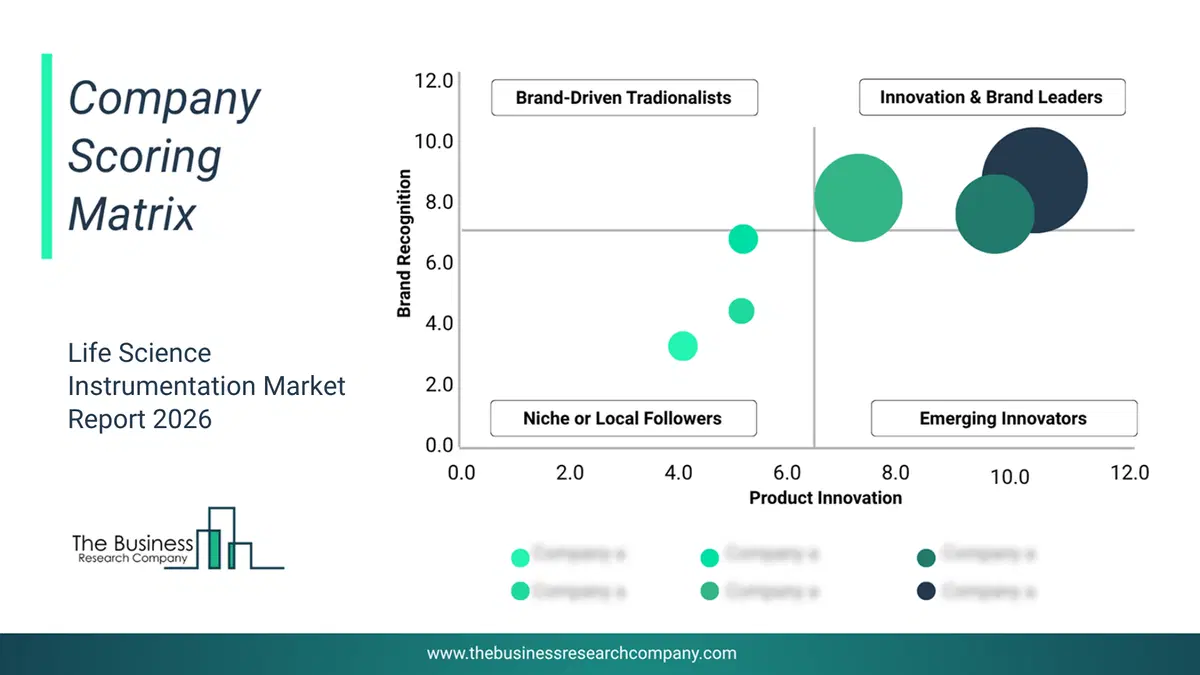
This chart maps companies by product innovation and brand strength, with bubble size indicating relative revenue, helping identify market leaders, challengers, and niche players. This is an illustrative chart; the full report provides a complete and accurate competitive analysis.
Global Life Science Instrumentation Market Trends and Insights
Major companies operating in the life science instrumentation market are focusing on developing innovative solutions, such as high-performance mass spectrometers with ultrahigh sensitivity, to improve proteomics, metabolomics, translational research, and precision medicine workflows. High-performance mass spectrometers are analytical instruments that detect and quantify molecules such as proteins, metabolites, and lipids by ionizing them and measuring their mass-to-charge ratio. Compared with traditional instruments, these modern systems deliver greater sensitivity, faster analysis, and higher throughput, enabling complex biological and clinical studies with enhanced accuracy. For instance, in June 2023, Thermo Fisher Scientific Inc., a US-based life-science instrumentation company, launched the Thermo Scientific Orbitrap Astral mass spectrometer, an advanced system providing deep proteome coverage, high resolution, and accelerated throughput for biomarker discovery and proteomics research. The Astral mass spectrometer allows detection of low-abundance proteins, faster processing of large sample batches, and improved support for translational and basic research, offering a significant performance improvement over conventional MS platforms in terms of sensitivity, efficiency, and data quality.What Are Latest Mergers And Acquisitions In The Life Science Instrumentation Market?
In January 2024, Calibre Scientific Inc., a US-based company specializing in life sciences and diagnostics, acquired Labtech International Ltd. for an undisclosed amount. This acquisition enables Calibre Scientific to expand its range of analytical instruments while enhancing its presence and service capabilities throughout the British Isles. Labtech International Ltd. is a UK-based manufacturer and supplier of laboratory instruments and equipment, with a focus on life sciences and scientific research.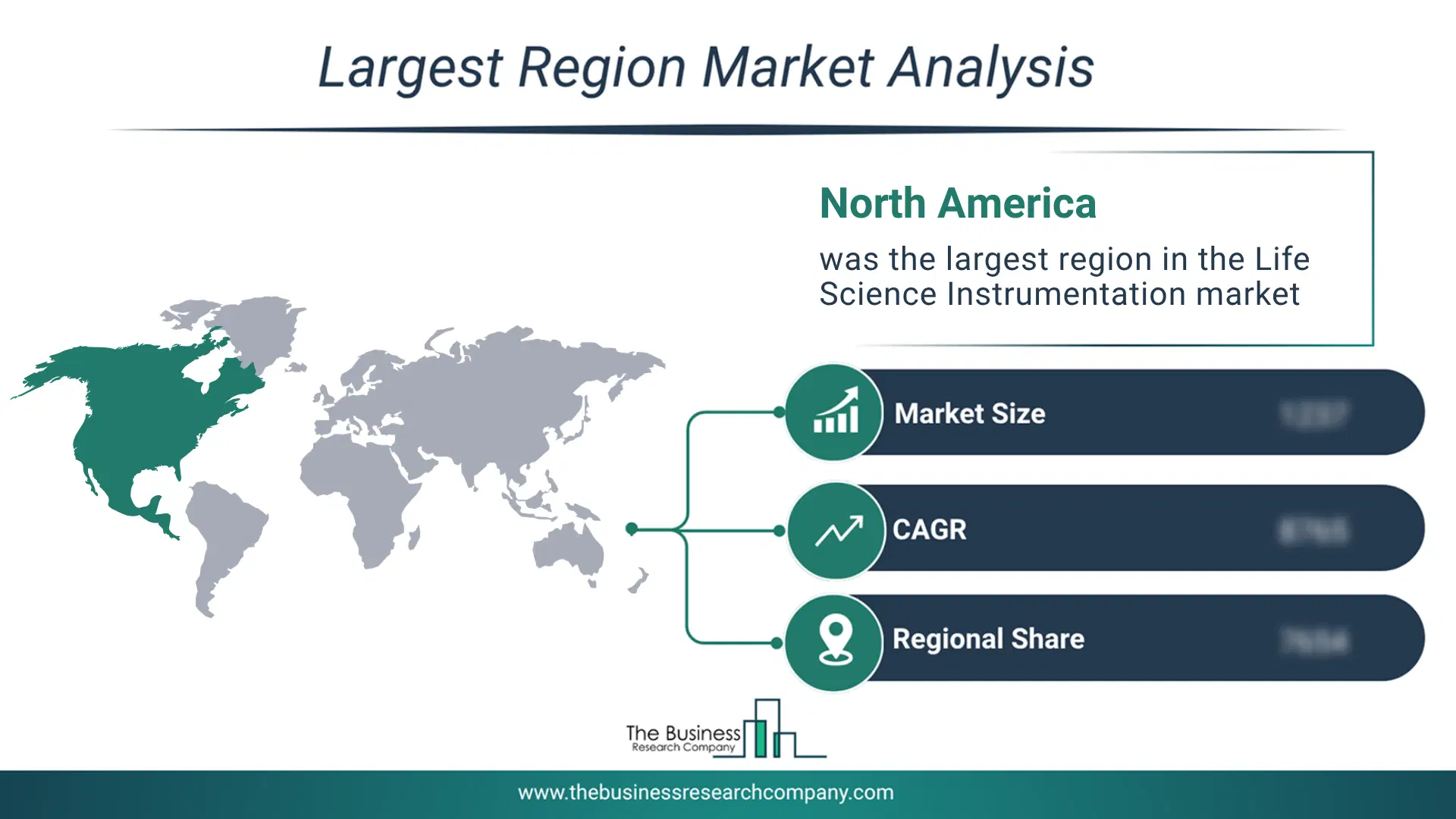
Regional Outlook
North America was the largest region in the life science instrumentation market in 2025. The regions covered in this market report are Asia-Pacific, South East Asia, Western Europe, Eastern Europe, North America, South America, Middle East, Africa. The countries covered in this market report are Australia, Brazil, China, France, Germany, India, Indonesia, Japan, Taiwan, Russia, South Korea, UK, USA, Canada, Italy, Spain.What Defines the Life Science Instrumentation Market?
The life science instrumentation market consists of sales of electrophoresis apparatus, polymerase chain reaction machines, chromatographs, and robotic liquid handlers. Values in this market are ‘factory gate’ values, that is the value of goods sold by the manufacturers or creators of the goods, whether to other entities (including downstream manufacturers, wholesalers, distributors and retailers) or directly to end customers. The value of goods in this market includes related services sold by the creators of the goods.How is Market Value Defined and Measured?
The market value is defined as the revenues that enterprises gain from the sale of goods and/or services within the specified market and geography through sales, grants, or donations in terms of the currency (in USD unless otherwise specified). The revenues for a specified geography are consumption values that are revenues generated by organizations in the specified geography within the market, irrespective of where they are produced. It does not include revenues from resales along the supply chain, either further along the supply chain or as part of other products.
This chart presents market attractiveness based on a quantitative evaluation of growth, competition, strategic alignment, and risk, offering a clear view of opportunity areas for decision-making. This chart is for illustrative purposes; the full report contains the complete analysis.

This chart highlights the Total Addressable Market (TAM) by estimating the maximum revenue opportunity using an assumption-driven approach, supporting strategic planning and opportunity sizing across markets. The chart is illustrative; the full report provides a more comprehensive analysis.
What Key Data and Analysis Are Included in the Life Science Instrumentation Market Report 2026?
The life science instrumentation market research report is one of a series of new reports from The Business Research Company that provides market statistics, including industry global market size, regional shares, competitors with the market share, detailed market segments, market trends and opportunities, and any further data you may need to thrive in the life science instrumentation industry. The market research report delivers a complete perspective of everything you need, with an in-depth analysis of the current and future state of the industry.Life Science Instrumentation Market Report Forecast Analysis
| Report Attribute | Details |
|---|---|
| Market Size Value In 2026 | $75.77 billion |
| Revenue Forecast In 2030 | $97.89 billion |
| Growth Rate | CAGR of 6.6% from 2026 to 2030 |
| Base Year For Estimation | 2025 |
| Actual Estimates/Historical Data | 2020-2025 |
| Forecast Period | 2026 - 2030 |
| Market Representation | Revenue in USD Billion and CAGR from 2026 to 2030 |
| Segments Covered | Technology, Application, End User |
| Regional Scope | Asia-Pacific, Western Europe, Eastern Europe, North America, South America, Middle East, Africa |
| Country Scope | The countries covered in the report are Australia, Brazil, China, France, Germany, India, Indonesia, Japan, Taiwan, Russia, South Korea, UK, USA, Canada, Italy, Spain |
| Key Companies Profiled | Thermo Fisher Scientific Inc, Agilent Technologies Inc, Danaher Corporation, Bruker Corporation, Shimadzu Corporation, Waters Corporation, PerkinElmer Inc, Bio-Rad Laboratories Inc, JEOL Ltd, Horiba Ltd, Eppendorf AG, Tecan Group AG, Leica Microsystems AG, Sartorius AG, Illumina Inc, Oxford Instruments plc, Becton Dickinson and Company, Beckman Coulter Inc, Carl Zeiss AG, Nikon Corporation, Hitachi High Technologies Corporation |
| Customization Scope | Request for Customization |
| Pricing And Purchase Options | Explore Purchase Options |