

Life Sciences IT Global Market Opportunities And Strategies To 2035
By Type (Software, Service), By Solution (Drug Discovery Informatics, Clinical Trial Management, Bioinformatics, Laboratory Information Management, Other Solutions), By End User (Pharmaceutical And Biotechnology Companies, Contract Research And Development Organizations, Other End Users), And By Region, Opportunities And Strategies – Global Forecast To 2035
Life Sciences IT Market Definition
Life Sciences information technology (IT) refers to the application of information technology systems, software, and digital infrastructure to support operations in the pharmaceutical, biotechnology, medical device, and healthcare sectors. The primary purpose of Life Sciences IT is to enable efficient data management, regulatory compliance, and digital transformation across research, development, manufacturing, and commercialization processes. The life sciences IT market consists of sales by entities (organizations, sole traders and partnerships) of life sciences IT primarily used by pharmaceutical companies, biotechnology firms, contract research organizations, research laboratories, healthcare institutions and regulatory bodies to manage scientific data, streamline research workflows, improve collaboration and ensure compliance with regulatory standards. These solutions are used throughout the lifecycle of life sciences activities, from early-stage drug discovery and preclinical research to clinical trials, regulatory submissions, manufacturing and post-market surveillance. It includes solutions such as laboratory information management systems (LIMS), clinical trial management systems (CTMS), electronic lab notebooks (ELN), bioinformatics platforms, data analytics tools, cloud computing, and cybersecurity systems tailored to regulated environments.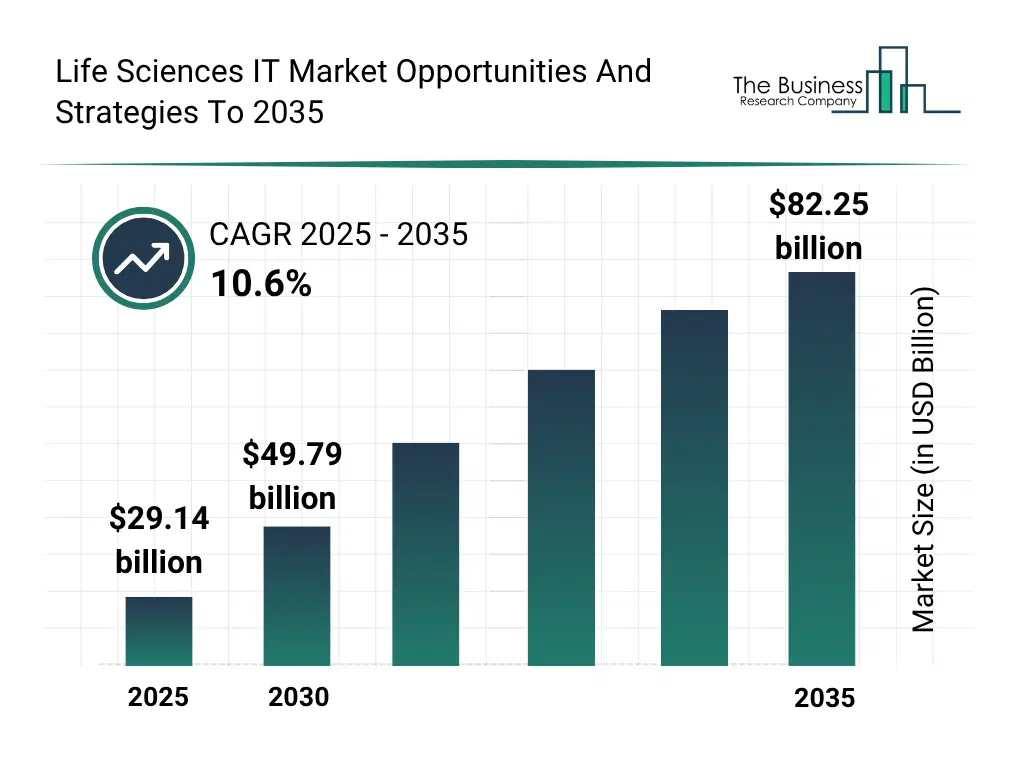
Life Sciences IT Market Size
The global life sciences IT market reached a value of nearly $29,140.0 million in 2025, having grown at a compound annual growth rate (CAGR) of 12.1% since 2020. The market is expected to grow from $29,140.0 million in 2025 to $49,792.0 million in 2030 at a rate of 11.3%. The market is then expected to grow at a CAGR of 10.6% from 2030 and reach $82,245.0 million in 2035. Growth in the historic period resulted from increasing pharmaceutical research and development (R&D) spending, expansion of precision medicine and genomics research, growing number of clinical trials and growing focus on drug safety monitoring. Factors that negatively affected growth in the historic period were data privacy concern and high implementation costs. Going forward, rising healthcare spending, growing demand for real-world evidence (RWE) and advanced data analytics, increasing government support for medical research and growing volume of biomedical data will drive the growth. Factors that could hinder the growth of the life sciences IT market in the future include integration challenges with legacy IT infrastructure, strict regulatory compliance requirements and impact of trade wars and tariffs.
Life Sciences IT Market Segmentation
The life sciences IT market is segmented by type, by solution, by end user.
By Type –
The life sciences IT market is segmented by type into:
By Solution –
The life sciences IT market is segmented by solution into:
By End User –
The life sciences IT market is segmented by end user into:
By Geography - The life sciences IT market is segmented by geography into:
By Type –
The life sciences IT market is segmented by type into:
- a) Software
- b) Service
By Solution –
The life sciences IT market is segmented by solution into:
- a) Drug Discovery Informatics
- b) Clinical Trial Management
- c) Bioinformatics
- d) Laboratory Information Management
- e) Other Solutions
By End User –
The life sciences IT market is segmented by end user into:
- a) Pharmaceutical And Biotechnology Companies
- b) Contract Research And Development Organizations
- g) Other End Users
By Geography - The life sciences IT market is segmented by geography into:
- China
- India
- Japan
- Australia
- Indonesia
- South Korea
- USA
- Canada
- Brazil
- France
- Germany
- UK
- Italy
- Spain
- Russia
-
o Asia Pacific
o Africa