
Light-Emitting Cement Market Report 2026
Global Outlook – By Raw Material (Concrete, Fiber), By Application (Wall Cladding, Roofing, Flooring, Other Applications), By End User (Residential, Non Residential) – Market Size, Trends, Strategies, and Forecast to 2030
Light-Emitting Cement Market Overview
• Light-Emitting Cement market size has reached to $5.63 billion in 2025 • Expected to grow to $45.71 billion in 2030 at a compound annual growth rate (CAGR) of 51.9% • Growth Driver: Growing Residential Construction Expands The Light-Emitting Cement Market Growth To Enhance Safety And Aesthetics • Europe was the largest region and fastest growing region.What Is Covered Under Light-Emitting Cement Market?
Light-emitting cement is a type of construction material engineered to absorb and store energy from a light source during the day and release it in the form of visible light in dark environments. It is designed with specific properties that enable it to exhibit photoluminescent behavior, allowing it to glow without requiring an external power supply. The main raw materials of light-emitting cement are concrete and fiber. Concrete is a composite building material made by mixing cement, sand, aggregates (such as gravel), and water, which hardens into a stone-like mass. It is applied for wall cladding, roofing, flooring, and others by various end users, including residential and non-residential.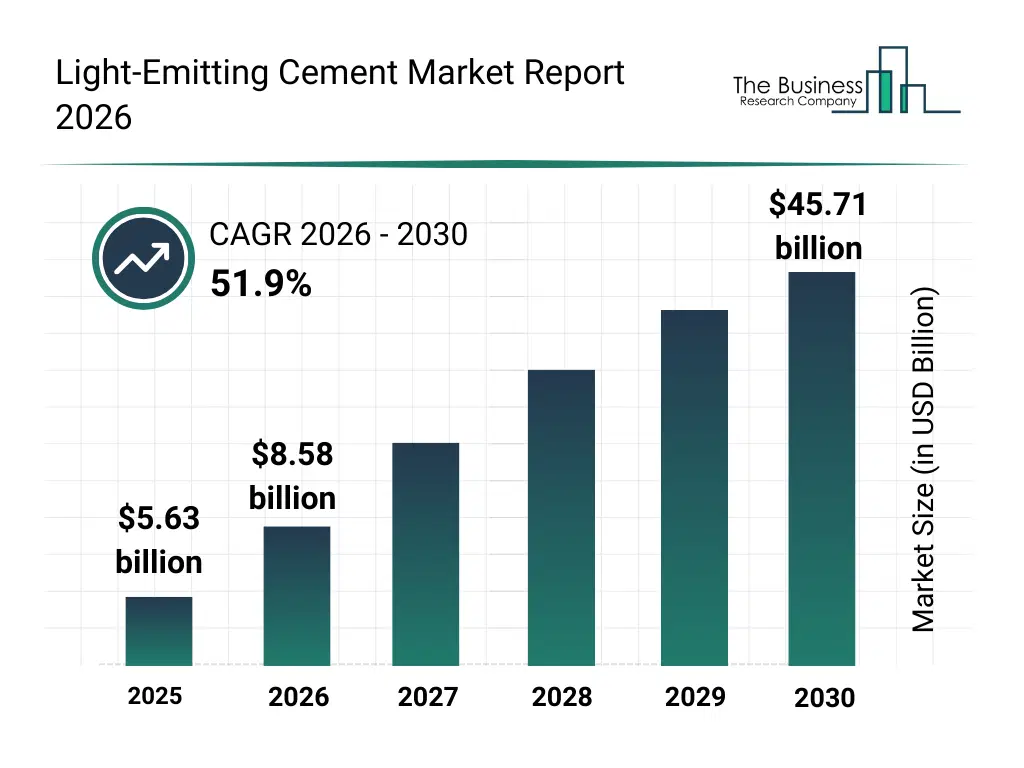
What Is The Light-Emitting Cement Market Size and Share 2026?
The light-emitting cement market size has grown exponentially in recent years. It will grow from $5.63 billion in 2025 to $8.58 billion in 2026 at a compound annual growth rate (CAGR) of 52.2%. The growth in the historic period can be attributed to rising use of photoluminescent materials in construction, increasing adoption of glow-in-the-dark panels, expansion of urban infrastructure applications, growing demand for energy-efficient concrete, focus on innovative building materials.What Is The Light-Emitting Cement Market Growth Forecast?
The light-emitting cement market size is expected to see exponential growth in the next few years. It will grow to $45.71 billion in 2030 at a compound annual growth rate (CAGR) of 51.9%. The growth in the forecast period can be attributed to increasing integration of IoT-enabled monitoring, growth in sustainable and eco-friendly cement solutions, rising adoption of self-illuminating paving and panels, development of high-performance light-emitting cement, expansion of modular and precast applications. Major trends in the forecast period include development of photoluminescent concrete panels, integration of AI-based light storage analysis, deployment of IOT-enabled energy monitoring, expansion of sustainable glow-in-the-dark cement materials, advancement of smart urban lighting applications.
Global Light-Emitting Cement Market Segmentation
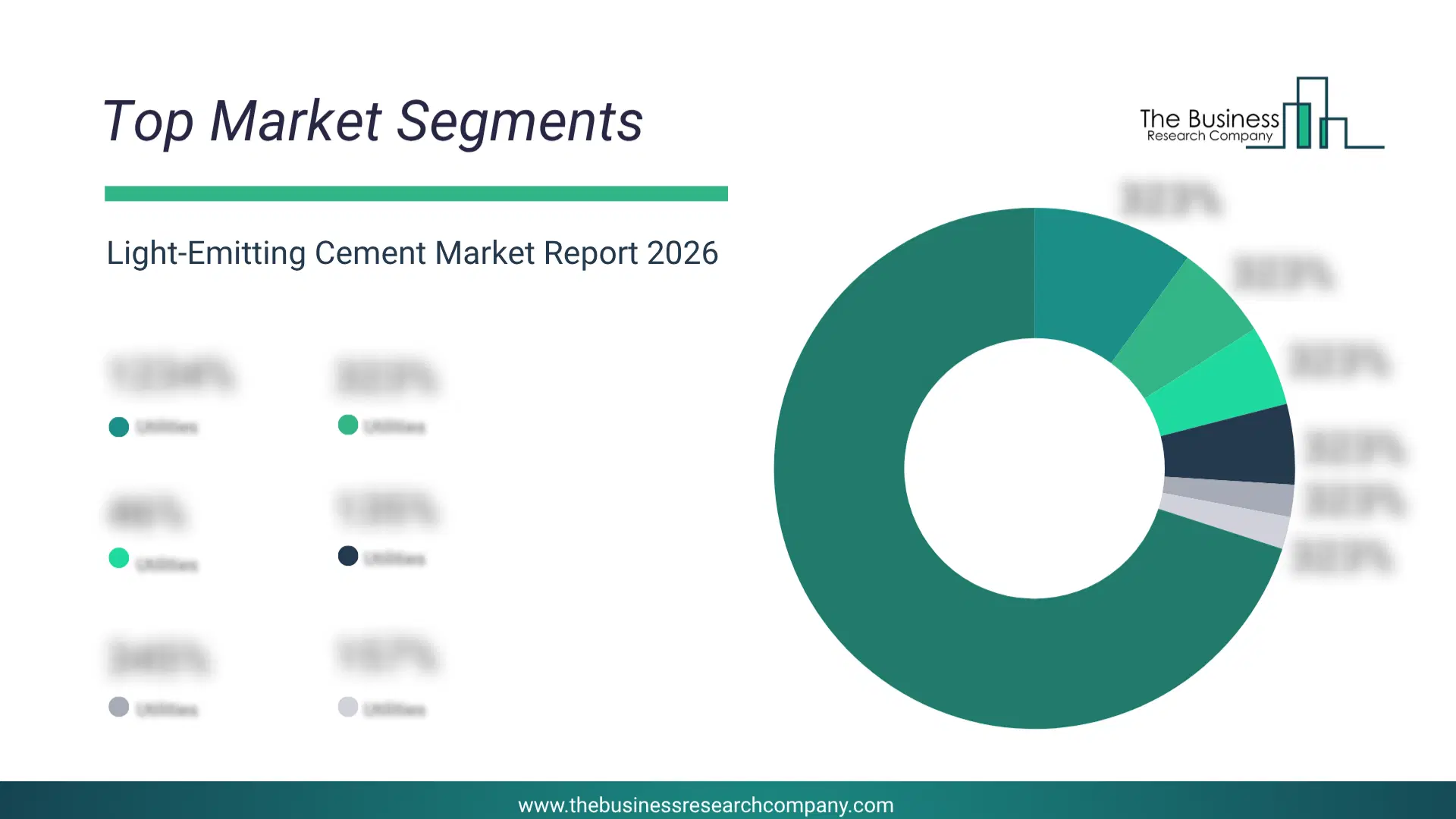
1) By Raw Material: Concrete, Fiber 2) By Application: Wall Cladding, Roofing, Flooring, Other Applications 3) By End User: Residential, Non Residential Subsegments: 1) By Concrete: Precast Concrete Panels, Reinforced Concrete, High-Performance Concrete, Lightweight Concrete, Ready-Mix Concrete, Self-Healing Concrete, Ultra-High Performance Concrete (UHPC), Recycled Aggregate Concrete 2) By Fiber: Glass Fiber, Carbon Fiber, Synthetic Fiber, Natural Fiber, Steel Fiber, Basalt Fiber, Aramid Fiber, Hybrid Fiber CompositesWhat Is The Driver Of The Light-Emitting Cement Market?
The growing residential construction sector is expected to drive the growth of the light-emitting cement market in the future. Residential construction involves the development or alteration of structures designed for human habitation, such as single-family homes, apartments, and various housing units. The residential construction is increasing due to rapid urbanization, as more people relocate to cities, driving demand for additional housing to support the expanding population. Light-emitting cement proves advantageous in residential construction by improving visibility at night, lowering dependence on artificial lighting, and promoting energy efficiency in outdoor and pathway spaces. For instance, in May 2024, according to the National Association of Realtors, a US-based trade association, the existing home sales increased by 9% in 2024 to reach 4.46 million, up from 4.09 million in 2023. Therefore, the growing residential construction is driving the growth of the light-emitting cement industry.What Is The Driver Of The Light-Emitting Cement Market?
The rising green construction is expected to propel the growth of the light-emitting cement market going forward. Green construction is the approach of developing buildings through processes that prioritize environmental sustainability and efficient use of resources throughout all phases, from planning to deconstruction. The rising green construction is due to increasing environmental awareness, as it plays a key role in cutting down carbon emissions and lessening the ecological footprint of buildings. Light-emitting cement supports green construction by decreasing the reliance on artificial lighting, which helps conserve energy and promotes eco-friendly building solutions. For instance, in December 2024, according to a report published by the Green Building Council Australia, an Australia-based government agency, the Australian building sector achieved a significant milestone by surpassing 1,000 buildings, fitouts, and precincts recognized with green star certification for their sustainability achievements in 2024. Additionally, the number of submissions for these certifications has doubled from 2023 levels, with more than 120 project applications and over 150 inquiries recorded in just three months. Therefore, the rising green construction is driving the growth of the light-emitting cement industry.What Is The Driver Of The Light-Emitting Cement Market?
The rising hospitality industry is anticipated to fuel the growth of the light-emitting cement market in the coming years. The hospitality industry includes businesses that offer services such as lodging, food and beverages, travel, and entertainment to provide comfort and satisfaction to customers. The hospitality industry is experiencing growth due to the rise in global tourism, as a growing number of individuals are traveling for both leisure and business, increasing the need for hotels, restaurants, and related services. Light-emitting cement adds value to the hospitality sector by improving the visual appeal and illumination of outdoor spaces at night, helping create an attractive and energy-efficient atmosphere for guests. For instance, in February 2025, according to a report published by the American Hotel and Lodging Association, a US-based hotel association, hotel occupancy in the United States is forecasted to climb to 63.38% in 2025, showing a gradual increase compared to 62.97% in 2023 and 63.01% in 2024. Therefore, the rising hospitality industry is driving the growth of the light-emitting cement industry.Key Players In The Global Light-Emitting Cement Market
Major companies operating in the light-emitting cement market are Cemex SAB De CV, Italcementi Spa, Pan-United Corporation Ltd., Orient Cement, Sanghi Industries, Chryso Inc., Florack Bauunternehmung GmbH, Naidu Consulting Ltd., Aarka Technology Pvt. Ltd., LUCCON Lichtbeton GmbH, LUCEM GmbH, LiTraCon Bt, Fapinex LLC, Glass Block Technology Limited, Kann GmbH, Nova Formworks Pvt. Ltd., Pavers India Company, Gravelli, LCT GesmbH, and Resocrete Composites.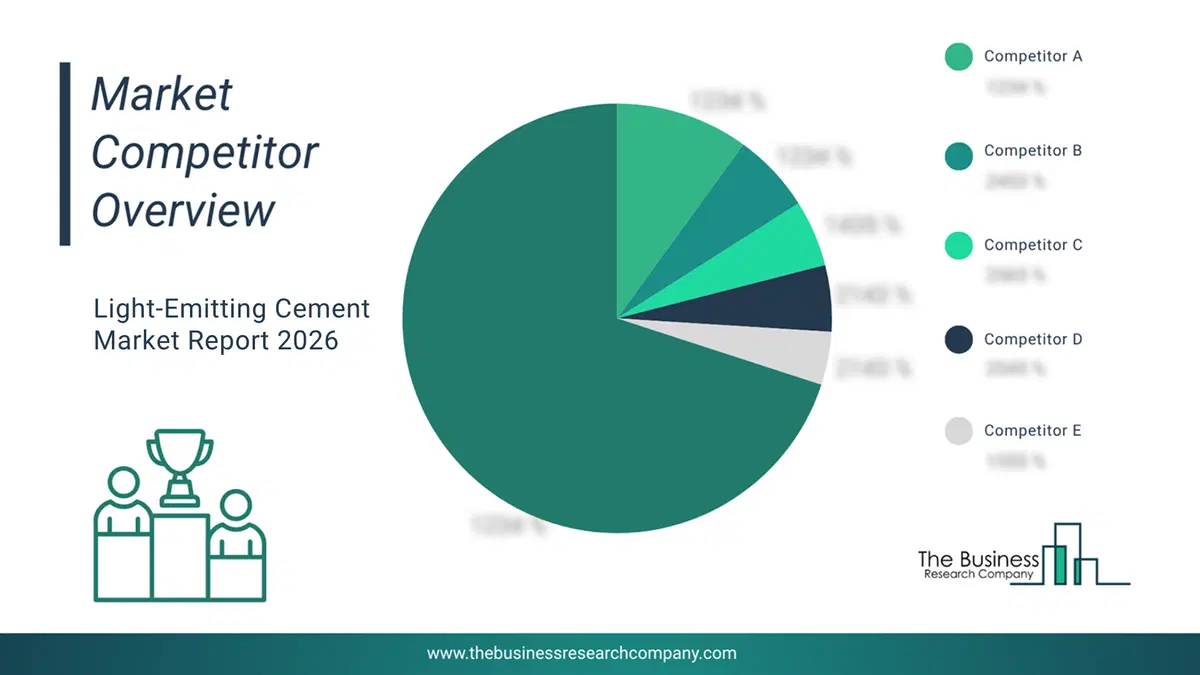
This chart is for illustrative purposes; the full report includes a detailed competitor analysis and comprehensive overview of the top 10 companies in the market.
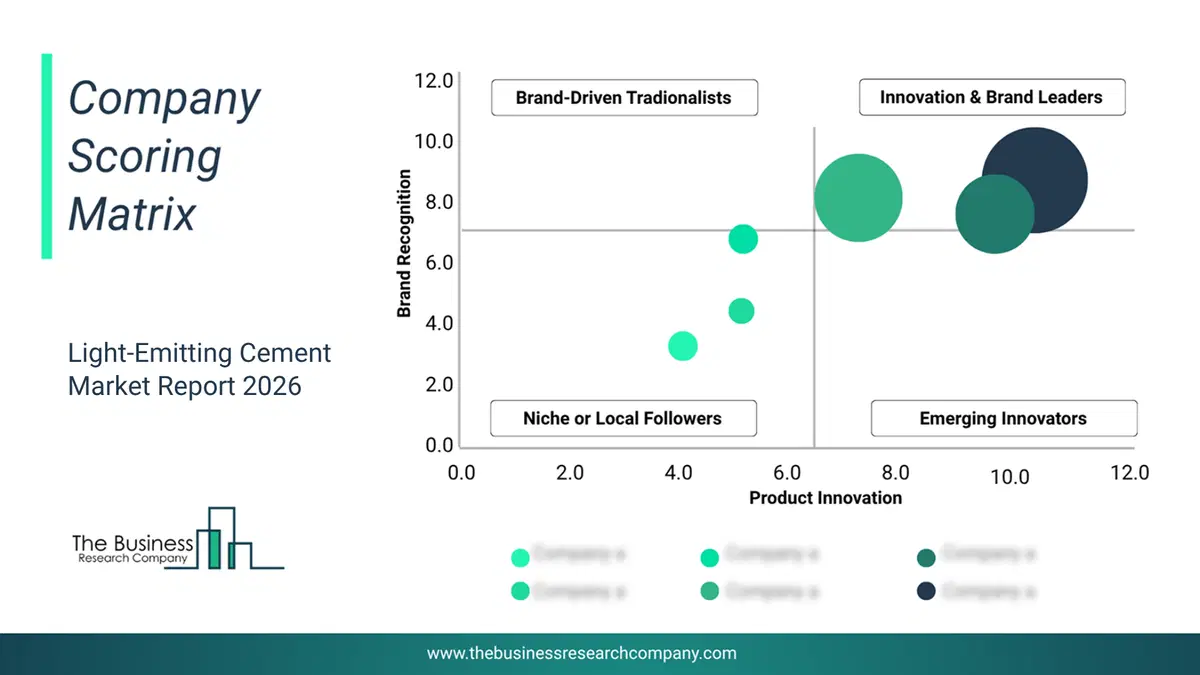
This chart maps companies by product innovation and brand strength, with bubble size indicating relative revenue, helping identify market leaders, challengers, and niche players. This is an illustrative chart; the full report provides a complete and accurate competitive analysis.
Regional Insights
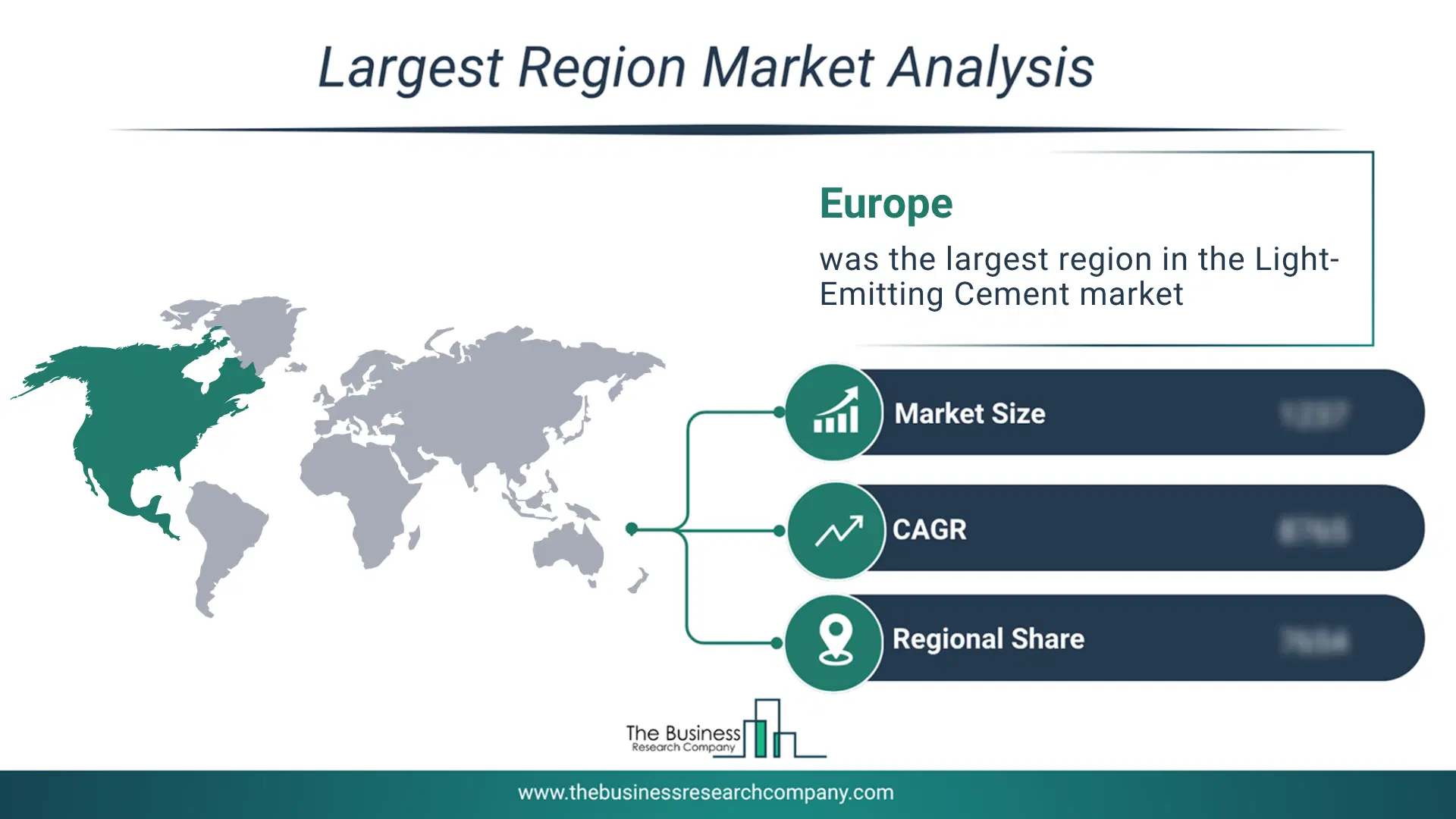
Europe was the largest region in the light-emitting cement market in 2025. The regions covered in this market report are Asia-Pacific, South East Asia, Western Europe, Eastern Europe, North America, South America, Middle East, Africa. The countries covered in this market report are Australia, Brazil, China, France, Germany, India, Indonesia, Japan, Taiwan, Russia, South Korea, UK, USA, Canada, Italy, Spain.What Defines the Light-Emitting Cement Market?
The light-emitting cement market consists of sales of glow-in-the-dark paving tiles, self-illuminating road surfaces, light-emitting concrete panels, and illuminated building blocks. Values in this market are ‘factory gate’ values, that is, the value of goods sold by the manufacturers or creators of the goods, whether to other entities (including downstream manufacturers, wholesalers, distributors, and retailers) or directly to end customers. The value of goods in this market includes related services sold by the creators of the goods.How is Market Value Defined and Measured?
The market value is defined as the revenues that enterprises gain from the sale of goods and/or services within the specified market and geography through sales, grants, or donations in terms of the currency (in USD unless otherwise specified). The revenues for a specified geography are consumption values that are revenues generated by organizations in the specified geography within the market, irrespective of where they are produced. It does not include revenues from resales along the supply chain, either further along the supply chain or as part of other products.
This chart presents market attractiveness based on a quantitative evaluation of growth, competition, strategic alignment, and risk, offering a clear view of opportunity areas for decision-making. This chart is for illustrative purposes; the full report contains the complete analysis.

This chart highlights the Total Addressable Market (TAM) by estimating the maximum revenue opportunity using an assumption-driven approach, supporting strategic planning and opportunity sizing across markets. The chart is illustrative; the full report provides a more comprehensive analysis.
What Key Data and Analysis Are Included in theLight-Emitting Cement Market Report 2026?
The light-emitting cement market research report is one of a series of new reports from The Business Research Company that provides market statistics, including industry global market size, regional shares, competitors with the market share, detailed market segments, market trends and opportunities, and any further data you may need to thrive in the light-emitting cement industry. The market research report delivers a complete perspective of everything you need, with an in-depth analysis of the current and future state of the industry.Light-Emitting Cement Market Report Forecast Analysis
| Report Attribute | Details |
|---|---|
| Market Size Value In 2026 | $8.58 billion |
| Revenue Forecast In 2030 | $45.71 billion |
| Growth Rate | CAGR of 52.2% from 2026 to 2030 |
| Base Year For Estimation | 2025 |
| Actual Estimates/Historical Data | 2020-2025 |
| Forecast Period | 2026 - 2030 |
| Market Representation | Revenue in USD Billion and CAGR from 2026 to 2030 |
| Segments Covered | Raw Material, Application, End User |
| Regional Scope | Asia-Pacific, Western Europe, Eastern Europe, North America, South America, Middle East, Africa |
| Country Scope | The countries covered in this market report are Australia, Brazil, China, France, Germany, India, Indonesia, Japan, Taiwan, Russia, South Korea, UK, USA, Canada, Italy, Spain |
| Key Companies Profiled | Cemex SAB De CV, Italcementi Spa, Pan-United Corporation Ltd., Orient Cement, Sanghi Industries, Chryso Inc., Florack Bauunternehmung GmbH, Naidu Consulting Ltd., Aarka Technology Pvt. Ltd., LUCCON Lichtbeton GmbH, LUCEM GmbH, LiTraCon Bt, Fapinex LLC, Glass Block Technology Limited, Kann GmbH, Nova Formworks Pvt. Ltd., Pavers India Company, Gravelli, LCT GesmbH, and Resocrete Composites. |
| Customization Scope | Request for Customization |
| Pricing And Purchase Options | Explore Purchase Options |