
Light Tactical Vehicle Market Report 2026
Global Outlook – By Vehicle Type (Armored Light Tactical Vehicles, Unarmored Light Tactical Vehicles), By Mobility (Four-Wheel-Drive Light Tactical Vehicles, Six-Wheel-Drive Light Tactical Vehicles), By Propulsion (Diesel, Hybrid, Electric), By Application (Troop Transport, Reconnaissance, Command And Control, Logistics And Cargo Transport, Patrol And Border Security, Medical Evacuation, Weapons Carrier), By End User (Defense, Law Enforcement, Commercial) – Market Size, Trends, Strategies, and Forecast to 2035
Light Tactical Vehicle Market Overview
• Light Tactical Vehicle market size has reached to $12.4 billion in 2025 • Expected to grow to $18.15 billion in 2030 at a compound annual growth rate (CAGR) of 7.8% • Growth Driver: Growing Geopolitical Tensions Driving The Growth Of The Market Due To Territorial And Maritime Disputes • Market Trend: Next-Generation Hybrid Platforms Support Modern Military Operations • North America was the largest region in 2025 and Asia-Pacific is the fastest growing region.What Is Covered Under Light Tactical Vehicle Market?
A light tactical vehicle (LTV) is a lightweight, highly mobile military vehicle designed to transport personnel, equipment, and supplies across challenging terrains while supporting tactical operations. It is engineered for enhanced maneuverability, survivability, and mission flexibility, often incorporating advanced protection systems, communication equipment, and off-road capabilities for combat and reconnaissance missions. The main vehicle types of light tactical vehicles include armored light tactical vehicles and unarmored light tactical vehicles. Armored light tactical vehicles refer to lightweight military vehicles equipped with protective armor to safeguard personnel and equipment against ballistic and battlefield threats while maintaining mobility across challenging terrain. These vehicles are available as four-wheel-drive light tactical vehicles and six-wheel-drive light tactical vehicles and use diesel, hybrid, and electric propulsion systems. They find application in troop transport, reconnaissance, command and control, logistics and cargo transport, patrol and border security, medical evacuation, and weapons carrier operations, serving end users including defense, law enforcement, and commercial sectors.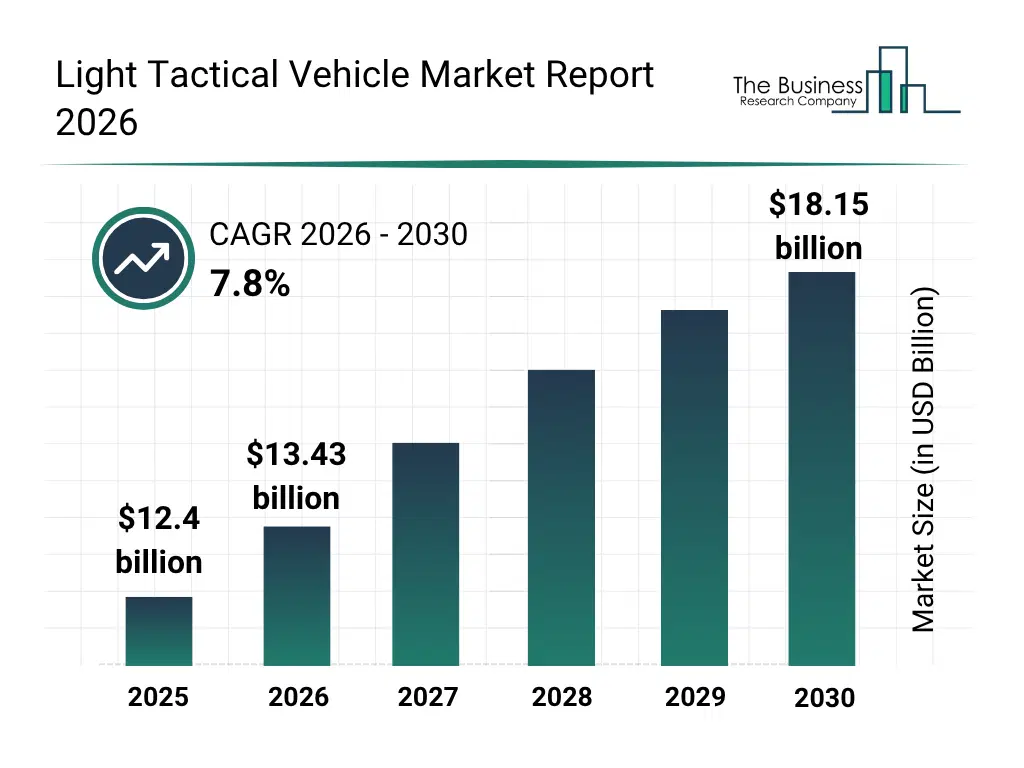
What Is The Light Tactical Vehicle Market Size and Share 2026?
The light tactical vehicle market size has grown strongly in recent years. It will grow from $12.4 billion in 2025 to $13.43 billion in 2026 at a compound annual growth rate (CAGR) of 8.3%. The growth in the historic period can be attributed to increasing military modernization programs, rising demand for tactical mobility, growing cross-border security requirements, increasing deployment of light tactical vehicles for reconnaissance missions, expanding defense procurement for troop and logistics transport.What Is The Light Tactical Vehicle Market Growth Forecast?
The light tactical vehicle market size is expected to see strong growth in the next few years. It will grow to $18.15 billion in 2030 at a compound annual growth rate (CAGR) of 7.8%. The growth in the forecast period can be attributed to increasing demand for enhanced battlefield survivability, rising requirement for multi-mission tactical platforms, growing adoption of lightweight vehicle architectures, increasing demand for extended operational range, expanding procurement of next-generation tactical fleets. Major trends in the forecast period include increasing adoption of modular light tactical vehicle platforms, rising demand for enhanced ballistic and mine protection, growing preference for lightweight high-strength vehicle materials, increasing demand for advanced off-road mobility and suspension systems, rising adoption of multi-mission configurable tactical vehicles.Tariff Impact On Light Tactical Vehicle Market
Tariffs are impacting the Light Tactical Vehicle market by increasing the cost of imported vehicle components, armor materials, powertrain systems, electronics, and specialized manufacturing equipment required for tactical vehicle production. This is increasing procurement and manufacturing costs for light tactical vehicle programs, particularly in regions dependent on imported defense components and specialized materials. Hardware-intensive segments such as armored vehicles, advanced propulsion systems, and tactical communication equipment are most affected due to global supply chain dependencies. However, tariffs are also encouraging local manufacturing, regional supplier diversification, and increased investment in domestic defense production ecosystems, creating long-term resilience in the market.
Global Light Tactical Vehicle Market Segmentation
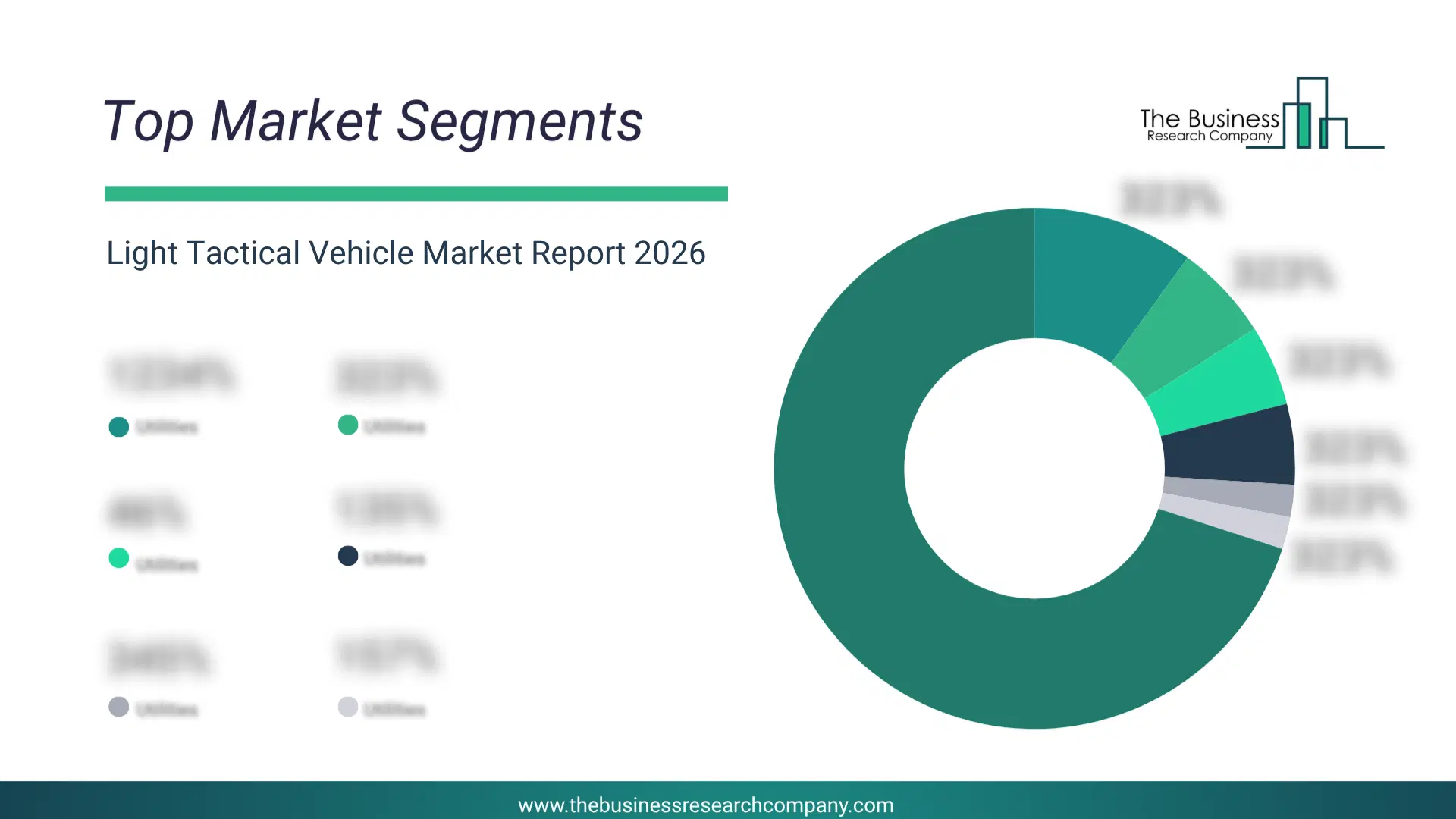
2) By Mobility: Four-Wheel-Drive Light Tactical Vehicles, Six-Wheel-Drive Light Tactical Vehicles 3) By Propulsion: Diesel, Hybrid, Electric 4) By Application: Troop Transport, Reconnaissance, Command And Control, Logistics And Cargo Transport, Patrol And Border Security, Medical Evacuation, Weapons Carrier 5) By End User: Defense, Law Enforcement, Commercial Subsegments: 1) By Armored Light Tactical Vehicles: Mine-Resistant Light Tactical Vehicles, Ballistic-Protected Patrol Vehicles, Armored Reconnaissance Vehicles, Armored Command And Liaison Vehicles, Armored Utility Tactical Vehicles 2) By Unarmored Light Tactical Vehicles: Utility Tactical Vehicles, Troop Carrier Vehicles, Cargo Tactical Vehicles, Reconnaissance Vehicles, Command And Liaison VehiclesWhat Is The Driver Of The Light Tactical Vehicle Market?
The growing geopolitical tensions are expected to propel the growth of the light tactical vehicle market going forward. Geopolitical tensions refer to rising political, military, or strategic conflicts and rivalries between nations or regions that increase security risks and defense preparedness. Geopolitical tensions are growing due to territorial and maritime disputes, where nations contest the ownership and control of land borders, islands, and strategic sea areas, leading to prolonged regional conflicts and security concerns. Growing geopolitical tensions are driving demand for light tactical vehicles by increasing defense spending, military modernization programs, border security operations, and rapid deployment capabilities for armed forces. For instance, in June 2026, according to the Stockholm International Peace Research Institute (SIPRI), a Sweden-based independent nonprofit research institute, 49 states experienced armed conflict in 2025, while the number of interstate armed conflicts doubled from three in 2024 to six in 2025, involving at least 13 states. Therefore, the growing geopolitical tensions are driving the growth of the light tactical vehicle industry.Key Players In The Global Light Tactical Vehicle Market
Major companies operating in the light tactical vehicle market are General Dynamics Corporation, BAE Systems plc, RTX Corporation, Lockheed Martin Corporation, Rheinmetall AG, Krauss-Maffei Wegmann GmbH & Co. KG, Leonardo S.p.A., Thales Group, Airbus SE, Textron Inc., Oshkosh Corporation, AM General LLC, Elbit Systems Ltd., Navistar International Corporation, PT Pindad, Tata Advanced Systems Limited, Bharat Forge Limited, Mahindra & Mahindra Limited, Ashok Leyland Limited, ST Engineering Ltd, Hanwha Aerospace Co. Ltd., Mitsubishi Heavy Industries Ltd., Hyundai Rotem Company, EDGE Group PJSC, KNDS N.V., John Cockerill SA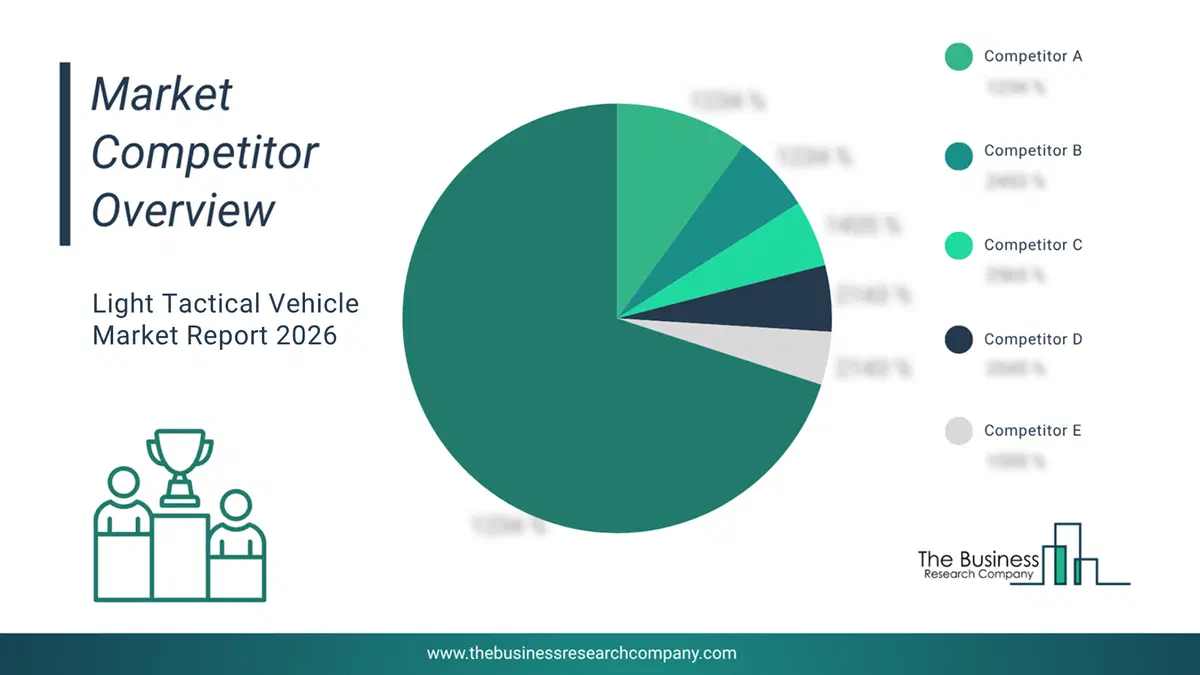
This chart is for illustrative purposes; the full report includes a detailed competitor analysis and comprehensive overview of the top 10 companies in the market.
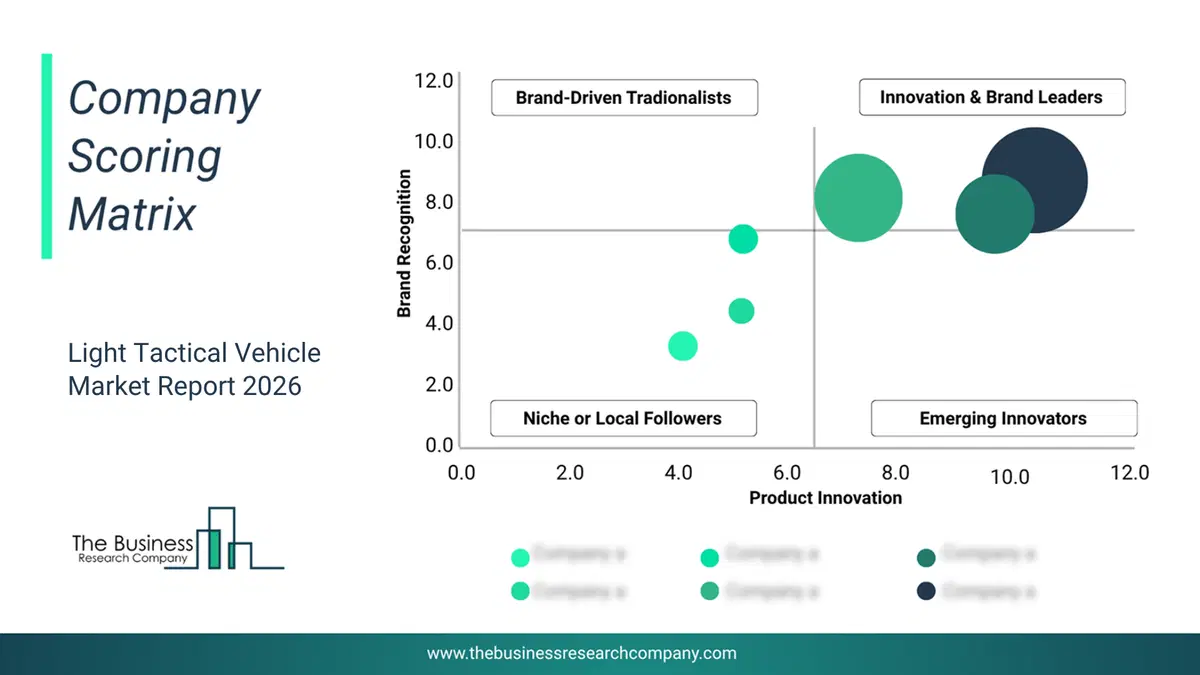
This chart maps companies by product innovation and brand strength, with bubble size indicating relative revenue, helping identify market leaders, challengers, and niche players. This is an illustrative chart; the full report provides a complete and accurate competitive analysis.
Global Light Tactical Vehicle Market Trends and Insights
Major companies operating in the light tactical vehicle market are focusing on developing innovative platforms, such as hybrid tactical vehicle platforms, to enhance battlefield mobility, fuel efficiency, stealth operations, and onboard power generation for modern military missions. Hybrid tactical vehicle platforms integrate diesel-powered engines with electric propulsion systems and advanced battery packs, enabling silent drive, silent watch, extended operational range, and exportable electrical power while reducing fuel consumption and acoustic and thermal signatures compared to conventional light tactical vehicles powered solely by internal combustion engines. For instance, in January 2025, General Motors Defense LLC, a US-based defense technology company, launched the Next Generation Tactical Vehicle-Hybrid (NGTV-H), an advanced light tactical vehicle designed to meet evolving military mobility requirements. The NGTV-H combines a 2.8L Duramax turbo-diesel engine, a 12-module battery pack, and electric drive motors to deliver hybrid propulsion with enhanced operational efficiency. It supports Silent Drive and Silent Watch modes, allowing troops to move and operate with reduced acoustic and thermal signatures in contested environments. The vehicle also provides exportable onboard power for mission systems, sensors, communications equipment, and unmanned platforms while offering greater mission endurance than conventional tactical vehicles. Built on proven commercial truck technology, it is available in multiple seating configurations, is autonomy-ready, is armor-capable, and can be configured for missions including command and control, reconnaissance, casualty evacuation, counter-unmanned systems, and network extension, providing greater operational flexibility for modern armed forces.What Are Latest Mergers And Acquisitions In The Light Tactical Vehicle Market?
In October 2025, AM General, a US-based military mobility solutions provider, collaborated with Marshall Land Systems to prepare for the upcoming United Kingdom Land Mobility Programme solicitation. With this collaboration, AM General aims to combine its manufacturing, engineering, and aftermarket support capabilities with Marshall Land Systems’ vehicle assembly, systems integration, and in-service support expertise to strengthen its offering for the UK Ministry of Defense and support long-term regional development in the UK. Marshall Land Systems is a UK-based defense contractor specializing in vehicle assembly, systems integration, and in-service support for the UK Armed Forces.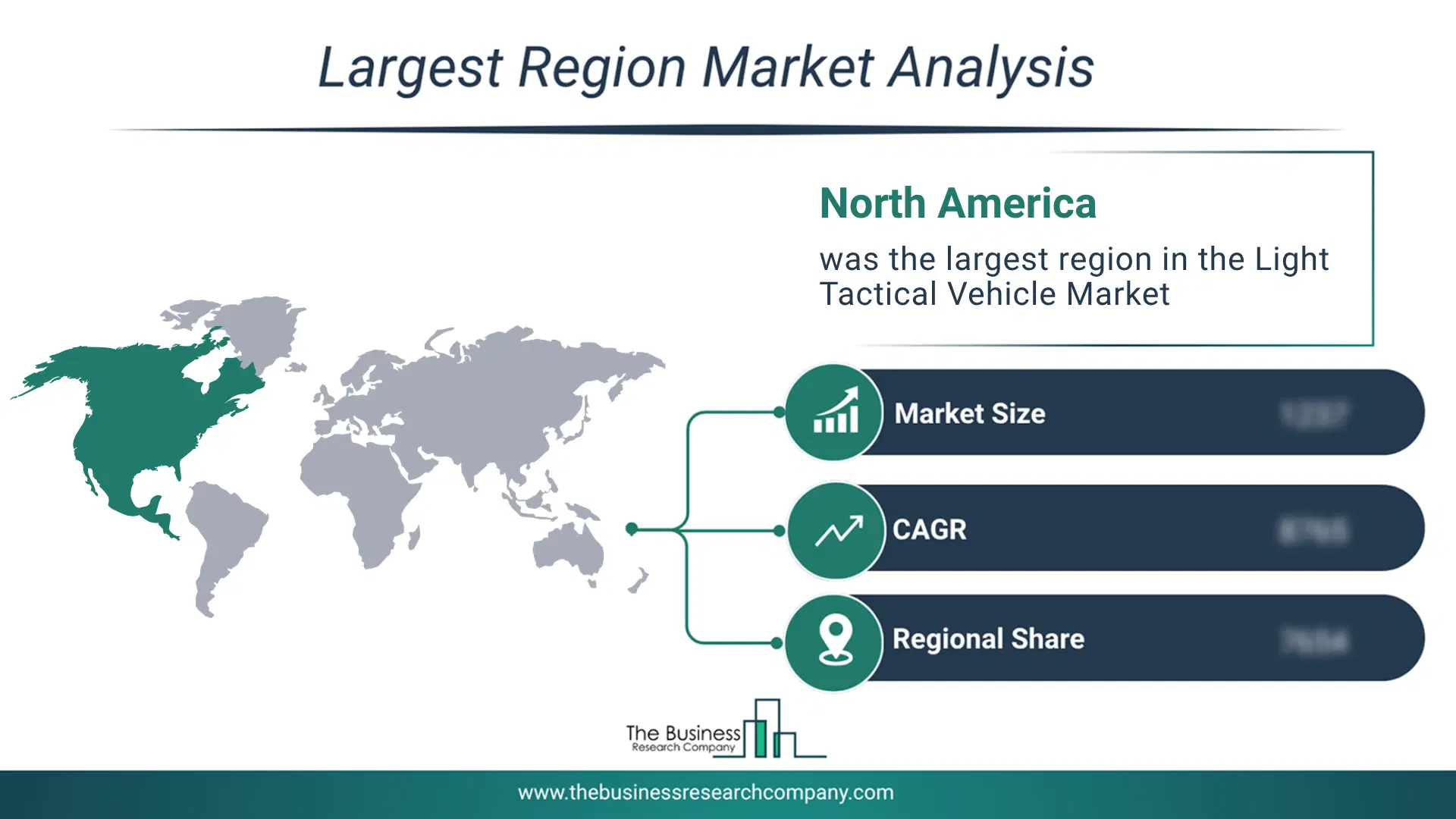
Regional Outlook/Insights
North America was the largest region in the light tactical vehicle market in 2025. Asia-Pacific is expected to be the fastest-growing region in the forecast period. The regions covered in this market report are Asia-Pacific, South East Asia, Western Europe, Eastern Europe, North America, South America, Middle East, Africa. The countries covered in this market report are Australia, Brazil, China, France, Germany, India, Indonesia, Japan, Taiwan, Russia, South Korea, UK, USA, Canada, Italy, Spain.What Defines the Light Tactical Vehicle Market?
The light tactical vehicle market consists of sales of tactical personnel carriers, tactical cargo vehicles, reconnaissance vehicles, command and communication vehicles, and special operations vehicles. Values in this market are ‘factory gate’ values, that is, the value of goods sold by the manufacturers or creators of the goods, whether to other entities (including downstream manufacturers, wholesalers, distributors, and retailers) or directly to end customers. The value of goods in this market includes related services sold by the creators of the goods.How is Market Value Defined and Measured?
The market value is defined as the revenues that enterprises gain from the sale of goods and/or services within the specified market and geography through sales, grants, or donations in terms of the currency (in USD unless otherwise specified). The revenues for a specified geography are consumption values that are revenues generated by organizations in the specified geography within the market, irrespective of where they are produced. It does not include revenues from resales along the supply chain, either further along the supply chain or as part of other products.
This chart presents market attractiveness based on a quantitative evaluation of growth, competition, strategic alignment, and risk, offering a clear view of opportunity areas for decision-making. This chart is for illustrative purposes; the full report contains the complete analysis.

This chart highlights the Total Addressable Market (TAM) by estimating the maximum revenue opportunity using an assumption-driven approach, supporting strategic planning and opportunity sizing across markets. The chart is illustrative; the full report provides a more comprehensive analysis.
What Key Data and Analysis Are Included in the Light Tactical Vehicle Market Report 2026?
The light tactical vehicle market research report is one of a series of new reports from The Business Research Company that provides market statistics, including industry global market size, regional shares, competitors with the market share, detailed market segments, market trends and opportunities, and any further data you may need to thrive in the light tactical vehicle industry. The market research report delivers a complete perspective of everything you need, with an in-depth analysis of the current and future state of the industry.Light Tactical Vehicle Market Report Forecast Analysis
| Report Attribute | Details |
|---|---|
| Market Size Value In 2026 | $13.43 billion |
| Revenue Forecast In 2030 | $18.15 billion |
| Growth Rate | CAGR of 7.8% from 2026 to 2035 |
| Base Year For Estimation | 2025 |
| Actual Estimates/Historical Data | 2020-2025 |
| Forecast Period | 2026 - 2030 |
| Market Representation | Revenue in USD Billion and CAGR from 2026 to 2030 |
| Segments Covered | Vehicle Type, Mobility, Propulsion, Application, End User |
| Regional Scope | Asia-Pacific, Western Europe, Eastern Europe, North America, South America, Middle East, Africa |
| Country Scope | The countries covered in the report are Australia, Brazil, China, France, Germany, India, Indonesia, Japan, Taiwan, Russia, South Korea, UK, USA, Canada, Italy, Spain. |
| Customization Scope | Request for Customization |
| Pricing And Purchase Options | Explore Purchase Options |