
Light Vehicle Fuel Injection Market Report 2026
Global Outlook – By Type (Gasoline Port Fuel Injection (PFI), Gasoline Direct Injection (GDI), Common Rail Direct Injection (CRDI), Throttle Body Injection (TBI)), By Component (Fuel Injectors, Fuel Pump, Fuel Rail, Fuel Pressure Regulator, Electronic Control Unit (ECU), Fuel Filters, Fuel Injection Sensors), By Fuel Type (Diesel, Compressed Natural Gas, Liquefied Petroleum Gas, Ethanol Or Flex-Fuel, Hydrogen), By Sales Channel (Original Equipment Manufacturer (OEM), Aftermarket) – Market Size, Trends, Strategies, and Forecast to 2030
Light Vehicle Fuel Injection Market Overview
• Light Vehicle Fuel Injection market size has reached to $33.62 billion in 2025 • Expected to grow to $45.44 billion in 2030 at a compound annual growth rate (CAGR) of 6.1% • Growth Driver: Surge In Demand For Fuel-efficient Light Vehicles Fueling The Growth Of The Market Due To Rising Fuel Costs • Market Trend: Advancements In High-Pressure Gasoline Direct Injection Technology Support Fuel Efficiency And Future Emissions Compliance • Asia-Pacific was the largest region and fastest growing region.What Is Covered Under Light Vehicle Fuel Injection Market?
Light vehicle fuel injection is the system that precisely delivers the required amount of fuel into the engine's intake manifold or combustion chamber in passenger cars and light commercial vehicles. It optimizes the air-fuel mixture to ensure efficient combustion, improve engine performance, enhance fuel economy, and reduce exhaust emissions while supporting compliance with emission regulations. The main types of light vehicle fuel injection include gasoline port fuel injection (PFI), gasoline direct injection (GDI), common rail direct injection (CRDI), and throttle body injection (TBI). Gasoline port fuel injection (PFI) refers to a fuel delivery system that injects gasoline into the intake port near the engine's intake valve, enabling controlled fuel-air mixing and combustion. These systems consist of components such as fuel injectors, fuel pump, fuel rail, fuel pressure regulator, electronic control unit (ECU), fuel filters, and fuel injection sensors, and support fuel types such as diesel, compressed natural gas, liquefied petroleum gas, ethanol or flex-fuel, and hydrogen. They are sold through channels such as original equipment manufacturer (OEM) and aftermarket.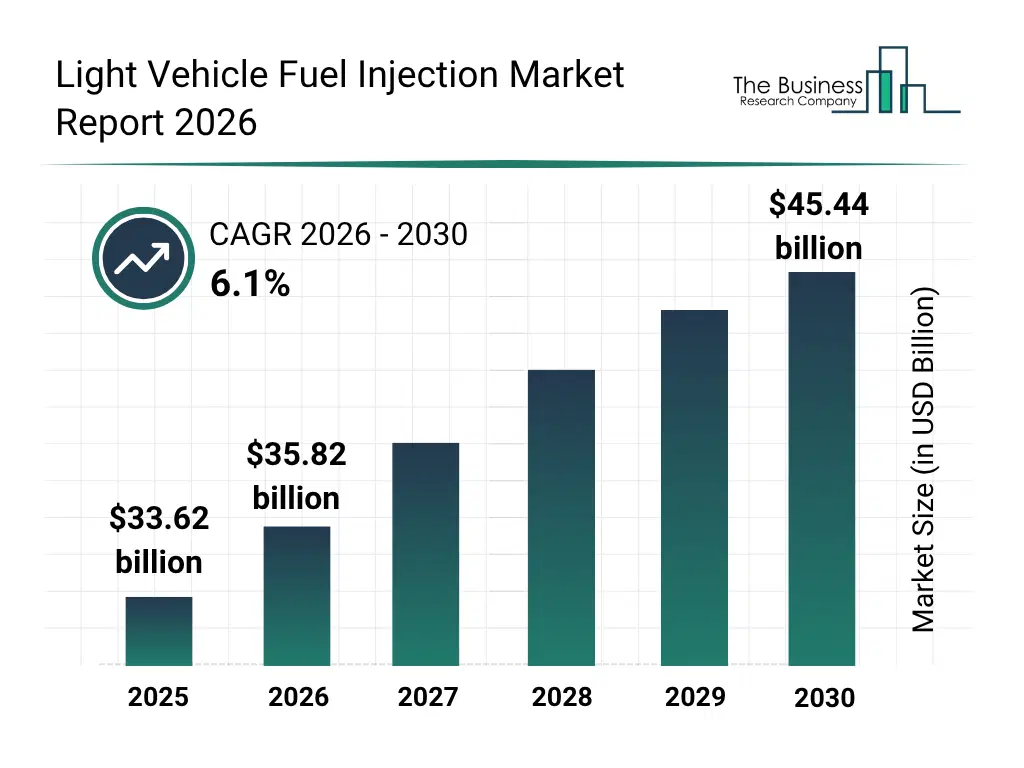
What Is The Light Vehicle Fuel Injection Market Size and Share 2026?
The light vehicle fuel injection market size has grown strongly in recent years. It will grow from $33.62 billion in 2025 to $35.82 billion in 2026 at a compound annual growth rate (CAGR) of 6.6%. The growth in the historic period can be attributed to growth in passenger vehicle production, expansion of light commercial vehicle fleets, increasing adoption of electronic fuel injection systems, stricter vehicle emission regulations, rising demand for improved fuel economy.What Is The Light Vehicle Fuel Injection Market Growth Forecast?
The light vehicle fuel injection market size is expected to see strong growth in the next few years. It will grow to $45.44 billion in 2030 at a compound annual growth rate (CAGR) of 6.1%. The growth in the forecast period can be attributed to increasing demand for low-emission internal combustion engines, rising adoption of gasoline direct injection systems, growing demand for advanced fuel injectors, increasing integration of electronically controlled fuel systems, expansion of alternative-fuel light vehicles. Major trends in the forecast period include increasing adoption of high-pressure fuel injection systems, development of advanced multi-hole fuel injectors, rising use of gasoline direct injection systems, increasing integration of variable fuel pressure control, development of compact and lightweight fuel injection components.Tariff Impact On Light Vehicle Fuel Injection Market
Tariffs are impacting the light vehicle fuel injection market by increasing the cost of imported fuel injectors, fuel pumps, fuel rails, sensors, electronic control units, and other precision automotive components required for fuel injection systems. This is raising vehicle component costs and affecting supply chains for passenger cars and light commercial vehicles, particularly in regions dependent on imported automotive components such as Asia-Pacific, Europe, and North America. Component-intensive segments such as electronic control units, fuel injectors, and fuel injection sensors are most affected due to their reliance on specialized semiconductor and precision manufacturing inputs. However, tariffs are also encouraging local component production, regional supplier diversification, domestic sourcing, and investment in localized automotive manufacturing capabilities.
Global Light Vehicle Fuel Injection Market Segmentation
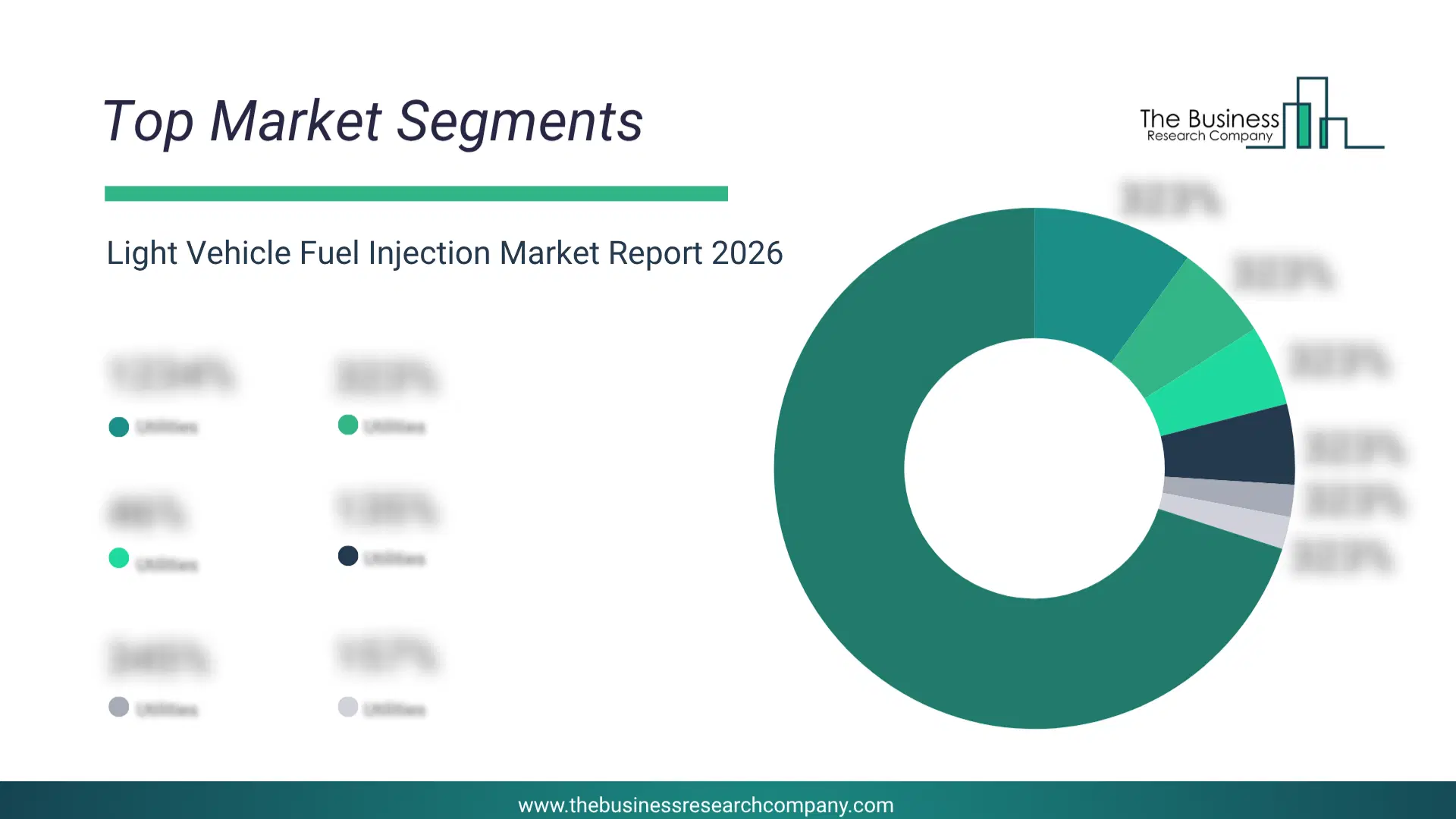
1) By Type: Gasoline Port Fuel Injection (PFI), Gasoline Direct Injection (GDI), Common Rail Direct Injection (CRDI), Throttle Body Injection (TBI) 2) By Component: Fuel Injectors, Fuel Pump, Fuel Rail, Fuel Pressure Regulator, Electronic Control Unit (ECU), Fuel Filters, Fuel Injection Sensors 3) By Fuel Type: Diesel, Compressed Natural Gas, Liquefied Petroleum Gas, Ethanol Or Flex-Fuel, Hydrogen 4) By Sales Channel: Original Equipment Manufacturer (OEM), Aftermarket Subsegments: 1) By Gasoline Port Fuel Injection (PFI): Single Point Port Injection, Multi Point Port Injection, Sequential Port Injection 2) By Gasoline Direct Injection (GDI): Wall Guided Direct Injection, Spray Guided Direct Injection, Air Guided Direct Injection 3) By Common Rail Direct Injection (CRDI): Solenoid Injector Systems, Piezoelectric Injector Systems 4) By Throttle Body Injection (TBI): Single Injector Throttle Body Injection, Dual Injector Throttle Body InjectionWhat Is The Driver Of The Light Vehicle Fuel Injection Market?
The increasing demand for fuel-efficient light vehicles is expected to propel the growth of the light vehicle fuel injection market going forward. Fuel-efficient light vehicles refer to passenger cars and light-duty vehicles designed to maximize fuel economy by consuming less fuel while maintaining driving performance and meeting emission standards. The increasing demand for fuel-efficient light vehicles is driven by rising fuel costs, as consumers increasingly prefer vehicles that consume less fuel and reduce overall operating expenses. This vehicle demand supports light vehicle fuel injection by accelerating the adoption of advanced fuel injection systems that precisely control fuel delivery, improve combustion efficiency, reduce emissions, and enhance engine performance. For instance, in February 2026, according to the U.S. Environmental Protection Agency, a US-based federal agency, the average real-world fuel economy of new model year 2024 vehicles increased by 0.1 mpg to a record 27.2 mpg, reflecting the continued improvement in vehicle fuel efficiency. Therefore, the increasing demand for fuel-efficient light vehicles is driving the growth of the light vehicle fuel injection industry.Key Players In The Global Light Vehicle Fuel Injection Market
Major companies operating in the light vehicle fuel injection market are Robert Bosch GmbH, DENSO Corporation, BorgWarner Inc., Marelli Holdings Co. Ltd., Hitachi Astemo Ltd., Rheinmetall AG, Sensata Technologies Inc., PHINIA Inc., Aisan Industry Co. Ltd., Standard Motor Products Inc., Shindengen Electric Manufacturing Co. Ltd., Stanadyne LLC, UCAL Limited, Dell'Orto S.p.A., GB Remanufacturing Inc.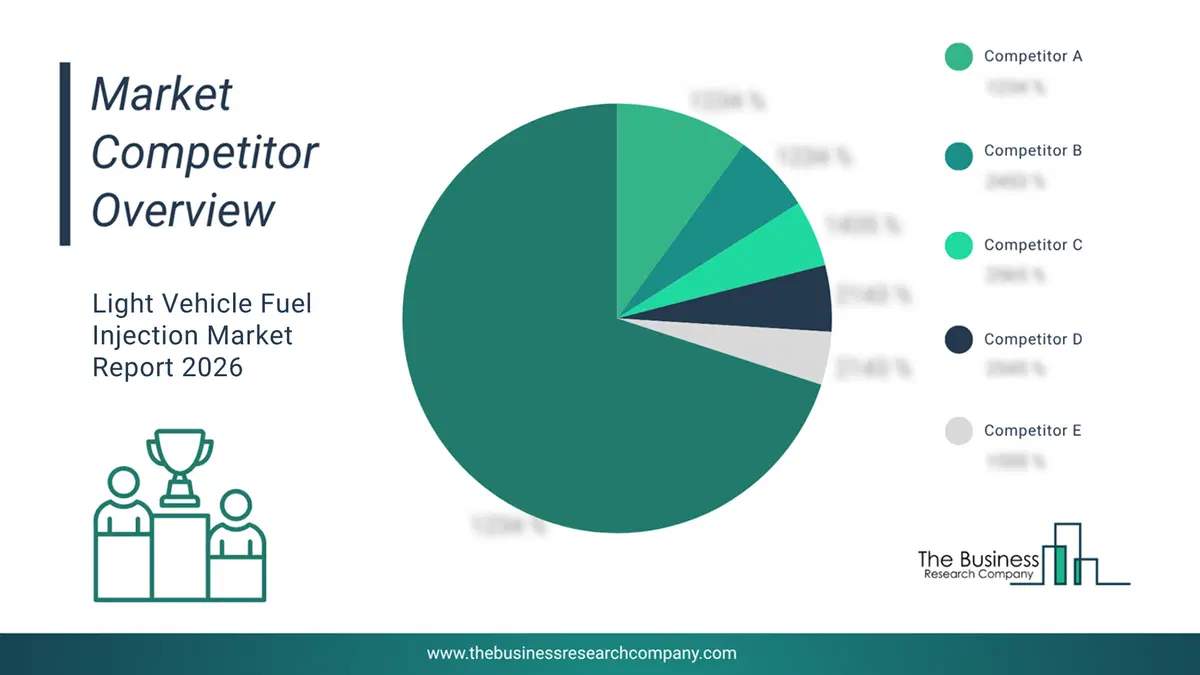
This chart is for illustrative purposes; the full report includes a detailed competitor analysis and comprehensive overview of the top 10 companies in the market.
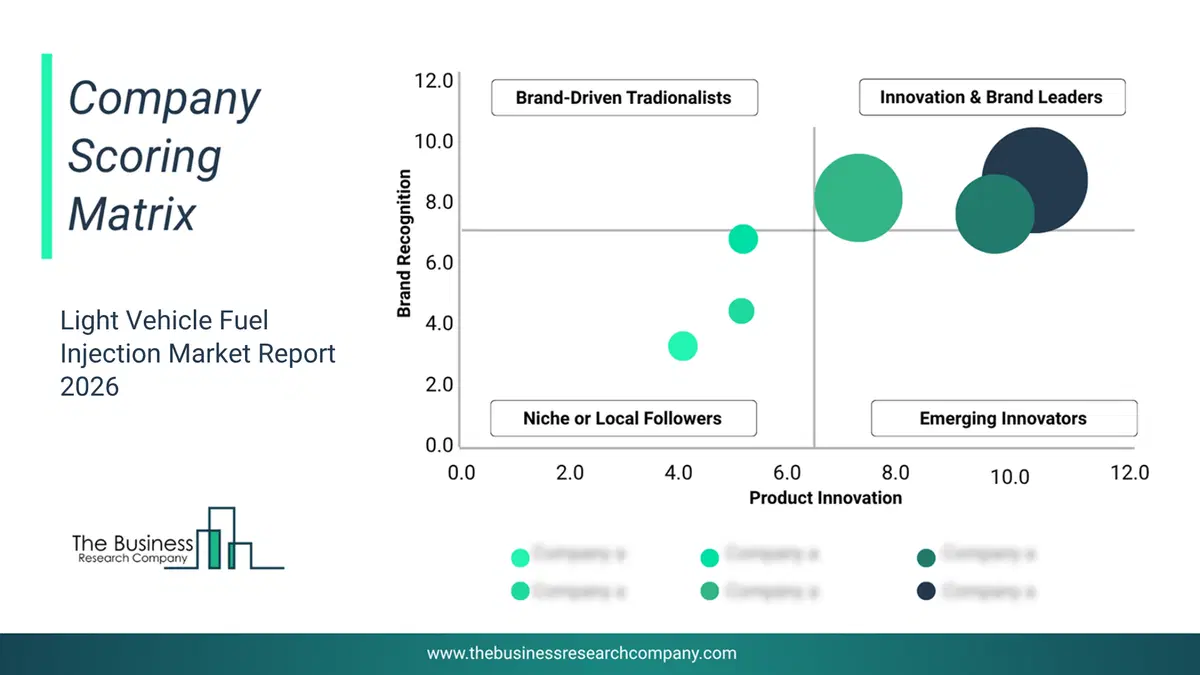
This chart maps companies by product innovation and brand strength, with bubble size indicating relative revenue, helping identify market leaders, challengers, and niche players. This is an illustrative chart; the full report provides a complete and accurate competitive analysis.
Global Light Vehicle Fuel Injection Market Trends and Insights
Major companies operating in the light vehicle fuel injection market are focusing on developing advanced high-pressure gasoline direct injection systems to improve fuel efficiency, reduce particulate emissions, and support compliance with future vehicle emission standards. High-pressure gasoline direct injection systems are fuel delivery technologies that inject fuel directly into the combustion chamber at elevated pressures, enabling finer fuel atomization, improved combustion efficiency, and lower emissions. For instance, in April 2026, PHINIA Inc., a US-based fuel systems manufacturer, unveiled its 500bar+ gasoline direct injection (GDI) system at Auto China 2026. The system incorporates advanced software and optimized fuel injection technology to enhance fuel atomization, improve fuel efficiency, and reduce particulate emissions. It also supports compliance with future emission regulations while featuring methanol and ethanol injection solutions to enable multi-fuel vehicle applications.What Are Latest Mergers And Acquisitions In The Light Vehicle Fuel Injection Market?
In January 2025, Phinia Inc., a US-based manufacturer of light vehicle fuel injection systems, partnered with Alpine Racing to support the development of the Alpenglow hydrogen-powered prototype using advanced hydrogen fuel injection technology. Through this partnership, PHINIA and Automobiles Alpine aim to advance hydrogen-powered light vehicle technology by developing and validating advanced hydrogen fuel injection systems for high-performance internal combustion engines. Alpine Racing is a France-based motorsports company.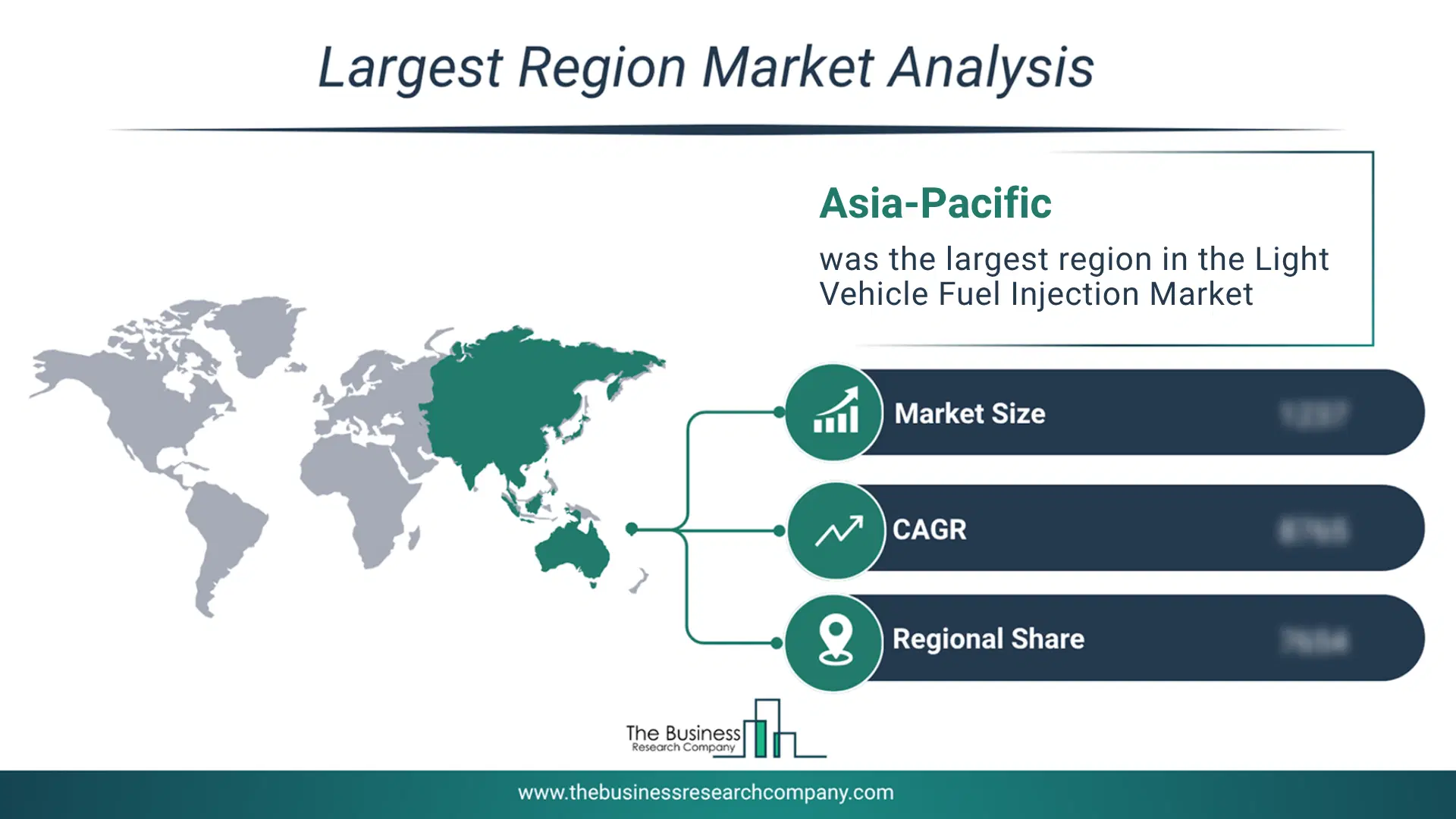
Regional Outlook
Asia-Pacific was the largest region in the light vehicle fuel injection market in 2025. Asia-Pacific is expected to be the fastest-growing region in the forecast period. The regions covered in this market report are Asia-Pacific, South East Asia, Western Europe, Eastern Europe, North America, South America, Middle East, Africa. The countries covered in this market report are Australia, Brazil, China, France, Germany, India, Indonesia, Japan, Taiwan, Russia, South Korea, UK, USA, Canada, Italy, Spain.What Defines the Light Vehicle Fuel Injection Market?
The light vehicle fuel injection market consists of sales of manifold absolute pressure sensor, injector seal, injector connector, and pressure relief valve. Values in this market are ‘factory gate’ values, that is, the value of goods sold by the manufacturers or creators of the goods, whether to other entities (including downstream manufacturers, wholesalers, distributors, and retailers) or directly to end customers. The value of goods in this market includes related services sold by the creators of the goods.How is Market Value Defined and Measured?
The market value is defined as the revenues that enterprises gain from the sale of goods and/or services within the specified market and geography through sales, grants, or donations in terms of the currency (in USD unless otherwise specified). The revenues for a specified geography are consumption values that are revenues generated by organizations in the specified geography within the market, irrespective of where they are produced. It does not include revenues from resales along the supply chain, either further along the supply chain or as part of other products.
This chart presents market attractiveness based on a quantitative evaluation of growth, competition, strategic alignment, and risk, offering a clear view of opportunity areas for decision-making. This chart is for illustrative purposes; the full report contains the complete analysis.

This chart highlights the Total Addressable Market (TAM) by estimating the maximum revenue opportunity using an assumption-driven approach, supporting strategic planning and opportunity sizing across markets. The chart is illustrative; the full report provides a more comprehensive analysis.
What Key Data and Analysis Are Included in the Light Vehicle Fuel Injection Market Report 2026?
The light vehicle fuel injection market research report is one of a series of new reports from The Business Research Company that provides market statistics, including industry global market size, regional shares, competitors with the market share, detailed market segments, market trends and opportunities, and any further data you may need to thrive in the light vehicle fuel injection industry. The market research report delivers a complete perspective of everything you need, with an in-depth analysis of the current and future state of the industry.Light Vehicle Fuel Injection Market Report Forecast Analysis
| Report Attribute | Details |
|---|---|
| Market Size Value In 2026 | $35.82 billion |
| Revenue Forecast In 2030 | $45.44 billion |
| Growth Rate | CAGR of 6.1% from 2026 to 2030 |
| Base Year For Estimation | 2025 |
| Actual Estimates/Historical Data | 2020-2025 |
| Forecast Period | 2026 - 2030 |
| Market Representation | Revenue in USD Billion and CAGR from 2026 to 2030 |
| Segments Covered | Type, Component, Fuel Type, Sales Channel |
| Regional Scope | Asia-Pacific, Western Europe, Eastern Europe, North America, South America, Middle East, Africa |
| Country Scope | The countries covered in the report are Australia, Brazil, China, France, Germany, India, Indonesia, Japan, Taiwan, Russia, South Korea, UK, USA, Canada, Italy, Spain. |
| Key Companies Profiled | Robert Bosch GmbH, DENSO Corporation, BorgWarner Inc., Marelli Holdings Co. Ltd., Hitachi Astemo Ltd., Rheinmetall AG, Sensata Technologies Inc., PHINIA Inc., Aisan Industry Co. Ltd., Standard Motor Products Inc., Shindengen Electric Manufacturing Co. Ltd., Stanadyne LLC, UCAL Limited, Dell'Orto S.p.A., GB Remanufacturing Inc. |
| Customization Scope | Request for Customization |
| Pricing And Purchase Options | Explore Purchase Options |