
Lighting Energy Analytics Market Report 2026
Global Outlook – By Component (Software, Hardware, Services), By Deployment Mode (Cloud Based, On Premise, Hybrid), By Application (Commercial, Industrial, Residential, Government And Public Infrastructure, Other Applications), By End User (Retail, Healthcare, Education, Hospitality, Manufacturing, Other End Users) – Market Size, Trends, Strategies, and Forecast to 2030
Lighting Energy Analytics Market Overview
• Lighting Energy Analytics market size has reached to $4.64 billion in 2025 • Expected to grow to $9.41 billion in 2030 at a compound annual growth rate (CAGR) of 15.3% • Growth Driver: Rise In Demand For Energy Efficiency In Buildings Driving The Growth Of The Market Due To Rising Energy Costs And Operational Savings • North America was the largest region in 2025 and Asia-Pacific is the fastest growing region.What Is Covered Under Lighting Energy Analytics Market?
Lighting energy analytics refers to the application of data-driven tools and systems to monitor and evaluate energy consumption in lighting infrastructure. It enables the collection and analysis of usage patterns, performance metrics, and efficiency indicators through sensors, smart meters, and software platforms. The system integrates analytical and monitoring technologies to optimize lighting performance, reduce energy costs, and support informed decision-making for sustainable lighting management. The main components of lighting energy analytics are software, hardware, and services. Software refers to digital solutions that monitor, analyze, and optimize lighting energy consumption to improve efficiency and reduce costs. These solutions are deployed through various deployment modes, including cloud-based, on-premise, and hybrid. They are used across multiple applications, such as commercial, industrial, residential, government and public infrastructure, and other applications, and serve a range of end-users, including retail, healthcare, education, hospitality, manufacturing, and other end-users.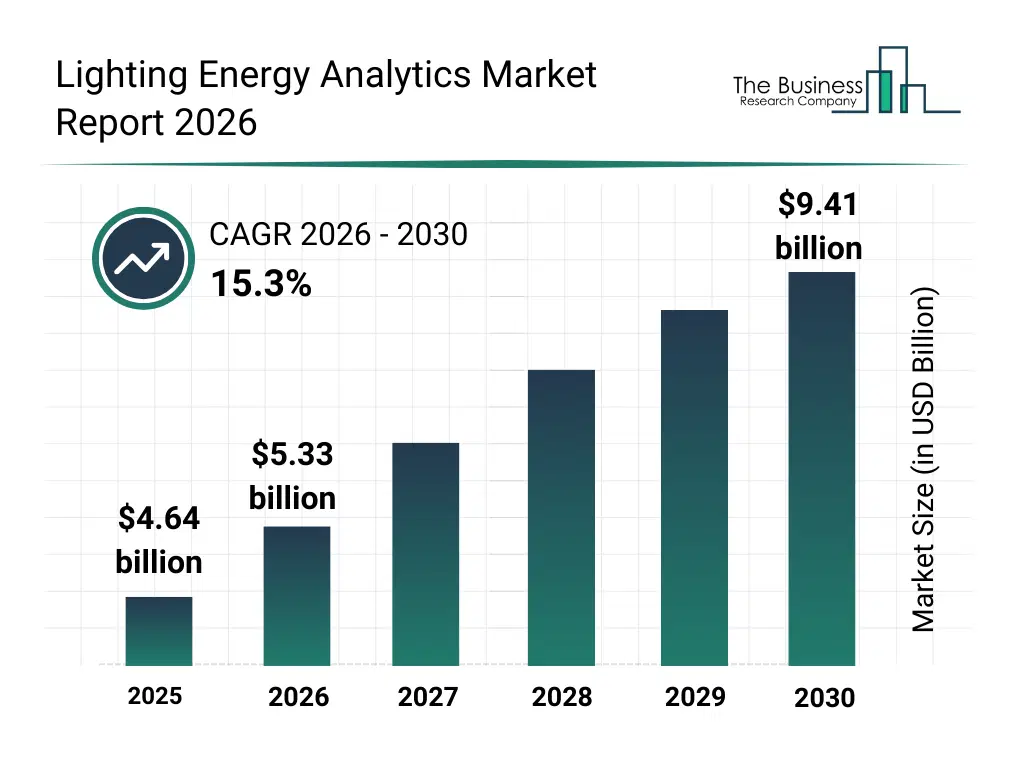
What Is The Lighting Energy Analytics Market Size and Share 2026?
The lighting energy analytics market size has grown rapidly in recent years. It will grow from $4.64 billion in 2025 to $5.33 billion in 2026 at a compound annual growth rate (CAGR) of 15.0%. The growth in the historic period can be attributed to growth of commercial building automation, expansion of smart city projects, rising electricity costs, adoption of LED lighting infrastructure, increasing demand for energy monitoring tools.What Is The Lighting Energy Analytics Market Growth Forecast?
The lighting energy analytics market size is expected to see rapid growth in the next few years. It will grow to $9.41 billion in 2030 at a compound annual growth rate (CAGR) of 15.3%. The growth in the forecast period can be attributed to increasing focus on energy efficiency regulations, rising investments in smart infrastructure, growing adoption of AI-driven analytics, expansion of net-zero building initiatives, increasing demand for real-time energy insights. Major trends in the forecast period include increasing deployment of Smart Lighting analytics platforms, rising adoption of occupancy-based lighting optimization, growing use of predictive maintenance analytics, expansion of cloud-based energy monitoring solutions, enhanced integration with building management systems.
Global Lighting Energy Analytics Market Segmentation
1) By Component: Software; Hardware; Services 2) By Deployment Mode: Cloud Based; On Premise; Hybrid 3) By Application: Commercial; Industrial; Residential; Government And Public Infrastructure; Other Applications 4) By End User: Retail; Healthcare; Education; Hospitality; Manufacturing; Other End Users Subsegments: 1) By Software: Energy Management Software; Lighting Control Software; Data Analytics And Visualization Software; Predictive Maintenance Software 2) By Hardware: Smart Light Fixtures; Sensors And Internet of Things Devices; Gateways And Controllers; Energy Monitoring Devices 3) By Services: Installation And Deployment Services; Monitoring And Maintenance Services; Consulting And Advisory Services; Training And Support ServicesWhat Are The Drivers Of The Lighting Energy Analytics Market?
The increasing demand for energy efficiency in buildings is expected to propel the growth of the lighting energy analytics market going forward. Energy efficiency in buildings refers to the reduction of energy consumption through better design, improved materials, efficient systems, and technologies that minimize energy use while maintaining comfort and functionality. Increasing demand for energy efficiency in buildings is due to rising energy costs, as higher utility expenses motivate building owners and occupants to adopt measures that reduce energy consumption and lower operational costs. Lighting energy analytics helps improve energy efficiency in buildings by monitoring, optimizing, and managing lighting usage to reduce unnecessary consumption and lower overall energy costs. For instance, in July 2024, according to the U.S. Green Building Council, a US-based non-profit organization, in 2024, they were part of over 46,000 residential projects certified under the LEED green building rating system, with 2023 seeing nearly a 5% rise in new LEED residential project registrations. Therefore, the increasing demand for energy efficiency in buildings is driving the growth of the lighting energy analytics industry. The rising energy costs are expected to propel the growth of the lighting energy analytics market going forward. Energy costs refer to the total expenses incurred for producing, purchasing, transmitting, or consuming energy, including the cost of fuels, electricity generation, distribution, and associated operational charges paid by consumers, businesses, or utilities. Energy costs are increasing primarily due to rising fuel prices, which raise the cost of electricity generation and energy supply across markets. Lighting energy analytics helps reduce energy costs by providing data-driven insights that optimize lighting usage, minimize waste, and improve efficiency through real-time monitoring and performance analysis. For instance, in October 2024, according to Eurostat, a Luxembourg-based government agency, in 2023, average household electricity prices in the EU rose to $31.21 per 100 kWh in the first half of the year, up from $27.32 per 100 kWh during the same period in 2022. Therefore, the rising energy costs are driving the growth of the lighting energy analytics industry. The growing cloud adoption is expected to propel the growth of the lighting energy analytics market going forward. Cloud adoption refers to the process by which organizations migrate their data, applications, and IT workloads from on-premises infrastructure to cloud-based platforms in order to improve scalability, flexibility, cost efficiency, and access to advanced digital services. Cloud adoption is increasing primarily due to the need for scalable and flexible IT infrastructure that can quickly support growing data volumes and digital transformation initiatives. Lighting energy analytics supports cloud adoption by leveraging cloud-based platforms to collect, process, and analyze lighting data in real time, enabling scalable insights, remote management, and continuous optimization across facilities. For instance, in 2025, according to the Eurostat, a Luxembourg-based statistical office of the European Union, in 2023, 45% of EU businesses purchased cloud computing services. Large enterprises were significantly more inclined to adopt cloud solutions than SMEs, with 78% of large businesses using cloud services compared to 44% of SMEs. Therefore, the growing cloud adoption is driving the growth of the lighting energy analytics industry.Key Players In The Global Lighting Energy Analytics Market
Major companies operating in the lighting energy analytics market are Siemens AG, LG Electronics Inc., Panasonic Holdings Corporation, Cisco Systems Inc., Schneider Electric SE, Honeywell International Inc., ABB Ltd., Eaton Corporation plc, Delta Electronics Inc., Legrand S.A., Signify N.V., Hubbell Incorporated, Acuity Brands Inc., Leviton Manufacturing Co. Inc., Zumtobel Group AG, Lutron Electronics Co. Inc., Helvar Oy Ab, Enlighted Inc., DimOnOff Inc., Current Lighting Solutions LLC.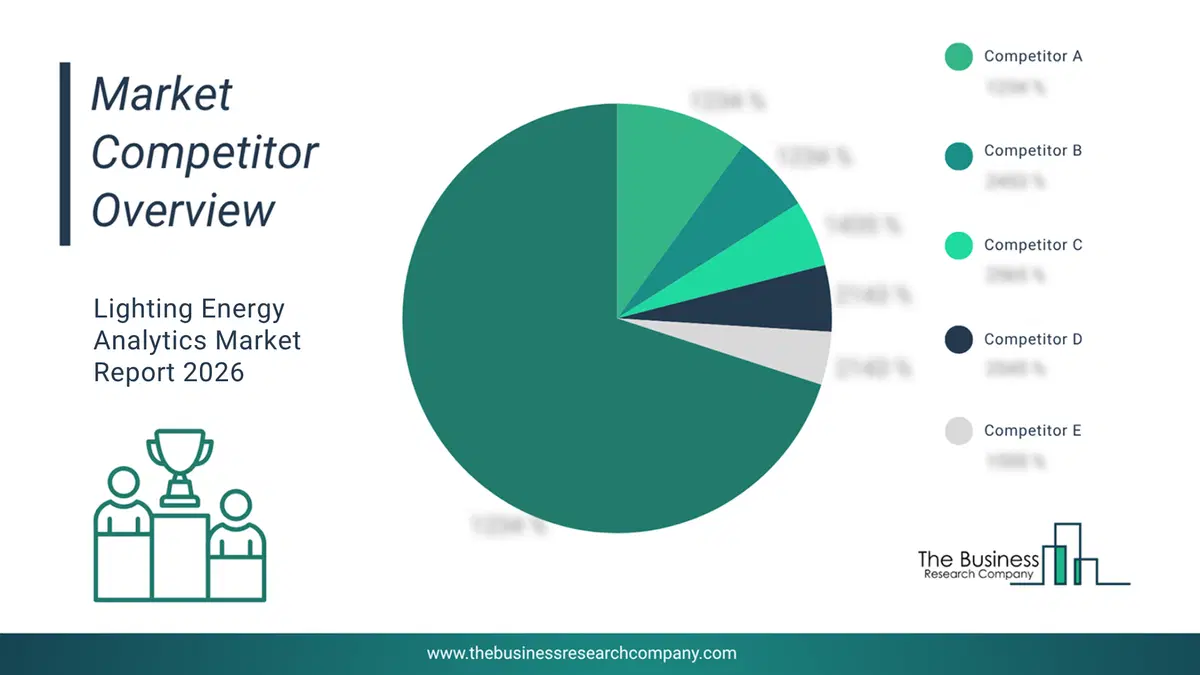
This chart is for illustrative purposes; the full report includes a detailed competitor analysis and comprehensive overview of the top 10 companies in the market.
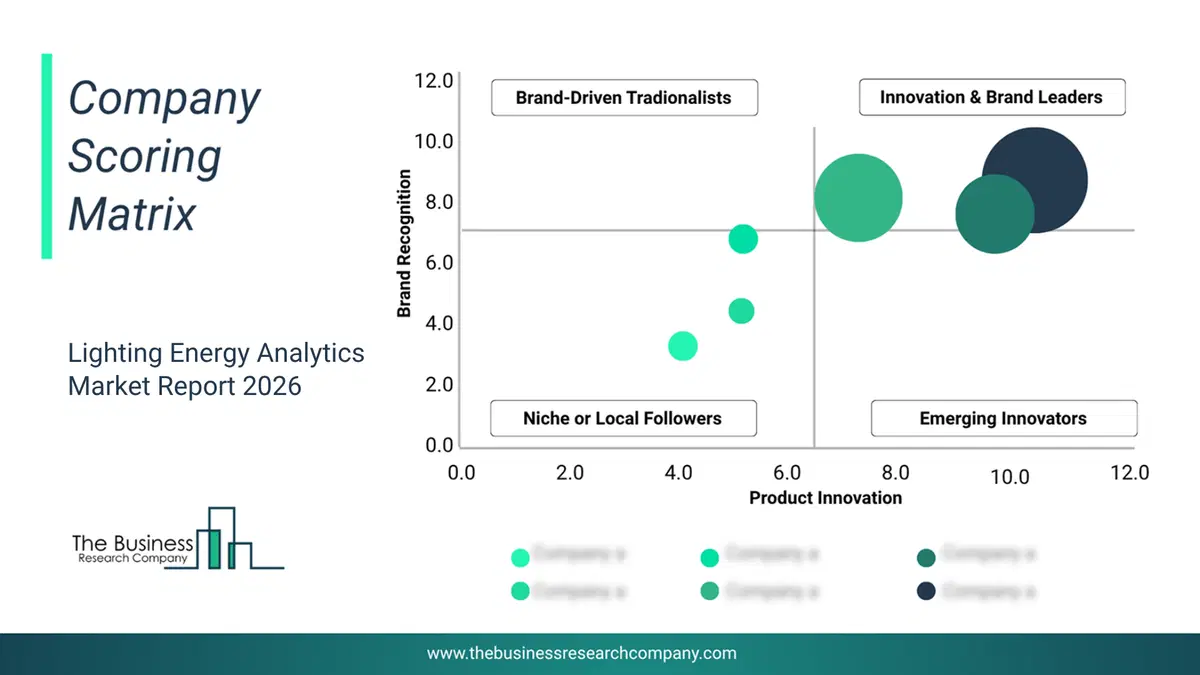
This chart maps companies by product innovation and brand strength, with bubble size indicating relative revenue, helping identify market leaders, challengers, and niche players. This is an illustrative chart; the full report provides a complete and accurate competitive analysis.
Regional Insights
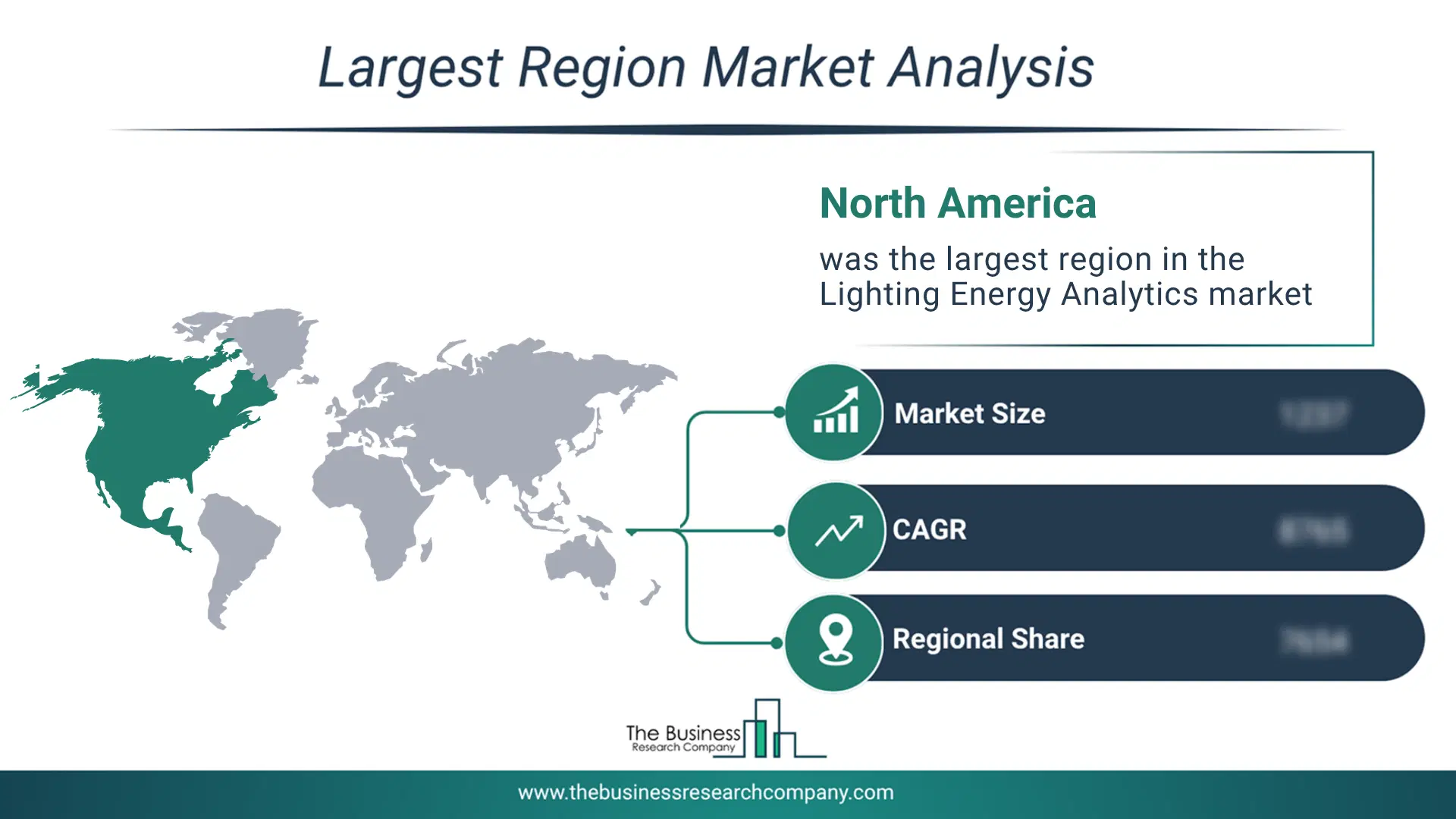
North America was the largest region in the lighting energy analytics market in 2025. Asia-Pacific is expected to be the fastest-growing region in the forecast period. The regions covered in this market report are Asia-Pacific, South East Asia, Western Europe, Eastern Europe, North America, South America, Middle East, Africa. The countries covered in this market report are Australia, Brazil, China, France, Germany, India, Indonesia, Japan, Taiwan, Russia, South Korea, UK, USA, Canada, Italy, Spain.What Defines the Lighting Energy Analytics Market?
The lighting energy analytics market consists of revenues earned by entities by providing services such as energy consumption monitoring, usage optimization, occupancy analysis, fault detection and alerts, predictive maintenance, reporting and dashboards and integration with building management systems. The market value includes the value of related goods sold by the service provider or included within the service offering. The lighting energy analytics market includes sales of usage-based lighting analytics, occupancy-based lighting analytics, daylight harvesting analytics, predictive lighting analytics, and asset performance analytics. Values in this market are ‘factory gate’ values, that is, the value of goods sold by the manufacturers or creators of the goods, whether to other entities (including downstream manufacturers, wholesalers, distributors, and retailers) or directly to end customers. The value of goods in this market includes related services sold by the creators of the goods.How is Market Value Defined and Measured?
The market value is defined as the revenues that enterprises gain from the sale of goods and/or services within the specified market and geography through sales, grants, or donations in terms of the currency (in USD unless otherwise specified). The revenues for a specified geography are consumption values that are revenues generated by organizations in the specified geography within the market, irrespective of where they are produced. It does not include revenues from resales along the supply chain, either further along the supply chain or as part of other products.
This chart presents market attractiveness based on a quantitative evaluation of growth, competition, strategic alignment, and risk, offering a clear view of opportunity areas for decision-making. This chart is for illustrative purposes; the full report contains the complete analysis.

This chart highlights the Total Addressable Market (TAM) by estimating the maximum revenue opportunity using an assumption-driven approach, supporting strategic planning and opportunity sizing across markets. The chart is illustrative; the full report provides a more comprehensive analysis.
What Key Data and Analysis Are Included in the Lighting Energy Analytics Market Report 2026?
The lighting energy analytics market research report is one of a series of new reports from The Business Research Company that provides market statistics, including industry global market size, regional shares, competitors with the market share, detailed market segments, market trends and opportunities, and any further data you may need to thrive in the lighting energy analytics industry. The market research report delivers a complete perspective of everything you need, with an in-depth analysis of the current and future state of the industry.Lighting Energy Analytics Market Report Forecast Analysis
| Report Attribute | Details |
|---|---|
| Market Size Value In 2026 | $5.33 billion |
| Revenue Forecast In 2030 | $9.41 billion |
| Growth Rate | CAGR of 15.3% from 2026 to 2030 |
| Base Year For Estimation | 2025 |
| Actual Estimates/Historical Data | 2020-2025 |
| Forecast Period | 2026 - 2030 |
| Market Representation | Revenue in USD Billion and CAGR from 2026 to 2030 |
| Segments Covered | Component, Deployment Mode, Application, End User |
| Regional Scope | Asia-Pacific, Western Europe, Eastern Europe, North America, South America, Middle East, Africa |
| Country Scope | The Countries Covered In This Market Report Are Australia, Brazil, China, France, Germany, India, Indonesia, Japan, Taiwan, Russia, South Korea, Uk, Usa, Canada, Italy, Spain. |
| Key Companies Profiled | Siemens AG, LG Electronics Inc., Panasonic Holdings Corporation, Cisco Systems Inc., Schneider Electric SE, Honeywell International Inc., ABB Ltd., Eaton Corporation plc, Delta Electronics Inc., Legrand S.A., Signify N.V., Hubbell Incorporated, Acuity Brands Inc., Leviton Manufacturing Co. Inc., Zumtobel Group AG, Lutron Electronics Co. Inc., Helvar Oy Ab, Enlighted Inc., DimOnOff Inc., Current Lighting Solutions LLC. |
| Customization Scope | Request for Customization |
| Pricing And Purchase Options | Explore Purchase Options |