
Lightweight Hydrogen Fuel Cells Market Report 2026
Global Outlook – By Type (Proton Exchange Membrane Fuel Cell, Alkaline Fuel Cell, Solid Oxide Fuel Cell), By Component (Power Electronics, Fuel Cell Stack, Membrane Electrode Assembly, Bipolar Plates, Catalysts, Gas Diffusion Layers, Hydrogen Storage Systems, Balance-Of-Plant Components), By Distribution Channel (Direct Sales, Distributors And Dealers, Online Channels), By End-Use Industry (Telecommunications, Automotive, Aerospace And Defense, Marine, Logistics And Material Handling, Industrial, Energy And Utilities, Consumer Electronics) – Market Size, Trends, Strategies, and Forecast to 2035
Lightweight Hydrogen Fuel Cells Market Overview
• Lightweight Hydrogen Fuel Cells market size has reached to $0.72 billion in 2025 • Expected to grow to $1.35 billion in 2030 at a compound annual growth rate (CAGR) of 13.5% • Growth Driver: Surge In Clean Energy Solutions Fueling The Growth Of The Market Due To Increasing Demand For Low-emission And Efficient Power Systems • Market Trend: Innovations In Lightweight Hydrogen Fuel Cell Technology Enhance Sustainable And Energy-Efficient Rail Transportation • North America was the largest region in 2025 and Asia-Pacific is the fastest growing region.What Is Covered Under Lightweight Hydrogen Fuel Cells Market?
Lightweight hydrogen fuel cells are hydrogen fuel-cell systems designed with reduced mass or compact construction to meet the weight constraints of applications such as aerospace, mobility, portable power, and other weight-sensitive systems. They generate electricity through an electrochemical reaction involving hydrogen and an oxidant, typically oxygen, with water and heat as reaction products. The main types of lightweight hydrogen fuel cells include proton exchange membrane fuel cell, alkaline fuel cell, and solid oxide fuel cell. Proton exchange membrane fuel cells use a polymer electrolyte membrane to conduct protons while enabling hydrogen and oxygen to react electrochemically to generate electricity with water and heat as byproducts. These fuel cells comprise power electronics, fuel cell stack, membrane electrode assembly, bipolar plates, catalysts, gas diffusion layers, hydrogen storage systems, and balance-of-plant components. They are distributed through direct sales, distributors and dealers, and online channels and are used across end use industries such as telecommunications, automotive, aerospace and defense, marine, logistics and material handling, industrial, energy and utilities, and consumer electronics.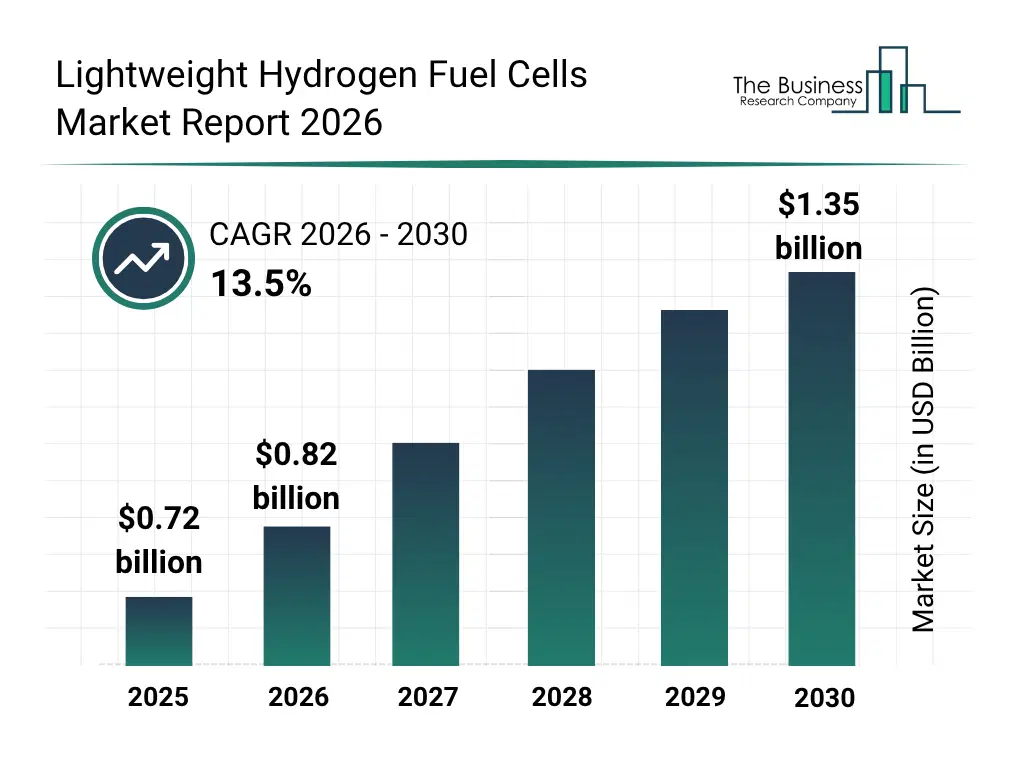
What Is The Lightweight Hydrogen Fuel Cells Market Size and Share 2026?
The lightweight hydrogen fuel cells market size has grown rapidly in recent years. It will grow from $0.72 billion in 2025 to $0.82 billion in 2026 at a compound annual growth rate (CAGR) of 13.9%. The growth in the historic period can be attributed to increasing adoption of hydrogen fuel cell vehicles, growing demand for lightweight power systems, expansion of hydrogen infrastructure, rising aerospace interest in fuel cell power, increasing deployment of backup power systems.What Is The Lightweight Hydrogen Fuel Cells Market Growth Forecast?
The lightweight hydrogen fuel cells market size is expected to see rapid growth in the next few years. It will grow to $1.35 billion in 2030 at a compound annual growth rate (CAGR) of 13.5%. The growth in the forecast period can be attributed to rising demand for zero-emission aviation technologies, increasing adoption of hydrogen-powered mobility, growing need for lightweight portable power solutions, expansion of green hydrogen production, increasing investment in high-efficiency fuel cell technologies. Major trends in the forecast period include lightweight fuel cell stack design, high-energy-density hydrogen storage, advanced membrane electrode assemblies, compact balance-of-plant integration, low-weight bipolar plate development.Tariff Impact On Lightweight Hydrogen Fuel Cells Market
Tariffs are impacting the lightweight hydrogen fuel cells market by increasing the cost of imported fuel cell stacks, catalysts, membrane electrode assemblies, bipolar plates, hydrogen storage systems, and power electronics. Aerospace and defense, automotive, and telecommunications applications may experience greater cost pressures, particularly in North America, Europe, and Asia-Pacific due to globally distributed component supply chains. However, tariffs can encourage domestic manufacturing, regional sourcing, and investment in localized hydrogen and fuel cell supply chains, potentially strengthening long-term production capabilities.
Global Lightweight Hydrogen Fuel Cells Market Segmentation
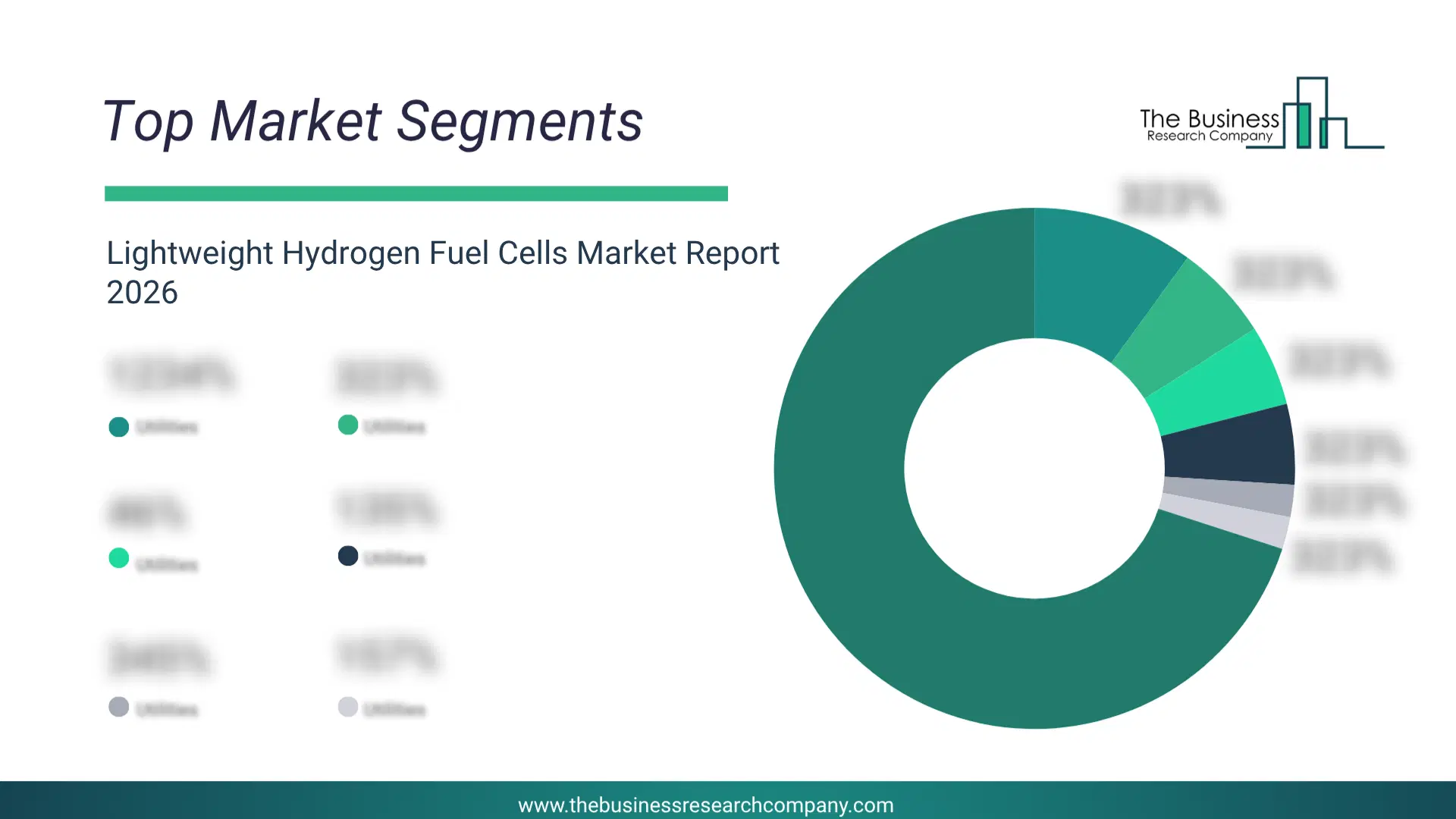
2) By Component: Power Electronics, Fuel Cell Stack, Membrane Electrode Assembly, Bipolar Plates, Catalysts, Gas Diffusion Layers, Hydrogen Storage Systems, Balance-Of-Plant Components 3) By Distribution Channel: Direct Sales, Distributors And Dealers, Online Channels 4) By End-Use Industry: Telecommunications, Automotive, Aerospace And Defense, Marine, Logistics And Material Handling, Industrial, Energy And Utilities, Consumer Electronics Subsegments: 1) By Proton Exchange Membrane Fuel Cell: Low-Temperature Proton Exchange Membrane Fuel Cell, High-Temperature Proton Exchange Membrane Fuel Cell 2) By Alkaline Fuel Cell: Traditional Alkaline Fuel Cell, Anion Exchange Membrane Fuel Cell 3) By Solid Oxide Fuel Cell: Planar Solid Oxide Fuel Cell, Tubular Solid Oxide Fuel CellWhat Is The Driver Of The Lightweight Hydrogen Fuel Cells Market?
The rising demand for clean energy solutions is expected to propel the growth of the lightweight hydrogen fuel cells market going forward. Clean energy solutions refer to technologies and practices that generate, store, and use energy with minimal environmental impact by reducing greenhouse gas emissions and reliance on fossil fuels. The rising demand for clean energy solutions is driven by increasing environmental concerns, as governments and industries are adopting renewable energy technologies to reduce carbon emissions and achieve sustainability goals. The growth in clean energy solutions supports the lightweight hydrogen fuel cells by increasing the demand for compact, lightweight, and high-efficiency power systems that provide reliable, low-emission electricity for mobility, industrial, and backup power applications. For instance, in March 2026, according to the US Energy Information Administration, a US-based government department, wind and solar power generation in the US totaled 760,000 gigawatthours (GWh) in 2025, an increase of 88,000 gigawatthours (GWh) from 2024, with wind generation rising by 3% to 464,000 gigawatthours (GWh) and utility-scale solar generation increasing by 34% to 296,000 gigawatthours (GWh). Therefore, the rising demand for clean energy solutions is driving the growth of the lightweight hydrogen fuel cells industry.Key Players In The Global Lightweight Hydrogen Fuel Cells Market
Major companies operating in the lightweight hydrogen fuel cells market are Toyota Motor Corporation, Honda Motor Co Ltd, Hyundai Motor Company, Robert Bosch GmbH, Panasonic Holdings Corporation, Ceres Power Holdings plc, Cummins Inc, Johnson Matthey Plc, Bramble Energy Limited, ElringKlinger AG, Plug Power Inc, SFC Energy AG, Ballard Power Systems Inc, ZeroAvia Inc, Intelligent Energy Limited, PowerCell Sweden AB, Horizon Fuel Cell Technologies Pte Ltd, H3 Dynamics Holdings Pte Ltd, Spectronik Pte Ltd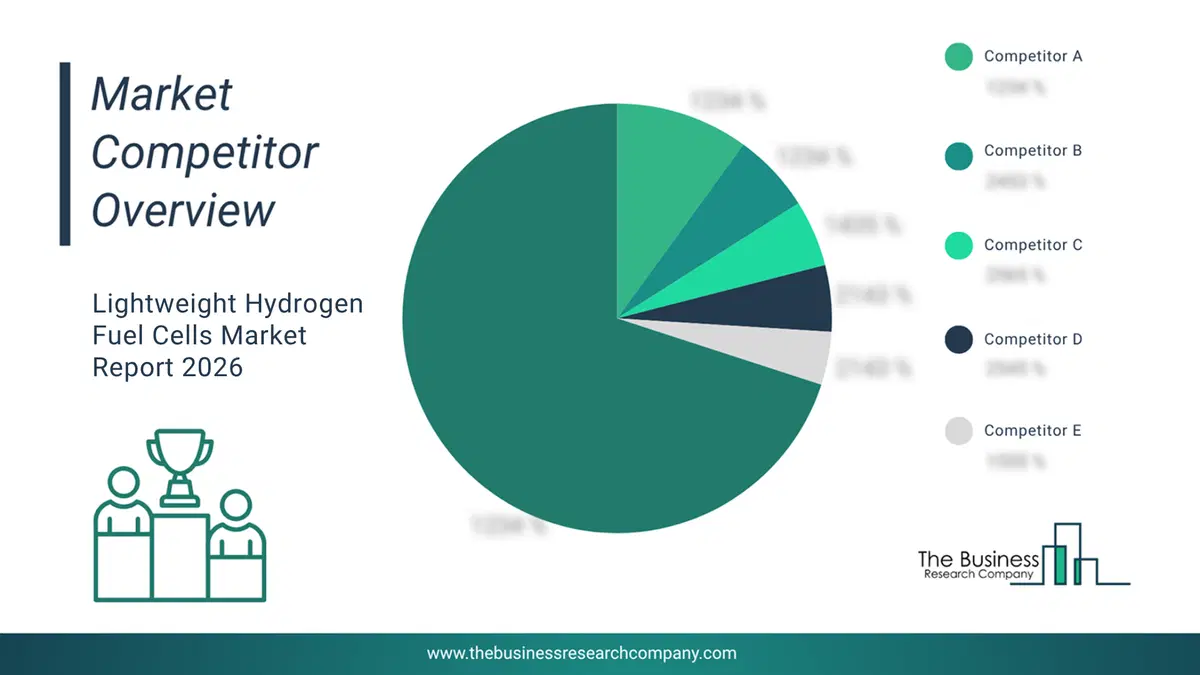
This chart is for illustrative purposes; the full report includes a detailed competitor analysis and comprehensive overview of the top 10 companies in the market.
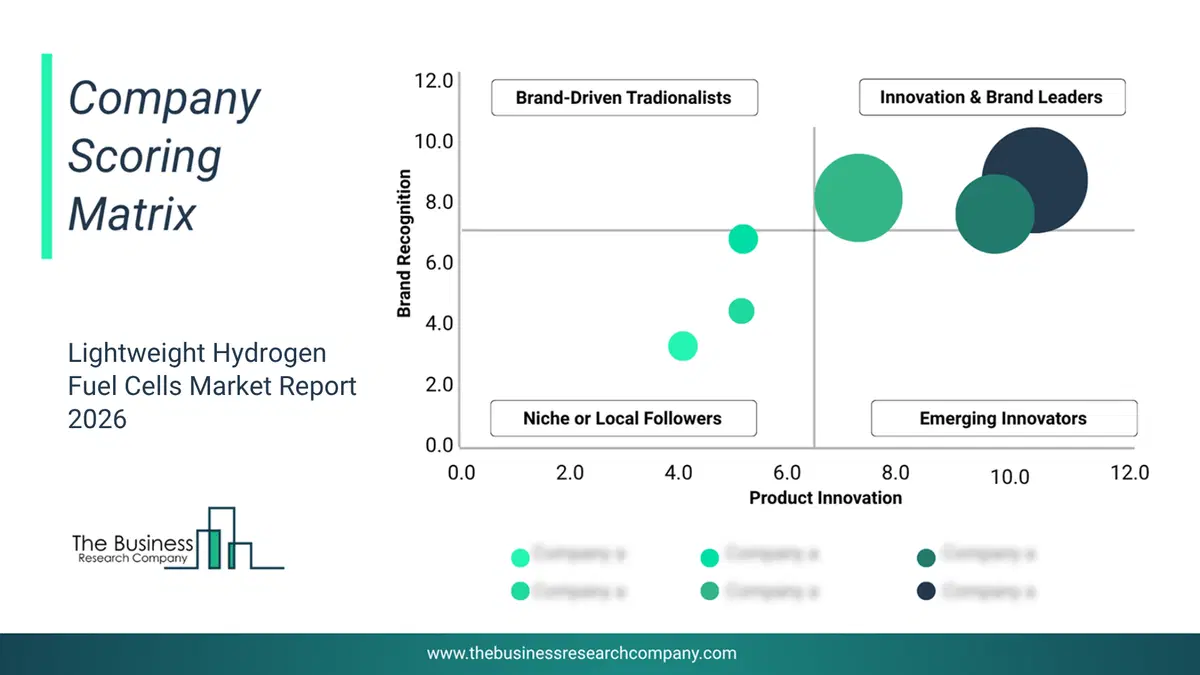
This chart maps companies by product innovation and brand strength, with bubble size indicating relative revenue, helping identify market leaders, challengers, and niche players. This is an illustrative chart; the full report provides a complete and accurate competitive analysis.
Global Lightweight Hydrogen Fuel Cells Market Trends and Insights
Major companies operating in the lightweight hydrogen fuel cells market are focusing on developing advanced hydrogen propulsion solutions to improve energy efficiency, reduce emissions, and expand hydrogen fuel cell applications in lightweight transportation systems. Hydrogen propulsion solutions are integrated power systems that use hydrogen fuel to generate clean energy for vehicle propulsion, enabling efficient, lightweight, and zero-emission transportation. For instance, in July 2026, Stadler, a Switzerland-based rail vehicle manufacturer, unveiled the world's first narrow-gauge hydrogen-powered train featuring a lightweight body and an innovative hydrogen-electric propulsion system. The train features a dedicated power pack with hydrogen tanks and fuel cells that generate electricity to charge traction batteries. This lightweight hydrogen propulsion system enables quiet, energy-efficient, and zero-emission operation on non-electrified railway networks, supporting sustainable regional transportation.What Are Latest Mergers And Acquisitions In The Lightweight Hydrogen Fuel Cells Market?
In June 2025, Proteus Energy, a Singapore-based provider of hydrogen fuel cell power solutions, partnered with Symbio France to develop hydrogen fuel cell solutions for the maritime sector. Through this partnership, Proteus and Symbio aim to expand the application of lightweight hydrogen fuel cell technology from automotive platforms to maritime transportation by enabling zero-emission, efficient, and compact marine power solutions. Symbio France is a France-based hydrogen fuel cell manufacturer.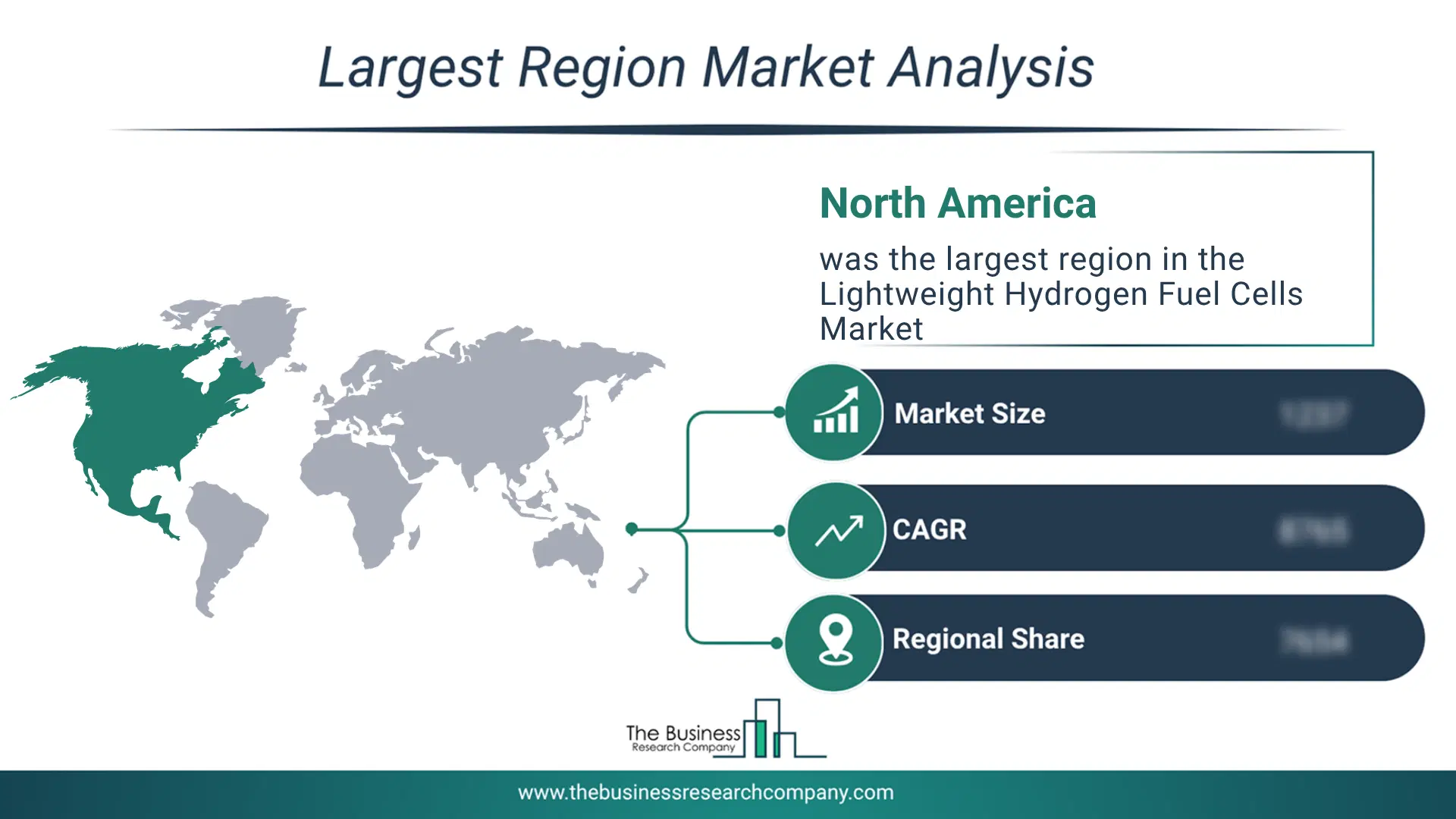
Regional Outlook/Insights
North America was the largest region in the lightweight hydrogen fuel cells market in 2025. Asia-Pacific is expected to be the fastest-growing region in the forecast period. The regions covered in this market report are Asia-Pacific, South East Asia, Western Europe, Eastern Europe, North America, South America, Middle East, Africa. The countries covered in this market report are Australia, Brazil, China, France, Germany, India, Indonesia, Japan, Taiwan, Russia, South Korea, UK, USA, Canada, Italy, Spain.What Defines the Lightweight Hydrogen Fuel Cells Market?
The lightweight hydrogen fuel cells market consists of sales of lightweight fuel cell modules, hydrogen fuel cell power generators, fuel cell propulsion units, and portable hydrogen fuel cell power systems. Values in this market are ‘factory gate’ values, that is, the value of goods sold by the manufacturers or creators of the goods, whether to other entities (including downstream manufacturers, wholesalers, distributors, and retailers) or directly to end customers. The value of goods in this market includes related services sold by the creators of the goods.How is Market Value Defined and Measured?
The market value is defined as the revenues that enterprises gain from the sale of goods and/or services within the specified market and geography through sales, grants, or donations in terms of the currency (in USD unless otherwise specified). The revenues for a specified geography are consumption values that are revenues generated by organizations in the specified geography within the market, irrespective of where they are produced. It does not include revenues from resales along the supply chain, either further along the supply chain or as part of other products.
This chart presents market attractiveness based on a quantitative evaluation of growth, competition, strategic alignment, and risk, offering a clear view of opportunity areas for decision-making. This chart is for illustrative purposes; the full report contains the complete analysis.

This chart highlights the Total Addressable Market (TAM) by estimating the maximum revenue opportunity using an assumption-driven approach, supporting strategic planning and opportunity sizing across markets. The chart is illustrative; the full report provides a more comprehensive analysis.
What Key Data and Analysis Are Included in the Lightweight Hydrogen Fuel Cells Market Report 2026?
The lightweight hydrogen fuel cells market research report is one of a series of new reports from The Business Research Company that provides market statistics, including industry global market size, regional shares, competitors with the market share, detailed market segments, market trends and opportunities, and any further data you may need to thrive in the lightweight hydrogen fuel cells industry. The market research report delivers a complete perspective of everything you need, with an in-depth analysis of the current and future state of the industry.Lightweight Hydrogen Fuel Cells Market Report Forecast Analysis
| Report Attribute | Details |
|---|---|
| Market Size Value In 2026 | $0.82 billion |
| Revenue Forecast In 2030 | $1.35 billion |
| Growth Rate | CAGR of 13.5% from 2026 to 2035 |
| Base Year For Estimation | 2025 |
| Actual Estimates/Historical Data | 2020-2025 |
| Forecast Period | 2026 - 2030 |
| Market Representation | Revenue in USD Billion and CAGR from 2026 to 2030 |
| Segments Covered | Type, Component, Distribution Channel, End-Use Industry |
| Regional Scope | Asia-Pacific, Western Europe, Eastern Europe, North America, South America, Middle East, Africa |
| Country Scope | The countries covered in the report are Australia, Brazil, China, France, Germany, India, Indonesia, Japan, Taiwan, Russia, South Korea, UK, USA, Canada, Italy, Spain. |
| Customization Scope | Request for Customization |
| Pricing And Purchase Options | Explore Purchase Options |