

Lightweight (LW) Sport Aircraft Market Report 2026
Global Outlook – By Aircraft Type (Fixed-Wing, Flex-Wing, Powered Parachutes, Gyroplanes), By Propulsion Type (Internal Combustion Engine, Electric, Hybrid), By Material Type (Composite Materials, Aluminum Structures, Fabric-Covered Structures, Wood And Hybrid Composites), By Application (Sport And Recreation, Flight Training, Aircraft Rental), By End Use (Individual, Rental Operators, Clubs) – Market Size, Trends, Strategies, and Forecast to 2035
Lightweight (LW) Sport Aircraft Market Overview
• Lightweight (LW) Sport Aircraft market size has reached to $3.95 billion in 2025 • Expected to grow to $6.01 billion in 2030 at a compound annual growth rate (CAGR) of 8.8% • Growth Driver: Surge In Interest In Recreational And Leisure Flying Fueling The Growth Of The Market Due To Rising Pilot Training Participation And Expanding Entry-level Aviation Demand • Market Trend: Advancements In Electric Propulsion Technology Accelerate Adoption Of Lightweight Sport Aircraft • North America was the largest region in 2025 and Asia-Pacific is the fastest growing region.What Is Covered Under Lightweight (LW) Sport Aircraft Market?
Lightweight (LW) sport aircraft refers to small-sized airplanes designed primarily for recreational flying and personal aviation use. These aircraft are built with simplified structures and lower maximum takeoff weights to ensure ease of handling, fuel efficiency, and lower operating costs. The main aircraft types of lightweight (LW) sport aircraft include fixed-wing, flex-wing, powered parachutes, and gyroplanes. Fixed-wing refer to lightweight recreational aircraft equipped with stationary wings for sport flying, pilot training, and leisure aviation activities. These aircraft are powered by propulsion types including internal combustion engine, electric, and hybrid systems and are manufactured using material types such as composite materials, aluminum structures, fabric-covered structures, and wood and hybrid composites. They find application in sport and recreation, flight training, and aircraft rental, serving end users including individual, rental operators, and clubs.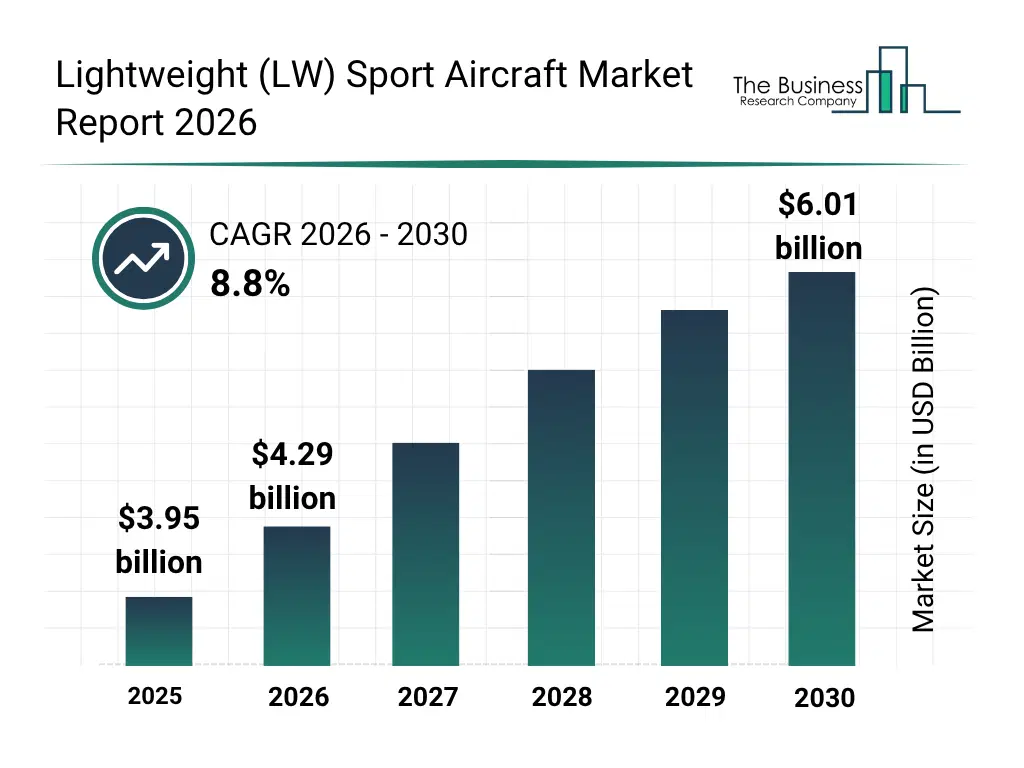
What Is The Lightweight (LW) Sport Aircraft Market Size and Share 2026?
The lightweight (LW) sport aircraft market size has grown strongly in recent years. It will grow from $3.95 billion in 2025 to $4.29 billion in 2026 at a compound annual growth rate (CAGR) of 8.6%. The growth in the historic period can be attributed to high cost of traditional general aviation aircraft limiting accessibility, limited recreational flying infrastructure and training facilities, reliance on conventional fuel based propulsion systems, low adoption of lightweight composite materials in small aircraft, restrictive regulatory frameworks for sport aviation operations.What Is The Lightweight (LW) Sport Aircraft Market Growth Forecast?
The lightweight (LW) sport aircraft market size is expected to see strong growth in the next few years. It will grow to $6.01 billion in 2030 at a compound annual growth rate (CAGR) of 8.8%. The growth in the forecast period can be attributed to rising demand for recreational aviation and personal flying experiences, increasing adoption of electric and hybrid propulsion systems, advancements in lightweight composite manufacturing technologies, growing pilot training programs and aviation academies, supportive regulatory reforms for sport and ultralight aviation expansion. Major trends in the forecast period include lightweight composite airframe innovation for fuel efficiency and performance optimization, electric propulsion integration in ultralight sport aircraft for reduced emissions, enhanced safety avionics and autopilot systems for recreational aviation, modular and easy-to-maintain aircraft design for cost-effective ownership, growing adoption of pilot training focused sport aircraft for general aviation expansion.
Global Lightweight (LW) Sport Aircraft Market Segmentation
1) By Aircraft Type: Fixed-Wing, Flex-Wing, Powered Parachutes, Gyroplanes 2) By Propulsion Type: Internal Combustion Engine, Electric, Hybrid 3) By Material Type: Composite Materials, Aluminum Structures, Fabric-Covered Structures, Wood And Hybrid Composites 4) By Application: Sport And Recreation, Flight Training, Aircraft Rental 5) By End Use: Individual, Rental Operators, Clubs Subsegments: 1) By Fixed-Wing: High Wing, Low Wing, Tailwheel Landing Gear, Tricycle Landing Gear, Composite Structure Fixed Wing, Metal Structure Fixed Wing, Ultralight Fixed Wing 2) By Flex-Wing: Weight Shift Control Trikes, Powered Hang Gliders, Open Frame Trikes 3) By Powered Parachutes: Single Seat Powered Parachutes, Two Seat Powered Parachutes, Tandem Seat Powered Parachutes 4) By Gyroplanes: Single Seat Gyroplanes, Two Seat Gyroplanes, Open Cockpit Gyroplanes, Enclosed Cockpit GyroplanesWhat Is The Driver Of The Lightweight (LW) Sport Aircraft Market?
The growing interest in recreational and leisure flying is expected to propel the growth of the lightweight sport aircraft market going forward. Recreational and leisure flying refers to the use of aircraft for non-commercial purposes such as personal enjoyment, tourism, and hobby aviation. The growing interest in recreational and leisure flying is increasing due to rising participation in pilot training and entry-level aviation activities, which reflect expanding consumer interest in flying as a leisure pursuit. Light sport aircraft support the recreational and leisure flying trend by offering affordable, easy-to-operate aircraft that enable new entrants to participate in recreational aviation with lower barriers to entry. For instance, in March 2024, according to the Federal Aviation Administration, a US-based aviation regulator, 69,503 new student pilot certificates were issued in 2023, an increase of 13,334 compared to 2022, representing a growth of approximately 24%. Therefore, the growing interest in recreational and leisure flying is driving the growth of the LW sport aircraft market.Key Players In The Global Lightweight (LW) Sport Aircraft Market
Major companies operating in the lightweight (lw) sport aircraft market are Tecnam, ICON Aircraft Inc., TL-Ultralight s.r.o., Flight Design General Aviation GmbH, Aeroprakt Ltd., CubCrafters Inc., BRM Aero s.r.o., American Legend Aircraft Company LLC, Vashon Aircraft Inc., Textron Aviation Inc. (Cessna Aircraft Company brand), Jabiru Aircraft Pty Ltd, Zenith Aircraft Company, Kitfox Aircraft LLC, Sonex Aircraft LLC, REMOS Aircraft GmbH, U-Fly-It LLC, Shark Aero s.r.o., Montaer Aircraft Industries LLC, SkyReach Aircraft (Pty) Ltd, Niki Rotor Aviation LLCGlobal Lightweight (LW) Sport Aircraft Market Trends and Insights
Major companies operating in the lightweight (LW) sport aircraft market are focusing on advancing electric propulsion systems and expanding deliveries of certified electric aircraft to promote sustainable aviation and reduce carbon emissions. Electric propulsion in lightweight aircraft refers to the use of battery-powered engines instead of conventional internal combustion systems, enabling quieter operations, lower maintenance, and zero in-flight emissions. For instance, in April 2024, Pipistrel, a Slovenia-based aircraft manufacturer, delivered its first four Velis Electro airframes to customers in the United States. This milestone marked an important turning point in the commercialization of electric light sport aircraft in the U.S. market, supporting pilot training and recreational aviation with environmentally friendly alternatives while strengthening Pipistrel’s presence in the global LW sport aircraft segment.What Are Latest Mergers And Acquisitions In The Lightweight (LW) Sport Aircraft Market?
In October 2025, Green Aerolease, a France-based training aircraft lessor, announced a partnership with Tecnam Aircraft to provide sustainable, modern, and cost-efficient aircraft solutions for pilot training. To expand access to fuel-efficient, lightweight training aircraft and modernize flight training fleets through collaboration with Tecnam Aircraft. Tecnam Aircraft is an Italy-based manufacturer known for producing lightweight sport aircraft (LSA) and trainer aircraft widely used in flight training programs.Regional Outlook/Insights
North America was the largest region in the lightweight (LW) sport aircraft market in 2025. Asia-Pacific is expected to be the fastest-growing region in the forecast period. The regions covered in this market report are Asia-Pacific, South East Asia, Western Europe, Eastern Europe, North America, South America, Middle East, Africa. The countries covered in this market report are Australia, Brazil, China, France, Germany, India, Indonesia, Japan, Taiwan, Russia, South Korea, UK, USA, Canada, Italy, Spain.What Defines the Lightweight (LW) Sport Aircraft Market?
The lightweight (LW) sport aircraft market consists of sales of control cables, electrical wiring harness, exhaust system, brake system, and navigation system. Values in this market are ‘factory gate’ values, that is, the value of goods sold by the manufacturers or creators of the goods, whether to other entities (including downstream manufacturers, wholesalers, distributors, and retailers) or directly to end customers. The value of goods in this market includes related services sold by the creators of the goods.How is Market Value Defined and Measured?
The market value is defined as the revenues that enterprises gain from the sale of goods and/or services within the specified market and geography through sales, grants, or donations in terms of the currency (in USD unless otherwise specified). The revenues for a specified geography are consumption values that are revenues generated by organizations in the specified geography within the market, irrespective of where they are produced. It does not include revenues from resales along the supply chain, either further along the supply chain or as part of other products.What Key Data and Analysis Are Included in the Lightweight (LW) Sport Aircraft Market Report 2026?
The lightweight (lw) sport aircraft market research report is one of a series of new reports from The Business Research Company that provides market statistics, including industry global market size, regional shares, competitors with the market share, detailed market segments, market trends and opportunities, and any further data you may need to thrive in the lightweight (lw) sport aircraft industry. The market research report delivers a complete perspective of everything you need, with an in-depth analysis of the current and future state of the industry.Lightweight (LW) Sport Aircraft Market Report Forecast Analysis
| Report Attribute | Details |
|---|---|
| Market Size Value In 2026 | $4.29 billion |
| Revenue Forecast In 2035 | $6.01 billion |
| Growth Rate | CAGR of 8.8% from 2026 to 2035 |
| Base Year For Estimation | 2025 |
| Actual Estimates/Historical Data | 2020-2025 |
| Forecast Period | 2026 - 2030 - 2035 |
| Market Representation | Revenue in USD Billion and CAGR from 2026 to 2035 |
| Segments Covered | Aircraft Type, Propulsion Type, Material Type, Application, End Use |
| Regional Scope | Asia-Pacific, Western Europe, Eastern Europe, North America, South America, Middle East, Africa |
| Country Scope | The countries covered in the report are Australia, Brazil, China, France, Germany, India, Indonesia, Japan, Taiwan, Russia, South Korea, UK, USA, Canada, Italy, Spain. |
| Key Companies Profiled | Tecnam, ICON Aircraft Inc., TL-Ultralight s.r.o., Flight Design General Aviation GmbH, Aeroprakt Ltd., CubCrafters Inc., BRM Aero s.r.o., American Legend Aircraft Company LLC, Vashon Aircraft Inc., Textron Aviation Inc. (Cessna Aircraft Company brand), Jabiru Aircraft Pty Ltd, Zenith Aircraft Company, Kitfox Aircraft LLC, Sonex Aircraft LLC, REMOS Aircraft GmbH, U-Fly-It LLC, Shark Aero s.r.o., Montaer Aircraft Industries LLC, SkyReach Aircraft (Pty) Ltd, Niki Rotor Aviation LLC |
| Customization Scope | Request for Customization |
| Pricing And Purchase Options | Explore Purchase Options |