
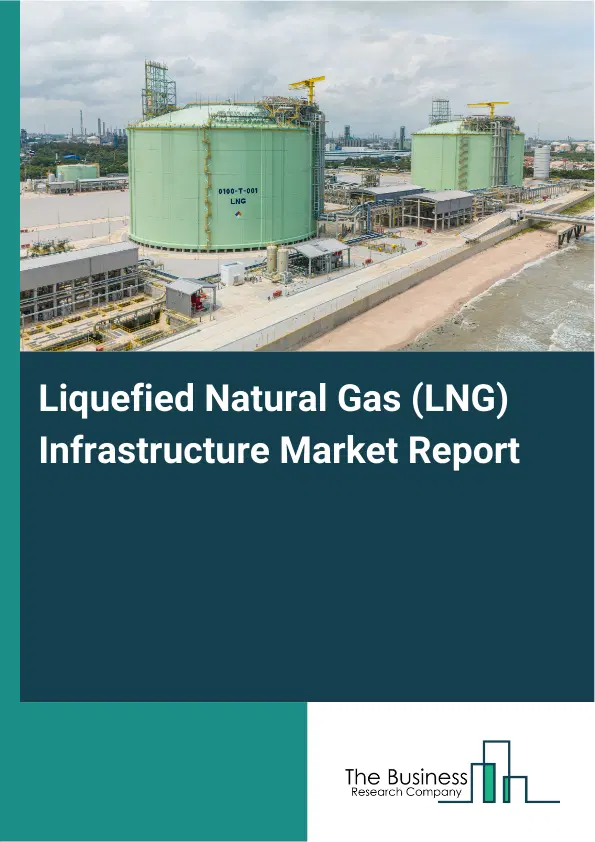
Liquefied Natural Gas (LNG) Infrastructure Market Report 2026
Global Outlook – By Type (Production Infrastructure, Transportation Infrastructure, Regasification Infrastructure, Distribution Infrastructure, Storage Facilities, Other Types), By Production (Liquefaction Plants, Natural Gas Processing Facilities, LNG Storage Tanks, Others), By Distribution (Pipeline Networks, Virtual Pipeline Solutions), By End User Industry (Heavy-Duty Vehicles, Electric Power Generation, Marine Transport) – Market Size, Trends, Strategies, and Forecast to 2030
Liquefied Natural Gas (LNG) Infrastructure Market Overview
• Liquefied Natural Gas (LNG) Infrastructure market size has reached to $74.2 billion in 2025 • Expected to grow to $138.43 billion in 2030 at a compound annual growth rate (CAGR) of 13% • Growth Driver: Driving Forces Behind the Expansion Of LNG Infrastructure Meeting Surging Demand for Electricity Generation • Market Trend: Focus on LNG Projects Driving Industry Growth • Asia-Pacific was the largest region and fastest growing region.Market Gains By 2030 – Top Opportunities By Segment
Market Gain identifies the most promising market opportunities by highlighting the segments or products expected to generate the highest incremental revenue growth over the next five years.
What Is Covered Under Liquefied Natural Gas (LNG) Infrastructure Market?
Liquefied natural gas (LNG) infrastructure refers to the facilities and systems involved in the production, storage, transportation, and regasification of LNG. This infrastructure is used for several purposes, primarily revolving around the transportation, storage, and distribution of natural gas in its liquefied form. The main types of liquefied natural gas (LNG) infrastructure are production infrastructure, transportation infrastructure, regasification infrastructure, distribution infrastructure, storage facilities, and others. Production infrastructure refers to the facilities and processes involved in extracting, processing, and liquefying natural gas for transportation and storage. It includes various production facilities, such as liquefaction plants, natural gas processing facilities, LNG storage tanks, and other production infrastructure, and is distributed through various pipeline networks and virtual pipeline solutions, as well end users also include heavy-duty vehicles, electric power generation, and marine transport.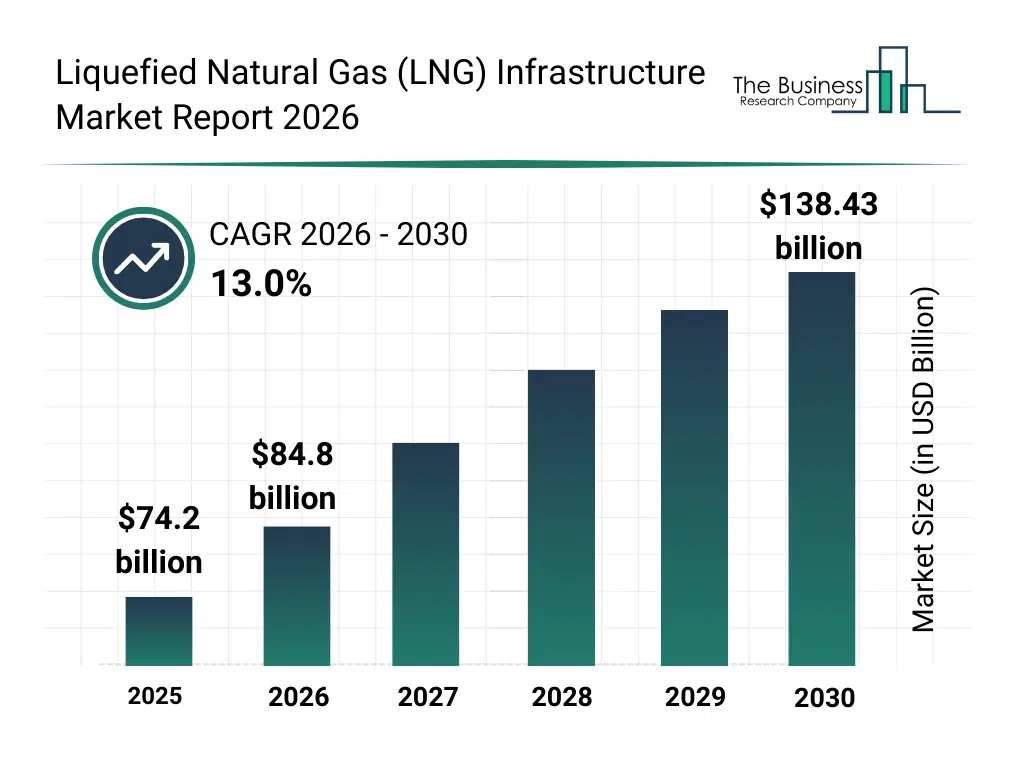
What Is The Liquefied Natural Gas (LNG) Infrastructure Market Size and Share 2026?
The liquefied natural gas (lng) infrastructure market size has grown rapidly in recent years. It will grow from $74.2 billion in 2025 to $84.8 billion in 2026 at a compound annual growth rate (CAGR) of 14.3%. The growth in the historic period can be attributed to investment in onshore lng storage tanks, development of liquefaction plants and natural gas processing facilities, expansion of pipeline networks, increasing marine transport of lng, growth in heavy-duty vehicle adoption of lng.What Is The Liquefied Natural Gas (LNG) Infrastructure Market Growth Forecast?
The liquefied natural gas (lng) infrastructure market size is expected to see rapid growth in the next few years. It will grow to $138.43 billion in 2030 at a compound annual growth rate (CAGR) of 13.0%. The growth in the forecast period can be attributed to advancements in floating storage regasification units (fsrus), expansion of virtual pipeline solutions, rising focus on modular lng plants, increasing electrification and integration with renewable energy, growth in lng distribution stations and delivery networks. Major trends in the forecast period include expansion of lng liquefaction capacity, growth in floating lng (flng) projects, increasing adoption of small-scale lng infrastructure, integration of lng supply chain optimization technologies, rising demand for lng fuels in transportation and industry.
Global Liquefied Natural Gas (LNG) Infrastructure Market Segmentation
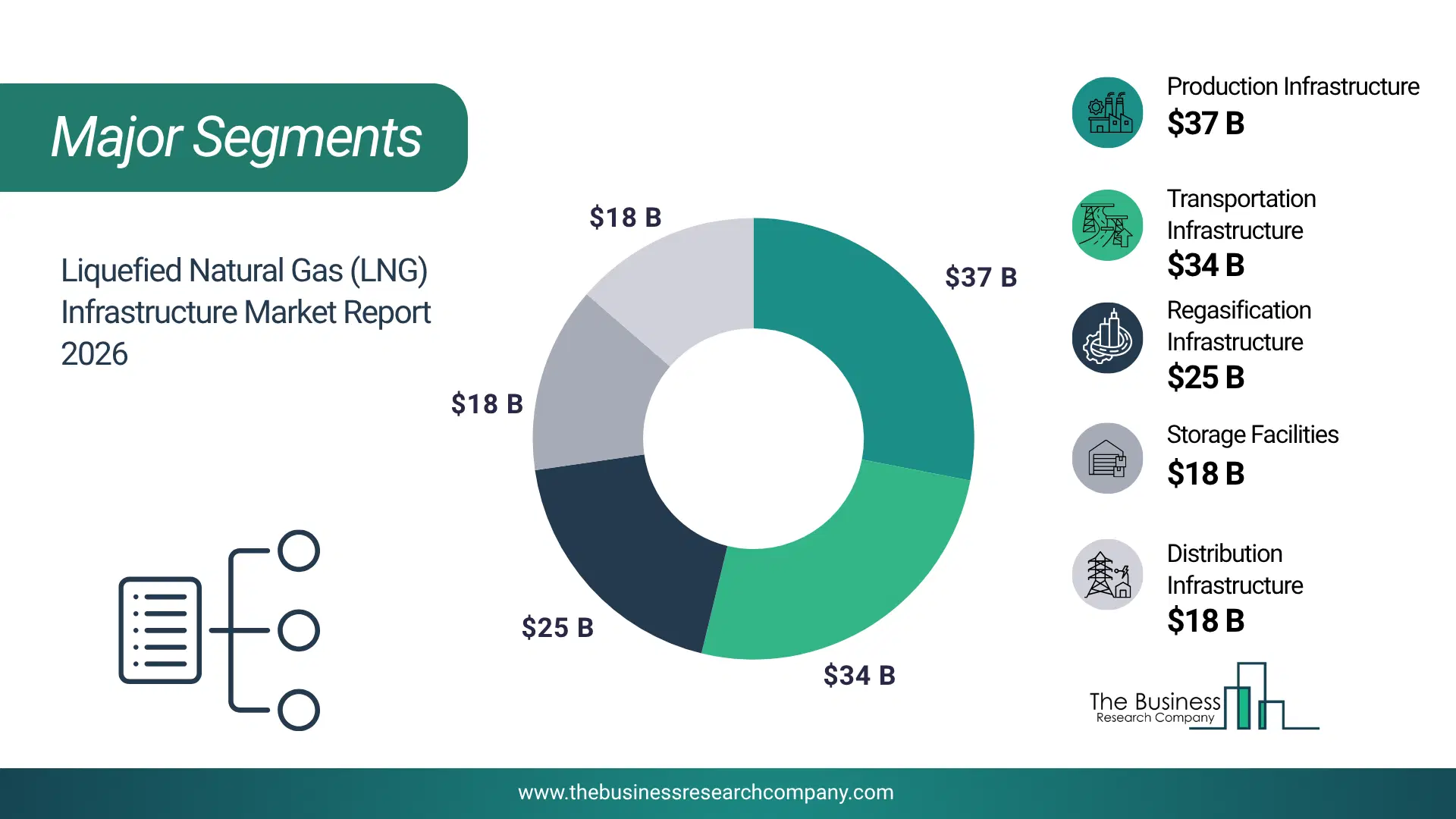
1) By Type: Production Infrastructure, Transportation Infrastructure, Regasification Infrastructure, Distribution Infrastructure, Storage Facilities, Other Types 2) By Production: Liquefaction Plants, Natural Gas Processing Facilities, LNG Storage Tanks, Others 3) By Distribution: Pipeline Networks, Virtual Pipeline Solutions 4) By End User Industry: Heavy-Duty Vehicles, Electric Power Generation, Marine Transport Subsegments: 1) By Production Infrastructure: Liquefaction Plants, Modular LNG Plants, Floating LNG (FLNG) Units 2) By Transportation Infrastructure: LNG Carriers, LNG Bunkering Vessels, LNG Trucks, LNG Railcars, Pipelines for LNG Transport 3) By Regasification Infrastructure: Onshore Regasification Terminals, Floating Storage Regasification Units (FSRUs), Regasification Plants, Regasification Systems 4) By Distribution Infrastructure: LNG Distribution Stations, LNG Delivery Trucks, LNG Depots, Distribution Networks (Pipeline Or Other Delivery Systems) 5) By Storage Facilities: LNG Storage Tanks (Onshore), Offshore Storage Facilities, Floating Storage Units (FSUs), Underground LNG Storage 6) By Other Types: Small-scale LNG Infrastructure, Integrated LNG Solutions, LNG Supply Chain Optimization Technology, LNG Fuels For Transportation And Industry The top segments in the smokeless powder market will be: • Single Base will reach $1.6 Billion by 2030. • Double Base will reach $1.27 Billion by 2030. • Triple Base will reach $0.38 Billion by 2030. The top segments in the liquefied natural gas (lng) infrastructure market will be: • Production Infrastructure will reach $37.47 Billion by 2030. • Transportation Infrastructure will reach $34.35 Billion by 2030. • Regasification Infrastructure will reach $25.13 Billion by 2030. • Storage Facilities will reach $18.42 Billion by 2030. • Distribution Infrastructure will reach $18.03 Billion by 2030.What Is The Driver Of The Liquefied Natural Gas (LNG) Infrastructure Market?
Rising demand for electricity generation is expected to propel the growth of the liquefied natural gas (LNG) infrastructure market going forward. Electricity generation is the process of converting various forms of energy into electrical energy. The rising demand for electricity generation is due to the proliferation of electronic devices and appliances and, an increasing shift towards electric heating systems and air conditioning, necessitating more electricity generation. Liquefied natural gas (LNG) infrastructure provides flexibility in natural gas trading and pricing, allowing buyers to respond to changing market conditions and take advantage of price disparities. This flexibility can help stimulate demand by making natural gas more attractive compared to other energy sources. For instance, in October 2024, according to the International Energy Agency, a France-based government organization, In July 2024, total net electricity production in the OECD reached 996.1 TWh, marking a 2.6% increase from July 2023. Therefore, the rising demand for electricity generation drives the liquefied natural gas(LNG) infrastructure market.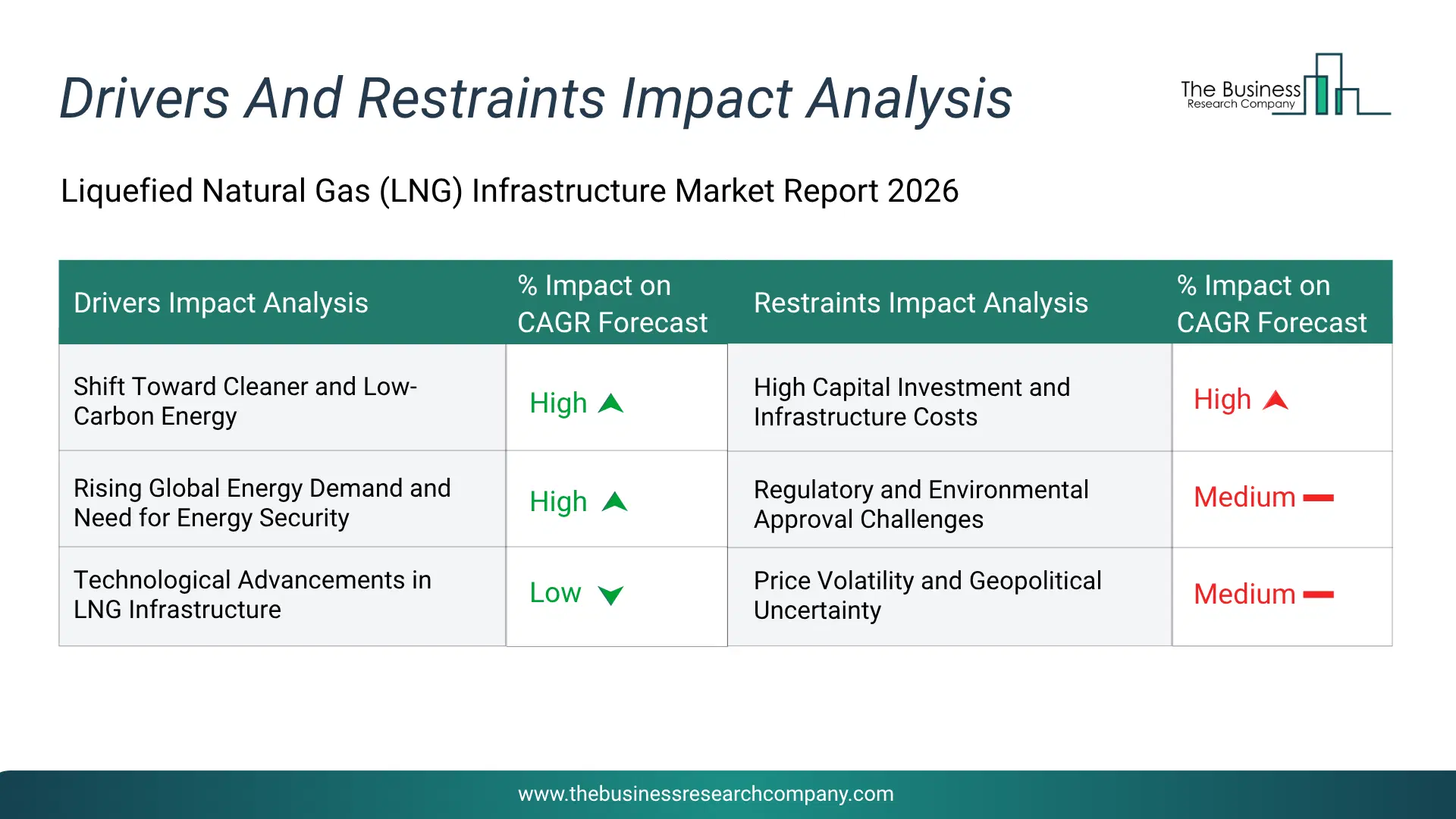
Infographic Chart Showing Key Market Drivers Analysis And Restraints For Liquefied Natural Gas (Lng) Infrastructure Market
The chart presents an impact analysis of key drivers and restraints, quantifying their relative influence on the market's growth rate and helping assess the balance between growth enablers and limiting factors. This chart offers a high-level perspective; the full report contains more detailed insights.
How Will The Drivers Impact Growth In The Global Liquefied Natural Gas (LNG) Infrastructure Market?
• Shift Toward Cleaner and Low-Carbon Energy (High) – During the forecast period, the shift toward cleaner and low-carbon energy is expected to become a key growth driver for the liquefied natural gas (LNG) infrastructure market by 2030. The increasing transition from coal and oil toward cleaner fuel alternatives is accelerating investments in LNG infrastructure worldwide. Governments and energy companies are expanding LNG import terminals, liquefaction facilities, and regasification plants to support lower-emission energy generation and industrial operations. LNG is increasingly viewed as a transition fuel capable of supporting decarbonization goals while ensuring reliable energy supply across multiple sectors. This transition is also encouraging the development of advanced transportation and storage infrastructure to improve supply efficiency and reduce environmental impact. Collectively, these developments are strengthening long-term investments across the LNG value chain and accelerating infrastructure expansion globally. • Rising Global Energy Demand and Need for Energy Security (High) – During the forecast period, the rising global energy demand and need for energy security is expected to emerge as a major factor driving the expansion of the liquefied natural gas (LNG) infrastructure market by 2030. Increasing global energy consumption and growing concerns regarding energy supply stability are significantly supporting investments in LNG infrastructure. Countries are strengthening LNG import and export capabilities to diversify energy sources and reduce dependence on conventional pipeline networks and unstable supply routes. Rising industrialization, urbanization, and electricity demand are also encouraging the construction of new LNG terminals, storage facilities, and transportation systems to ensure uninterrupted fuel availability. In addition, geopolitical uncertainties and supply disruptions are increasing the importance of flexible LNG trade networks and strategic storage capacities. • Technological Advancements in LNG Infrastructure (Low) – During the forecast period, the technological advancements in LNG infrastructure is expected to act as a key growth catalyst for the liquefied natural gas (LNG) infrastructure market by 2030. Continuous advancements in LNG liquefaction, storage, transportation, and regasification technologies are increasing the efficiency and scalability of global LNG infrastructure projects. Modern floating storage and regasification units (FSRUs), modular liquefaction systems, and advanced cryogenic storage technologies are helping reduce operational costs and improve project flexibility. These innovations are also supporting faster deployment timelines and enabling infrastructure expansion in remote and emerging markets. Furthermore, the integration of automation, digital monitoring systems, and predictive maintenance technologies is enhancing operational safety, reliability, and energy efficiency across LNG facilities. Consequently, technological progress is accelerating infrastructure modernization and supporting the broader expansion of global LNG networks.How Will The Restraints Impact Growth In The Global Liquefied Natural Gas (LNG) Infrastructure Market?
• High Capital Investment and Infrastructure Costs (High) – During the forecast period, the high capital investment is one of the most significant restraints in the LNG infrastructure market, as projects such as liquefaction plants, storage terminals, and regasification facilities require billions of dollars in upfront spending. These projects involve complex engineering, advanced safety systems, and strict compliance requirements, which further increase costs. The long payback period discourages investors, especially in regions with uncertain energy demand. Cost overruns caused by supply chain disruptions and labor shortages add additional financial risks. As a result, high capital requirements limit market entry and slow infrastructure expansion globally. • Regulatory and Environmental Approval Challenges (High) – During the forecast period, the regulatory hurdles and environmental concerns act as a major restraint by delaying LNG infrastructure development projects. Obtaining permits for construction and operation involves lengthy approval processes due to strict environmental and safety standards. Compliance with emission regulations, especially methane leakage concerns, adds complexity and cost to projects. These delays extend project timelines and reduce investor confidence in long-term returns. Additionally, evolving government policies and energy transition goals create uncertainty, further restricting infrastructure growth. • Price Volatility and Geopolitical Uncertainty (Low) – During the forecast period, the volatility in LNG prices and geopolitical tensions significantly restrain market growth by creating uncertainty in revenue generation. Fluctuations in global supply-demand dynamics make it difficult for companies to plan long-term infrastructure investments. Geopolitical conflicts, trade disruptions, and supply chain instability can delay projects and increase operational risks. Price instability also affects affordability for importing countries, reducing demand in price-sensitive regions. Consequently, this uncertainty discourages large-scale investments and slows the expansion of LNG infrastructure networks.Key Players In The Global Liquefied Natural Gas (LNG) Infrastructure Market
Major companies operating in the liquefied natural gas (lng) infrastructure market are ExxonMobil Corporation, Chevron Corporation, BP PLC, Royal Dutch Shell PLC, TotalEnergies SE, Cheniere Energy Inc, QatarEnergy, Petronas, Novatek, Woodside Energy Group Ltd, ConocoPhillips Company, Equinor ASA, Eni S.p.A, Sempra Energy, Freeport LNG, NextDecade Corporation, Dominion Energy (Cove Point), China National Offshore Oil Corporation CNOOC, Gazprom, Petronet LNG Ltd, Santos Ltd, Tellurian Inc, Venture Global LNG, Indonesia’s Pertamina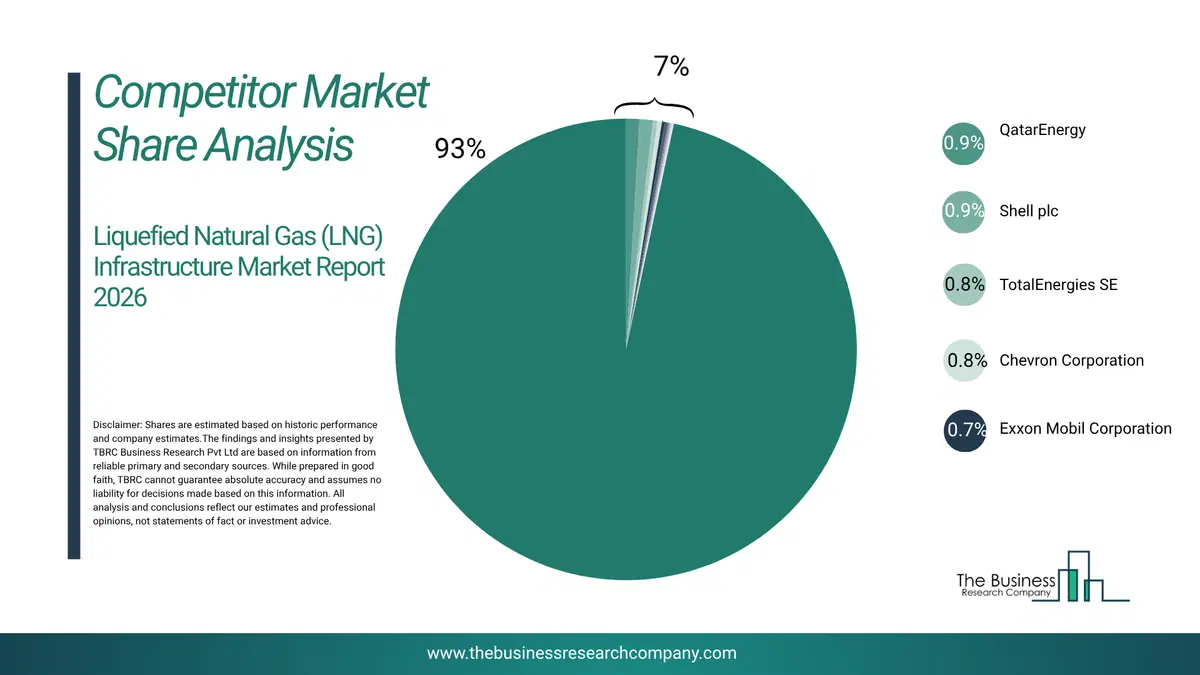
This chart is for illustrative purposes; the full report includes a detailed competitor analysis and comprehensive overview of the top 10 companies in the market.
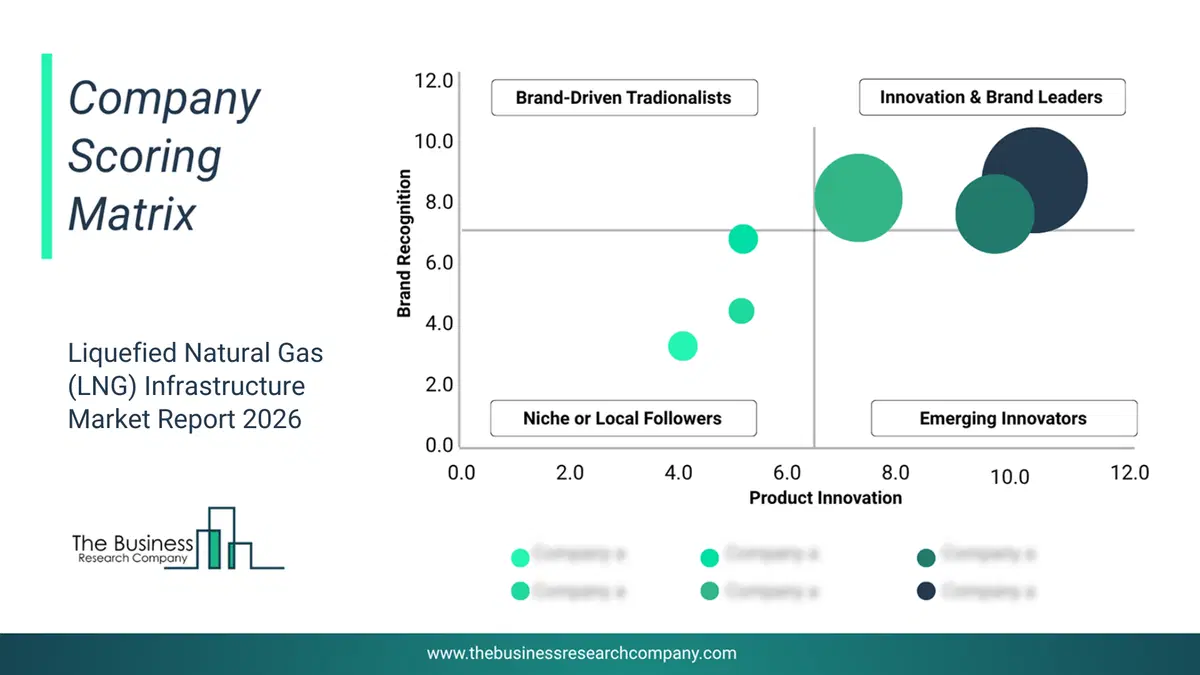
This chart maps companies by product innovation and brand strength, with bubble size indicating relative revenue, helping identify market leaders, challengers, and niche players. This is an illustrative chart; the full report provides a complete and accurate competitive analysis.
Global Liquefied Natural Gas (LNG) Infrastructure Market Trends and Insights
Major companies operating in the liquefied natural gas infrastructure market are focused on developing and investing in new LNG projects such as port arthur LNG project that support the growth and development of the natural gas industry. Port Arthur LNG project represents a major infrastructure development aimed at expanding LNG operations, creating jobs, boosting economic growth, and contributing to American energy security. For instance, in March 2023, Sempra, a US-based energy infrastructure company, launched the port arthur LNG project, a next-generation liquefaction facility that is expected to provide abundant, clean, reliable, and affordable U.S. natural gas to world markets. The proposed project includes two natural gas liquefaction trains and LNG storage tanks, as well as associated facilities capable of producing up to approximately 13.5 Mtpa of LNG, enabling the export of approximately 11 Mtpa of LNG on a long-term basis. Additionally, design changes to reduce the proposed LNG projects' overall emissions, including electric drives, renewable power sourcing, and other technological solutions.What Are Latest Mergers And Acquisitions In The Liquefied Natural Gas (LNG) Infrastructure Market?
In January 2024, Nebula Energy LLC, a US-based investment and asset management company, acquired a majority stake in AG&P LNG for $300 million. Through this acquisition, Nebula Energy aims to accelerate the deployment of the LNG infrastructure ecosystem for downstream markets, bridging the gap between infrastructure/logistics and demand with advanced proprietary LNG technology and the ability to own and operate LNG assets in fast-growing markets. AG&P LNG is a United Arab Emirates-based liquefied natural gas (LNG) infrastructure company that develops and operates LNG terminals and downstream infrastructure and facilitates.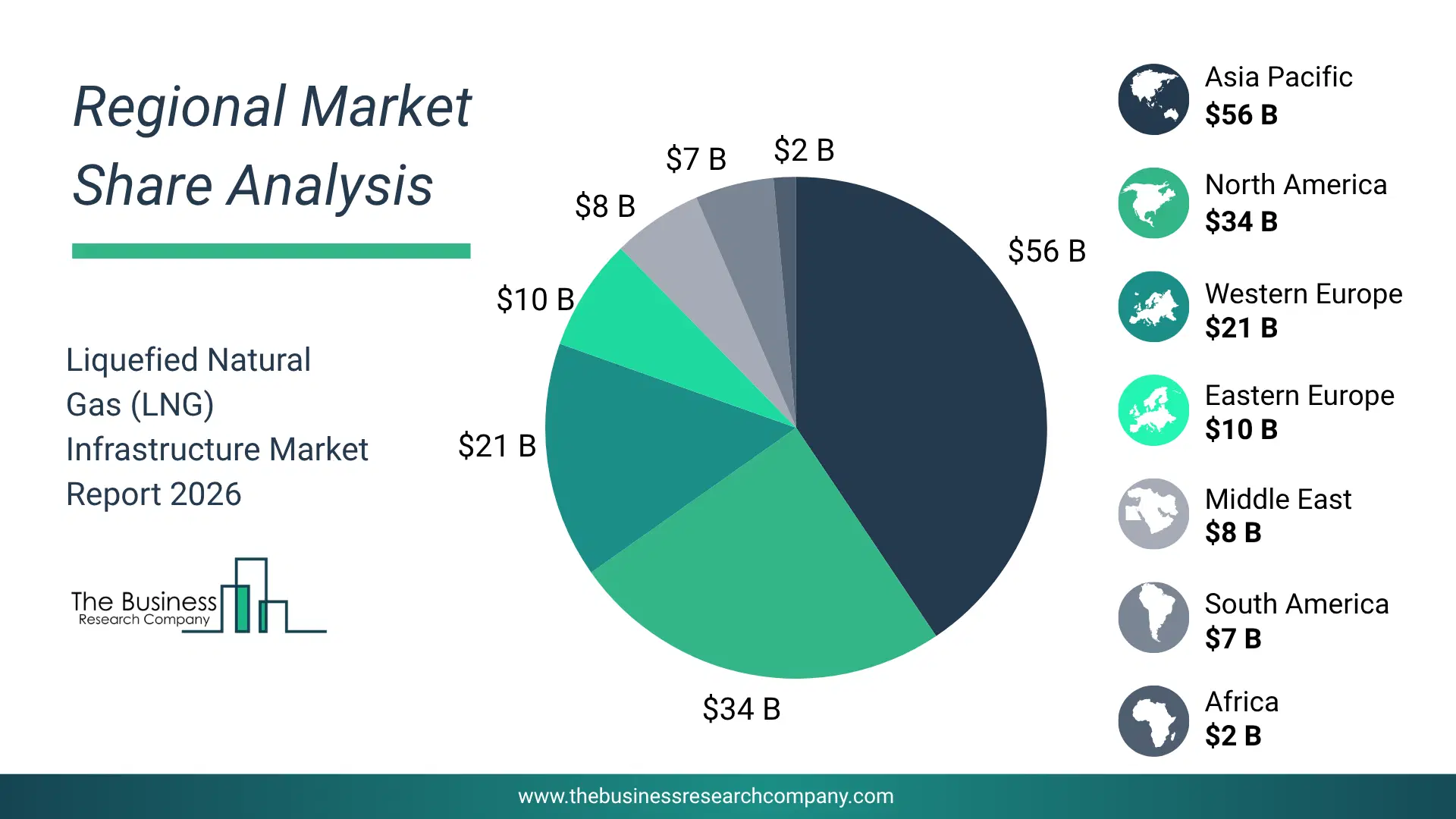
Regional Outlook
Asia-Pacific was the largest region in the liquefied natural gas (LNG) infrastructure market in 2025. Asia-Pacific is expected to be the fastest-growing region in the forecast period. The regions covered in this market report are Asia-Pacific, South East Asia, Western Europe, Eastern Europe, North America, South America, Middle East, Africa. The countries covered in this market report are Australia, Brazil, China, France, Germany, India, Indonesia, Japan, Taiwan, Russia, South Korea, UK, USA, Canada, Italy, SpainWhat Defines the Liquefied Natural Gas (LNG) Infrastructure Market?
The liquefied natural gas (LNG) infrastructure market consist of revenue earned by providing services such as LNG production facilities, transportation, storage facilities, regulation facilities, distribution pipelines, and LNG trucking and bunkering. The market value includes the value of related goods sold by the service provider or included within the service offering. The liquefied natural gas (LNG) infrastructure market also includes sales of storage tanks, LNG carriers, receiving terminals, monitoring systems, and safety systems. Values in this market are ‘factory gate’ values, that is, the value of goods sold by the manufacturers or creators of the goods, whether to other entities (including downstream manufacturers, wholesalers, distributors, and retailers) or directly to end customers. The value of goods in this market includes related services sold by the creators of the goods.How is Market Value Defined and Measured?
The market value is defined as the revenues that enterprises gain from the sale of goods and/or services within the specified market and geography through sales, grants, or donations in terms of the currency (in USD unless otherwise specified). The revenues for a specified geography are consumption values that are revenues generated by organizations in the specified geography within the market, irrespective of where they are produced. It does not include revenues from resales along the supply chain, either further along the supply chain or as part of other products.
This chart presents market attractiveness based on a quantitative evaluation of growth, competition, strategic alignment, and risk, offering a clear view of opportunity areas for decision-making. This chart is for illustrative purposes; the full report contains the complete analysis.

This chart highlights the Total Addressable Market (TAM) by estimating the maximum revenue opportunity using an assumption-driven approach, supporting strategic planning and opportunity sizing across markets. The chart is illustrative; the full report provides a more comprehensive analysis.
What Key Data and Analysis Are Included in the Liquefied Natural Gas (LNG) Infrastructure Market Report 2026?
The liquefied natural gas (lng) infrastructure market research report is one of a series of new reports from The Business Research Company that provides market statistics, including Market Report 2026?global market size, regional shares, competitors with the market share, detailed market segments, market trends and opportunities, and any further data you may need to thrive in the liquefied natural gas (lng) infrastructure Market Report 2026? The market research report delivers a complete perspective of everything you need, with an in-depth analysis of the current and future state of the Market Report 2026?Liquefied Natural Gas (LNG) Infrastructure Market Report Forecast Analysis
| Report Attribute | Details |
|---|---|
| Market Size Value In 2026 | $84.8 billion |
| Revenue Forecast In 2030 | $138.43 billion |
| Growth Rate | CAGR of 14.3% from 2026 to 2030 |
| Base Year For Estimation | 2025 |
| Actual Estimates/Historical Data | 2020-2025 |
| Forecast Period | 2026 - 2030 |
| Market Representation | Revenue in USD Billion and CAGR from 2026 to 2030 |
| Segments Covered | Type, Production, Distribution, End User Industry |
| Regional Scope | Asia-Pacific, Western Europe, Eastern Europe, North America, South America, Middle East, Africa |
| Country Scope | The countries covered in the report are Australia, Brazil, China, France, Germany, India, Indonesia, Japan, Taiwan, Russia, South Korea, UK, USA, Canada, Italy, Spain. |
| Key Companies Profiled | ExxonMobil Corporation, Chevron Corporation, BP PLC, Royal Dutch Shell PLC, TotalEnergies SE, Cheniere Energy Inc, QatarEnergy, Petronas, Novatek, Woodside Energy Group Ltd, ConocoPhillips Company, Equinor ASA, Eni S.p.A, Sempra Energy, Freeport LNG, NextDecade Corporation, Dominion Energy (Cove Point), China National Offshore Oil Corporation CNOOC, Gazprom, Petronet LNG Ltd, Santos Ltd, Tellurian Inc, Venture Global LNG, Indonesia’s Pertamina |
| Customization Scope | Request for Customization |
| Pricing And Purchase Options | Explore Purchase Options |