
Liquid Carbon Dioxide Market Report 2026
Global Outlook – By Source Of Production (Natural Source, Synthetic Production), By Purity Level (Industrial Grade, Food Grade, Pharmaceutical Grade), By Distribution Channel (Direct Sales, Distributors, Online Sales, Retail), By Application (Food And Beverage Industry, Oil And Gas Industry, Medical And Healthcare, Chemical Manufacturing, Metallurgical Applications), By End-User (Industrial Manufacturing, Food Processing, Healthcare, Agriculture, Research And Development) – Market Size, Trends, Strategies, and Forecast to 2030
Liquid Carbon Dioxide Market Overview
• Liquid Carbon Dioxide market size has reached to $6.54 billion in 2025 • Expected to grow to $9.23 billion in 2030 at a compound annual growth rate (CAGR) of 7.1% • Growth Driver: Rising Demand For Food And Beverages Fueling The Growth Of The Market Due To Increasing Global Population And Export Surge • Market Trend: Innovative Storage Solutions Maintain CO2 Stability Over Long Distances • North America was the largest region in 2025 and Asia-Pacific is the fastest growing region.Market Gains By 2030 – Top Opportunities By Segment
Market Gain identifies the most promising market opportunities by highlighting the segments or products expected to generate the highest incremental revenue growth over the next five years.
What Is Covered Under Liquid Carbon Dioxide Market?
Liquid carbon dioxide is the liquefied form of carbon dioxide gas, maintained under high pressure and low temperature. It is a colorless, odorless liquid used primarily as a solvent, refrigerant, and in fire suppression systems. It enables efficient cooling, cleaning, and extraction processes in industrial, food, and environmental applications. The main source of production types of liquid carbon dioxide are natural sources and synthetic production. Natural source refers to liquid carbon dioxide (LCO2) obtained from naturally occurring CO2 reservoirs, such as underground geological formations. It is available in various purity levels, including industrial grade, food grade, and pharmaceutical grade, and is distributed through several channels, such as direct sales, distributors, online platforms, and retail outlets. The key applications span across the food and beverage industry, oil and gas sector, medical and healthcare, chemical manufacturing, and metallurgical processes, serving various end-users, including industrial manufacturing, food processing, healthcare, agriculture, and research and development sectors.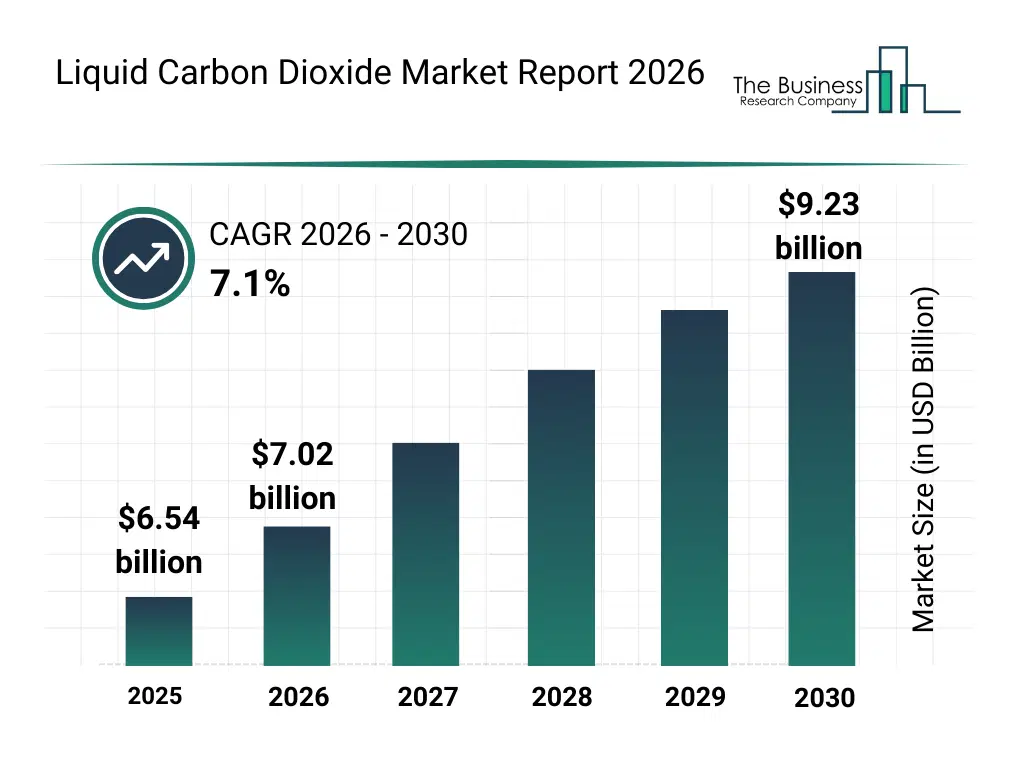
What Is The Liquid Carbon Dioxide Market Size and Share 2026?
The liquid carbon dioxide market size has grown strongly in recent years. It will grow from $6.54 billion in 2025 to $7.02 billion in 2026 at a compound annual growth rate (CAGR) of 7.3%. The growth in the historic period can be attributed to expansion of carbonated beverage production driving demand for food-grade carbon dioxide, increased industrial use of liquid carbon dioxide for welding and shielding applications, growth in adoption of cryogenic co2 for cooling and refrigeration processes, early utilization of supercritical co2 in extraction and cleaning technologies, development of co2 capture and purification systems supporting supply availability.What Is The Liquid Carbon Dioxide Market Growth Forecast?
The liquid carbon dioxide market size is expected to see strong growth in the next few years. It will grow to $9.23 billion in 2030 at a compound annual growth rate (CAGR) of 7.1%. The growth in the forecast period can be attributed to rising adoption of supercritical co2 for sustainable extraction and processing, growing demand for liquid co2 in precision cooling for electronics and industrial equipment, expansion of fire suppression applications using clean-agent co2 systems, increased deployment of carbon capture, utilization, and storage infrastructure enhancing feedstock availability, technological advancements improving liquefaction efficiency and purity levels. Major trends in the forecast period include rising demand for liquid co2 in food and beverage processing for carbonation, cooling, and modified atmosphere packaging, expansion of cryogenic freezing and chilling applications in meat, poultry, and seafood processing, growing use of liquid co2 in metal fabrication and welding for shielding, cleaning, and surface treatment, increasing adoption of high-purity liquid co2 in pharmaceuticals, medical devices, and healthcare applications, capacity expansion and integration of liquid co2 plants near fermentation, fertilizer, and refinery sites to secure feedstock and reduce logistics costs.
Global Liquid Carbon Dioxide Market Segmentation
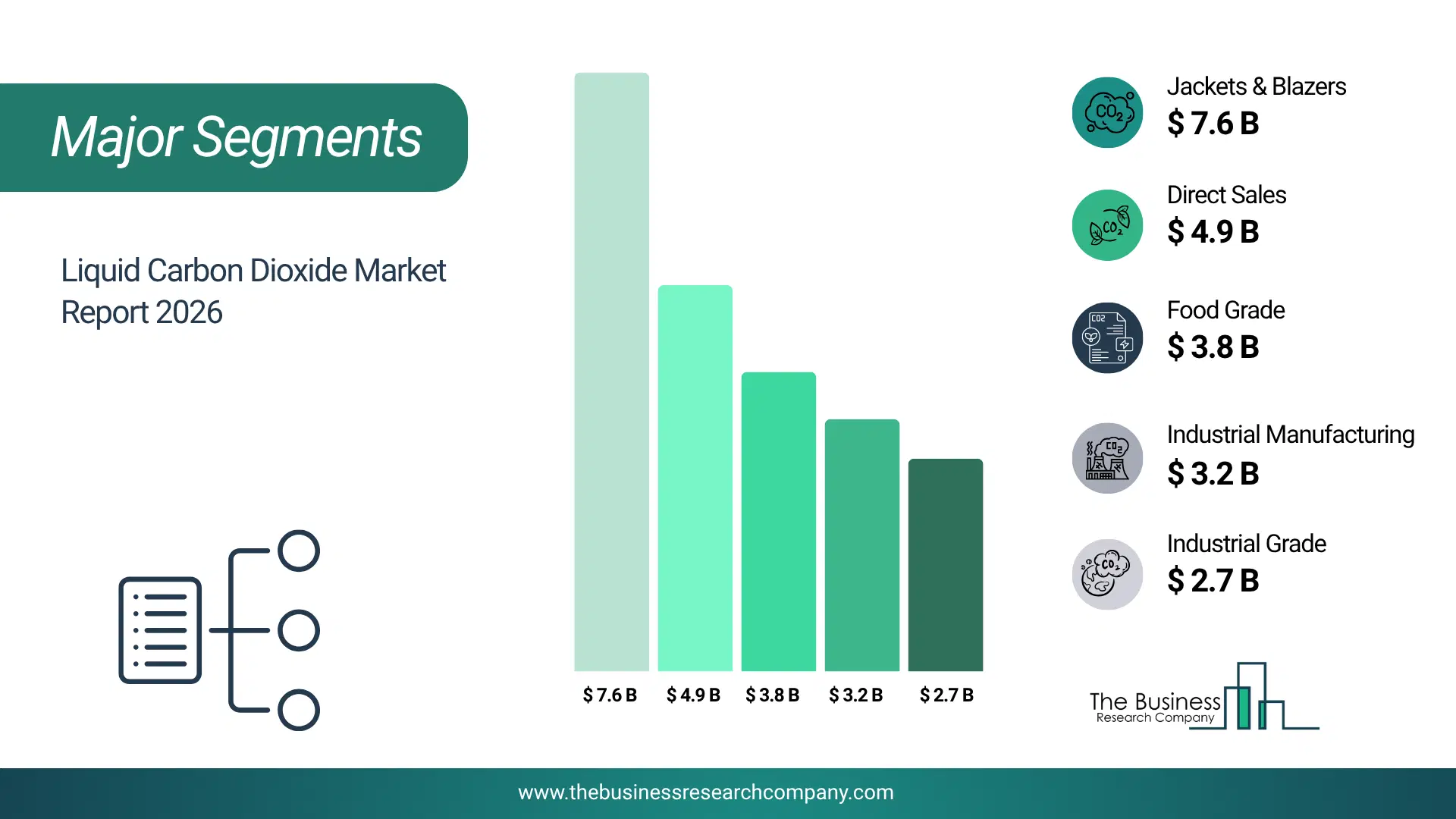
1) By Source Of Production: Natural Source, Synthetic Production 2) By Purity Level: Industrial Grade, Food Grade, Pharmaceutical Grade 3) By Distribution Channel: Direct Sales, Distributors, Online Sales, Retail 4) By Application: Food And Beverage Industry, Oil And Gas Industry, Medical And Healthcare, Chemical Manufacturing, Metallurgical Applications 4) By End-User: Industrial Manufacturing, Food Processing, Healthcare, Agriculture, Research And Development Subsegments: 1) By Natural Source: Geothermal Wells, Volcanic Activity, Natural Carbon Dioxide Reservoirs 2) By Synthetic Production: Industrial Fermentation, Combustion Of Fossil Fuels, Chemical Processes The top segments in the liquid carbon dioxide market will be: • Synthetic Production will reach $7674.47 Million by 2030. • Direct Sales will reach $4934.05 Million by 2030. • Food Grade will reach $3832.67 Million by 2030. • Industrial Manufacturing will reach $3254.31 Million by 2030. • Industrial Grade will reach $2749.86 Million by 2030.What Is Driver Of The Liquid Carbon Dioxide Market?
The rising demand for food and beverages is expected to propel the growth of the liquid carbon dioxide market going forward. Food and beverages refer to solid and liquid consumable products intended for human consumption, including everything from raw ingredients to processed meals and drinks. Food and beverage is increasing due to the rising global population, which creates a higher demand for nourishment and products. Liquid carbon dioxide is used in the food and beverage industry for carbonation, refrigeration, and preservation to maintain product quality and freshness. For instance, in June 2025, according to the Statistics Canada, a Canada-based statistical agency, reported that in 2024, food and beverage sales accounted for nearly one-quarter of total retail spending in Canada. Specifically, food and beverage retailers saw a 1.8% increase, while general merchandise retailers experienced an 8.9% rise in food sales compared to 2023. Therefore, the rising demand for food and beverages is driving the growth of the liquid carbon dioxide industry.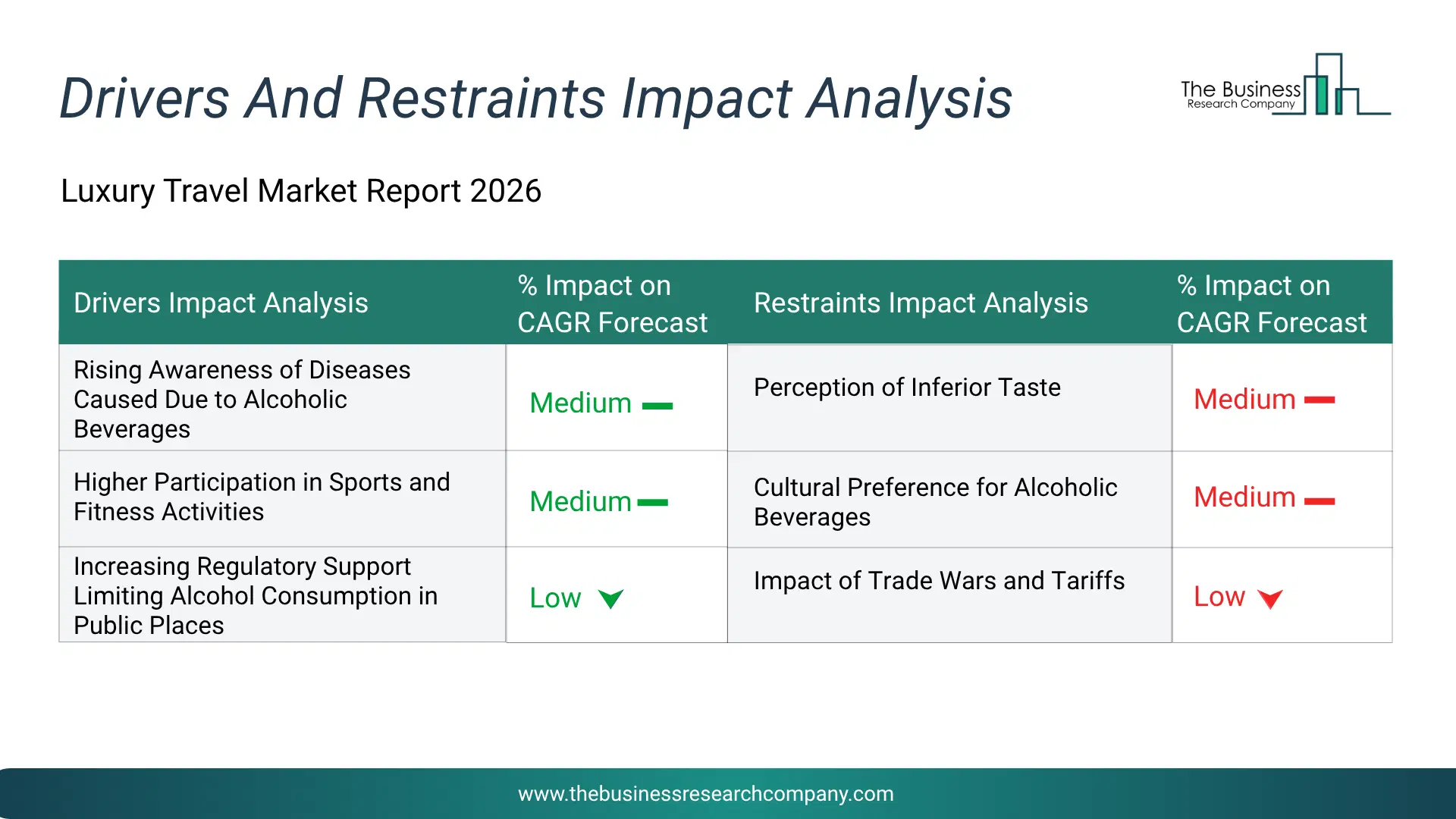
Infographic Chart Showing Key Market Drivers Analysis And Restraints For Liquid Carbon Dioxide Market
The chart presents an impact analysis of key drivers and restraints, quantifying their relative influence on the market's growth rate and helping assess the balance between growth enablers and limiting factors. This chart offers a high-level perspective; the full report contains more detailed insights.
How Will The Drivers Impact Growth In The Global Liquid Carbon Dioxide Market?
• Integration of Carbon Capture, Utilization, and Storage (CCUS) Infrastructure (Medium) – During the forecast period, the integration of carbon capture, utilization, and storage (ccus) infrastructure will become a key driver of growth in the liquid carbon dioxide market by 2030. the expansion of large-scale carbon capture, utilization, and storage systems increases the volume of captured co₂ that must be conditioned, purified, and converted into liquid form for transport, storage, or downstream use. liquefaction enables efficient handling of co₂ over long distances, especially where pipelines are not viable, supporting cross-border movement and centralized storage solutions. captured co₂ also creates new supply streams for food, industrial, and chemical applications once appropriately processed. as capture projects scale up, demand rises for reliable liquefaction, storage, and logistics infrastructure, strengthening the role of liquid co₂ across industrial value chains. as a result, the integration of carbon capture, utilization, and storage (ccus) infrastructure is anticipated to contributing to a 1.5% annual growth in the market. • Growth of Cold-Chain and Refrigeration Logistics (Medium) – During the forecast period, the growth of cold-chain and refrigeration logistics will emerge as a major factor driving the expansion of the liquid carbon dioxide market by 2030. expansion of temperature-controlled logistics for food, pharmaceuticals, and vaccines drives higher use of liquid co₂ and dry ice for cooling and preservation. liquid co₂ supports rapid dry ice production and cryogenic chilling, which are critical for long-distance and last-mile cold-chain transport. increasing demand for safe, non-toxic, and residue-free cooling solutions strengthens its adoption across logistics networks. as cold-chain infrastructure scales, associated consumption of liquid co₂ grows in parallel. rising e-commerce activity and pharmaceutical distribution further amplify the need for reliable co₂-based refrigeration solutions. consequently, the growth of cold-chain and refrigeration logistics is projected to contributing to a 1.0% annual growth in the market. • Expansion in Chemical Industry Applications (Low) – During the forecast period, the expansion in chemical industry applications will serve as a key growth catalyst for the liquid carbon dioxide market by 2030. the chemical sector increasingly uses liquid co₂ as a feedstock, processing aid, and inerting agent in applications such as polymer production, ph control, and specialty chemical synthesis. growth in chemical manufacturing increases the need for consistent, high-purity co₂ supplies to support continuous operations. liquid form enables easier storage, precise dosing, and integration into existing chemical processes. as chemical plants expand capacity, reliance on dependable liquid co₂ handling and supply systems rises accordingly. this trend is further supported by stricter process control requirements and the shift toward cleaner, more efficient chemical production routes. therefore, this expansion in chemical industry applications operations is projected to supporting to a 0.8% annual growth in the market. • Expansion of Industrial Gas Distribution Networks (Low) – During the forecast period, expansion of industrial gas distribution networks are accelerating the adoption of liquid carbon dioxide. widening industrial gas distribution networks improve access to liquid co₂ across regional and emerging industrial hubs. investments in bulk storage, cryogenic tankers, and filling stations reduce delivery times and improve supply reliability for end users. broader distribution coverage enables penetration into smaller and remote industrial customers previously constrained by logistics. as networks expand, utilization of liquid co₂ increases across a wider range of industrial and commercial applications. improved distribution efficiency also helps stabilize pricing and mitigates supply disruptions during peak demand periods. the expansion of industrial gas distribution networks growth contribution during the forecast period in 2025 is 0.5%.How Will The Restraints Impact Growth In The Global Liquid Carbon Dioxide Market?
• Supply Dependence on By-Product CO₂ Sources (Medium) – During the forecast period, the supply dependence on by-product co₂ sources remains a significant barrier to market expansion. reliance on by-product co₂ generated from ammonia, ethanol, and hydrogen plants creates supply constraints due to fluctuations in operating rates and unplanned shutdowns at these facilities. when primary host plants reduce output or undergo maintenance, the availability of recoverable co₂ declines sharply, leading to shortages and price volatility. this dependence limits supply stability and reduces flexibility in meeting demand peaks across food, industrial, and medical applications. it also restricts expansion into new regions where suitable host facilities are absent, increasing logistical complexity and supply risk. growth affected by supply dependence on by-product co₂ sources during the forecast period in 2025 is -2.0%. • High Transportation and Logistics Costs (Medium) – During the forecast period, the high transportation and logistics costs a significant barrier to market expansion. high transportation and logistics costs limit wider adoption due to the need for specialized cryogenic tankers, insulated storage vessels, and strict handling requirements to maintain co₂ in liquid form. long-distance transportation significantly increases fuel, labor, and compliance expenses, especially in regions lacking nearby production facilities. these costs are further amplified by limited tanker availability and return logistics inefficiencies. as a result, end users in remote or low-demand regions face higher prices and inconsistent supply, which constrains broader usage and slows capacity expansion. growth affected by high transportation and logistics costs during the forecast period in 2025 is -1.0%. • Impact Of Trade War And Tariffs (Low) – During the forecast period, the impact of trade war and tariffs remains a significant barrier to market expansion. trade wars and the imposition of tariffs disrupt cross-border movement of liquid co₂ and related equipment, increasing procurement and transportation costs. restrictions on imports and exports reduce supply flexibility, particularly in regions dependent on cross-border sourcing to balance seasonal demand. tariffs on industrial gases, cryogenic equipment, and transport components also raise operational expenses for suppliers. these trade barriers create pricing volatility and supply uncertainty, discouraging expansion plans and limiting access to cost-effective liquid co₂ in affected regions. growth affected by impact of trade war and tariffs during the forecast period in 2025 is -0.2%.Key Players In The Global Liquid Carbon Dioxide Market
Major companies operating in the liquid carbon dioxide market are Linde plc, Air Liquide Deutschland GmbH, Air Products and Chemicals Inc., Messer Group GmbH, BOSCO India, Westfalen AG, SOL Group, Matheson Tri-Gas Inc., Gulf Cryo Holding, Continental Carbonic Products Inc., Praxair Inc, INOX Air Products Private Limited, BOC Ltd., Goyal MG Gases Pvt. Ltd., SICGIL Industrial Gases Limited, Southern Industrial Gas Sdn Bhd, Coregas Pty Ltd., Axcel Industrial Gases Pvt. Ltd., Bathinda Industrial Gases Pvt. Ltd., UIG Universal Cryo Gas LLC, Sri Venkateswara Carbonic Gases Private Limited, Iwatani Corporation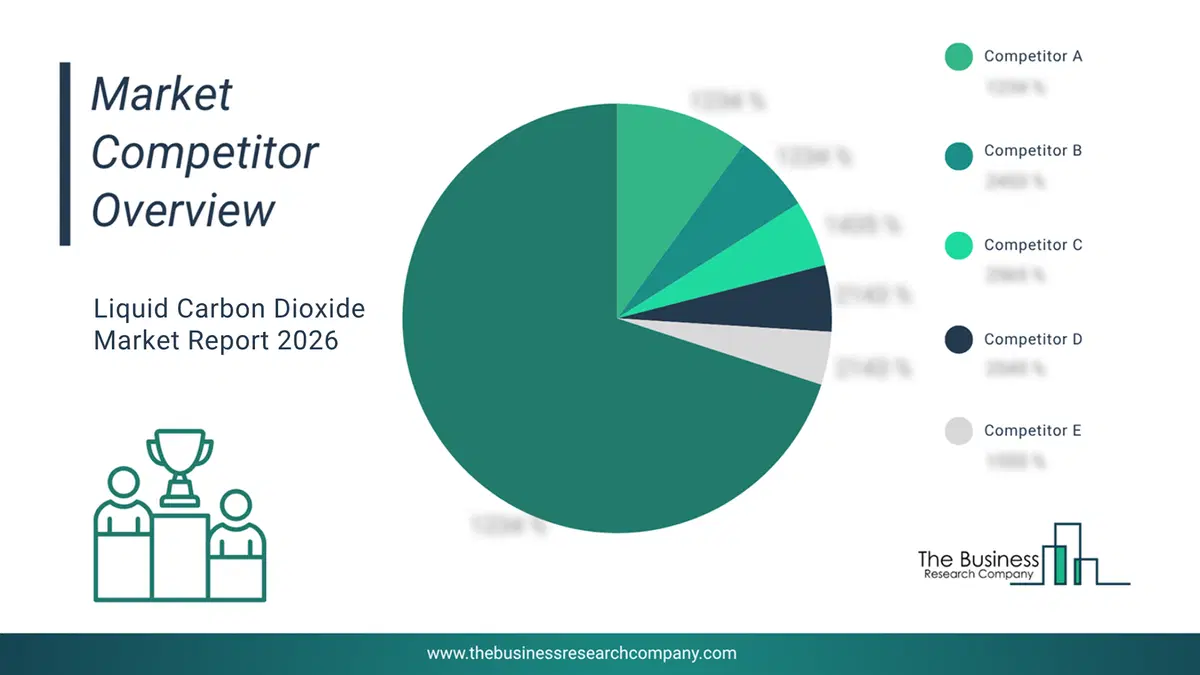
This chart is for illustrative purposes; the full report includes a detailed competitor analysis and comprehensive overview of the top 10 companies in the market.
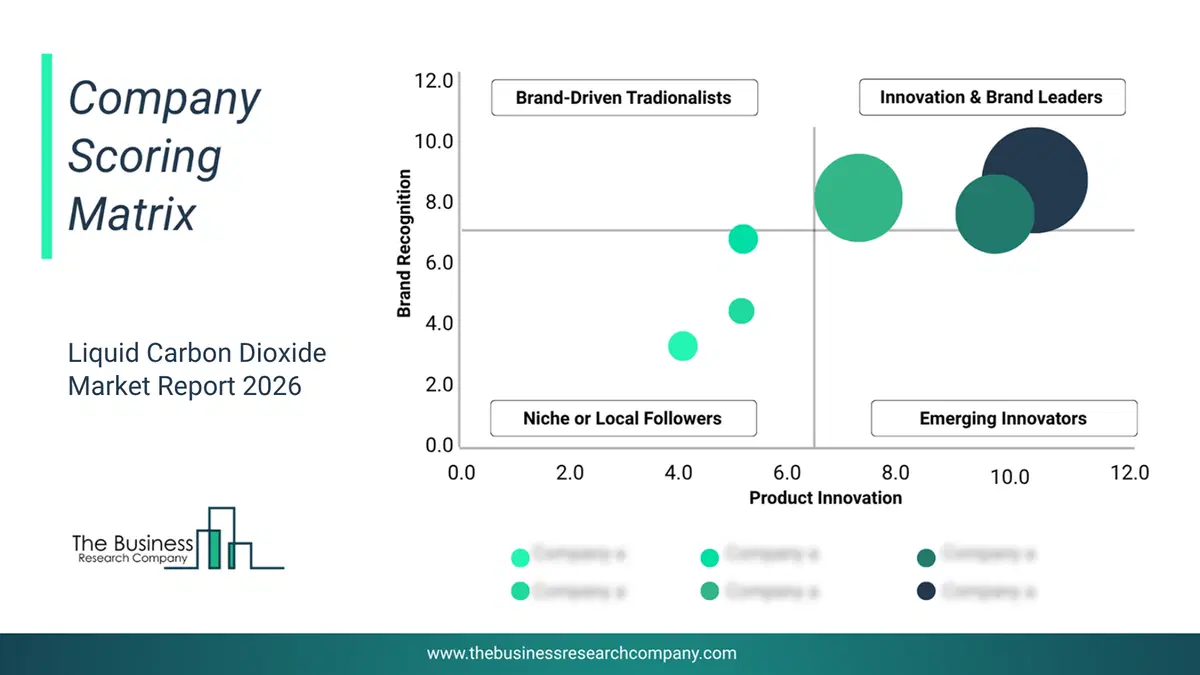
This chart maps companies by product innovation and brand strength, with bubble size indicating relative revenue, helping identify market leaders, challengers, and niche players. This is an illustrative chart; the full report provides a complete and accurate competitive analysis.
Global Liquid Carbon Dioxide Market Trends and Insights
Major companies operating in the liquid carbon dioxide market are focusing on developing innovative products, such as liquid carbon dioxide carriers, to improve storage and transport efficiency, reduce energy loss, and maintain CO2 stability during long-distance shipping. A liquid carbon dioxide (CO2) Carrier is a specialized vessel, container, or system designed to transport carbon dioxide in its liquid form under controlled temperature and pressure conditions. For instance, in April 2025, Hyundai Mipo Dockyard Co. Ltd., a South Korea-based shipbuilding company, launched a liquefied carbon dioxide (LCO2) carrier. It efficiently transports captured CO2 over long distances for storage or utilization, supporting global decarbonization and carbon capture goals. Their large capacity lowers transport costs and enables flexible, economical movement of CO2 compared to pipelines, especially for distances over 300 km.What Are Latest Mergers And Acquisitions In The Liquid Carbon Dioxide Market? Alto Ingredients Acquires Kodiak Carbonic To Strengthen CO₂ Capabilities
In January 2025, Alto Ingredients Inc., a US-based chemical industry company, acquired Kodiak Carbonic LLC for an undisclosed amount. With this acquisition, Alto Ingredients aims to optimize byproduct CO₂ utilization, boost operational efficiency and margins, secure long-term revenue streams, and enhance the overall value and growth potential of its Columbia facility. Kodiak Carbonic LLC is a US-based company that provides beverage-grade liquid carbon dioxide processing services.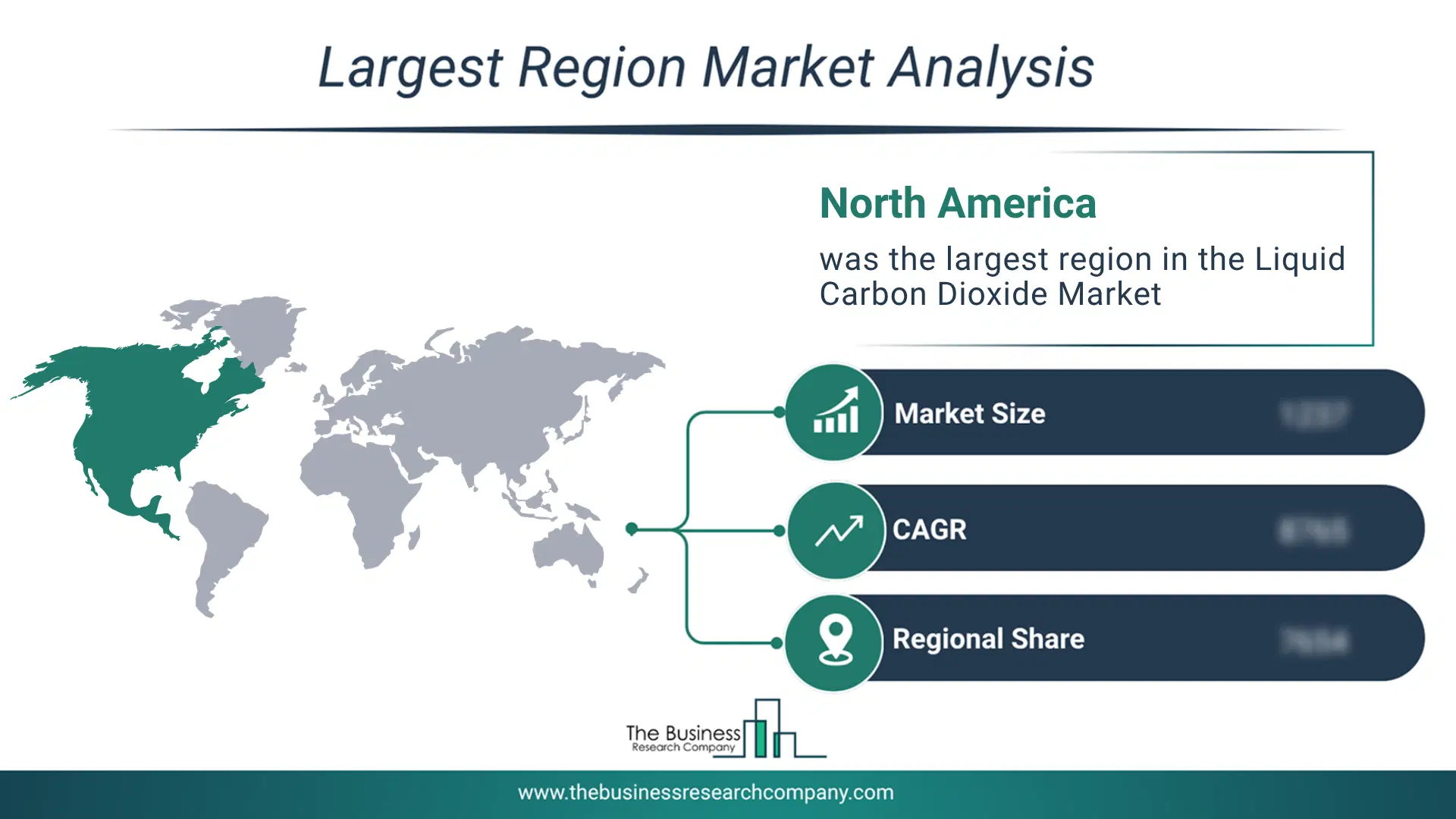
Regional Insights
North America was the largest region in the liquid carbon dioxide market in 2025. Asia-Pacific is expected to be the fastest-growing region in the forecast period. The regions covered in this market report are Asia-Pacific, South East Asia, Western Europe, Eastern Europe, North America, South America, Middle East, Africa. The countries covered in this market report are Australia, Brazil, China, France, Germany, India, Indonesia, Japan, Taiwan, Russia, South Korea, UK, USA, Canada, Italy, SpainWhat Defines the Liquid Carbon Dioxide Market?
The liquid carbon dioxide market consists of sales of supercritical liquid carbon dioxide, carbonated beverages carbon dioxide grade, welding-grade carbon dioxide, and cryogenic liquid carbon dioxide. Values in this market are ‘factory gate’ values, that is, the value of goods sold by the manufacturers or creators of the goods, whether to other entities (including downstream manufacturers, wholesalers, distributors, and retailers) or directly to end customers. The value of goods in this market includes related services sold by the creators of the goods.How is Market Value Defined and Measured?
The market value is defined as the revenues that enterprises gain from the sale of goods and/or services within the specified market and geography through sales, grants, or donations in terms of the currency (in USD unless otherwise specified). The revenues for a specified geography are consumption values that are revenues generated by organizations in the specified geography within the market, irrespective of where they are produced. It does not include revenues from resales along the supply chain, either further along the supply chain or as part of other products.
This chart presents market attractiveness based on a quantitative evaluation of growth, competition, strategic alignment, and risk, offering a clear view of opportunity areas for decision-making. This chart is for illustrative purposes; the full report contains the complete analysis.

This chart highlights the Total Addressable Market (TAM) by estimating the maximum revenue opportunity using an assumption-driven approach, supporting strategic planning and opportunity sizing across markets. The chart is illustrative; the full report provides a more comprehensive analysis.
What Key Data and Analysis Are Included in the Liquid Carbon Dioxide Market Report 2026?
The liquid carbon dioxide market research report is one of a series of new reports from The Business Research Company that provides market statistics, including industry global market size, regional shares, competitors with the market share, detailed market segments, market trends and opportunities, and any further data you may need to thrive in the liquid carbon dioxide industry. The market research report delivers a complete perspective of everything you need, with an in-depth analysis of the current and future state of the industry.Liquid Carbon Dioxide Market Report Forecast Analysis
| Report Attribute | Details |
|---|---|
| Market Size Value In 2026 | $7.02 billion |
| Revenue Forecast In 2030 | $9.23 billion |
| Growth Rate | CAGR of 7.3% from 2026 to 2030 |
| Base Year For Estimation | 2025 |
| Actual Estimates/Historical Data | 2020-2025 |
| Forecast Period | 2026 - 2030 - 2035 |
| Market Representation | Revenue in USD Billion and CAGR from 2026 to 2030 |
| Segments Covered | Source Of Production, Purity Level, Distribution Channel, Application, End-User |
| Regional Scope | Asia-Pacific, Western Europe, Eastern Europe, North America, South America, Middle East, Africa |
| Country Scope | The countries covered in the report are Australia, Brazil, China, France, Germany, India, Indonesia, Japan, Taiwan, Russia, South Korea, UK, USA, Canada, Italy, Spain. |
| Key Companies Profiled | Linde plc, Air Liquide Deutschland GmbH, Air Products and Chemicals Inc., Messer Group GmbH, BOSCO India, Westfalen AG, SOL Group, Matheson Tri-Gas Inc., Gulf Cryo Holding, Continental Carbonic Products Inc., Praxair Inc, INOX Air Products Private Limited, BOC Ltd., Goyal MG Gases Pvt. Ltd., SICGIL Industrial Gases Limited, Southern Industrial Gas Sdn Bhd, Coregas Pty Ltd., Axcel Industrial Gases Pvt. Ltd., Bathinda Industrial Gases Pvt. Ltd., UIG Universal Cryo Gas LLC, Sri Venkateswara Carbonic Gases Private Limited, Iwatani Corporation |
| Customization Scope | Request for Customization |
| Pricing And Purchase Options | Explore Purchase Options |