

Lithium-Ion Cell Post Processing Equipment Market Report 2026
Global Outlook – By Type (Formation Equipment, Capacity Dividing Equipment, Test Equipment, Other Types ), By Cell Type (Cylindrical Cells, Prismatic Cells, Pouch Cells ), By Application (3C Consumer Battery, Energy Storage Battery, Power Battery) – Market Size, Trends, Strategies, and Forecast to 2030
Lithium-Ion Cell Post Processing Equipment Market Overview
• Lithium-Ion Cell Post Processing Equipment market size has reached to $2.21 billion in 2025 • Expected to grow to $4.42 billion in 2030 at a compound annual growth rate (CAGR) of 14.9% • Growth Driver: Rising Adoption Of Electric Vehicles Fueling The Growth Of The Market Due To Growing Demand For Efficient Battery Production • Market Trend: Automation And Data-Driven Innovations Advancing Next-Generation Battery Manufacturing • North America was the largest region in 2025.What Is Covered Under Lithium-Ion Cell Post Processing Equipment Market?
Lithium-ion cell post-processing equipment refers to the machines and systems used after cell manufacturing to perform processes such as formation, aging, testing, grading, and packaging, ensuring each battery cell meets quality, safety, and performance standards before assembly. The main types of lithium-ion cell post processing equipment are formation equipment, capacity dividing equipment, test equipment, and others. Formation equipment is used to perform the initial charge and chemical activation of lithium-ion cells, stabilizing their internal structure. These systems are compatible with various cell types, including cylindrical cells, prismatic cells, and pouch cells, and have applications across 3C consumer batteries, energy storage batteries, and power batteries.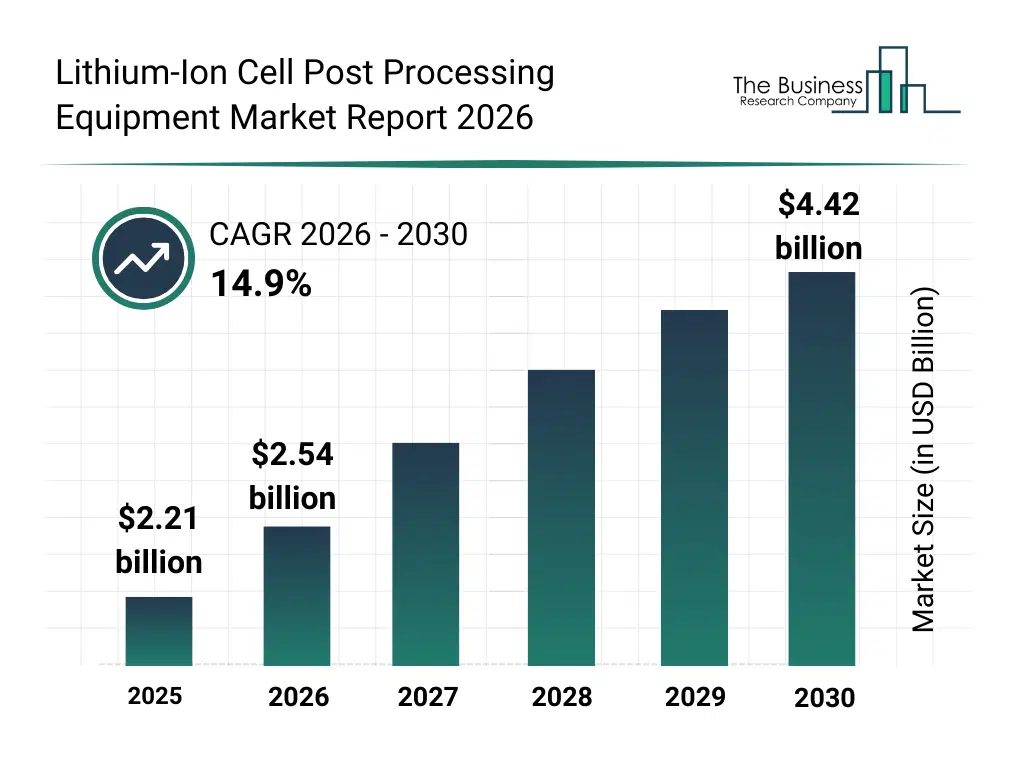
What Is The Lithium-Ion Cell Post Processing Equipment Market Size and Share 2026?
The lithium-ion cell post processing equipment market size has grown rapidly in recent years. It will grow from $2.21 billion in 2025 to $2.54 billion in 2026 at a compound annual growth rate (CAGR) of 15.1%. The growth in the historic period can be attributed to expansion of lithium-ion battery manufacturing capacity, rising demand for quality assurance in battery cells, increased investments in EV battery plants, adoption of automated post-processing equipment, growing emphasis on battery safety standards.What Is The Lithium-Ion Cell Post Processing Equipment Market Growth Forecast?
The lithium-ion cell post processing equipment market size is expected to see rapid growth in the next few years. It will grow to $4.42 billion in 2030 at a compound annual growth rate (CAGR) of 14.9%. The growth in the forecast period can be attributed to acceleration of electric vehicle production, expansion of grid-scale energy storage projects, increasing localization of battery manufacturing, rising adoption of smart factory systems, continuous improvements in battery performance requirements. Major trends in the forecast period include increasing automation in cell formation and aging lines, rising adoption of high-precision cell testing and grading systems, growing integration of inline quality inspection and vision systems, expansion of scalable post-processing lines for gigafactories, higher focus on safety validation and traceability.Tariff Impact On Lithium-Ion Cell Post Processing Equipment Market
Tariffs are significantly impacting the lithium-ion cell post-processing equipment market by increasing the cost of importing precision power electronics, formation cyclers, environmental chambers, automation components, and advanced testing systems. These impacts are most pronounced in regions such as North America and Europe that rely heavily on imported equipment from Asia-Pacific manufacturing hubs, particularly China, Japan, and South Korea. Higher capital expenditure requirements are slowing new production line deployments and capacity expansions. However, tariffs are also encouraging domestic equipment manufacturing, regional supplier ecosystem development, and long-term investments in localized battery production infrastructure.
Global Lithium-Ion Cell Post Processing Equipment Market Segmentation
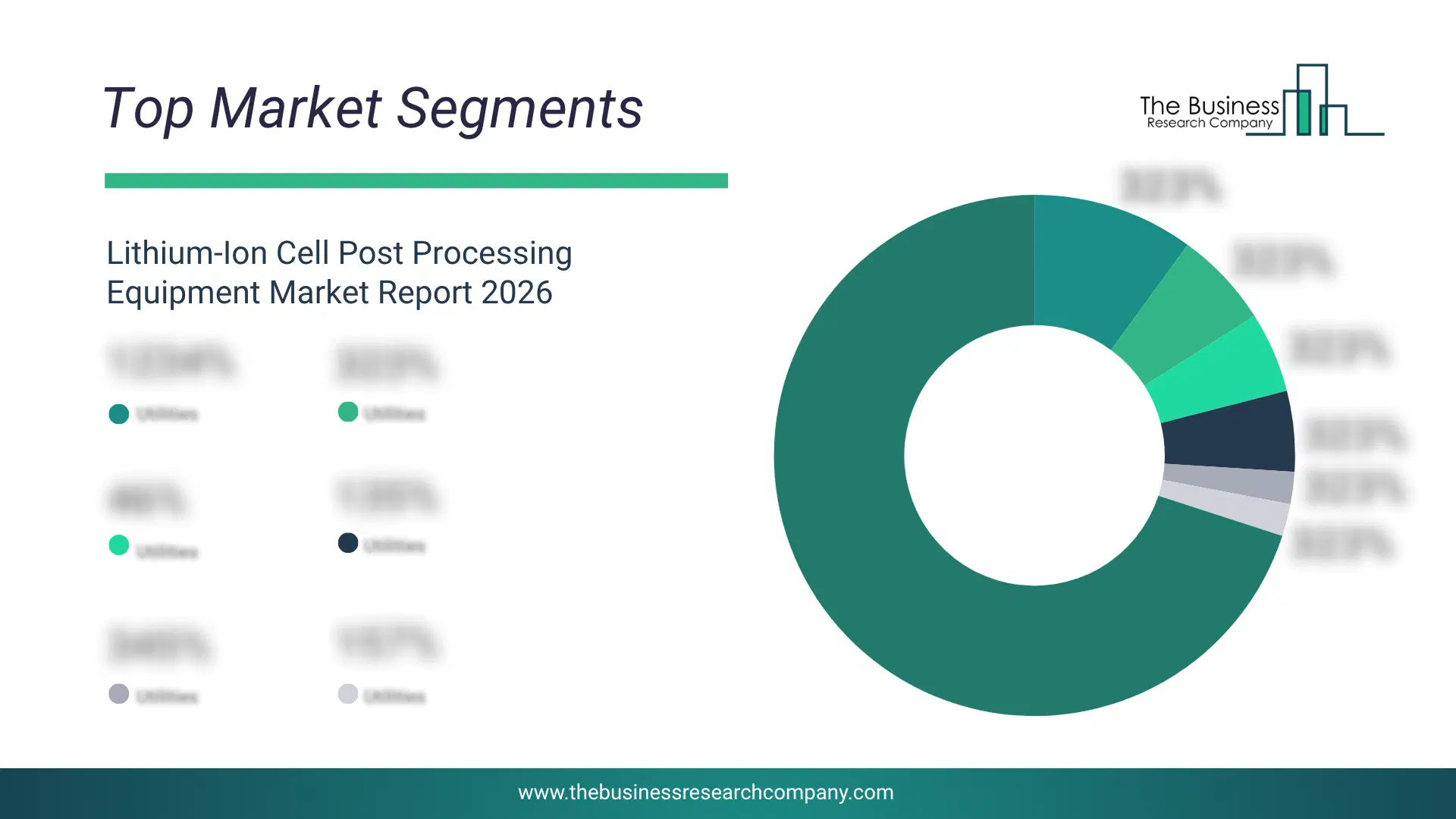
1) By Type: Formation Equipment, Capacity Dividing Equipment, Test Equipment, Other Types 2) By Cell Type: Cylindrical Cells, Prismatic Cells, Pouch Cells 3) By Application: 3C Consumer Battery, Energy Storage Battery, Power Battery Subsegments: 1) By Formation Equipment: Single-Cell Formation Cyclers, Multi-Channel Or Multi-String Formation Cyclers, Programmable Charge Or Discharge Power Supplies, Formation Racks And Fixtures, Formation Aging Chambers Or Controlled-Environment Rooms, Formation Process Control And Data Acquisition Systems, In-Line Formation Monitoring 2) By Capacity Dividing Equipment: Capacity Grading Testers, Voltage Or Impedance-Based Sorting Systems, Automated Cell Sorting Or Binning Conveyors And Robots, Throughput Binning Controllers And Database Systems, Cell Matching And Pairing Systems 3) By Test Equipment: Cycle Life Or Charge-Discharge Testers, Internal Resistance Or ESR Testers, High-Precision Coulombic Efficiency Testers, Safety Test Systems, Environmental Or Thermal Shock Chambers For Testing, Pack Or BMS Functional Test Rigs, Automated Test Equipment (ATE) Handlers And Vision Inspection For Testing 4) By Other Types: Degassing Or Vacuum Drying Systems, Sealing Or Crimping Or Terminal Welding Equipment, Laser Marking Or Labeling Systems, Final Inspection And Optical Or Vision QA Systems, Cell Balancing Or Pre-Conditioning Stations, Module Or Pack Assembly And End-Of-Line Conveyor SystemsWhat Are The Drivers Of The Lithium-Ion Cell Post Processing Equipment Market?
The increasing adoption of electric vehicles (EVs) is expected to propel the growth of the lithium-ion cell post processing equipment market going forward. An electric vehicle (EV) is a mode of transportation powered entirely or primarily by electricity, utilizing electric motors instead of internal combustion engines. The adoption of electric vehicles is rising due to increasing environmental awareness and government incentives promoting clean and sustainable transportation. Lithium-ion cell post-processing equipment is used in electric vehicles to refine, test, and assemble battery cells into reliable packs, ensuring optimal performance, safety, and energy efficiency in EV batteries. For instance, in April 2024, according to the International Energy Agency (IEA), a France-based intergovernmental organization, the number of new electric car registrations in China reached 8.1 million in 2023, representing a 35% increase compared to 2022. Therefore, the increasing adoption of electric vehicles is driving the growth of the lithium-ion cell post processing equipment industry. The expansion of renewable energy storage solutions is expected to propel the growth of the lithium-ion cell post processing equipment market going forward. Renewable energy storage solutions are systems that store energy generated from renewable sources such as solar, wind, or hydro for later use, ensuring a steady and reliable power supply. The demand for renewable energy storage solutions is increasing due to the growing need to balance intermittent power supply from renewable sources and ensure energy reliability. Lithium-ion cell post-processing equipment is used in renewable energy storage solutions to enhance the performance, safety, and lifespan of battery cells through precise formation, testing, and quality control processes. For instance, in February 2025, the World Resources Institute, a US-based non-profit organization, reported that in 2024, solar energy set a new record by adding an estimated 39.6 gigawatts (GW) of capacity, surpassing the 27.4 GW installed in 2023. Therefore, the expansion of renewable energy storage solutions is driving the growth of the lithium-ion cell post processing equipment industry.Key Players In The Global Lithium-Ion Cell Post Processing Equipment Market
Major companies operating in the lithium-ion cell post processing equipment market are Ruineng Shares Co. Ltd., Chroma ATE Inc., Qingtian Group Co. Ltd., BENNING Elektrotechnik und Elektronik GmbH & Co. KG, Constant Wing Energy Co. Ltd., Maccor Inc., Arbin Instruments Inc., Hanchuan Intelligence Technology Co. Ltd., Kataoka Corporation, Ningbo Beite Battery Co. Ltd., WONIK PNE Co. Ltd., Titan New Power Technology Co. Ltd., Hangke Technology Co. Ltd., Guangdong Lyric Robot Automation Co. Ltd., Smart Performance Technology Co. Ltd., Nebula Technology Co. Ltd. (Nebula Shares), Huazi Technology Co. Ltd., Newwell Electronics Co. Ltd., Wuhan Blue Electric Co. Ltd., Digatron Power Electronics GmbH, Lanqi Electronics Co. Ltd.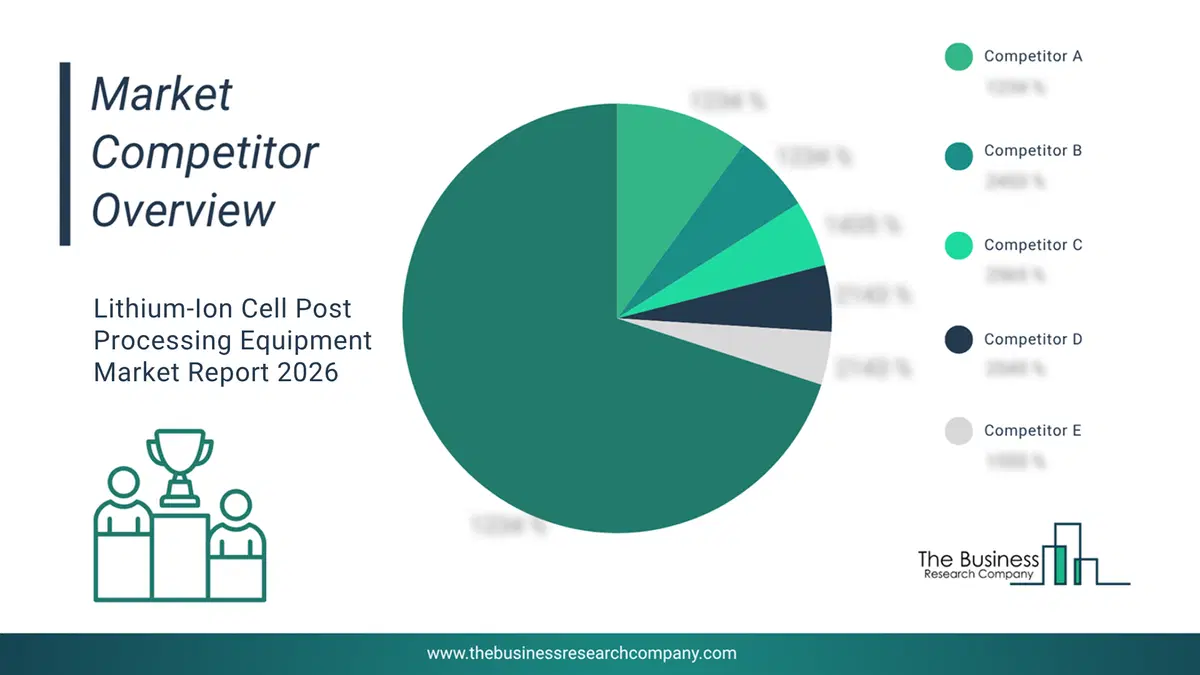
This chart is for illustrative purposes; the full report includes a detailed competitor analysis and comprehensive overview of the top 10 companies in the market.
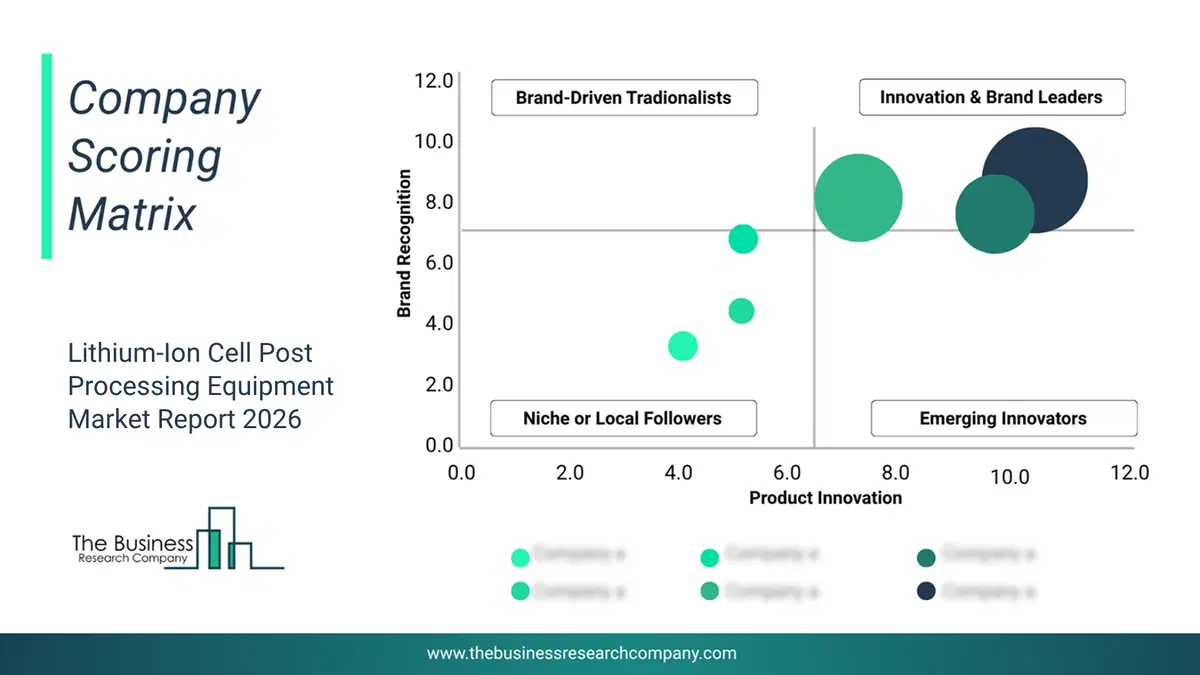
This chart maps companies by product innovation and brand strength, with bubble size indicating relative revenue, helping identify market leaders, challengers, and niche players. This is an illustrative chart; the full report provides a complete and accurate competitive analysis.
Global Lithium-Ion Cell Post Processing Equipment Market Trends and Insights
Major companies operating in the lithium-ion cell post-processing equipment market are focusing on developing advanced and automated solutions to enhance cell efficiency, precision, and sustainability, while expanding their capabilities from prototyping to large-scale production through innovations in formation, testing, and data-driven process optimization. For instance, in June 2024, Comau S.p.A., an Italy-based automation solution company, introduced its new cell formation and testing technologies at The Battery Show Europe 2024, marking a major step in advancing Europe’s local battery manufacturing capabilities. These turnkey solutions cover every stage from prototyping to giga-scale production, aiming to enhance productivity, safety, and sustainability. The technologies automate critical battery formation cycles, charging and discharging to ensure optimal performance and longevity. Alongside, Comau showcased its Racer-5 SE cleanroom robot and in.Grid data management platform, highlighting automation, precision, and energy reuse.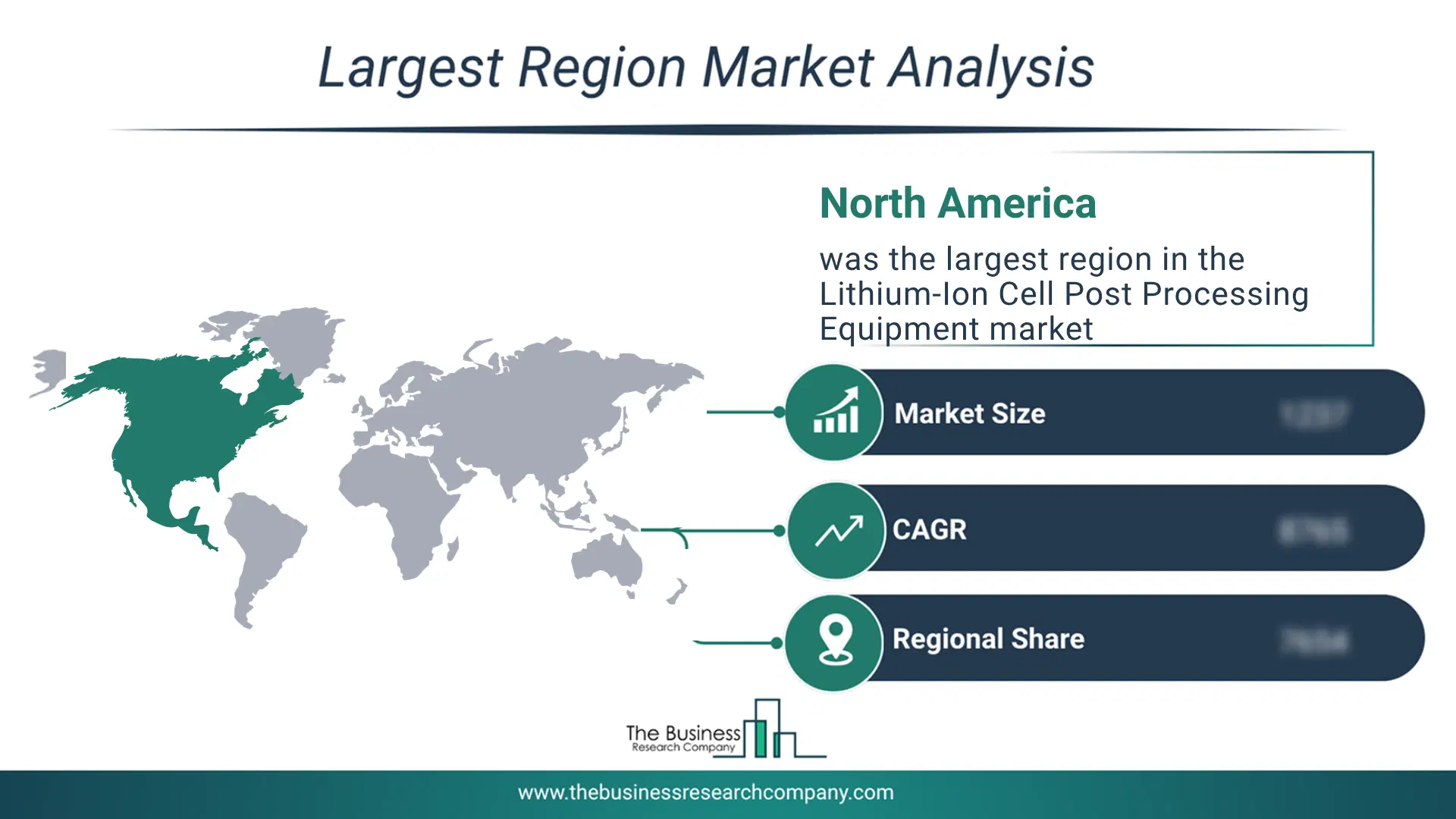
Regional Outlook
North America was the largest region in the lithium-ion cell post processing equipment market in 2025. The regions covered in this market report are Asia-Pacific, South East Asia, Western Europe, Eastern Europe, North America, South America, Middle East, Africa The countries covered in this market report are Australia, Brazil, China, France, Germany, India, Indonesia, Japan, Taiwan, Russia, South Korea, UK, USA, Canada, Italy, Spain.What Defines the Lithium-Ion Cell Post Processing Equipment Market?
The lithium-ion cell post processing equipment market consists of sales of formation machines, aging cabinets, grading machines, battery cell testers, internal resistance testers, voltage measurement units, temperature control chambers, and automation conveyor systems. Values in this market are ‘factory gate’s values, that is, the value of goods sold by the manufacturers or creators of the goods, whether to other entities (including downstream manufacturers, wholesalers, distributors, and retailers) or directly to end customers. The value of goods in this market includes related services sold by the creators of the goods.How is Market Value Defined and Measured?
The market value is defined as the revenues that enterprises gain from the sale of goods and/or services within the specified market and geography through sales, grants, or donations in terms of the currency (in USD unless otherwise specified). The revenues for a specified geography are consumption values that are revenues generated by organizations in the specified geography within the market, irrespective of where they are produced. It does not include revenues from resales along the supply chain, either further along the supply chain or as part of other products.
This chart presents market attractiveness based on a quantitative evaluation of growth, competition, strategic alignment, and risk, offering a clear view of opportunity areas for decision-making. This chart is for illustrative purposes; the full report contains the complete analysis.

This chart highlights the Total Addressable Market (TAM) by estimating the maximum revenue opportunity using an assumption-driven approach, supporting strategic planning and opportunity sizing across markets. The chart is illustrative; the full report provides a more comprehensive analysis.
What Key Data and Analysis Are Included in the Lithium-Ion Cell Post Processing Equipment Market Report 2026?
The lithium-ion cell post processing equipment market research report is one of a series of new reports from The Business Research Company that provides market statistics, including industry global market size, regional shares, competitors with the market share, detailed market segments, market trends and opportunities, and any further data you may need to thrive in the lithium-ion cell post processing equipment industry. The market research report delivers a complete perspective of everything you need, with an in-depth analysis of the current and future state of the industry.Lithium Ion Cell Post Processing Equipment Market Report Forecast Analysis
| Report Attribute | Details |
|---|---|
| Market Size Value In 2026 | $2.54 billion |
| Revenue Forecast In 2030 | $4.42 billion |
| Base Year For Estimation | 2025 |
| Actual Estimates/Historical Data | 2020-2025 |
| Forecast Period | 2026 - 2030 |
| Market Representation | Revenue in USD Billion and CAGR from 2026 to 2030 |
| Segments Covered | Type, Cell Type, Application |
| Regional Scope | Asia-Pacific, Western Europe, Eastern Europe, North America, South America, Middle East, Africa |
| Key Companies Profiled | Ruineng Shares Co. Ltd., Chroma ATE Inc., Qingtian Group Co. Ltd., BENNING Elektrotechnik und Elektronik GmbH & Co. KG, Constant Wing Energy Co. Ltd., Maccor Inc., Arbin Instruments Inc., Hanchuan Intelligence Technology Co. Ltd., Kataoka Corporation, Ningbo Beite Battery Co. Ltd., WONIK PNE Co. Ltd., Titan New Power Technology Co. Ltd., Hangke Technology Co. Ltd., Guangdong Lyric Robot Automation Co. Ltd., Smart Performance Technology Co. Ltd., Nebula Technology Co. Ltd. (Nebula Shares), Huazi Technology Co. Ltd., Newwell Electronics Co. Ltd., Wuhan Blue Electric Co. Ltd., Digatron Power Electronics GmbH, Lanqi Electronics Co. Ltd. |
| Customization Scope | Request for Customization |
| Pricing And Purchase Options | Explore Purchase Options |