
Livestock Breeding Management Market Report 2026
Global Outlook – By Product Type (Breeding Software, Breeding Equipment, Other Product Types), By Animal Type (Cattle, Sheep, Swine, Goats), By Farm Size (Small Scale Farms, Medium Scale Farms, Large Scale Farms), By Application (Genetic Testing, Artificial Insemination, Embryo Transfer, Other Applications), By End User (Farms, Veterinary Clinics, Research Institutes, Other End Users) – Market Size, Trends, Strategies, and Forecast to 2035
Livestock Breeding Management Market Overview
• Livestock Breeding Management market size has reached to $4.8 billion in 2025 • Expected to grow to $7.07 billion in 2030 at a compound annual growth rate (CAGR) of 8% • Growth Driver: Surge In Precision Livestock Farming Technologies Fueling The Market Growth Due To Improving Breeding Efficiency • Market Trend: Advanced Livestock Reproductive Technologies Strengthen Indigenous Cattle Breeding And Genetic Improvement • North America was the largest region in 2025 and Asia-Pacific is the fastest growing region.What Is Covered Under Livestock Breeding Management Market?
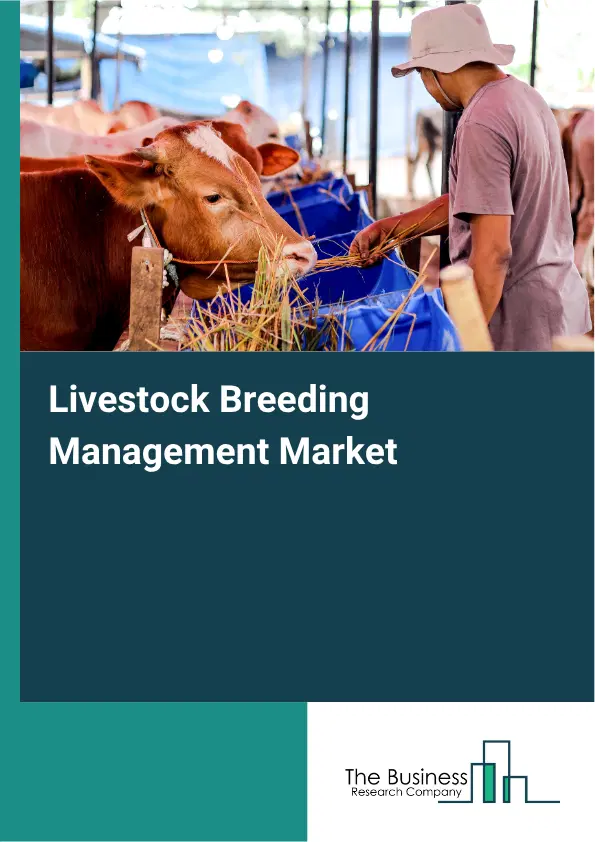
Livestock breeding management refers to the systematic planning, monitoring, and optimization of livestock breeding activities using genetic selection, reproductive technologies, and performance data. It aims to improve herd productivity, animal health, fertility, and desirable genetic traits while supporting sustainable livestock production, higher breeding efficiency, and long-term profitability for farmers and breeding organizations. The main product types of livestock breeding management include breeding software, breeding equipment, and other product types. Breeding software refers to digital solutions used to manage breeding records, monitor reproductive performance, track animal genetics, and support breeding decisions. These solutions are used for cattle, sheep, swine, and goats, and are adopted across small scale farms, medium scale farms, and large scale farms. They find application in genetic testing, artificial insemination, embryo transfer, and others, serving end users including farms, veterinary clinics, research institutes, and others.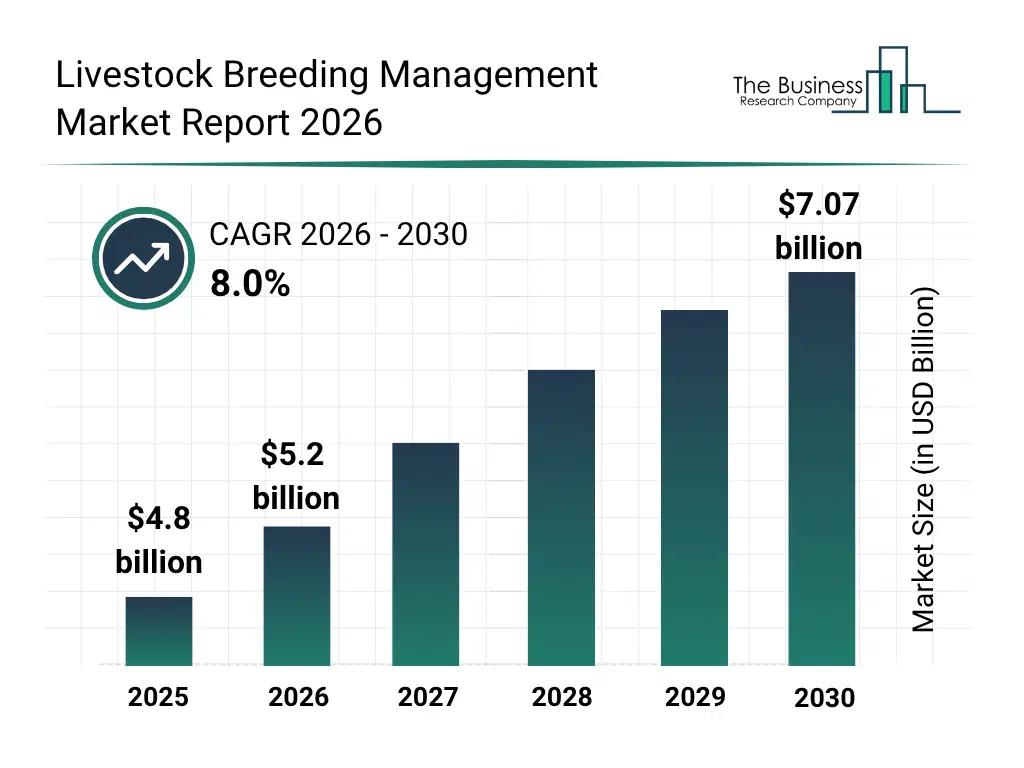
What Is The Livestock Breeding Management Market Size and Share 2026?
The livestock breeding management market size has grown strongly in recent years. It will grow from $4.8 billion in 2025 to $5.2 billion in 2026 at a compound annual growth rate (CAGR) of 8.4%. The growth in the historic period can be attributed to increasing demand for improved livestock productivity, rising adoption of artificial insemination, growing focus on genetic improvement of livestock herds, increasing demand for reproductive efficiency, expanding use of livestock performance records.What Is The Livestock Breeding Management Market Growth Forecast?
The livestock breeding management market size is expected to see strong growth in the next few years. It will grow to $7.07 billion in 2030 at a compound annual growth rate (CAGR) of 8.0%. The growth in the forecast period can be attributed to increasing demand for higher-yielding livestock genetics, rising requirement for improved breeding efficiency, growing adoption of embryo transfer programs, increasing demand for disease-resistant livestock traits, expanding commercial livestock breeding operations. Major trends in the forecast period include increasing adoption of genomic selection in livestock breeding, rising demand for precision reproductive management, growing use of sex-sorted semen in breeding programs, increasing adoption of advanced embryo transfer practices, rising demand for integrated livestock genetic performance records.Tariff Impact On Livestock Breeding Management Market
Tariffs are impacting the Livestock Breeding Management market by increasing the cost of imported breeding equipment, genetic testing equipment, reproductive monitoring systems, and specialized livestock management products. This is raising breeding program costs across farms, veterinary clinics, and research institutes, particularly in regions dependent on imported reproductive technologies and genetic services. Equipment-intensive segments such as artificial insemination, embryo transfer, and genetic testing are most affected due to international supply chain dependencies. However, tariffs are also encouraging local production, regional supplier diversification, and increased investment in domestic livestock breeding equipment and genetic service ecosystems, creating greater long-term resilience in the market.
Global Livestock Breeding Management Market Segmentation
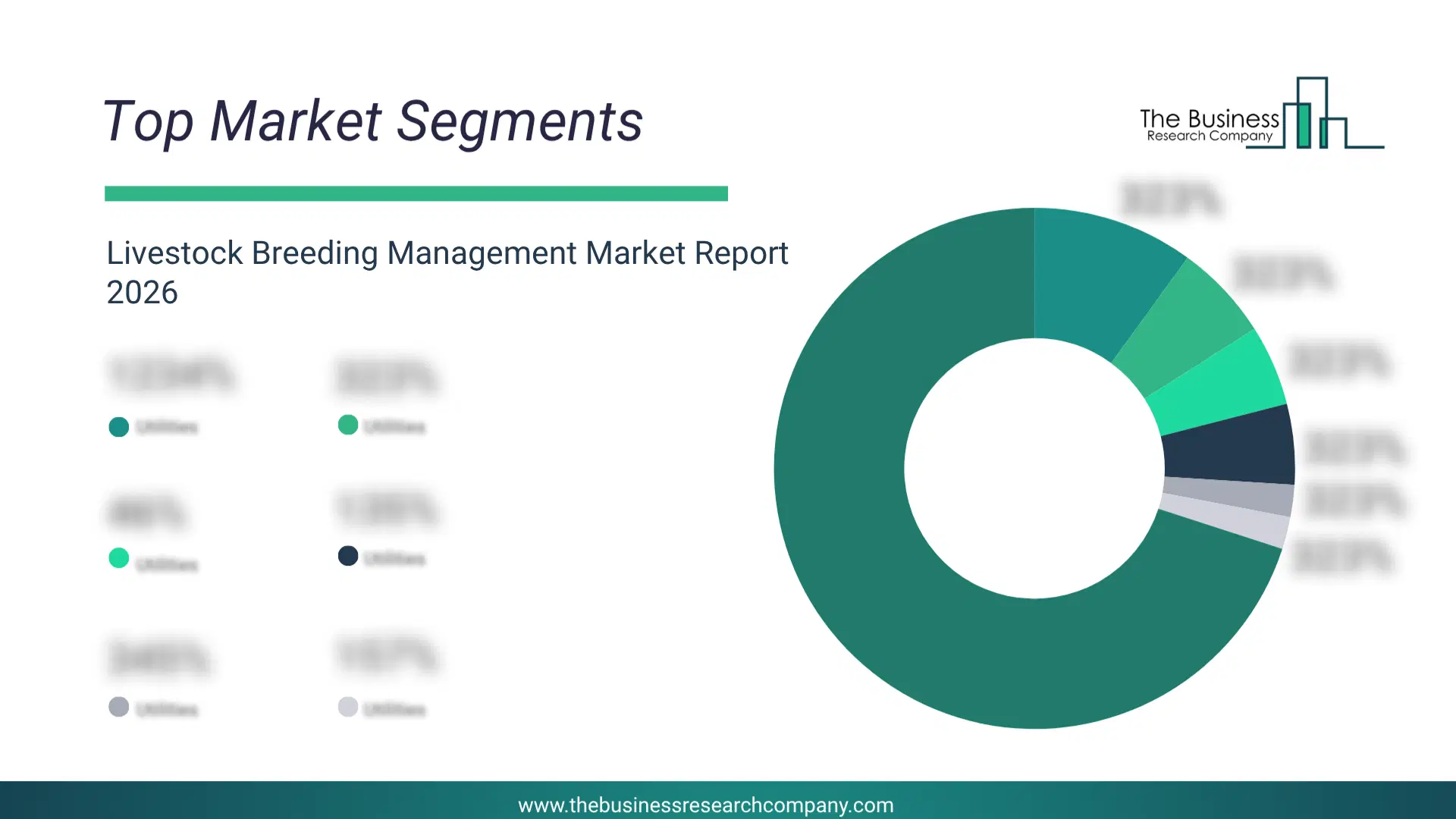
2) By Animal Type: Cattle, Sheep, Swine, Goats 3) By Farm Size: Small Scale Farms, Medium Scale Farms, Large Scale Farms 4) By Application: Genetic Testing, Artificial Insemination, Embryo Transfer, Other Applications 5) By End User: Farms, Veterinary Clinics, Research Institutes, Other End Users Subsegments: 1) By Breeding Software: Genetic Evaluation Software, Breeding Program Management Software, Reproductive Management Software, Animal Performance Tracking Software, Pedigree Management Software 2) By Breeding Equipment: Artificial Insemination Equipment, Embryo Transfer Equipment, Reproductive Monitoring Equipment, Genetic Testing Equipment, Animal Identification Equipment 3) By Other Product Types: Breeding Services, Genetic Data Services, Livestock Breeding Consultancy Services, Breeding Records And Analytics Services, Animal Health Management SolutionsWhat Is The Driver Of The Livestock Breeding Management Market?
The rising adoption of precision livestock farming is expected to propel the growth of the livestock breeding management market going forward. Precision livestock farming refers to the use of advanced technologies such as IoT, artificial intelligence (AI), sensors, and data analytics to monitor, manage, and optimize livestock production processes. The rising adoption of precision livestock farming technologies is driven by improved animal health monitoring, as they provide real-time data insights that enable early disease detection, better livestock management, and increased farm efficiency. The expansion of precision livestock farming supports livestock breeding management by enabling data-driven genetic selection, real-time reproductive monitoring, improved breeding accuracy, and optimized herd management, thereby increasing the efficiency and effectiveness of breeding programs. For instance, in January 2026, according to the U.S. Department of Agriculture (USDA) Economic Research Service, a US-based federal research agency, robotic milking adoption increased dairy farm net returns by an average of $3.15 per hundredweight (cwt), while farms implementing two or more precision dairy technologies achieved $3.18 per cwt higher net returns than nonadopters. Therefore, the rising adoption of precision livestock farming is driving the growth of the livestock breeding management industry.Key Players In The Global Livestock Breeding Management Market
Major companies operating in the livestock breeding management market are Zoetis Inc., Boehringer Ingelheim International GmbH, Tetra Laval International SA, Merck & Co. Inc., Elanco Animal Health Incorporated, GEA Group Aktiengesellschaft, Vetoquinol SA, Virbac SA, Genus plc, Neogen Corporation, Nedap N.V., Big Dutchman International GmbH, Hendrix Genetics B.V., Topigs Norsvin B.V., CRV Holding B.V., STgenetics, Select Sires Inc., URUS Group LP, Semex Alliance, VikingGenetics F.M.B.A., Aviagen Group, Livestock Improvement Corporation Limited, IMV Technologies SAS, Animal Genetics Inc.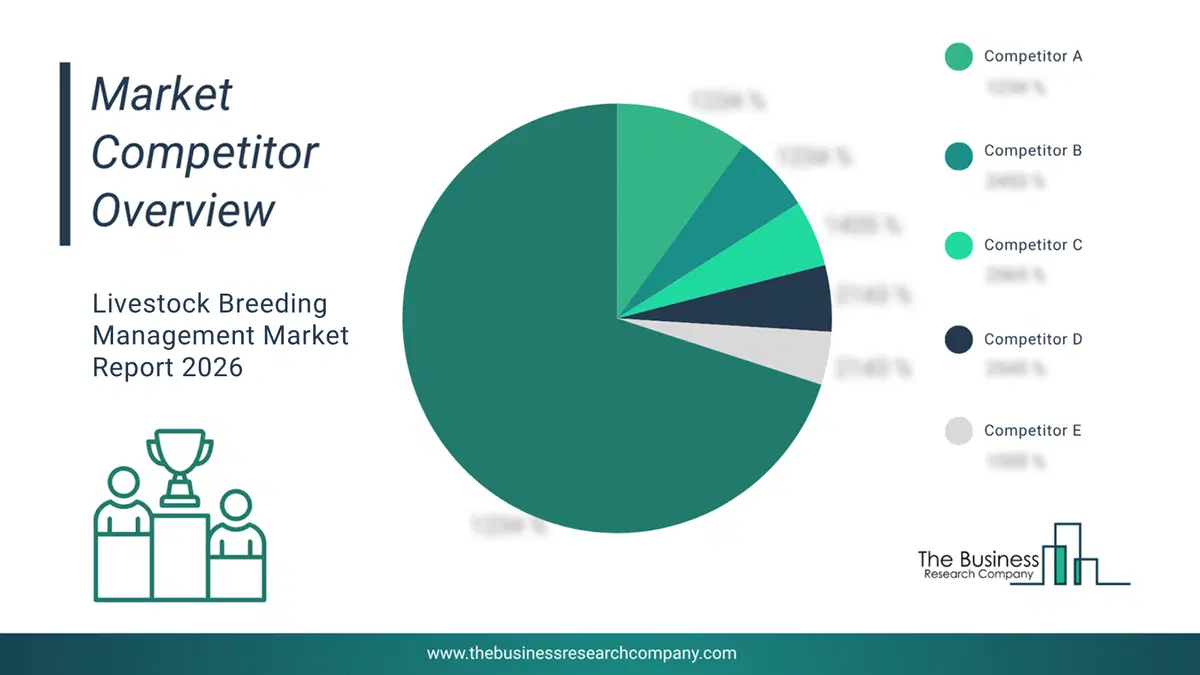
This chart is for illustrative purposes; the full report includes a detailed competitor analysis and comprehensive overview of the top 10 companies in the market.
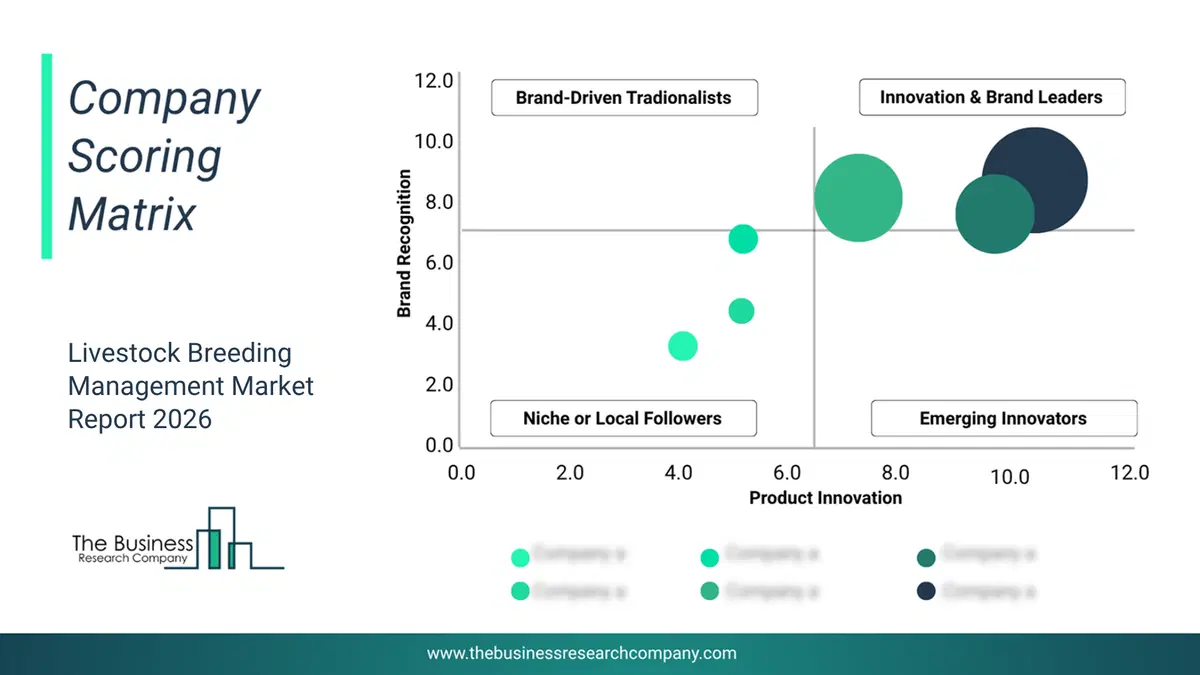
This chart maps companies by product innovation and brand strength, with bubble size indicating relative revenue, helping identify market leaders, challengers, and niche players. This is an illustrative chart; the full report provides a complete and accurate competitive analysis.
Global Livestock Breeding Management Market Trends and Insights
Major companies operating in the livestock breeding management market are focusing on developing advanced breeding and reproductive technology centers to improve genetic quality, increase breeding efficiency, and enhance livestock productivity. Advanced reproductive technology centers integrate innovations such as sex-sorted semen, in vitro fertilization (IVF), embryo transfer, and genetic evaluation to accelerate the production of high-genetic-merit livestock. For instance, in February 2026, the Kerala Livestock Development Board (KLDB), an India-based government organization, announced the establishment of the Centre of Excellence for Advanced Technologies in Bovine Production and Research (ATBPRC) in Kollam, India. The center will utilize indigenous sex sorting technology, in vitro fertilization (IVF)-based embryo production, deep-frozen semen development, and advanced fertility management to enhance indigenous cattle breeding and genetic improvement. It aims to increase milk productivity, promote sustainable livestock development, and support Kerala's goal of achieving milk self-sufficiency.What Are Latest Mergers And Acquisitions In The Livestock Breeding Management Market?
In May 2026, URUS Group LP, a US-based bovine genetics and livestock technology company, acquired AgriWebb for an undisclosed amount. Through this acquisition, URUS aims to expand its livestock technology capabilities, connect farm management data with genetics, breeding, sustainability, and animal productivity, and extend its established dairy-sector capabilities into the beef industry. AgriWebb Pty Ltd. is an Australia-based livestock management software company that provides farm mapping, grazing management, inventory tracking, and livestock data management solutions for farms and livestock operations.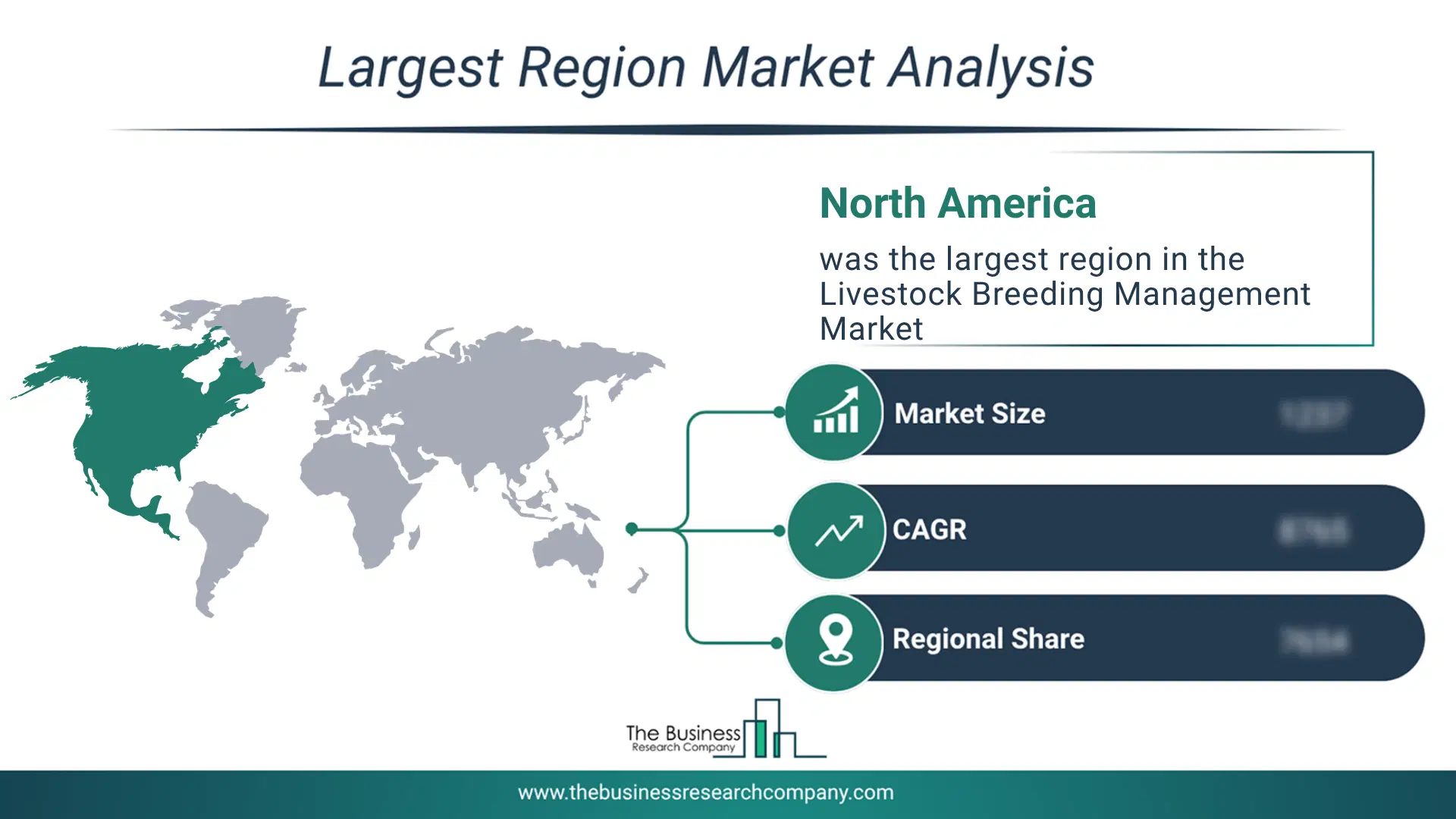
Regional Outlook/Insights
North America was the largest region in the livestock breeding management market in 2025. Asia-Pacific is expected to be the fastest-growing region in the forecast period. The regions covered in this market report are Asia-Pacific, South East Asia, Western Europe, Eastern Europe, North America, South America, Middle East, Africa. The countries covered in this market report are Australia, Brazil, China, France, Germany, India, Indonesia, Japan, Taiwan, Russia, South Korea, UK, USA, Canada, Italy, Spain.What Defines the Livestock Breeding Management Market?
The livestock breeding management market consists of revenues earned by entities by providing services such as reproductive assessment services, breeding record management services, and animal selection services. The market value includes the value of related goods sold by the service provider or included within the service offering. The livestock breeding management market also includes sales of semen straws, semen handling equipment, and cryogenic storage tanks. Values in this market are ‘factory gate’ values, that is, the value of goods sold by the manufacturers or creators of the goods, whether to other entities (including downstream manufacturers, wholesalers, distributors, and retailers) or directly to end customers. The value of goods in this market includes related services sold by the creators of the goods.How is Market Value Defined and Measured?
The market value is defined as the revenues that enterprises gain from the sale of goods and/or services within the specified market and geography through sales, grants, or donations in terms of the currency (in USD unless otherwise specified). The revenues for a specified geography are consumption values that are revenues generated by organizations in the specified geography within the market, irrespective of where they are produced. It does not include revenues from resales along the supply chain, either further along the supply chain or as part of other products.
This chart presents market attractiveness based on a quantitative evaluation of growth, competition, strategic alignment, and risk, offering a clear view of opportunity areas for decision-making. This chart is for illustrative purposes; the full report contains the complete analysis.

This chart highlights the Total Addressable Market (TAM) by estimating the maximum revenue opportunity using an assumption-driven approach, supporting strategic planning and opportunity sizing across markets. The chart is illustrative; the full report provides a more comprehensive analysis.
What Key Data and Analysis Are Included in the Livestock Breeding Management Market Report 2026?
The livestock breeding management market research report is one of a series of new reports from The Business Research Company that provides market statistics, including industry global market size, regional shares, competitors with the market share, detailed market segments, market trends and opportunities, and any further data you may need to thrive in the livestock breeding management industry. The market research report delivers a complete perspective of everything you need, with an in-depth analysis of the current and future state of the industry.Livestock Breeding Management Market Report Forecast Analysis
| Report Attribute | Details |
|---|---|
| Market Size Value In 2026 | $5.2 billion |
| Revenue Forecast In 2030 | $7.07 billion |
| Growth Rate | CAGR of 8.0% from 2026 to 2035 |
| Base Year For Estimation | 2025 |
| Actual Estimates/Historical Data | 2020-2025 |
| Forecast Period | 2026 - 2030 |
| Market Representation | Revenue in USD Billion and CAGR from 2026 to 2030 |
| Segments Covered | Product Type, Animal Type, Farm Size, Application, End User |
| Regional Scope | Asia-Pacific, Western Europe, Eastern Europe, North America, South America, Middle East, Africa |
| Country Scope | The countries covered in the report are Australia, Brazil, China, France, Germany, India, Indonesia, Japan, Taiwan, Russia, South Korea, UK, USA, Canada, Italy, Spain. |
| Customization Scope | Request for Customization |
| Pricing And Purchase Options | Explore Purchase Options |