

Loan Management Software Market Report 2026
Global Outlook – By Component (Solution, Service), By Deployment Mode (On-Premise, Cloud), By Enterprise Size (Large Enterprises, Small And Medium-sized Enterprises), By Application (Risk Management, Collateral Management, Loan Origination And Servicing, Other Applications), By End-User (Banks, Credit Unions, Non-Banking Financial Companies (NBFCs), Other End-Users) – Market Size, Trends, Strategies, and Forecast to 2030
Loan Management Software Market Overview
• Loan Management Software market size has reached to $12 billion in 2025 • Expected to grow to $26.94 billion in 2030 at a compound annual growth rate (CAGR) of 17.5% • Growth Driver: The Growing Significance Of Digitalization Fueling The Growth Of The Market Due To Expanding Digital Economy Share • Market Trend: Advancements In Loan Management Software With AI-Powered Automation And Decision Tools Transforming The Lending Process • North America was the largest region in 2025.Market Gains By 2030 – Top Opportunities By Segment
Market Gain identifies the most promising market opportunities by highlighting the segments or products expected to generate the highest incremental revenue growth over the next five years.
What Is Covered Under Loan Management Software Market?
Loan management software refers to a software that help banks and lenders to automate and manage loans, making the lending process easier and faster. The uses of loan management software include automating loan applications, processing payments, tracking loan status, and managing overdue payments to make lending easier and more efficient. The main components of loan management software are solutions and services. Loan management software solutions are comprehensive platforms that automate and streamline various aspects of the lending process. These are deployed through deployment modes such as on-premise, and cloud. These are used by various enterprise sizes such as large enterprises, small and medium-sized enterprises, and in various applications such as cash and liquidity management, risk management, collateral management, loan origination, and servicing, and also by various end-users such as banks, credit unions, non-banking financial companies (NBFCs), others.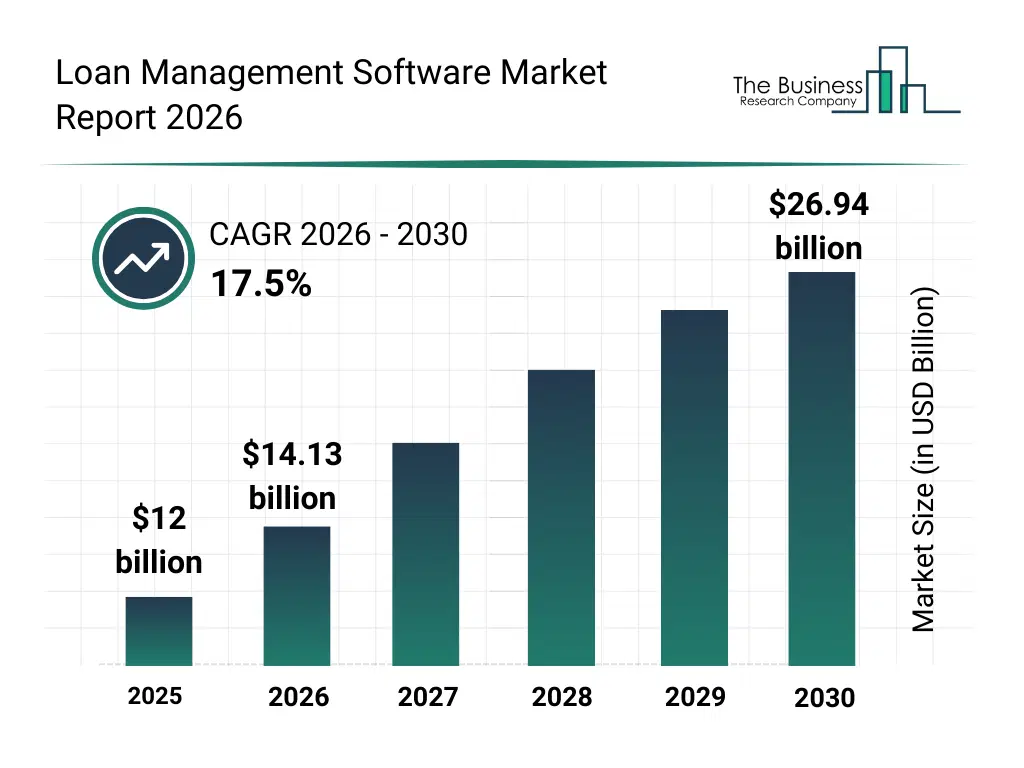
What Is The Loan Management Software Market Size and Share 2026?
The loan management software market size has grown rapidly in recent years. It will grow from $12 billion in 2025 to $14.13 billion in 2026 at a compound annual growth rate (CAGR) of 17.7%. The growth in the historic period can be attributed to increasing digitization of banking operations, expansion of retail and corporate lending portfolios, growing need for operational efficiency in loan processing, rising regulatory reporting requirements, increased adoption of core banking software.What Is The Loan Management Software Market Growth Forecast?
The loan management software market size is expected to see rapid growth in the next few years. It will grow to $26.94 billion in 2030 at a compound annual growth rate (CAGR) of 17.5%. The growth in the forecast period can be attributed to increasing demand for fully digital lending platforms, rising focus on real-time risk analytics, expansion of fintech-led lending models, growing adoption among SMEs, increasing integration with open banking ecosystems. Major trends in the forecast period include increasing adoption of end-to-end loan automation platforms, rising deployment of cloud-based loan management solutions, growing integration of ai-driven credit assessment tools, expansion of real-time loan monitoring capabilities, enhanced focus on regulatory-compliant loan processing.
Global Loan Management Software Market Segmentation
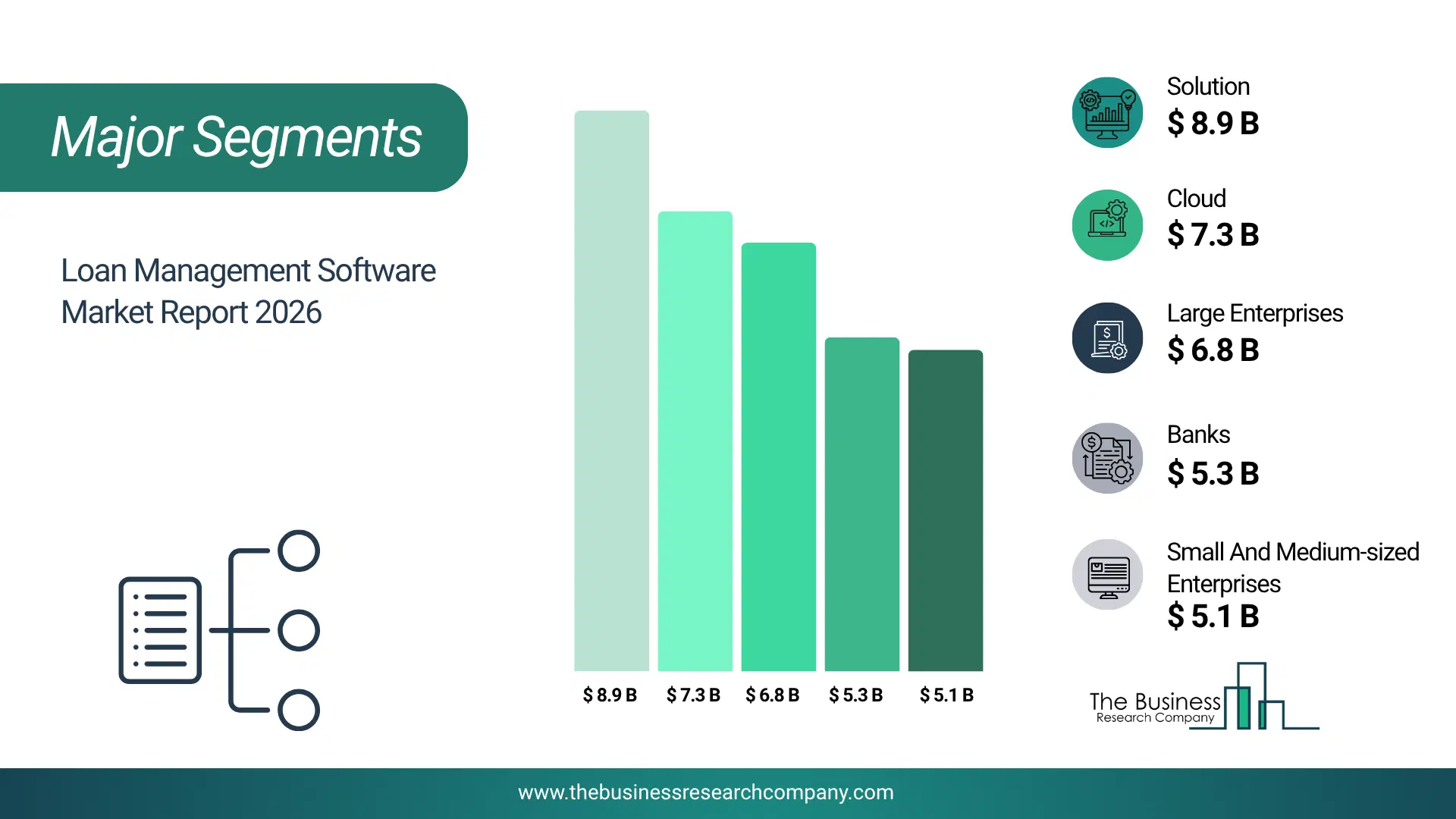
1) By Component: Solution, Service 2) By Deployment Mode: On-Premise, Cloud 3) By Enterprise Size: Large Enterprises, Small And Medium-sized Enterprises 4) By Application: Risk Management, Collateral Management, Loan Origination And Servicing, Other Applications 5) By End-User: Banks, Credit Unions, Non-Banking Financial Companies (NBFCs), Other End-Users Subsegments: 1) By Solution: Loan Origination Solution Or Loan Servicing Solution Or Loan Collection Solution Or Loan Risk Management Solution Or Loan Compliance Management Solution 2) By Service: Professional Services Or Managed Services The top segments in the loan management software market will be: • Solution will reach $8992.67 Million by 2025. • Cloud will reach $7368.24 Million by 2025. • Large Enterprises will reach $6896.62 Million by 2025. • Banks will reach $5375.76 Million by 2025. • Small And Medium-sized Enterprises will reach $5174.7 Million by 2025.What Is The Driver Of The Loan Management Software Market?
The growing significance of digitalization is expected to propel the growth of the Loan Management Software market going forward. Digitalization is the process of converting information, data, or physical objects into a digital format that computers can easily process, store, and transmit. The rise in digitalization is due to the expanding contribution of the digital economy to overall economic output, reflecting increased adoption of digital tools and services across industries. Loan Management Software supports digitalization by enabling financial institutions to digitize loan origination, underwriting, servicing, and collections, thereby improving operational efficiency and supporting digital-first customer engagement. For instance, in March 2025, according to the Department for Science, Innovation and Technology, a UK-based government department, the digital sector was provisionally estimated to account for 6.5% of total UK gross value added in 2023, equivalent to US$ 195 billion (£153.5 billion) in current prices. Therefore, the growing significance of digitalization is driving the growth of the Loan Management Software industry.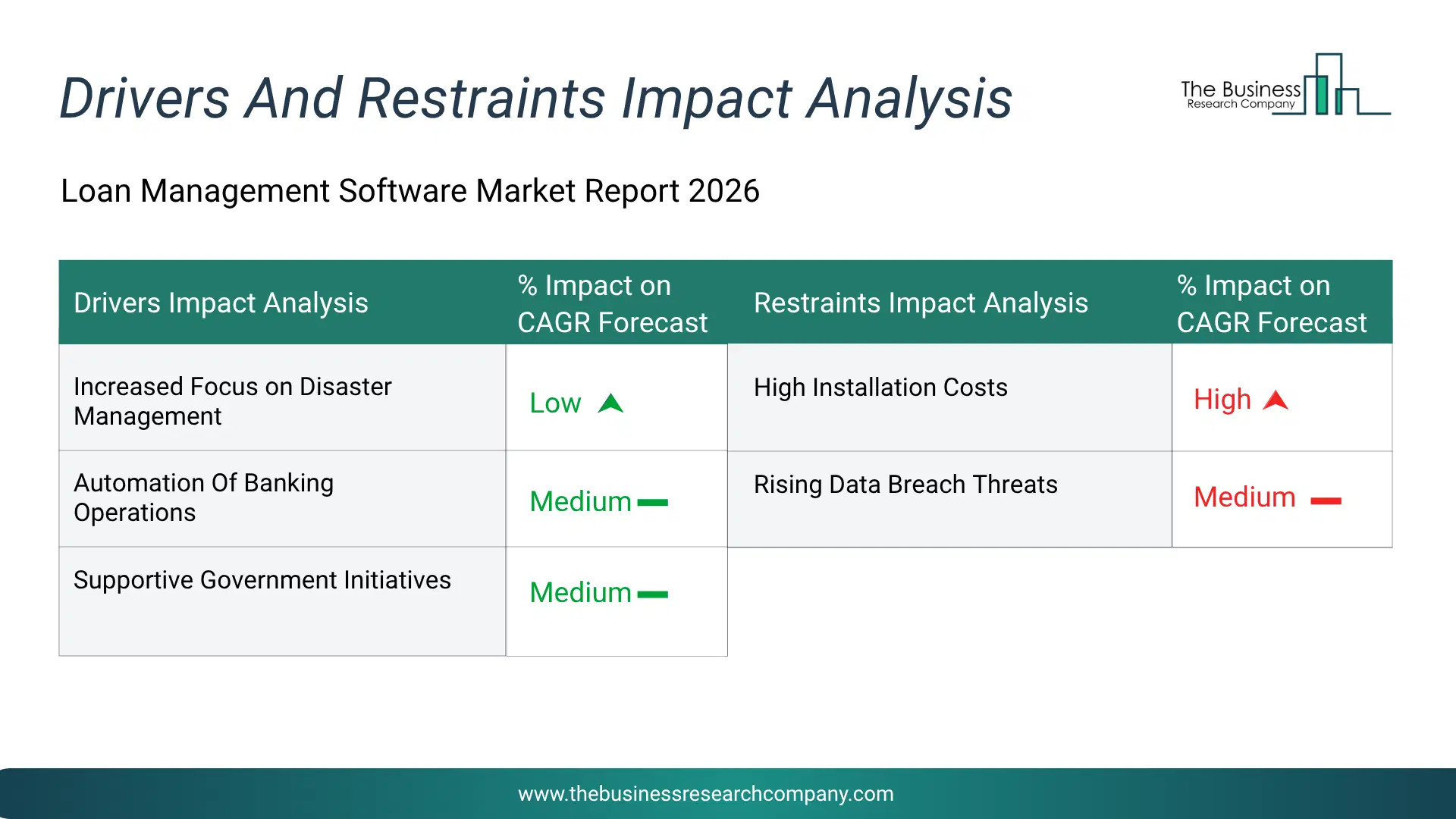
Infographic Chart Showing Key Market Drivers Analysis And Restraints For Loan Management Software Market
The chart presents an impact analysis of key drivers and restraints, quantifying their relative influence on the market's growth rate and helping assess the balance between growth enablers and limiting factors. This chart offers a high-level perspective; the full report contains more detailed insights.
How Will The Drivers Impact Growth In The Global Loan Management Software Market?
• Automation Of Banking Operations (Medium) – The automation of banking operations will become a key driver of growth in the loan management software market by 2030. Automation streamlines processes by reducing manual tasks like data entry, document verification and loan processing, minimizing errors and accelerating operations. It enhances decision-making by enabling faster credit assessments and risk evaluations, leading to quicker loan approvals and disbursements. Additionally, automated platforms integrate loan data into centralized systems for better monitoring, analysis and management. As a result, the automation of banking operations is anticipated to contributing to a 1.5% annual growth in the market. • Supportive Government Initiatives (Medium) – The supportive government initiatives will emerge as a major factor driving the expansion of the market by 2030. Public-private partnerships play a crucial role in advancing digital lending technology. Collaboration between government agencies and fintech firms drives the development of sophisticated loan management software tailored to market needs. Investments in digital infrastructure enhance connectivity and data management, facilitating seamless implementation and operation of modern financial solutions. Consequently, the supportive government initiatives is projected to contributing to a 1.0% annual growth in the market. • Increasing Adoption Of AI (Low) – The increasing adoption of AI (artificial intelligence) will serve as a key growth catalyst for the market by 2030. Artificial intelligence (AI)-powered systems can automate various steps in the loan origination, underwriting, and approval process, improving efficiency and reducing human error. This automation leads to faster loan processing, which enhances customer experience and drives demand for loan management software. Further, artificial intelligence (AI) can analyze vast amounts of data, including credit history, transaction behavior, and even social media data, to provide more accurate risk assessments. This leads to better decision-making and reduces the risk of defaults, making loan management software more attractive to lenders. Therefore, this increasing adoption of AI (artificial intelligence) is projected to supporting to a 0.7% annual growth in the market. • Rise in Non-Banking Financial Companies (NBFCs) (Low) – The rise in non-banking financial companies (NBFCs) will become a significant driver contributing to the growth of the market by 2030. As they scale, efficient software solutions become essential for handling increased loan applications and servicing. Offering diverse products such as consumer, small business and asset-backed loans, NBFCs benefit from loan management software that streamlines operations with customized workflows and product-specific modules. Consequently, the rise in non-banking financial companies (NBFCs) is projected to contributing to a 0.5% annual growth in the market.How Will The Restraints Impact Growth In The Global Loan Management Software Market?
• High Installation Costs (Medium) – High Installation Costs will restrict the growth of the Loan Management Software market during the forecast period. Enterprise loan management software implementation involves significant costs for licensing, customization, integration with existing systems, and staff training. The high total cost of ownership creates barriers for smaller financial institutions with limited IT budgets. Cost constraints may lead organizations to postpone or limit software adoption, affecting market growth. • Rising Data Breach Threats (Medium) – Rising Data Breach Threats will restrict the growth of the Loan Management Software market during the forecast period. Loan management software handles sensitive borrower data including personal information, financial details, and credit histories. Data breaches can result in regulatory fines, legal liability, and reputational damage. Security concerns about data protection can affect trust in cloud-based loan management solutions and slow adoption, particularly in regulated banking environments.Key Players In The Global Loan Management Software Market
Major companies operating in the loan management software market are Finflux, Fidelity National Information Services Inc., Finastra Group Holdings Ltd., Lendio Inc., Nelito Systems Pvt. Ltd., Allcloud Enterprise Solutions Private Limited, Mambu GmbH, TurnKey Lender Inc., LoanPro Software LLC, Zoot Enterprises Inc., Calyx Software Inc., Shaw Systems Associates LLC, Aryza Holdings Limited, Nortridge Software Inc., Provenir Inc., LendingPad Corporation, Infinity Enterprise Lending Systems, Temenos AG, Bryt Software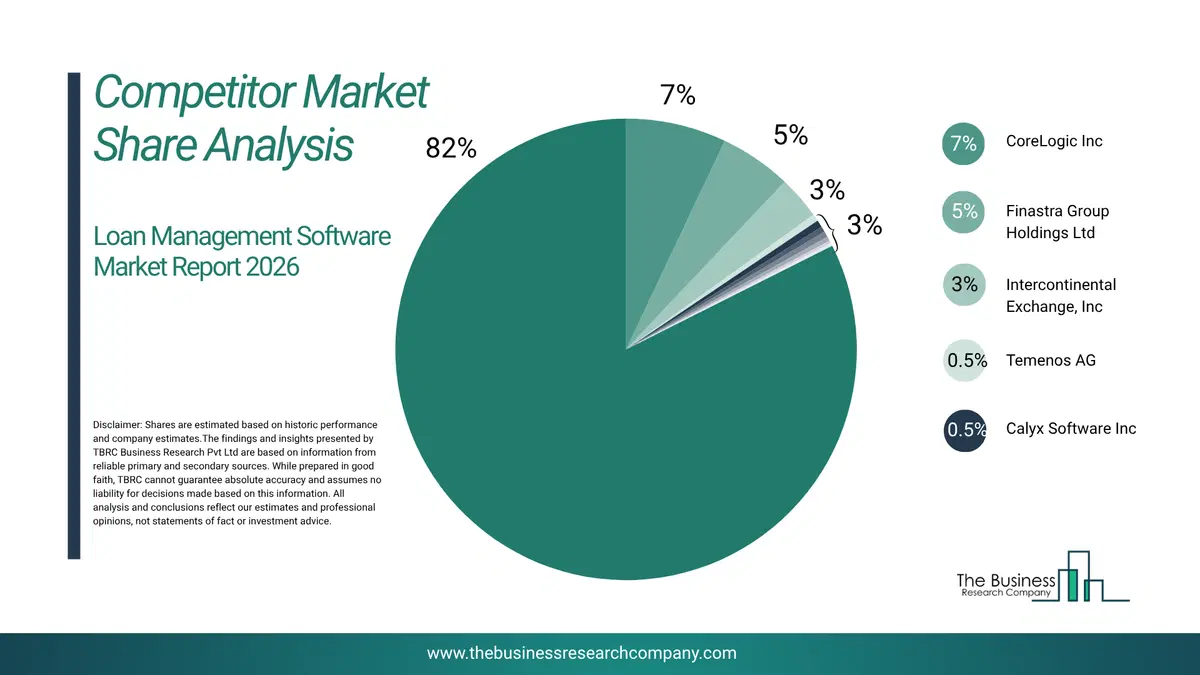
This chart is for illustrative purposes; the full report includes a detailed competitor analysis and comprehensive overview of the top 10 companies in the market.
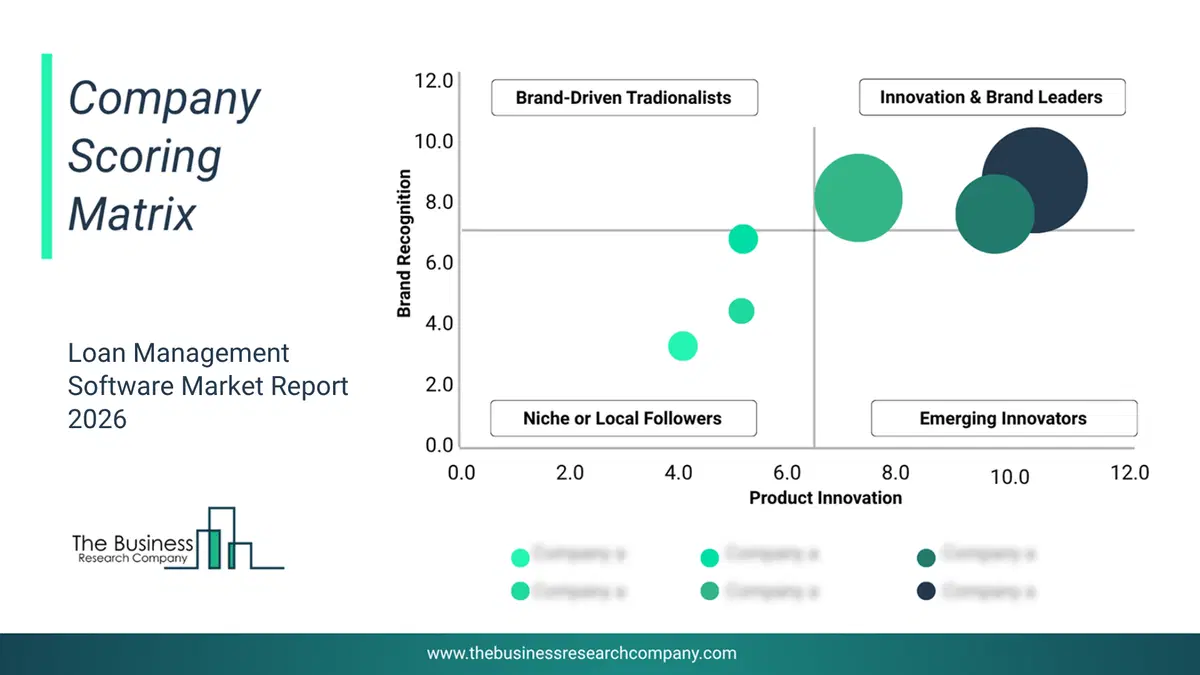
This chart maps companies by product innovation and brand strength, with bubble size indicating relative revenue, helping identify market leaders, challengers, and niche players. This is an illustrative chart; the full report provides a complete and accurate competitive analysis.
Global Loan Management Software Market Trends and Insights
Major companies operating in the loan management software market are focusing on technology development such as advanced loan management software comprising AI-powered lending automation and decision management tools to enhance the accuracy and efficiency of loan processing. AI-powered lending automation and decision management tools significantly enhance the efficiency, accuracy, and customer experience in the lending process, aligning with the broader trend of digital transformation in the financial services industry. For instance, in June 2024, CompassWay, a US-based fintech company, launched an advanced loan management software tailored for small business lending. The software utilizes advanced algorithms, analytics, AI, and machine learning to automate and streamline the entire lending process for small businesses. This system allows lenders to process applications more efficiently while minimizing errors and improving compliance with regulatory standards. The software offers a comprehensive suite of solutions that covers all phases of the loan lifecycle, from origination to servicing and debt collection.What Are Latest Mergers And Acquisitions In The Loan Management Software Market?
In January 2024, Newgen Software Technologies Limited, an India-based low-code software provider, partnered with Finastra to integrate Newgen’s low-code loan origination solution with Finastra’s LaserPro loan-document platform. Through this partnership, Newgen and Finastra aim to enhance loan origination processes for consumer, commercial, and mortgage lending by reducing manual data handling and improving operational efficiency. Finastra is a UK–based financial software company that provides comprehensive banking and lending technology solutions to financial institutions worldwide.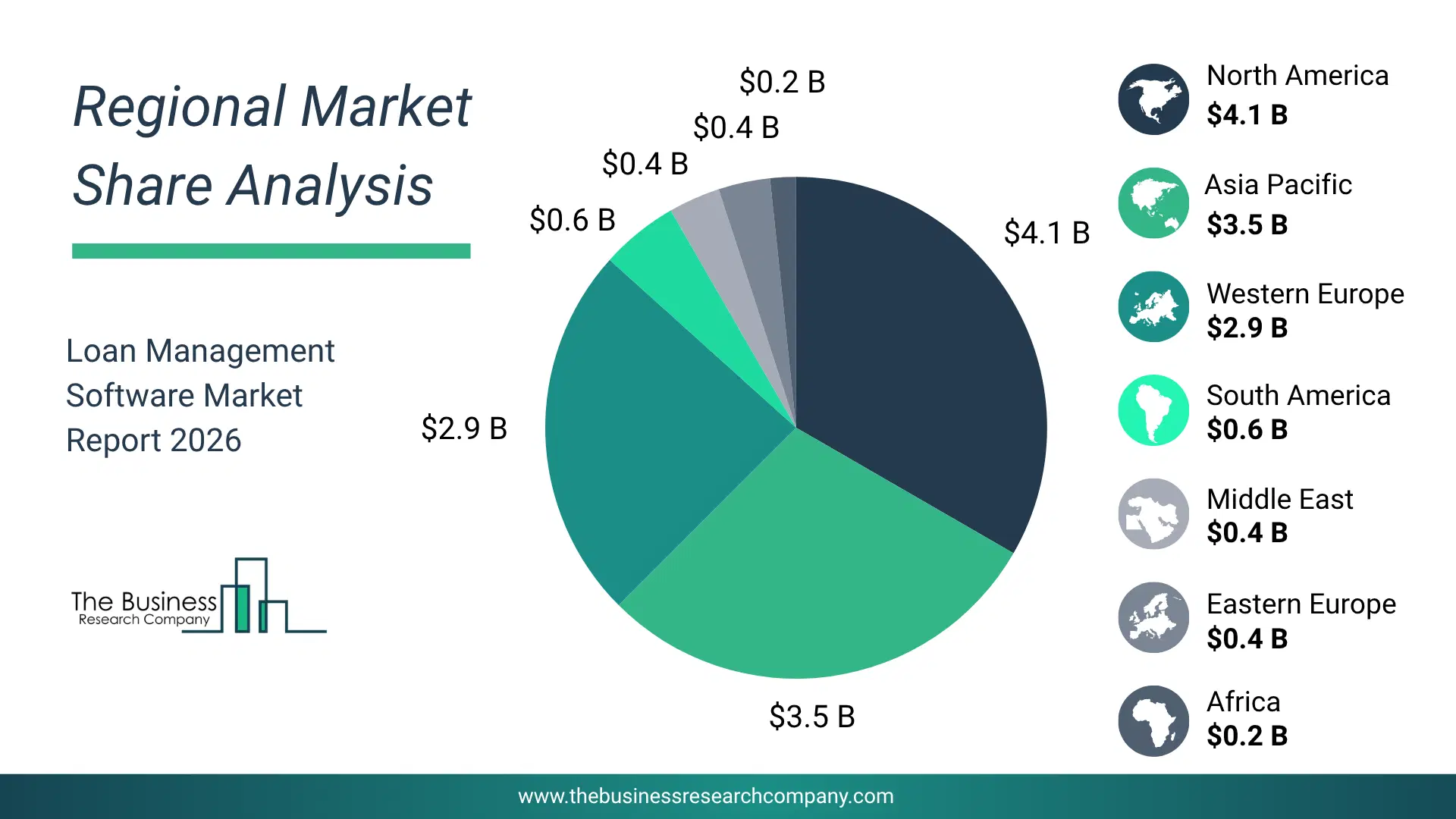
Regional Outlook
North America was the largest region in the loan management software market in 2025. The regions covered in this market report are Asia-Pacific, South East Asia, Western Europe, Eastern Europe, North America, South America, Middle East, Africa. The countries covered in this market report are Australia, Brazil, China, France, Germany, India, Indonesia, Japan, Taiwan, Russia, South Korea, UK, USA, Canada, Italy, Spain.What Defines the Loan Management Software Market?
The loan management software market includes revenues earned by entities by loan origination, payment processing, credit scoring, and collection management. The market value includes the value of related goods sold by the service provider or included within the service offering. The loan management software market consists of sales of loan servicing loan origination systems, loan servicing software, credit scoring tools, and risk management software. Values in this market are ‘factory gate’ values, that is, the value of goods sold by the manufacturers or creators of the goods, whether to other entities (including downstream manufacturers, wholesalers, distributors, and retailers) or directly to end customers. The value of goods in this market includes related services sold by the creators of the goods.How is Market Value Defined and Measured?
The market value is defined as the revenues that enterprises gain from the sale of goods and/or services within the specified market and geography through sales, grants, or donations in terms of the currency (in USD unless otherwise specified). The revenues for a specified geography are consumption values that are revenues generated by organizations in the specified geography within the market, irrespective of where they are produced. It does not include revenues from resales along the supply chain, either further along the supply chain or as part of other products.
This chart presents market attractiveness based on a quantitative evaluation of growth, competition, strategic alignment, and risk, offering a clear view of opportunity areas for decision-making. This chart is for illustrative purposes; the full report contains the complete analysis.

This chart highlights the Total Addressable Market (TAM) by estimating the maximum revenue opportunity using an assumption-driven approach, supporting strategic planning and opportunity sizing across markets. The chart is illustrative; the full report provides a more comprehensive analysis.
What Key Data and Analysis Are Included in the Loan Management Software Market Report 2026?
The loan management software market research report is one of a series of new reports from The Business Research Company that provides market statistics, including Market Report 2026?global market size, regional shares, competitors with the market share, detailed market segments, market trends and opportunities, and any further data you may need to thrive in the loan management software Market Report 2026? The market research report delivers a complete perspective of everything you need, with an in-depth analysis of the current and future state of the Market Report 2026?Loan Management Software Market Report Forecast Analysis
| Report Attribute | Details |
|---|---|
| Market Size Value In 2026 | $14.13 billion |
| Revenue Forecast In 2030 | $26.94 billion |
| Growth Rate | CAGR of 17.7% from 2026 to 2030 |
| Base Year For Estimation | 2025 |
| Actual Estimates/Historical Data | 2020-2025 |
| Forecast Period | 2026 - 2030 |
| Market Representation | Revenue in USD Billion and CAGR from 2026 to 2030 |
| Segments Covered | Component, Deployment Mode, Enterprise Size, Application, End-User |
| Regional Scope | Asia-Pacific, Western Europe, Eastern Europe, North America, South America, Middle East, Africa |
| Country Scope | The countries covered in the report are Australia, Brazil, China, France, Germany, India, Indonesia, Japan, Taiwan, Russia, South Korea, UK, USA, Canada, Italy, Spain. |
| Key Companies Profiled | Finflux, Fidelity National Information Services Inc., Finastra Group Holdings Ltd., Lendio Inc., Nelito Systems Pvt. Ltd., Allcloud Enterprise Solutions Private Limited, Mambu GmbH, TurnKey Lender Inc., LoanPro Software LLC, Zoot Enterprises Inc., Calyx Software Inc., Shaw Systems Associates LLC, Aryza Holdings Limited, Nortridge Software Inc., Provenir Inc., LendingPad Corporation, Infinity Enterprise Lending Systems, Temenos AG, Bryt Software |
| Customization Scope | Request for Customization |
| Pricing And Purchase Options | Explore Purchase Options |