
Location-Based Entertainment Market Report 2026
Global Outlook – By Offerings (Hardware, Software, Services), By Technology (3 Dimensional (3D), Cloud Merged Reality (CMR)), By End-Use (Amusement Parks, Arcade Studios) – Market Size, Trends, Strategies, and Forecast to 2035
Location-Based Entertainment Market Overview
• Location-Based Entertainment market size has reached to $4.81 billion in 2025 • Expected to grow to $14.35 billion in 2030 at a compound annual growth rate (CAGR) of 24.4% • Growth Driver: Increasing Consumer Spending On Games And Video Content Enhanced Growth Of The Location-Based Entertainment Market • Market Trend: STYLY Launches Open-Source Unity SDKs to Simplify Multi-User XR Experiences in Location-Based Entertainment • North America was the largest region in 2025 and Asia-Pacific is the fastest growing region.Market Gains By 2030 – Top Opportunities By Segment
Market Gain identifies the most promising market opportunities by highlighting the segments or products expected to generate the highest incremental revenue growth over the next five years.
What Is Covered Under Location-Based Entertainment Market?
Location-based entertainment (LBE) refers to a type of entertainment experience that takes place in a specific physical site or venue, such as amusement parks and themed entertainment venues, and frequently employs immersive technologies to enhance the visitor's engagement and enjoyment. These experiences often incorporate elements of virtual reality (VR), augmented reality (AR), or other immersive technologies to create immersive worlds and storytelling environments. The main offerings of location-based entertainment are hardware, software, and services. Location-based entertainment hardware refers to the physical equipment and devices utilized in venues such as amusement parks and arcades for immersive experiences like virtual reality (VR) attractions and interactive gaming. The various technologies include 2D, 3D, and cloud-merged reality (CMR), which are utilized by various end users, such as amusement parks, arcade studios, and 4D films.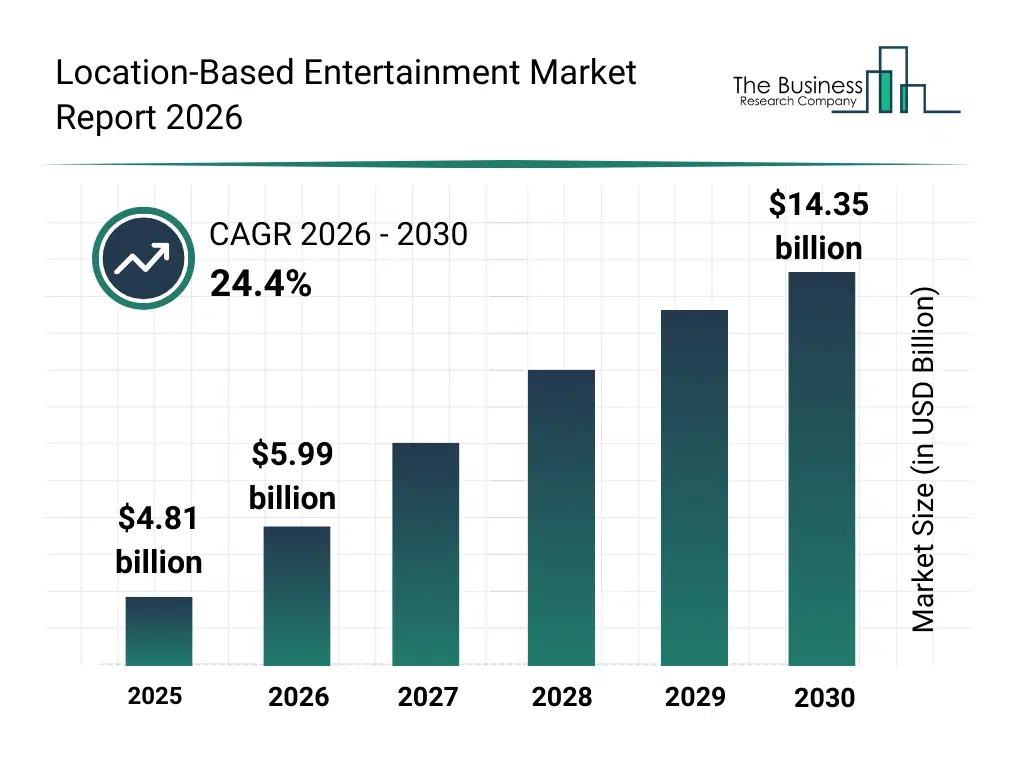
What Is The Location-Based Entertainment Market Size and Share 2026?
The location-based entertainment market size has grown exponentially in recent years. It will grow from $4.81 billion in 2025 to $5.99 billion in 2026 at a compound annual growth rate (CAGR) of 24.5%. The growth in the historic period can be attributed to expansion of amusement park infrastructure, increasing consumer spending on out-of-home entertainment, adoption of digital gaming experiences, growth of themed entertainment venues, rising popularity of experiential leisure activities.What Is The Location-Based Entertainment Market Growth Forecast?
The location-based entertainment market size is expected to see exponential growth in the next few years. It will grow to $14.35 billion in 2030 at a compound annual growth rate (CAGR) of 24.4%. The growth in the forecast period can be attributed to increasing investments in immersive entertainment technologies, rising demand for personalized visitor experiences, expansion of mixed reality entertainment formats, growing integration of data analytics in venue operations, increasing global tourism footfall. Major trends in the forecast period include increasing deployment of immersive theme-based attractions, rising adoption of vr and ar experiences, growing demand for interactive entertainment venues, expansion of story-driven location-based experiences, enhanced focus on visitor engagement.
Global Location-Based Entertainment Market Segmentation
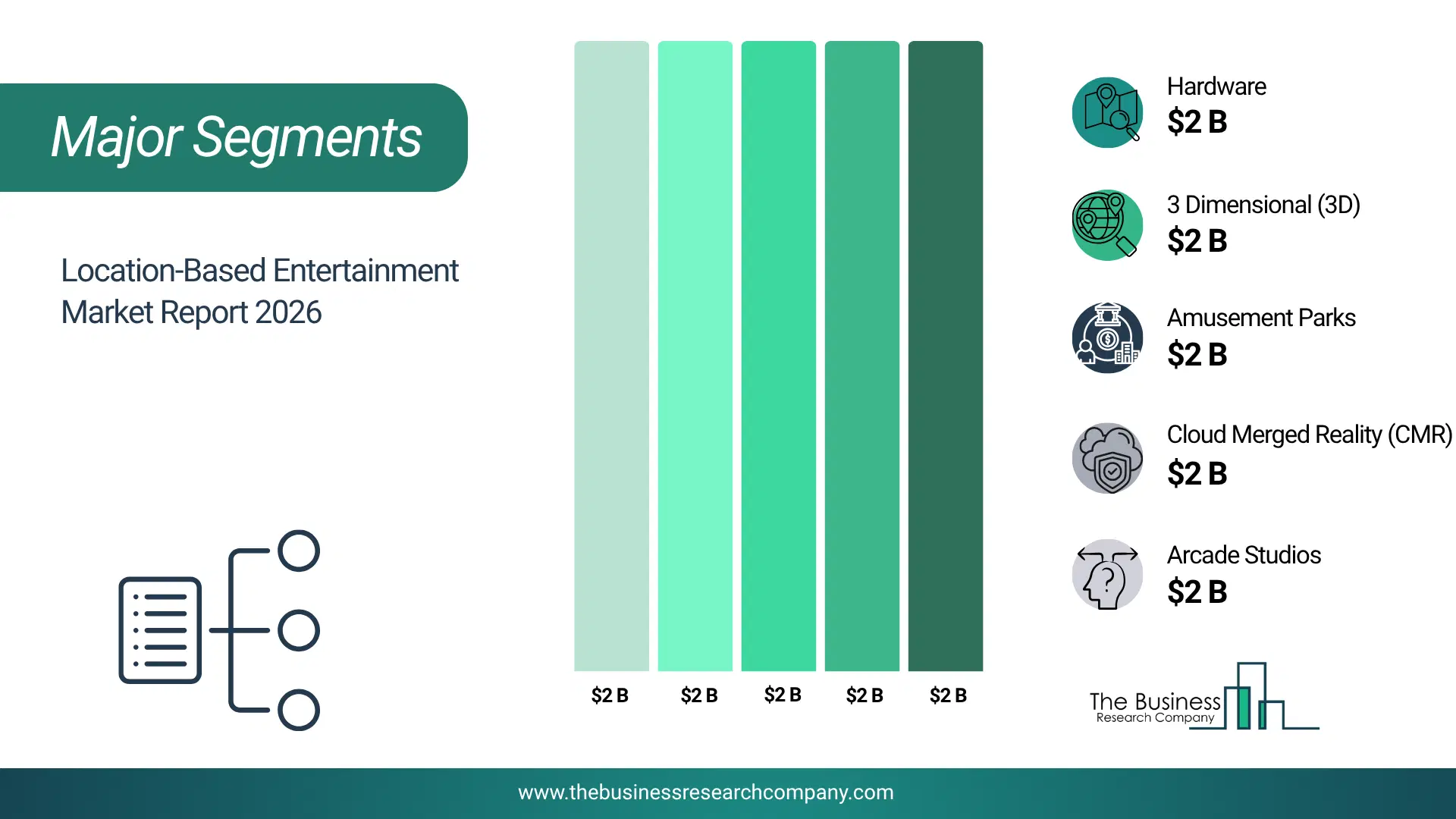
1) By Offerings: Hardware, Software, Services 2) By Technology: 3 Dimensional (3D), Cloud Merged Reality (CMR) 3) By End-Use: Amusement Parks, Arcade Studios Subsegments: 1) By Hardware: Virtual Reality (VR) Headsets, Augmented Reality (AR) Devices, Interactive Kiosks, Motion Tracking Equipment, Projection Equipment 2) By Software: Game Development Software, Simulation Software, VR Or AR Content Creation Software, Location-Based Game Applications, Analytics And Data Management Software 3) By Services: Game Hosting And Maintenance Services, Content Creation And Customization Services, Consulting And Integration Services, Customer Support And Technical Assistance, Installation And Setup Services The top segments in the location-based entertainment market will be: • Hardware will reach $2384.3 Million by 2025. • 3 Dimensional (3D) will reach $2264.6 Million by 2025. • Amusement Parks will reach $2027.5 Million by 2025. • Cloud Merged Reality (CMR) will reach $1784.1 Million by 2025. • Arcade Studios will reach $1618.5 Million by 2025.What Is The Driver Of The Location-Based Entertainment Market?
Increasing consumer spending on games and video content is expected to propel the growth of the location-based entertainment market going forward. Consumer spending on games and video content refers to the amount of money individuals spend on purchasing or subscribing to video games, downloadable content, in-game purchases, streaming services, and other related digital entertainment products. Increasing consumer spending on games and video content reflects growing demand for digital entertainment experiences, immersive gaming experiences, and a shift towards online streaming platforms. Consumer spending on games and video content helps bolster location-based entertainment by showcasing the potential for immersive experiences, driving interest in similar interactive and experiential offerings at physical venues. For instance, in February 2024, according to data published by the Entertainment Software Association, a US-based trade association of the video game industry, total video game sales surged to $57.2 billion in 2023, marking an increase from the $56.6 billion recorded in 2022. The rise was primarily fueled by a boost in video game content spending, which rose to $48.0 billion from $47.5 billion in 2022. Therefore, increasing consumer spending on games and video content is driving the growth of the location-based entertainment industry.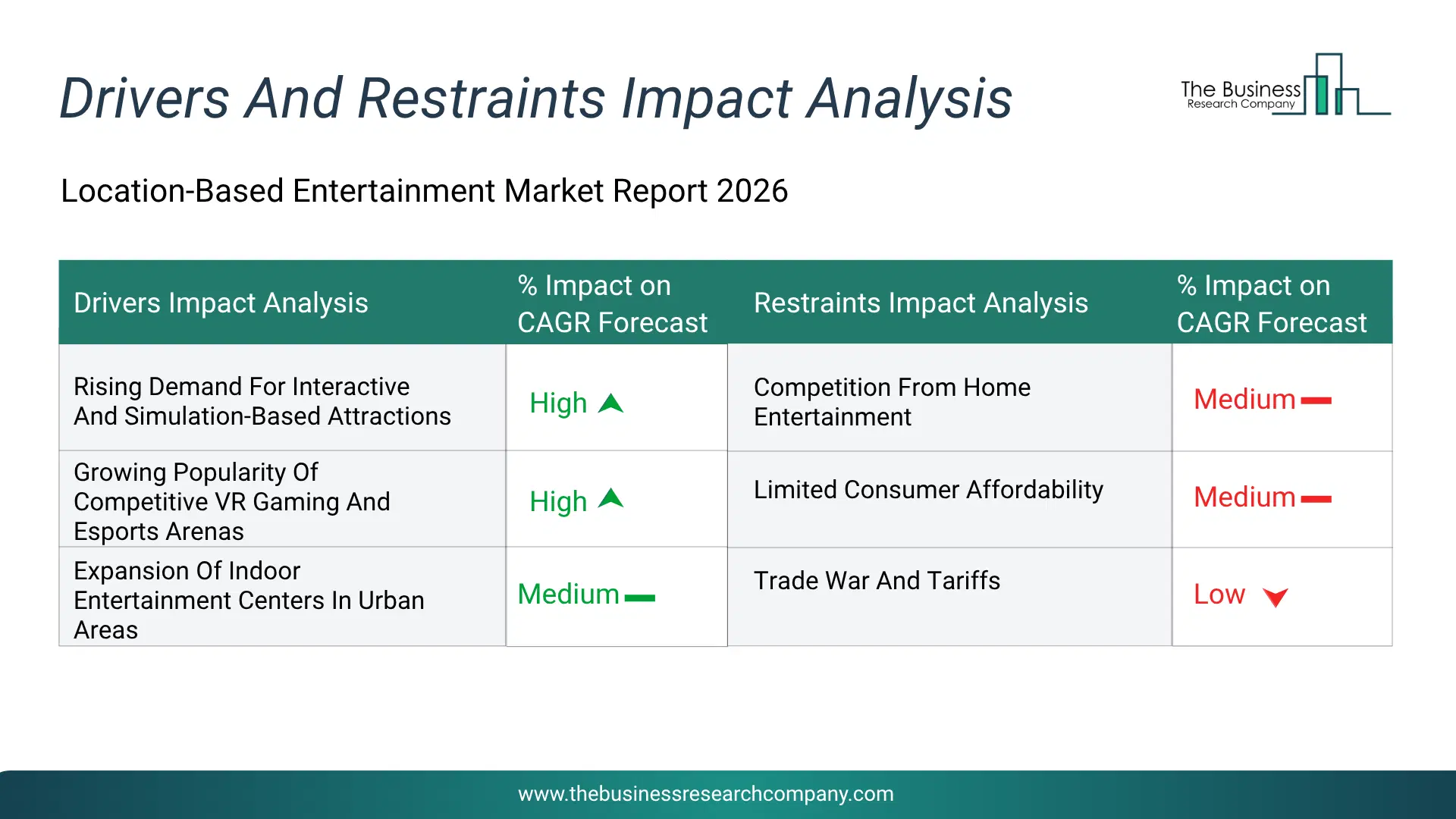
Infographic Chart Showing Key Market Drivers Analysis And Restraints For Location-Based Entertainment Market
The chart presents an impact analysis of key drivers and restraints, quantifying their relative influence on the market's growth rate and helping assess the balance between growth enablers and limiting factors. This chart offers a high-level perspective; the full report contains more detailed insights.
How Will The Drivers Impact Growth In The Global Location-Based Entertainment Market?
• Rising Demand For Interactive And Simulation-Based Attractions (High) – The rising demand for interactive and simulation-based attractions is expected to propel the growth of the location-based entertainment market. Consumers are increasingly seeking immersive experiences that combine advanced technologies such as virtual reality (VR), augmented reality (AR), motion simulators and mixed reality with entertainment. Entertainment venues are investing in interactive gaming zones, virtual sports, escape rooms and simulation rides to enhance visitor engagement and differentiate their offerings. These attractions provide realistic and personalized experiences, encouraging repeat visits and higher customer spending. In addition, advancements in digital technologies and increasing consumer preference for experiential entertainment are supporting the adoption of innovative simulation-based attractions across amusement parks, gaming centers and family entertainment venues. As a result, the rising demand for interactive and simulation-based attractions is anticipated to contributing to a 2.5% annual growth in the market. • Growing Popularity Of Competitive VR Gaming And Esports Arenas (High) – The growing popularity of competitive VR gaming and esports arenas is expected to propel the growth of the location-based entertainment market in the forecast period. Consumers, particularly younger demographics, are showing strong interest in immersive multiplayer gaming experiences that combine physical interaction with advanced digital technologies. Location-based entertainment venues are expanding VR gaming zones and esports facilities to attract gaming enthusiasts and host tournaments, events and social competitions. These venues offer high-quality equipment and interactive environments that are difficult to replicate at home, enhancing customer engagement and repeat visitation. In addition, the rising global esports audience and growing investments in VR technology are supporting the expansion of competitive gaming attractions across entertainment centers worldwide. Consequently, the growing popularity of competitive VR gaming and esports arenas is projected to contributing to a 2.0% annual growth in the market. • Expansion Of Indoor Entertainment Centers In Urban Areas (Medium) – The expansion of indoor entertainment centers in urban areas is expected to propel the growth of the location-based entertainment market in the forecast period. Rapid urbanization, rising disposable incomes and changing consumer lifestyles are increasing demand for accessible and year-round entertainment options in cities. Entertainment operators are investing in indoor venues such as family entertainment centers, VR gaming arenas, trampoline parks and interactive gaming zones within shopping malls and commercial complexes. These facilities offer convenient recreational experiences regardless of weather conditions, attracting families, young consumers and corporate groups. In addition, limited outdoor recreational space in densely populated urban areas and growing consumer preference for immersive social experiences are encouraging the development of modern indoor entertainment destinations worldwide. Therefore, this expansion of indoor entertainment centers in urban areas is projected to supporting to a 1.5% annual growth in the market. • Expansion Of Licensed Franchise-Based Entertainment Attractions (Low) – The expansion of licensed franchise-based entertainment attractions is expected to propel the growth of the location-based entertainment market. Entertainment operators are increasingly partnering with popular film studios, gaming companies and media franchises to develop immersive attractions based on well-known intellectual properties. These branded experiences attract large audiences by offering familiar characters, themed environments and interactive storytelling experiences that enhance customer engagement. Franchise-based attractions also strengthen brand recognition, increase visitor footfall and encourage repeat visits across amusement parks, family entertainment centers and themed venues. In addition, rising consumer interest in experiential entertainment and the global popularity of entertainment franchises are supporting investments in new licensed attractions and themed entertainment destinations worldwide. Consequently, the expansion of licensed franchise-based entertainment attractions is projected to contributing to a 0.5% annual growth in the market.How Will The Restraints Impact Growth In The Global Location-Based Entertainment Market?
• Competition From Home Entertainment (High) – Competition from home entertainment is expected to restrain market growth during the forecast period. It creates operational, financial, regulatory, or commercial challenges that can increase costs, delay projects, reduce investments, or discourage purchasing decisions depending on the market. These challenges can reduce product adoption, affect business confidence, and limit the ability of companies to expand efficiently across key regions. This can disrupt long-term growth strategies and reduce the ability of companies to capitalize on emerging market opportunities. • Limited Consumer Affordability (High) – During the forecast period, limited consumer affordability is likely to limit market expansion. It creates operational, financial, regulatory, or commercial challenges that can increase costs, delay projects, reduce investments, or discourage purchasing decisions depending on the market. These challenges can reduce product adoption, affect business confidence, and limit the ability of companies to expand efficiently across key regions. As a result, organizations may postpone purchasing decisions, limiting demand across both established and emerging markets. • Trade War And Tariffs (Medium) – The market is expected to face challenges due to trade war and tariffs over the forecast period. It creates operational, financial, regulatory, or commercial challenges that can increase costs, delay projects, reduce investments, or discourage purchasing decisions depending on the market. These challenges can reduce product adoption, affect business confidence, and limit the ability of companies to expand efficiently across key regions. This may reduce production efficiency, extend project timelines, and create challenges in meeting evolving customer requirements.Key Players In The Global Location-Based Entertainment Market
Major companies operating in the location-based entertainment market are The Walt Disney Company, Universal Parks & Resorts, Merlin Entertainments, Six Flags Entertainment Corporation, Cedar Fair Entertainment Company, SeaWorld Entertainment, VRstudios, Dreamscape Immersive, The VOID, Niantic, Sandbox VR, Zero Latency, Hologate, Two Bit Circus, Meow Wolf, AREA15, Fever, Secret Cinema, Illuminarium Experiences, TeamLab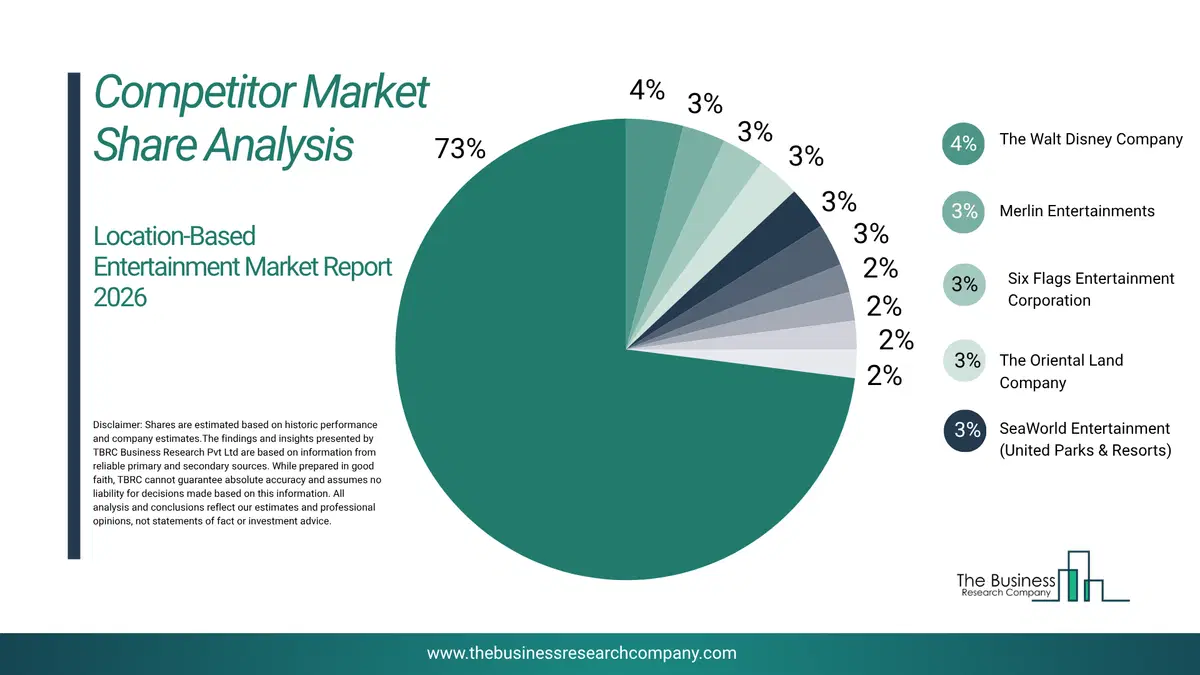
This chart is for illustrative purposes; the full report includes a detailed competitor analysis and comprehensive overview of the top 10 companies in the market.
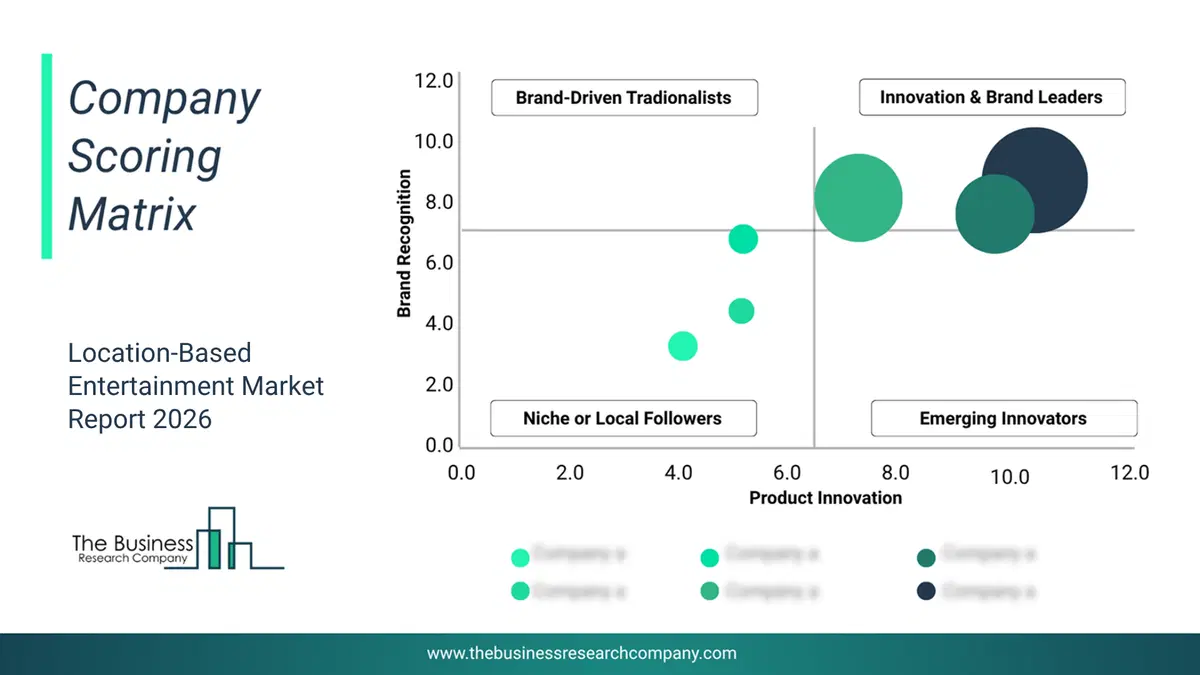
This chart maps companies by product innovation and brand strength, with bubble size indicating relative revenue, helping identify market leaders, challengers, and niche players. This is an illustrative chart; the full report provides a complete and accurate competitive analysis.
Global Location-Based Entertainment Market Trends and Insights
Major companies operating in the Location-Based Entertainment (LBE) market are focusing on developing innovative products, such as open-source Unity SDKs for multi-user XR experiences, to lower technical barriers, enable cross-device synchronization, and enhance immersive entertainment production quality in commercial and public venues. The feature “Unity-based SDKs for multi-user XR experiences” is defined as a set of developer tools that allow multiple users to interact simultaneously in AR/VR/MR environments, with networking, device compatibility, and server-side support. For instance, in December 2025, STYLY Inc., a Japan-based provider of spatial computing, XR content creation platforms, and immersive entertainment solutions, launched an open-source project for LBE. The product provides lightweight, high-performance networking capable of synchronizing up to 50 head-mounted devices, Unity-ready SDKs compatible with multiple HMDs including Meta Quest, Apple Vision Pro, Pico, HTC Vive, and SteamVR, and server-side capabilities using Unity or Python to implement scalable multi-user logic. Key features also include one-click XR rig setup, automatic VR/MR mode switching, avatar synchronization, and easy integration into both new and existing Unity projects, enabling creators to focus on production quality and immersive experience design while reducing technical complexity.What Are Latest Mergers And Acquisitions In The Location-Based Entertainment Market?
In December 2023, Lionsgate, a US-based motion picture company, acquired entertainment platform eOne from Hasbro for $375 million. With this acquisition, Lionsgate enriches its library with 6,500 film and television titles, enhances its scripted and unscripted television divisions, and increases its footprint in Canada and the UK. Hasbro is a US-based play and entertainment company that provides location-based entertainment.
Regional Outlook
North America was the largest region in the location-based entertainment market in 2025. Asia-Pacific is expected to be the fastest-growing region in the forecast period. The regions covered in this market report are Asia-Pacific, South East Asia, Western Europe, Eastern Europe, North America, South America, Middle East, Africa The countries covered in this market report are Australia, Brazil, China, France, Germany, India, Indonesia, Japan, Taiwan, Russia, South Korea, UK, USA, Canada, Italy, Spain.What Defines the Location-Based Entertainment Market?
The location-based entertainment market consists of revenues earned by entities by providing services such as gameplay, storytelling, projection mapping, and others. The market value includes the value of related goods sold by the service provider or included within the service offering. The location-based entertainment market also includes sales of virtual reality (VR) headsets, augmented reality (AR) devices, interactive controllers, and audio systems. Values in this market are ‘factory gate’ values, that is the value of goods sold by the manufacturers or creators of the goods, whether to other entities (including downstream manufacturers, wholesalers, distributors and retailers) or directly to end customers. The value of goods in this market includes related services sold by the creators of the goods.How is Market Value Defined and Measured?
The market value is defined as the revenues that enterprises gain from the sale of goods and/or services within the specified market and geography through sales, grants, or donations in terms of the currency (in USD unless otherwise specified). The revenues for a specified geography are consumption values that are revenues generated by organizations in the specified geography within the market, irrespective of where they are produced. It does not include revenues from resales along the supply chain, either further along the supply chain or as part of other products.
This chart presents market attractiveness based on a quantitative evaluation of growth, competition, strategic alignment, and risk, offering a clear view of opportunity areas for decision-making. This chart is for illustrative purposes; the full report contains the complete analysis.

This chart highlights the Total Addressable Market (TAM) by estimating the maximum revenue opportunity using an assumption-driven approach, supporting strategic planning and opportunity sizing across markets. The chart is illustrative; the full report provides a more comprehensive analysis.
What Key Data and Analysis Are Included in the Location-Based Entertainment Market Report 2026?
The location-based entertainment market research report is one of a series of new reports from The Business Research Company that provides market statistics, including Market Report 2026?global market size, regional shares, competitors with the market share, detailed market segments, market trends and opportunities, and any further data you may need to thrive in the location-based entertainment Market Report 2026? The market research report delivers a complete perspective of everything you need, with an in-depth analysis of the current and future state of the Market Report 2026?Location-Based Entertainment Market Report Forecast Analysis
| Report Attribute | Details |
|---|---|
| Market Size Value In 2026 | $5.99 billion |
| Revenue Forecast In 2035 | $14.35 billion |
| Growth Rate | CAGR of 24.5% from 2026 to 2035 |
| Base Year For Estimation | 2025 |
| Actual Estimates/Historical Data | 2020-2025 |
| Forecast Period | 2026 - 2030 - 2035 |
| Market Representation | Revenue in USD Billion and CAGR from 2026 to 2035 |
| Segments Covered | Offerings, Technology, End-Use |
| Regional Scope | Asia-Pacific, Western Europe, Eastern Europe, North America, South America, Middle East, Africa |
| Country Scope | The countries covered in the report are Australia, Brazil, China, France, Germany, India, ... |
| Key Companies Profiled | The Walt Disney Company, Universal Parks & Resorts, Merlin Entertainments, Six Flags Entertainment Corporation, Cedar Fair Entertainment Company, SeaWorld Entertainment, VRstudios, Dreamscape Immersive, The VOID, Niantic, Sandbox VR, Zero Latency, Hologate, Two Bit Circus, Meow Wolf, AREA15, Fever, Secret Cinema, Illuminarium Experiences, TeamLab |
| Customization Scope | Request for Customization |
| Pricing And Purchase Options | Explore Purchase Options |