Contact Us
  Search
The Business Research Company Logo
Location-Based Entertainment Market 2025
Published :May 2025
Pages :320
Format :PDF
Delivery Time :2-3 Business Days
Why 2-3 days? We update the report with the latest data and news before delivery. Let us know if you need us to expedite.
Report Price :$4,490.00

Location-Based Entertainment Market 2025

By Offerings (Hardware, Software, Services), By Technology (Dimensional (2D), Dimensional (3D), Cloud Merged Reality (CMR)), by End-Use (Amusement Parks, Arcade Studios, 4D Films), And By Region, Opportunities And Strategies – Global Forecast To 2035

Location-Based Entertainment Market Size and growth rate 2025 to 2029: Graph

Location-Based Entertainment Market Definition

Location based entertainment (LBE) is an entertainment experience, or a leisure offering that exists under a commercial location. This generally considered a key mode of key mode of immersive experience, social, and interactive experience that cannot be generated at home. Some of these commercial locations includes amusement parks, malls & retail spaces, recreation areas, resorts & hotels, and so on. The key objective of LBE is to increase visitor traffic to shopping centers, mixed-use projects, resort locations of all sizes, and malls, these experiential entertainment properties are crucial anchors. The Location-Based Entertainment market consists of offerings by hardware, software, and services. Amongst them hardware, and software segment holds significant market share encompassing the backbone of the location-based entertainment places like amusement parks, and theme parks. The adoption/ integration of technology for enhanced and immersive experience is key to the growth of the LBE market.

Research Expert

Book your 30 minutes free consultation with our research experts

Location-Based Entertainment Market Size

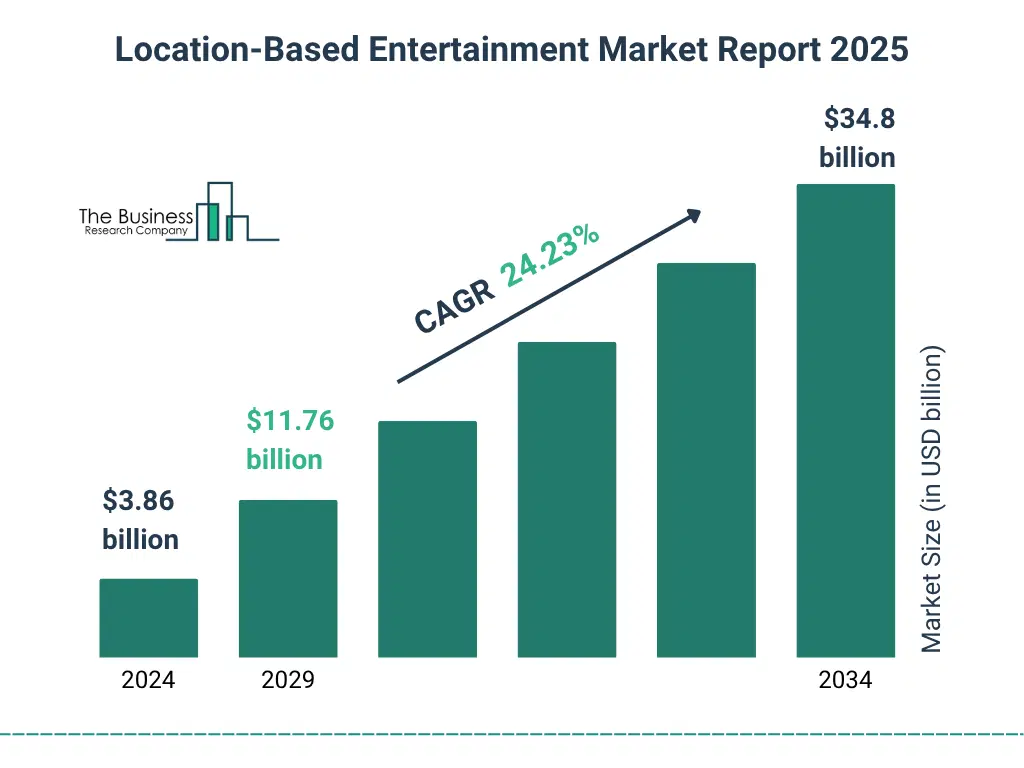
The global location-based entertainment market reached a value of nearly $3,860.94 million in 2024, having grown at a compound annual growth rate (CAGR) of 10.76% since 2019. The market is expected to grow from $3,860.94 million in 2024 to $11,757.99 million in 2029 at a rate of 24.95%. The market is then expected to grow at a CAGR of 24.23% from 2029 and reach $34,796.14 million in 2034. Growth in the historic period resulted from the advancements in immersive experiences, integration of LBE with tourism and retail, increased consumer spending on entertainment content and urbanization and rising disposable incomes. Factors that negatively affected growth in the historic period were impact of covid-19 pandemic and high capital and operational costs. Going forward, the strategic partnerships and intellectual property (IP) collaborations, expansion and development of the new parks and technology advancements and innovative attractions will drive the growth. Factor that could hinder the growth of the location-based entertainment market in the future include growing competition from home entertainment & other leisure and economic pressures and rising operational costs.

Location-Based Entertainment Market Drivers

The key drivers of the location-based entertainment market include: Strategic Partnerships and Intellectual Property (IP) Collaborations Collaborations between theme parks and well-known IPs are attracting a wide range of people. Notably, Minecraft is venturing outside of the digital arena with a $110 million agreement with Merlin Entertainments to develop themed rides, attractions, hotel rooms, and retail locations. The first two attractions are scheduled to open in the UK and the United States in 2026 and 2027, respectively. Over time, the two organizations intend to broaden their strategic cooperation, known as "Adventures Made Real," to include additional countries and territories. Therefore, the strategic partnerships and intellectual property (IP) collaborations will drive the growth of the Location-Based Entertainment market.

Location-Based Entertainment Market Restraints

The key restraints on the location-based entertainment market include: Growing competition from Home Entertainment & Other Leisure The rise of sophisticated home entertainment options threatens traditional amusement parks. With technological improvements, consumers may now get immersive experiences from home, perhaps contributing to experience weariness with traditional park offerings. With backdrop of the recent pandemic situation that led to development of these sophisticated option, home base entertainment and leisure activities demand has seen a greater increase with features similar to theme parks using VR and AR technologies. Therefore, growing competition from home entertainment & other leisure will restrain the growth of the Location-Based Entertainment market.

Need data on a specific region in this market?

Opportunities And Recommendations In The Location-Based Entertainment Market

Opportunities – The top opportunities in the location-based entertainment markets segmented by offering will arise in the software segment, which will gain $3,512.06 million of global annual sales by 2029. The top opportunities in the location-based entertainment markets segmented by technology will arise in the cloud merged reality (CMR) segment, which will gain $5,557.28 million of global annual sales by 2029. The top opportunities in the location-based entertainment markets segmented by end-use will arise in the arcade studios segment, which will gain $3,225.37 million of global annual sales by 2029. The location-based entertainment market size will gain the most in the USA at $1,693.41 million. Recommendations- To take advantage of the opportunities, The Business Research Company recommends the location-based entertainment to focus on integrating immersive technologies with branded experiences, focus on personalized guest experiences through data analytics, focus on enhancing themed food and beverage experiences, focus on high-growth regions in Asia-pacific and the middle east, focus on sustainability and inclusive policies to attract value-aligned visitors, focus on enhancing hybrid engagement through emerging technology, expand in emerging markets, continue to focus on developed markets, focus on expanding presence across high-traffic urban and travel hubs, focus on tiered pricing models based on experience type, focus on building awareness through partnerships and experience-driven campaigns, focus on personalized digital promotions and localized targeting and focus on targeting tech-savvy gamers through staff training and community engagement.
Chat with us