
Location-Based Virtual Reality (VR) Market Report 2026
Global Outlook – By Type (Head-Mounted Displays, Handheld Devices, Smart Glasses, Controllers), By Technology (Two-Dimensional (2D), Three-Dimensional (3D)), By Content (360-Degree Videos, 360-Degree Images, Augmented Reality, Mixed Reality), By Application (Virtual Reality (VR) Arcades, Virtual Reality (VR) Theme Parks, Virtual Reality (VR) Cinemas), By End-Use (Gaming, Entertainment, Travel, Education, Healthcare) – Market Size, Trends, Strategies, and Forecast to 2030
Location-Based Virtual Reality (VR) Market Overview
• Location-Based Virtual Reality (VR) market size has reached to $8.97 billion in 2025 • Expected to grow to $36.4 billion in 2030 at a compound annual growth rate (CAGR) of 32.3% • Growth Driver: Surge In Gaming and Entertainment Sectors Fueling The Growth Of The Market Due To Rising Demand For Immersive Experiences • Market Trend: Adoption of Wireless Free-Roam VR Arena Systems to Enhance Immersive Entertainment • North America was the largest region in 2025 and Asia-Pacific is the fastest growing region.What Is Covered Under Location-Based Virtual Reality (VR) Market?
Location-based virtual reality (LBVR) involves immersive virtual reality experiences hosted at dedicated physical venues that offer highly interactive and socially engaging environments. These setups provide rich, multi-sensory adventures beyond what’s possible with at-home virtual reality, often blending real-world motion with virtual simulations for a more realistic and dynamic experience. The main types of location-based virtual reality (VR) are head-mounted displays, handheld devices, smart glasses, and controllers. Head-mounted displays (HMDs) are wearable devices that position screens near the eyes to deliver immersive virtual reality experiences essential for gaming, training, and entertainment. It utilizes various technologies such as two-dimensional (2D) and three-dimensional (3D) with several contents including 360-degree videos, 360-degree images, augmented reality, and mixed reality. It is applicable for various applications such as virtual reality (VR) arcades, virtual reality (VR) theme parks, virtual reality (VR) cinemas, and is used by several end-uses including gaming, entertainment, travel, education, and healthcare.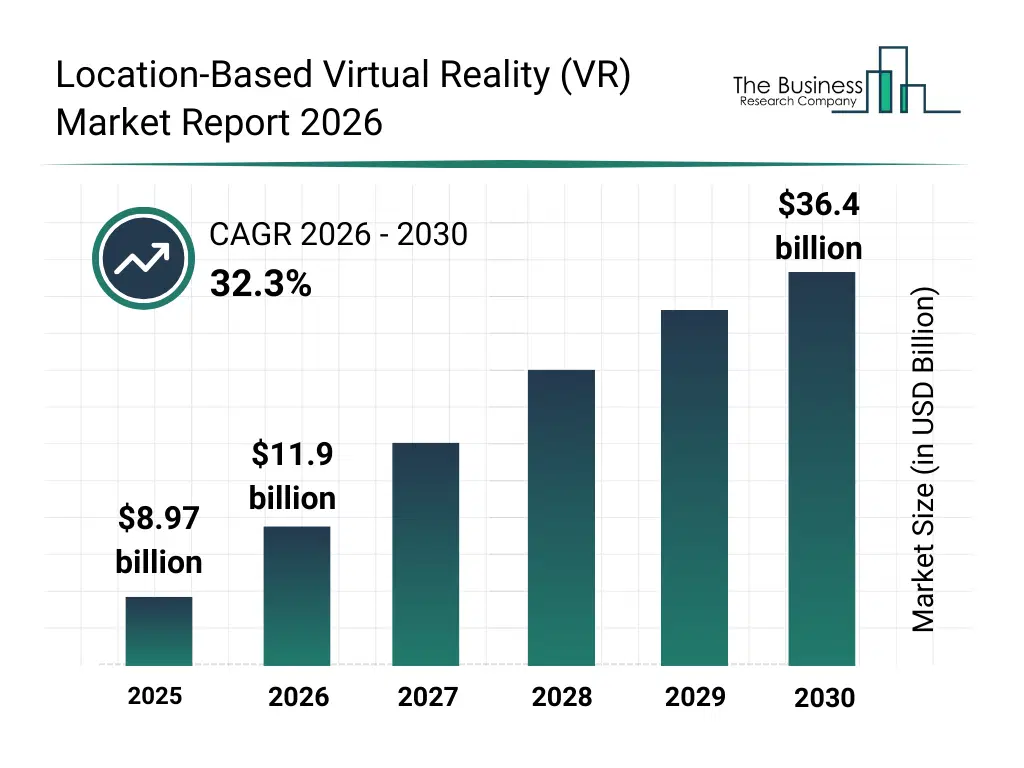
What Is The Location-Based Virtual Reality (VR) Market Size and Share 2026?
The location-based virtual reality (vr) market size has grown exponentially in recent years. It will grow from $8.97 billion in 2025 to $11.9 billion in 2026 at a compound annual growth rate (CAGR) of 32.6%. The growth in the historic period can be attributed to growth in entertainment technology adoption, expansion of VR arcades, rising demand for experiential entertainment, improvements in VR hardware performance, increase in gaming tourism.What Is The Location-Based Virtual Reality (VR) Market Growth Forecast?
The location-based virtual reality (vr) market size is expected to see exponential growth in the next few years. It will grow to $36.4 billion in 2030 at a compound annual growth rate (CAGR) of 32.3%. The growth in the forecast period can be attributed to integration of AI-powered VR environments, expansion of mixed reality attractions, growth of metaverse-based physical venues, adoption of wireless VR hardware, rising investment in experiential entertainment. Major trends in the forecast period include immersive entertainment experiences, multi-user VR environments, motion tracking integration, location-based gaming expansion, high-fidelity VR content deployment.
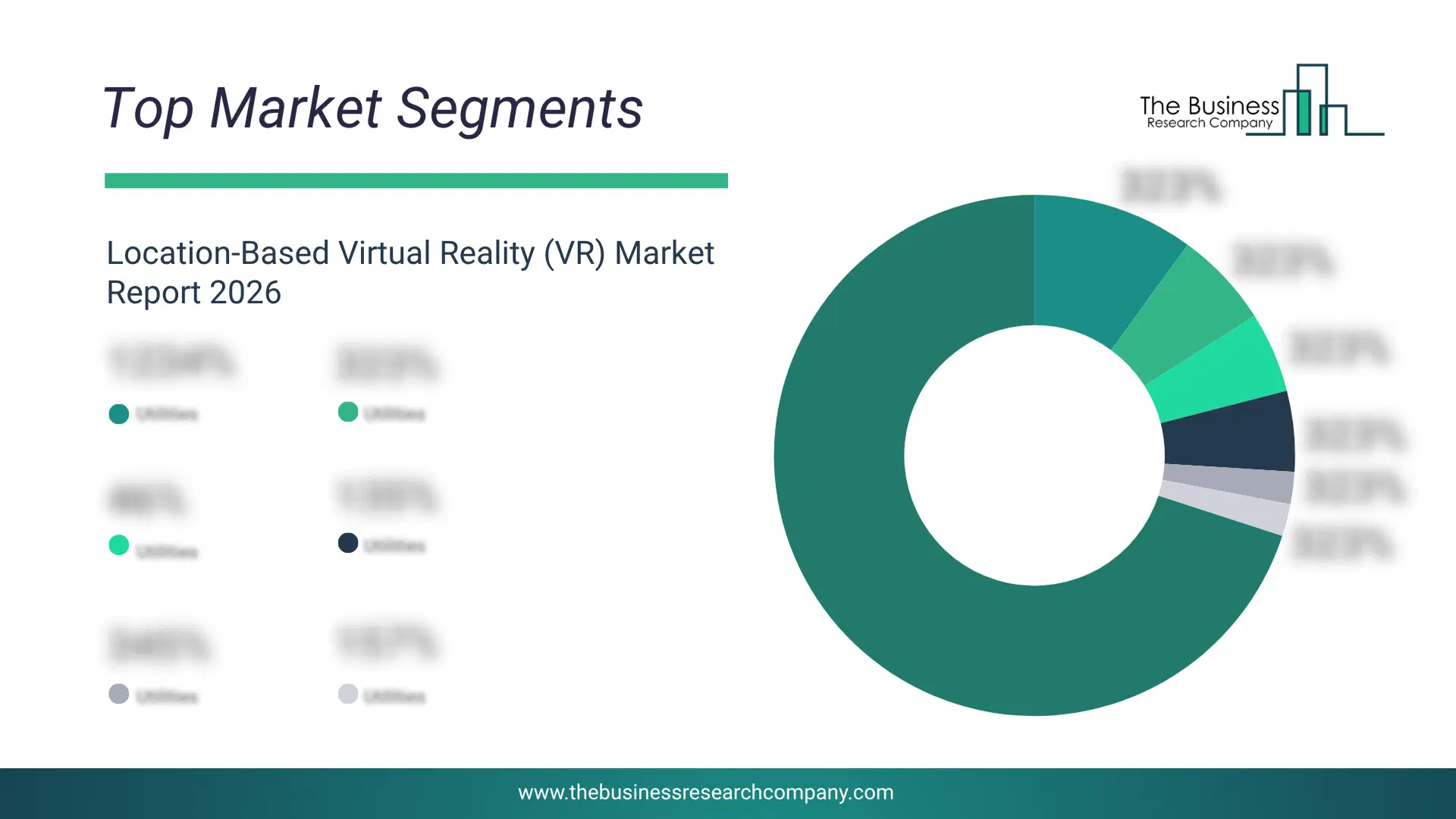
Global Location-Based Virtual Reality (VR) Market Segmentation
1) By Type: Head-Mounted Displays, Handheld Devices, Smart Glasses, Controllers 2) By Technology: Two-Dimensional (2D), Three-Dimensional (3D) 3) By Content: 360-Degree Videos, 360-Degree Images, Augmented Reality, Mixed Reality 4) By Application: Virtual Reality (VR) Arcades, Virtual Reality (VR) Theme Parks, Virtual Reality (VR) Cinemas 5) By End-Use: Gaming, Entertainment, Travel, Education, Healthcare Subsegments: 1) By Head-Mounted Displays (HMD): Wired Head-Mounted Displays (HMD), Wireless Head-Mounted Displays (HMD), Standalone Head-Mounted Displays (HMD), Tethered Head-Mounted Displays (HMD) 2) By Handheld Devices: Smartphones, Virtual Reality (VR) Gloves, Tracking Controllers 3) By Smart Glasses: Augmented Reality Glasses, Mixed Reality Glasses, Virtual Reality Glasses 4) By Controllers: Motion Controllers, Gamepad Controllers, Gesture-Based Controllers, Handheld Virtual Reality (VR) ControllersWhat Is The Driver Of The Location-Based Virtual Reality (VR) Market?
The growth of the gaming and entertainment sectors is expected to propel the growth of the location-based virtual reality (VR) market in the future. The gaming and entertainment sectors include industries centered around interactive gaming, digital content, and diverse leisure activities. The growth of the gaming and entertainment sectors is driven by technological progress, which enhances user experiences and creates more immersive, interactive games that appeal to a broader audience. The gaming and entertainment sectors aid location-based virtual reality by creating engaging, interactive experiences that attract a broad audience. They integrate advanced location-based VR technology to deliver immersive environments that enhance social interaction and entertainment value beyond home setups. For instance, in June 2024, according to the Interactive Games and Entertainment Association (IGEA), an Australia-based not-for-profit member organization, Australians spent $2.82 billion (AUD 4.4 billion) on video games and related hardware in 2023, marking a 5% increase from 2022, driven by an 11% rise in digital game sales. Therefore, the growth of the gaming and entertainment sectors is driving the growth of the location-based virtual reality (VR) industry.Key Players In The Global Location-Based Virtual Reality (VR) Market
Major companies operating in the location-based virtual reality (vr) market are Meta Platforms Inc., IMAX Corporation, HTC Corporation, Matterport Inc., Varjo Technologies Oy, EON Reality Inc., Survios Inc., Magnopus LLC, The VOID LLC, HOLOGATE GmbH, Pure Imagination Studios Inc., Virtuix Inc., Dreamscape Immersive Inc., Sandbox VR Inc., Immotion Group PLC, Arcadia Earth LLC, 360 Labs LLC, Holoride GmbH, Tyffon Inc., HQSoftware Industrial Ltd., Positron Inc., EXIT VR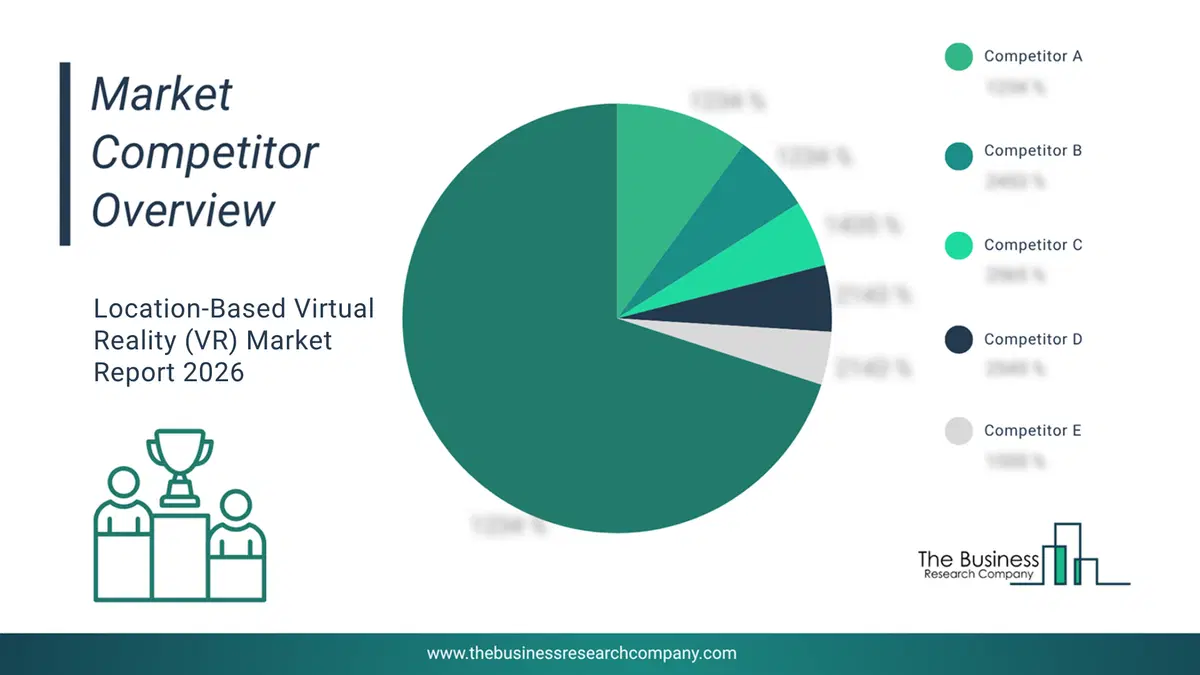
This chart is for illustrative purposes; the full report includes a detailed competitor analysis and comprehensive overview of the top 10 companies in the market.
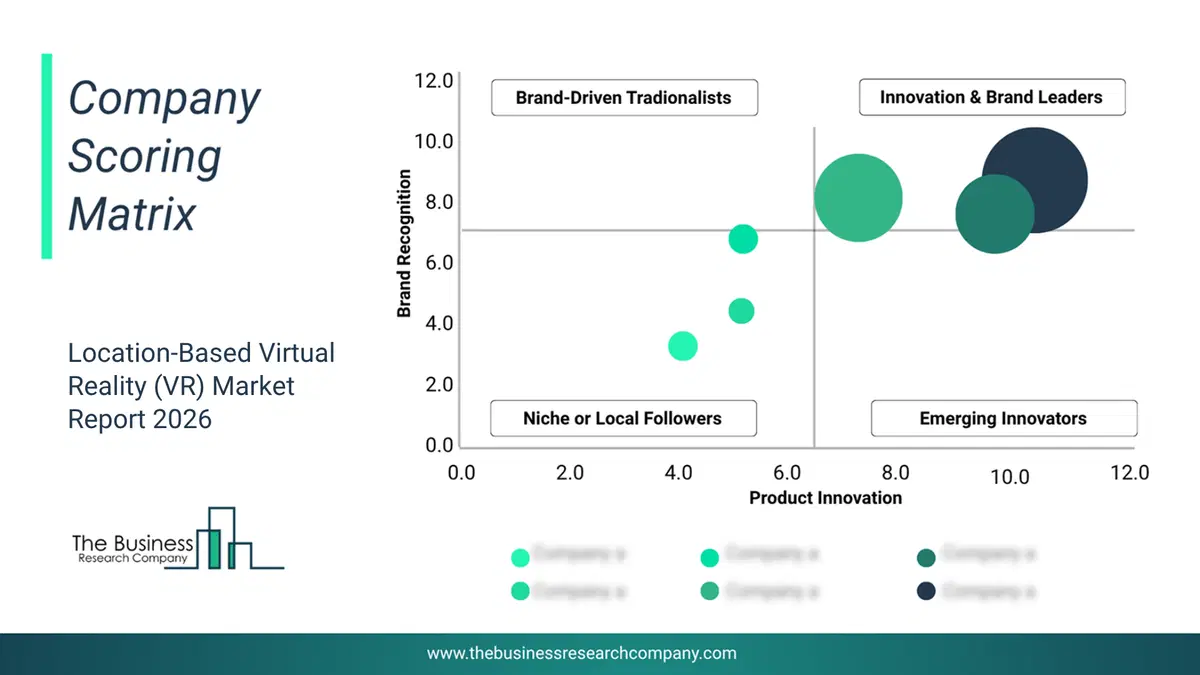
This chart maps companies by product innovation and brand strength, with bubble size indicating relative revenue, helping identify market leaders, challengers, and niche players. This is an illustrative chart; the full report provides a complete and accurate competitive analysis.
Global Location-Based Virtual Reality (VR) Market Trends and Insights
Major companies are operating in the location-based virtual reality (VR) market, focusing on developing technological advancements such as wireless free-roam multiplayer VR arena systems to enhance user immersion, increase social interaction, and optimize venue space utilization. A wireless free-roam VR arena system uses high-end head-mounted displays and full-body tracking in a mapped physical space allowing players to move freely and interact in a virtual environment compared to traditional in-home VR setups, which are typically tethered and restricted to small floor areas. For instance, in June 2024, HOLOGATE GmbH, a Germany-based entertainment technology company, launched the HOLOGATE ARENA Wireless Streaming Edition. The product features wireless high-resolution streaming directly to headsets, supports multiple players roaming freely in modular arena configurations, integrates haptic vests for physical feedback, and offers an updated operator interface for efficient venue management delivering a more immersive and scalable VR experience for entertainment centers..What Are Latest Mergers And Acquisitions In The Location-Based Virtual Reality (VR) Market?
In February 2025, SynthesisVR, a US-based virtual reality solutions company, acquired SpringboardVR for an undisclosed amount. With this acquisition, SynthesisVR aims to enhance its location-based virtual reality offerings by integrating SpringboardVR's comprehensive venue management platform and content library, expanding its market reach, and improving operational efficiency for virtual reality arcades and entertainment centers. SpringboardVR is a US-based provider of location-based virtual reality services.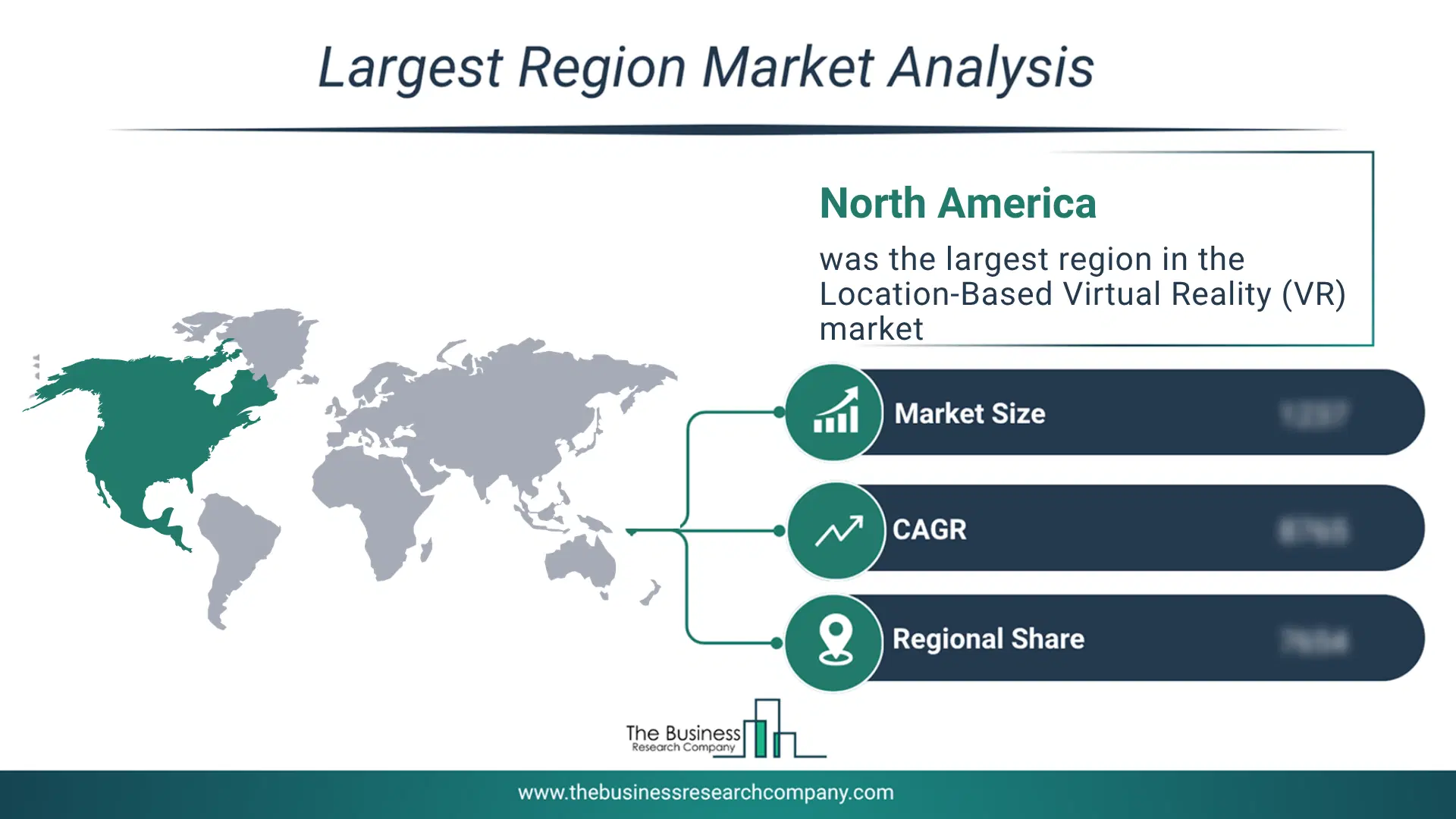
Regional Insights
North America was the largest region in the location-based virtual reality (VR) market in 2025. Asia-Pacific is expected to be the fastest-growing region in the forecast period. The regions covered in this market report are Asia-Pacific, South East Asia, Western Europe, Eastern Europe, North America, South America, Middle East, Africa. The countries covered in this market report are Australia, Brazil, China, France, Germany, India, Indonesia, Japan, Taiwan, Russia, South Korea, UK, USA, Canada, Italy, Spain.What Defines the Location-Based Virtual Reality (VR) Market?
The location-based virtual reality (VR) market consists of revenues earned by entities by providing services such as immersive entertainment experiences, virtual tourism, corporate training and simulations, and educational virtual reality programs. The market value includes the value of related goods sold by the service provider or included within the service offering. The location-based virtual reality market also includes sales of immersive simulators, haptic feedback suits, virtual reality (VR) arcade machines, and virtual reality (VR) pods. Values in this market are ‘factory gate’ values, that is, the value of goods sold by the manufacturers or creators of the goods, whether to other entities (including downstream manufacturers, wholesalers, distributors, and retailers) or directly to end customers. The value of goods in this market includes related services sold by the creators of the goods.How is Market Value Defined and Measured?
The market value is defined as the revenues that enterprises gain from the sale of goods and/or services within the specified market and geography through sales, grants, or donations in terms of the currency (in USD unless otherwise specified). The revenues for a specified geography are consumption values that are revenues generated by organizations in the specified geography within the market, irrespective of where they are produced. It does not include revenues from resales along the supply chain, either further along the supply chain or as part of other products.
This chart presents market attractiveness based on a quantitative evaluation of growth, competition, strategic alignment, and risk, offering a clear view of opportunity areas for decision-making. This chart is for illustrative purposes; the full report contains the complete analysis.

This chart highlights the Total Addressable Market (TAM) by estimating the maximum revenue opportunity using an assumption-driven approach, supporting strategic planning and opportunity sizing across markets. The chart is illustrative; the full report provides a more comprehensive analysis.
What Key Data and Analysis Are Included in the Location-Based Virtual Reality (VR) Market Report 2026?
The location-based virtual reality (vr) market research report is one of a series of new reports from The Business Research Company that provides market statistics, including industry global market size, regional shares, competitors with the market share, detailed market segments, market trends and opportunities, and any further data you may need to thrive in the location-based virtual reality (vr) industry. The market research report delivers a complete perspective of everything you need, with an in-depth analysis of the current and future state of the industry.Location-Based Virtual Reality (VR) Market Report Forecast Analysis
| Report Attribute | Details |
|---|---|
| Market Size Value In 2026 | $11.9 billion |
| Revenue Forecast In 2030 | $36.4 billion |
| Growth Rate | CAGR of 32.3% from 2026 to 2030 |
| Base Year For Estimation | 2025 |
| Actual Estimates/Historical Data | 2020-2025 |
| Forecast Period | 2026 - 2030 |
| Market Representation | Revenue in USD Billion and CAGR from 2026 to 2030 |
| Segments Covered | Type, Technology, Content, Application, End-Use |
| Regional Scope | Asia-Pacific, Western Europe, Eastern Europe, North America, South America, Middle East, Africa |
| Country Scope | The Countries Covered In This Market Report Are Australia, Brazil, China, France, Germany, India, Indonesia, Japan, Taiwan, Russia, South Korea, Uk, Usa, Canada, Italy, Spain. |
| Key Companies Profiled | Meta Platforms Inc., IMAX Corporation, HTC Corporation, Matterport Inc., Varjo Technologies Oy, EON Reality Inc., Survios Inc., Magnopus LLC, The VOID LLC, HOLOGATE GmbH, Pure Imagination Studios Inc., Virtuix Inc., Dreamscape Immersive Inc., Sandbox VR Inc., Immotion Group PLC, Arcadia Earth LLC, 360 Labs LLC, Holoride GmbH, Tyffon Inc., HQSoftware Industrial Ltd., Positron Inc., EXIT VR |
| Customization Scope | Request for Customization |
| Pricing And Purchase Options | Explore Purchase Options |