

Contact Us
  Search
The Business Research Company Logo
Location-Based Entertainment Global Market Opportunities And Strategies To 2035
Published :July 2026
Pages :387
Format :PDF
Delivery Time :2-3 Business Days
Why 2-3 days? We update the report with the latest data and news before delivery. Let us know if you need us to expedite.
Report Price :$4,490.00

Location-Based Entertainment Global Market Opportunities And Strategies To 2035

By Offerings (Hardware, Software, Services), By Technology (Two Dimensional (2D), Three Dimensional (3D), Cloud Merged Reality (CMR)), By End Use (Amusement Parks, Arcade Studios, 4D Films), And By Region, Opportunities And Strategies – Global Forecast To 2035

Location-Based Entertainment Market Definition

Location-based entertainment (LBE) refers to immersive entertainment experiences that are delivered at specific physical venues where consumers interact with digital, virtual or mixed reality technologies in a shared environment. These experiences combine advanced visualization systems, interactive hardware, simulation technologies and digital content to provide users with engaging entertainment activities that cannot typically be replicated in home environments. Location-based entertainment is widely used by consumers seeking immersive gaming, social entertainment, experiential attractions and interactive simulations. The location-based entertainment market consists of revenues generated by entities (organizations, sole traders and partnerships) by providing immersive entertainment services, software platforms, interactive content and enabling technologies deployed at physical entertainment venues. These experiences are delivered using technologies such as virtual reality (VR), augmented reality (AR), mixed reality (MR), projection mapping, motion simulation and interactive gaming systems. The market includes revenues generated from ticket sales, subscriptions, licensing fees, installation services, hardware deployment and maintenance services associated with immersive entertainment facilities.
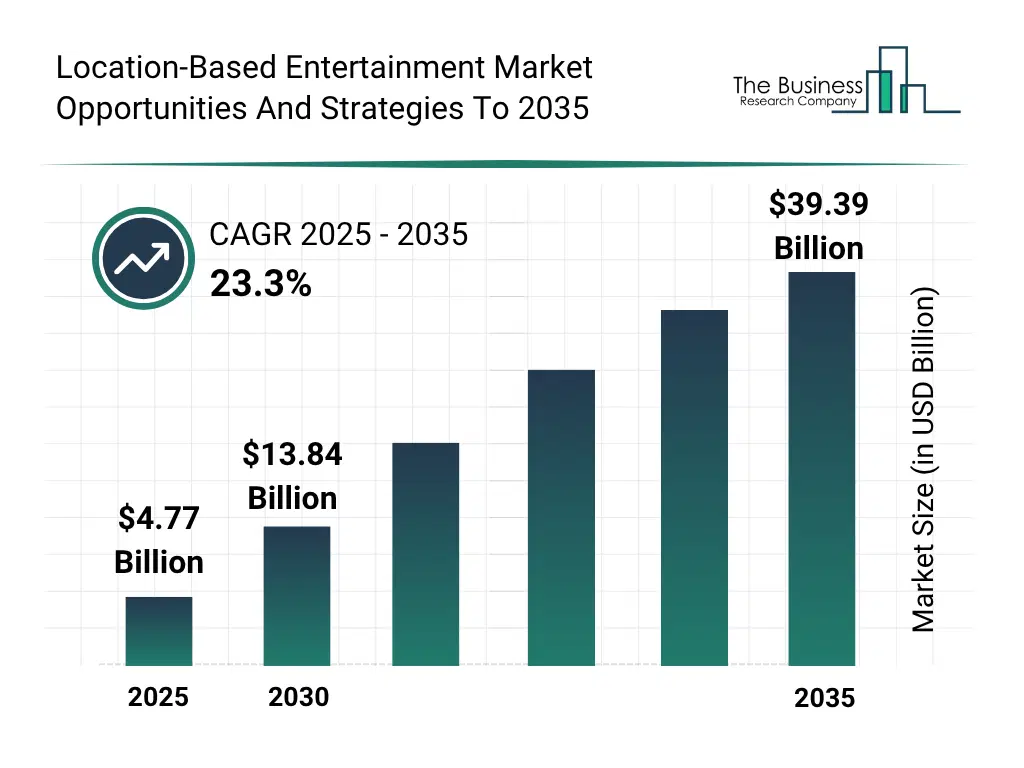
Location-Based Entertainment Global Market Opportunities And Strategies To 2035 Market Size and growth rate 2026 to 2030: Graph

Location-Based Entertainment Market Size

The global location-based entertainment market reached a value of nearly $4,769.7 million in 2025, having grown at a compound annual growth rate (CAGR) of 24.2% since 2020. The market is expected to grow from $4,769.7 million in 2025 to $13,836.5 million in 2030 at a rate of 23.7%. The market is then expected to grow at a CAGR of 23.3% from 2030 and reach $39,389.9 million in 2035. Growth in the historic period resulted from rising disposable income levels, expansion of theme parks and amusement centers, expansion of shopping mall entertainment zones and rapid adoption of virtual reality (VR) technologies in entertainment venues. Factors that negatively affected growth in the historic period were high initial capital investment and high maintenance and operating costs. Going forward, rising demand for interactive and simulation-based attractions, growing popularity of competitive VR gaming and esports arenas, expansion of licensed franchise-based entertainment attractions and expansion of indoor entertainment centers in urban areas will drive the growth. Factors that could hinder the growth of the location-based entertainment market in the future include limited consumer affordability, competition from home entertainment and trade war and tariffs.
Research Expert

Book your 30 minutes free consultation with our research experts

Location-Based Entertainment Market Segmentation

The location-based entertainment market is segmented by offerings, by technology and by end use.

By Offerings –
The location-based entertainment market is segmented by offerings into:
    • a) Hardware
    • b) Software
    • c) Services
The hardware market was the largest segment of the location-based entertainment market segmented by offerings, accounting for 50.0% or $2,384.3 million of the total in 2025. Going forward, the software segment is expected to be the fastest-growing segment in the location-based entertainment market segmented by product, at a CAGR of 32.3% during 2025-2030.

By Technology –
The location-based entertainment market is segmented by technology into:
    • a) 3 Dimensional (3D)
    • b) Cloud Merged Reality (CMR)
    • c) 2 Dimensional (2D)
The 3 dimensional (3D) market was the largest segment of the location-based entertainment market segmented by technology, accounting for 47.5% or $2,264.6 million of the total in 2025. Going forward, the cloud merged reality (CMR) segment is expected to be the fastest-growing segment in the location-based entertainment market segmented by technology, at a CAGR of 36.8% during 2025-2030.

By End Use –
The location-based entertainment market is segmented by end use into:
    • a) Amusement Parks
    • b) Arcade Studios
    • c) 4D Films
The amusement parks market was the largest segment of the location-based entertainment market segmented by end-use, accounting for 42.5% or $2,027.5 million of the total in 2025. Going forward, the arcade studios segment is expected to be the fastest-growing segment in the location-based entertainment market segmented by end-use, at a CAGR of 27.4% during 2025-2030.

By Geography - The location-based entertainment market is segmented by geography into:
      o Asia Pacific
      • China
      • India
      • Japan
      • Australia
      • Taiwan
      • South Korea
      o South East Asia
      • Indonesia
      o North America
      • USA
      • Canada
      o South America
      • Brazil
      o Western Europe
      • France
      • Germany
      • UK
      • Italy
      • Spain
      o Eastern Europe
      • Russia
      o Middle East
      o Africa
North America was the largest region in the location-based entertainment market, accounting for 33.6% or $1,602.8 million of the total in 2025. It was followed by Asia Pacific, Western Europe and then the other regions. Going forward, the fastest-growing regions in the location-based entertainment market will be Asia Pacific and South America where growth will be at CAGRs of 31.2% and 28.0% respectively. These will be followed by Africa and Eastern Europe where the markets are expected to grow at CAGRs of 23.9% and 22.7% respectively.

Location-Based Entertainment Market Drivers

The key drivers of the location-based entertainment market include: Rising Demand For Interactive And Simulation-Based Attractions During the forecast period, the rising demand for interactive and simulation-based attractions is expected to propel the growth of the location-based entertainment market. Consumers are increasingly seeking immersive experiences that combine advanced technologies such as virtual reality (VR), augmented reality (AR), motion simulators and mixed reality with entertainment. Entertainment venues are investing in interactive gaming zones, virtual sports, escape rooms and simulation rides to enhance visitor engagement and differentiate their offerings. These attractions provide realistic and personalized experiences, encouraging repeat visits and higher customer spending. In addition, advancements in digital technologies and increasing consumer preference for experiential entertainment are supporting the adoption of innovative simulation-based attractions across amusement parks, gaming centers and family entertainment venues. The rising demand for interactive and simulation-based attractions growth contribution during the forecast period in 2026 is 2.5%.

Location-Based Entertainment Market Restraints

The key restraints on the location-based entertainment market include: Competition From Home Entertainment During forecast period, competition from home entertainment is expected to hinder the growth of the location-based entertainment market. The widespread availability of advanced gaming consoles, virtual reality headsets, streaming platforms and high-speed internet has enabled consumers to access immersive entertainment experiences from home at lower costs and greater convenience. Consumers are increasingly spending more time on digital entertainment platforms, reducing the frequency of visits to entertainment venues such as arcades, VR centers and amusement facilities. In addition, continuous innovation in home-based gaming and interactive media is intensifying competition for consumer attention and discretionary spending. This shift in entertainment preferences may limit customer footfall and revenue growth for location-based entertainment operators. Growth affected by the competition from home entertainment during the forecast period in 2026 is -1.5%.

Location-Based Entertainment Market Competitive Landscape

Major Competitors are:

  • The Walt Disney Company
  • Merlin Entertainments
  • Six Flags Entertainment Corporation
  • The Oriental Land Company
  • SeaWorld Entertainment (United Parks & Resorts)
  • Other Competitors Include:

  • Parques Reunidos
  • Triotech
  • Fantawild Holdings Inc.
  • Dave & Buster's Entertainment Inc.
  • Village Roadshow pty Ltd.
  • Universal Parks & Resorts
  • OCT Group
  • AEON Fantasy Co., Ltd.
  • Samsung Electronics Co., Ltd.
  • Village Roadshow Theme Parks
  • VR Studios Inc.
  • Huis Ten Bosch Co., Ltd. (HTB)
  • Lotte World
  • Everland
  • iQIYI
  • Hashilus Co., Ltd.
  • Tyffon Inc.
  • Max-Matching Entertainments
  • Wahlap Technology
  • Temple of Light
  • AStation Enterverse
  • SKonec Entertainment
  • Awesomepia
  • Bibimble
  • TBCL
  • XrisP
  • Imagicaaworld
  • HTC Corporation
  • VAR LIVE
  • Brogent Technologies
  • Dreamscape Immersive
  • Moonbug Entertainment
  • PLAY Culture Co., Ltd.
  • Zero Latency VR
  • Third Culture Entertainment
  • 3Particle Group
  • Tomorrow Entertainment Group
  • Excape Entertainment Group
  • Asphere Innovations
  • Waveplay Interactive
  • VizioFly
  • Vostok VR
  • Sandbox VR
  • Carousel & Co.
  • Universal Music Group
  • Topgolf Megacity
  • Blu-O Rhythm & Bowl
  • Idea Live Arena
  • The VOID
  • Niantic
  • Fever
  • Zero Latency
  • Hologate
  • Two Bit Circus
  • Meow Wolf
  • AREA15
  • Secret Cinema
  • Illuminarium Experiences
  • teamLab
  • PortAventura World
  • Hello Park
  • Felimana Luna Park
  • BeFun Entertainment
  • CamOnApp
  • Arcade Haus
  • Coney Park
  • Fantasilandia
  • SPREE Interactive
  • Mixed Reality Peru
  • FuninVR
  • La Granja Villa
  • Play Land Park Perú Internacional
  • Dracula Land
  • Virtualware
  • Momentum Leisure
  • Miral
  • IMG Worlds
  • PMaestro
  • Hakuna Matata Theme Park
  • Need data on a specific region in this market?

    Opportunities And Recommendations In The Location-Based Entertainment Market

    Opportunities – The top opportunities in the location-based entertainment market segmented by offerings will arise in the software segment, which will gain $4,233.0 million of global annual sales by 2030. The top opportunities in the location-based entertainment market segmented by technology will arise in the cloud merged reality (CMR) segment, which will gain $6,775.7 million of global annual sales by 2030. The top opportunities in the location-based entertainment market segmented by end-use will arise in the arcade studios segment, which will gain $3,806.6 million of global annual sales by 2030. The location-based entertainment market size will gain the most in China at $1,834.4 million. Recommendations- To take advantage of the opportunities, The Business Research Company recommends the Location-Based Entertainment companies to focus on immersive franchise-based attractions and interactive storytelling, focus on multiplayer XR experiences and hybrid digital engagement, focus on open-source XR platforms to scale multi-user immersive experiences, focus on permanent immersive entertainment venues to drive year-round revenue growth, focus on franchise-driven permanent immersive entertainment venues, focus on software-driven immersive platforms for location-based entertainment growth, focus on cloud merged reality platforms for next-generation immersive entertainment, expand in emerging markets, continue to focus on developed markets, focus on tiered and value-based pricing models for location-based entertainment growth, experience led promotion and retention focused campaign design, data driven digital promotion and targeted audience acquisition strategy and focus on arcade studios for high-growth social and multiplayer entertainment expansion.
    Chat with us