
Long Term Care Software Global Market Opportunities And Strategies To 2035
By Product (Clinical Software, Non-Clinical Solutions), By Deployment Type (On-Premises, Cloud-Based), By End-User (Home Healthcare Agencies, Hospice Care Facilities, Nursing Homes, Assisted Living Facilities, Other End Users), And By Region, Opportunities And Strategies – Global Forecast To 2035
Industrial Ethernet Market Definition
Long term care software refers to digital solutions designed to support the management, administration and delivery of care services for individuals who require extended assistance due to aging, chronic illness, disability or recovery from medical conditions. These software systems are used by healthcare providers, caregivers, administrators and support staff across long-term care settings to streamline clinical workflows, manage patient records, coordinate care plans and ensure regulatory compliance. Long term care software is typically used on a continuous basis as part of daily operations in facilities that provide ongoing care, including nursing homes, assisted living centers and home healthcare agencies. The long term care software market consists of revenues generated by entities (organizations, sole traders and partnerships) for providing software solutions that facilitate clinical management, operational efficiency and regulatory adherence in long-term care environments. These solutions are developed using healthcare IT infrastructure, incorporating electronic health records, billing systems, scheduling tools and analytics capabilities.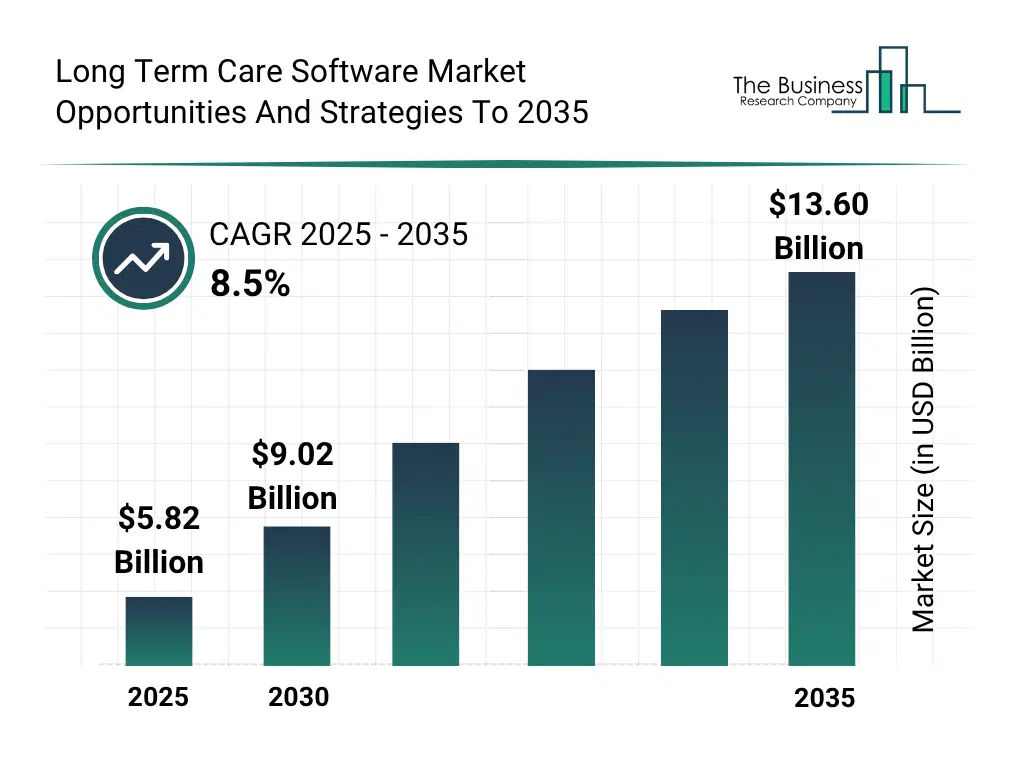
Industrial Ethernet Market Size
The global long term care software market reached a value of nearly $5,823.8 million in 2025, having grown at a compound annual growth rate (CAGR) of 10.8% since 2020. The market is expected to grow from $5,823.8 million in 2025 to $9,023.1 million in 2030 at a rate of 9.2%. The market is then expected to grow at a CAGR of 8.5% from 2030 and reach $13,598.6 million in 2035. Growth in the historic period resulted from rising prevalence of chronic diseases, increasing adoption of EHRs, increasing life expectancy and growing incidence of age-related cognitive disorders. Factors that negatively affected growth in the historic period were high initial implementation cost and data security and privacy concerns. Going forward, rapidly increasing aged population, rising investment in healthcare IT infrastructure, government initiatives promoting healthcare digitization and growth in assisted living and senior housing communities will drive the growth. Factors that could hinder the growth of the long term care software market in the future include ongoing maintenance and subscription costs, integration and interoperability challenges and impact of trade wars and tariffs.
Industrial Ethernet Market Segmentation
The long term care software market is segmented by product, by deployment type, by end-user.By Product –
The long term care software market is segmented By Product into:
- a) Clinical Software
- b) Non-Clinical Solutions
By Deployment Type –
The long term care software market is segmented by deployment type into:
- a) On-Premises
- b) Cloud-Based
By End-User –
The long term care software market is segmented by end-user into:
- a) Home Healthcare Agencies
- b) Hospice Care Facilities
- c) Nursing Homes
- d) Assisted Living Facilities
- e) Other End Users
By Geography - The long term care software market is segmented by geography into:
- China
- India
- Japan
- Australia
- Indonesia
- South Korea
- USA
- Canada
- Brazil
- France
- Germany
- UK
- Italy
- Spain
- Russia
-
o Asia Pacific
o Africa