
Long Term Evolution (LTE) Market Report 2026
Global Outlook – By Device Type (Smartphones, Tablets, Vehicles, Wearables, Gaming Consoles, Other Device Types), By Technology (Long Term Evolution - Time Division Duplex, Long Term Evolution Advanced, Long Term Evolution - Frequency Division Duplex), By Application (Video On Demand, Voice Over Long-Term Evolution, High Speed Data Services, Defense And Security, Other Applications), By End Users (Oil And Gas, Mining, Transportation, Manufacturing, Telecommunications And Information technology (IT), Enterprise, Consumer, Other End Users) – Market Size, Trends, Strategies, and Forecast to 2030
Long Term Evolution (LTE) Market Overview
• Long Term Evolution (LTE) market size has reached to $57.47 billion in 2025 • Expected to grow to $155.84 billion in 2030 at a compound annual growth rate (CAGR) of 22.1% • Growth Driver: Role Of Increased Data Usage In Driving Long-Term Evolution (LTE) Market Growth • Market Trend: telecom Giants Elevate LTE Market With VoLTE Integration For Enhanced Connectivity • North America was the largest region in 2025 and Asia-Pacific is the fastest growing region.What Is Covered Under Long Term Evolution (LTE) Market?
Long-term evolution (LTE) refers to a standard for wireless broadband communication for mobile devices and data terminals, providing high-speed data transmission for mobile devices and networks. It is designed to deliver high-speed data transfer rates with low latency, allowing users to browse the internet, stream media, make video chats, and run other data-intensive apps on their devices. The main types of devices in long-term evolution (LTE) are smartphones, tablets, vehicles, wearables, gaming consoles, and others. Smartphones are portable, handheld devices that combine communication, computing, and multimedia capabilities. It includes various technologies, such as long-term evolution - time division duplex, long-term evolution advanced, and long-term evolution - frequency division duplex, and used in various applications, including video on demand, voice over long-term evolution, high-speed data services, defense and security, and others. It is used by several end-users, including oil and gas, mining, transportation, manufacturing, telecommunications and information technology (IT), enterprises, consumers, and others.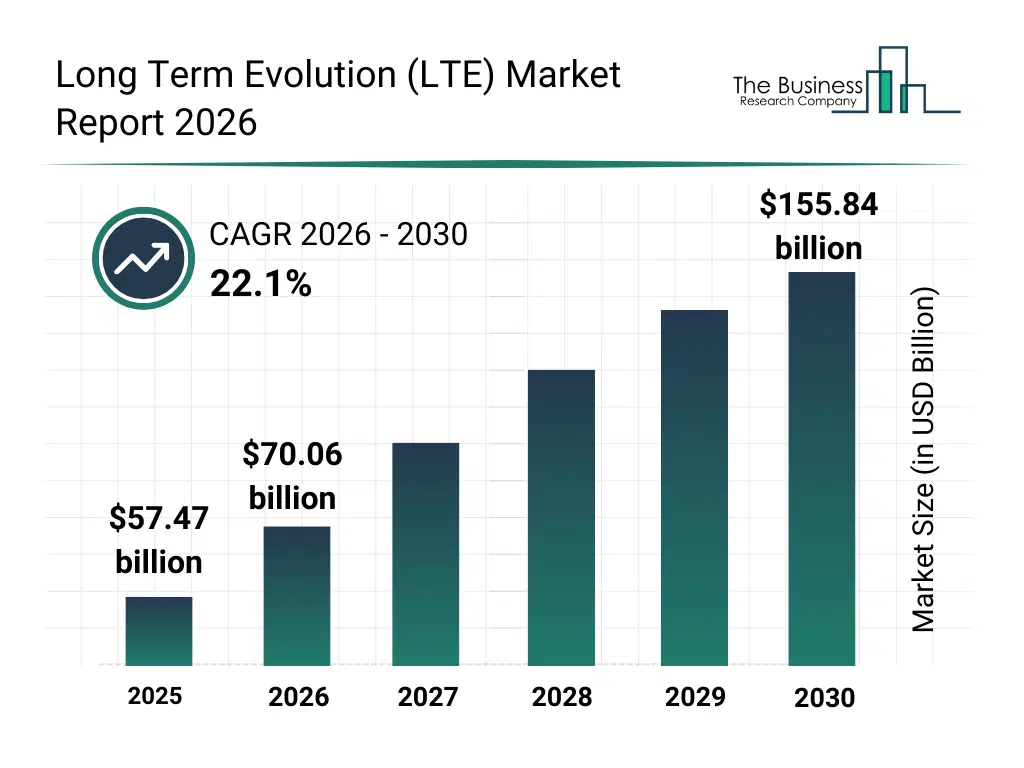
What Is The Long Term Evolution (LTE) Market Size and Share 2026?
The long term evolution (lte) market size has grown exponentially in recent years. It will grow from $57.47 billion in 2025 to $70.06 billion in 2026 at a compound annual growth rate (CAGR) of 21.9%. The growth in the historic period can be attributed to limited broadband coverage, slow data speeds, manual network management, early smartphone adoption, fragmented spectrum allocation.What Is The Long Term Evolution (LTE) Market Growth Forecast?
The long term evolution (lte) market size is expected to see exponential growth in the next few years. It will grow to $155.84 billion in 2030 at a compound annual growth rate (CAGR) of 22.1%. The growth in the forecast period can be attributed to surge in mobile internet usage, 5G-LTE coexistence, IoT device proliferation, low-latency application demand, enhanced network infrastructure investment. Major trends in the forecast period include high-speed mobile data services, voice over lte (volte) deployment, low-latency streaming applications, mobile device connectivity management, autonomous vehicle communication.
Global Long Term Evolution (LTE) Market Segmentation
1) By Device Type: Smartphones, Tablets, Vehicles, Wearables, Gaming Consoles, Other Device Types 2) By Technology: Long Term Evolution - Time Division Duplex, Long Term Evolution Advanced, Long Term Evolution - Frequency Division Duplex 3) By Application: Video On Demand, Voice Over Long-Term Evolution, High Speed Data Services, Defense And Security, Other Applications 4) By End Users: Oil And Gas, Mining, Transportation, Manufacturing, Telecommunications And Information technology (IT), Enterprise, Consumer, Other End Users Subsegments: 1) By Smartphones: 4G LTE Smartphones, 5G LTE Smartphones 2) By Tablets: 4G LTE Tablets, 5G LTE Tablets 3) By Vehicles: Connected Cars, Autonomous Vehicles, Infotainment Systems 4) By Wearables: Smartwatches, Fitness Trackers, Smart Glasses 5) By Gaming Consoles: Handheld Consoles, Home Consoles 6) By Other Device Types: IoT Devices, Laptops Or PCs With LTE Or 5G, M2M (Machine-To-Machine) DevicesWhat Is The Driver Of The Long Term Evolution (LTE) Market?
The increased demand for high data usage is expected to propel the growth of the long-term evolution (LTE) market going forward. Data usage refers to the lawful handling, processing, and use of data for intended purposes, including data analysis, reporting, decision-making, research, and other applications. Data usage is on the rise because of increased demand for streaming services, online gaming, social media, messaging, and remote work and learning. Long-term evolution (LTE) offers significantly higher data speeds compared to previous generations of mobile communication technologies like 3G. LTE networks can manage higher levels of data traffic, allowing more users to connect concurrently without encountering major slowdowns or congestion. For instance, in February 2023, according to Meltwater, a UK-based media monitoring company, the total number of internet users in the UK was 66.11 million, indicates that internet users in the UK increased by 224 thousand (+0.3%) between 2022 and 2023. Therefore, the increased demand for high data usage is driving the growth of the long-term evolution (LTE) market.Key Players In The Global Long Term Evolution (LTE) Market
Major companies operating in the long term evolution (lte) market are Samsung Electronics Co. Ltd.; Microsoft Corporation; China Mobile Communications Corporation; Verizon Communication Inc.; American Telephone and Telegraph Company Incorporated (AT&T); Deutsche Telekom AG; Huawei Technologies Co. Ltd.; T-Mobile US Inc.; LG Uplus Corp.; Vodafone Inc.; NTT DoCoMo Inc.; Cisco Systems Inc.; Qualcomm Incorporated; Telefónica S.A.; Broadcom Corporation; Telefonaktiebolaget LM Ericsson; KT Corporation; ZTE Corporation; Bharti Airtel Limited; SK Telecom Co. Ltd.; Nokia Solutions and Networks Oy; Juniper Networks Inc.; Alcatel-Lucent S.A.; MetroPCS Communications Inc.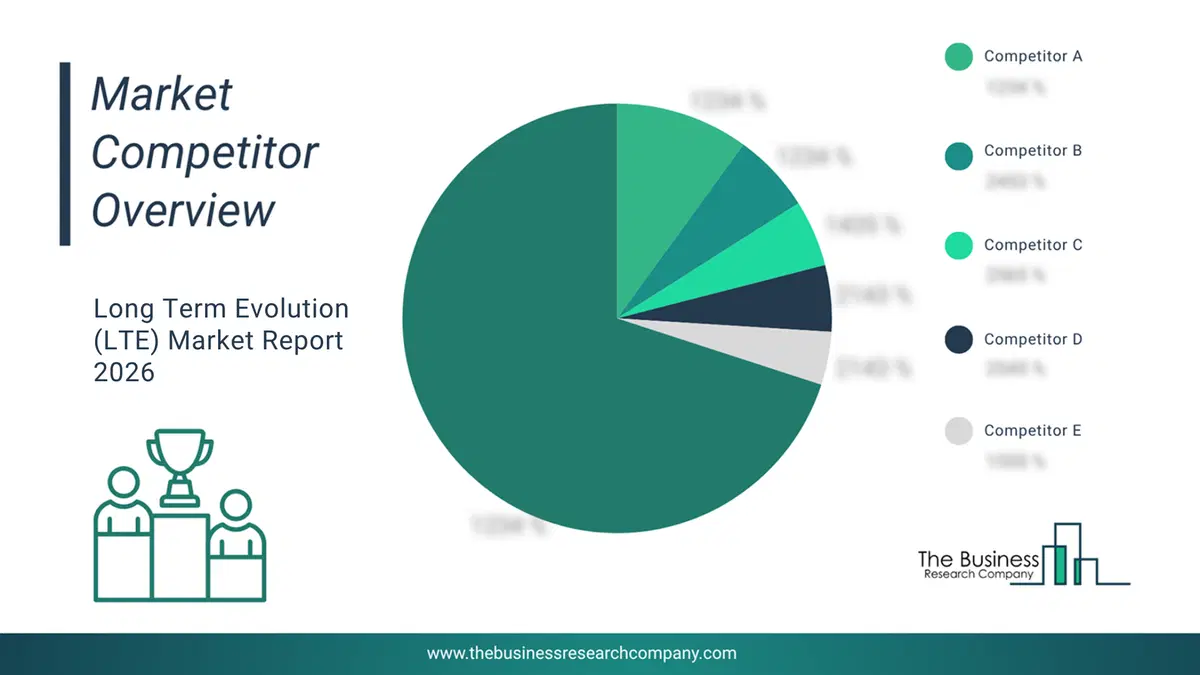
This chart is for illustrative purposes; the full report includes a detailed competitor analysis and comprehensive overview of the top 10 companies in the market.
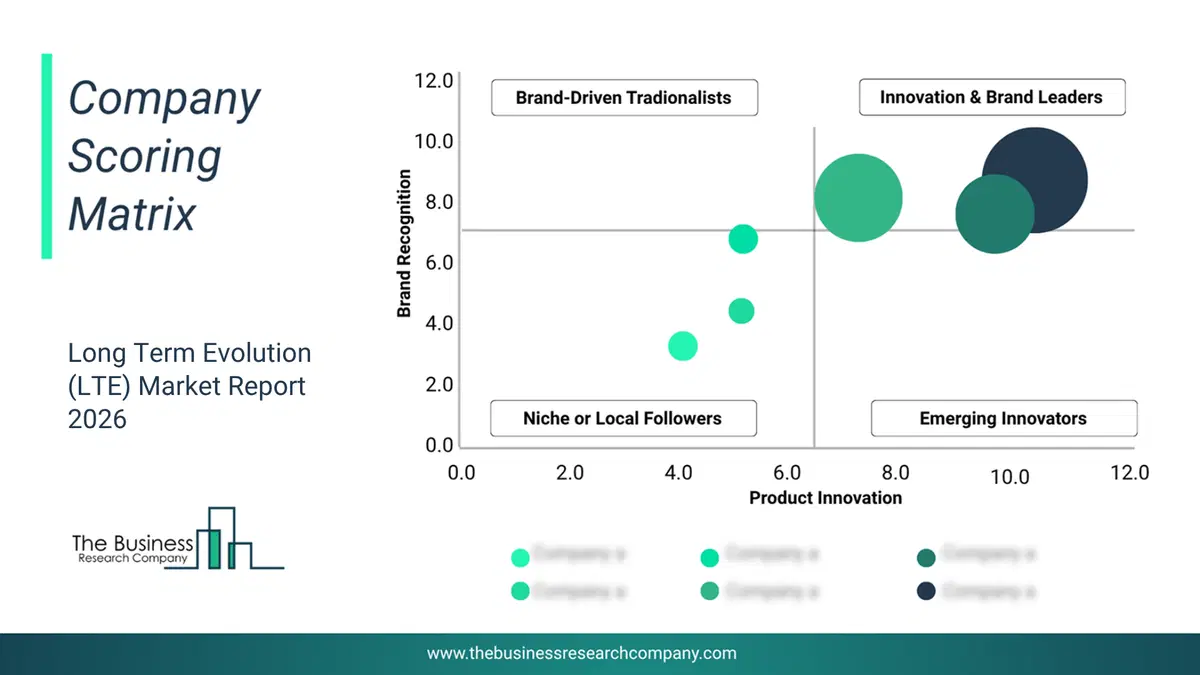
This chart maps companies by product innovation and brand strength, with bubble size indicating relative revenue, helping identify market leaders, challengers, and niche players. This is an illustrative chart; the full report provides a complete and accurate competitive analysis.
Global Long Term Evolution (LTE) Market Trends and Insights
Major companies operating in the long-term evolution (LTE) market are focusing on the development of advanced solutions, such as the adoption of voice-over LTE (VoLTE), to enhance the user experience, improve network efficiency, reduce costs, and support advanced technologies. VoLTE technology enables voice calls to be carried over high-speed 4G LTE networks, providing improved call quality and enhanced multimedia services. This integration within the Long-Term Evolution (LTE) market signifies a pivotal advancement, delivering superior voice quality and expanded multimedia capabilities over high-speed networks to meet evolving communication needs. For instance, in March 2024, Tele2 AB, a Sweden-based telecommunications company, launched VoLTE globally for IoT customers. This technology aims to enhance coverage across the globe by leveraging efficient future-proof network technology, providing higher voice quality and faster data services to improve the communication experience for IoT users. Additionally, it features high-quality calls, efficient spectrum utilization, extended battery life, reliable services, and compatibility requirements for conference calls, which simplifies network management and developer accessibility.What Are Latest Mergers And Acquisitions In The Long Term Evolution (LTE) Market?
In June 2023, Hewlett-Packard Enterprise, a US-based information technology company, acquired Athonet for an undisclosed amount. Through this acquisition, Hewlett-Packard Enterprise aims to strengthen its position in the growing market for private cellular networks, particularly 5G, and revolutionize private networking by simplifying and accelerating the deployment of private 5G. Athonet is an Italy-based provider of LTE services through its mobile core network solutions.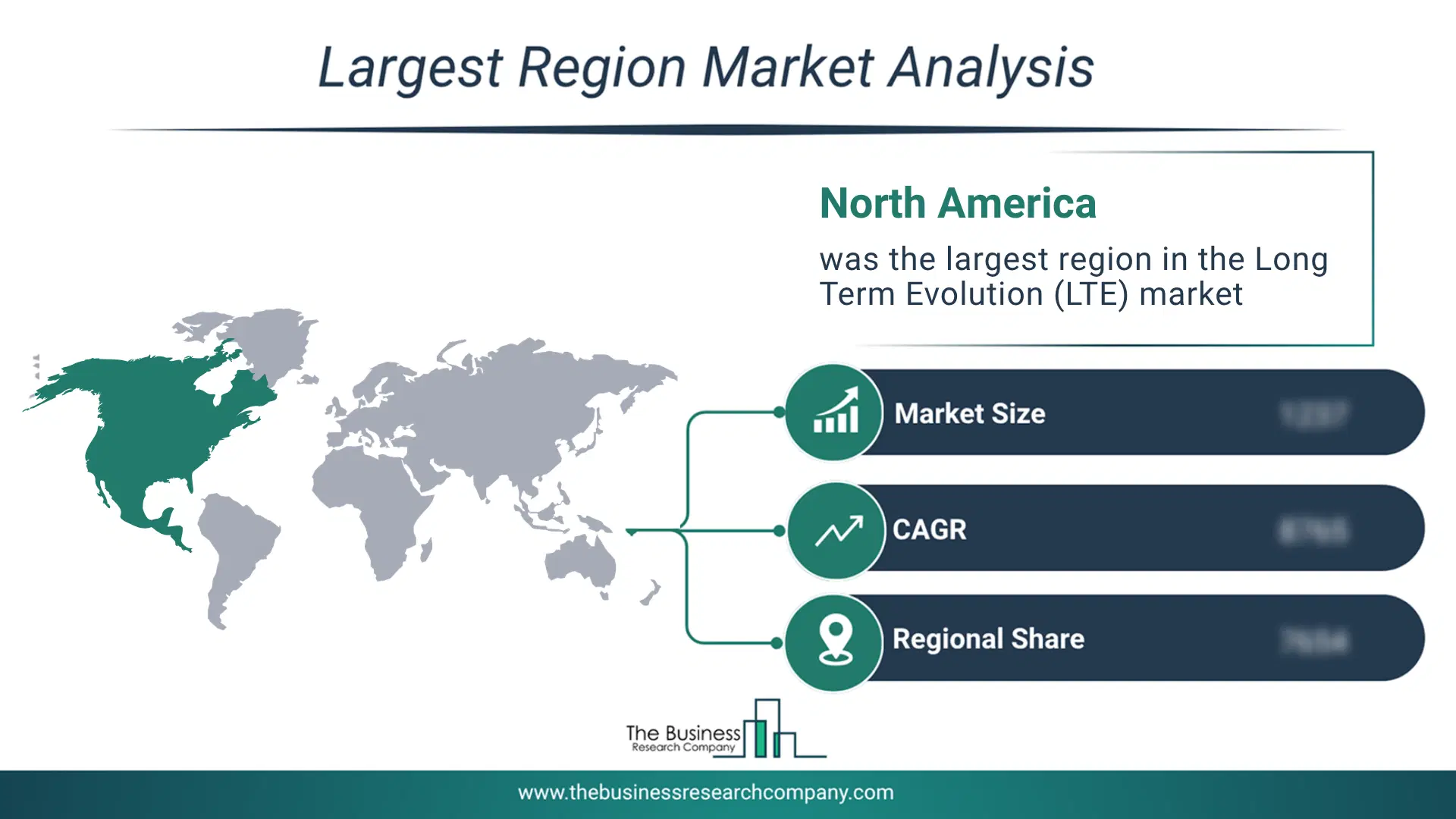
Regional Insights
North America was the largest region in the long term evolution market in 2025. Asia-Pacific is expected to be the fastest-growing region in the forecast period. The regions covered in this market report are Asia-Pacific, South East Asia, Western Europe, Eastern Europe, North America, South America, Middle East, Africa. The countries covered in this market report are Australia, Brazil, China, France, Germany, India, Indonesia, Japan, Taiwan, Russia, South Korea, UK, USA, Canada, Italy, SpainWhat Defines the Long Term Evolution (LTE) Market?
The long-term evolution (LTE) market consists of revenues earned by entities by providing services such as high-speed data transmission, voice-over LTE technology, video calling and conferencing, location-based services, and roaming services. The market value includes the value of related goods sold by the service provider or included within the service offering. The long-term evolution (LTE) market also includes sales of fixed wireless access (FWA) devices, USB (Universal Serial Bus) dongles and data cards, LTE-enabled wearables, user equipment, and home subscriber server tools, and LTE SIM (Subscriber Identity Module) cards. Values in this market are ‘factory gate’ values, that is, the value of goods sold by the manufacturers or creators of the goods, whether to other entities (including downstream manufacturers, wholesalers, distributors, and retailers) or directly to end customers. The value of goods in this market includes related services sold by the creators of the goods.How is Market Value Defined and Measured?
The market value is defined as the revenues that enterprises gain from the sale of goods and/or services within the specified market and geography through sales, grants, or donations in terms of the currency (in USD unless otherwise specified). The revenues for a specified geography are consumption values that are revenues generated by organizations in the specified geography within the market, irrespective of where they are produced. It does not include revenues from resales along the supply chain, either further along the supply chain or as part of other products.
This chart presents market attractiveness based on a quantitative evaluation of growth, competition, strategic alignment, and risk, offering a clear view of opportunity areas for decision-making. This chart is for illustrative purposes; the full report contains the complete analysis.

This chart highlights the Total Addressable Market (TAM) by estimating the maximum revenue opportunity using an assumption-driven approach, supporting strategic planning and opportunity sizing across markets. The chart is illustrative; the full report provides a more comprehensive analysis.
What Key Data and Analysis Are Included in the Long Term Evolution (LTE) Market Report 2026?
The long term evolution (lte) market research report is one of a series of new reports from The Business Research Company that provides market statistics, including industry global market size, regional shares, competitors with the market share, detailed market segments, market trends and opportunities, and any further data you may need to thrive in the long term evolution (lte) industry. The market research report delivers a complete perspective of everything you need, with an in-depth analysis of the current and future state of the industry.Long Term Evolution (LTE) Market Report Forecast Analysis
| Report Attribute | Details |
|---|---|
| Market Size Value In 2026 | $70.06 billion |
| Revenue Forecast In 2030 | $155.84 billion |
| Growth Rate | CAGR of 22.1% from 2026 to 2030 |
| Base Year For Estimation | 2025 |
| Actual Estimates/Historical Data | 2020-2025 |
| Forecast Period | 2026 - 2030 |
| Market Representation | Revenue in USD Billion and CAGR from 2026 to 2030 |
| Segments Covered | Device Type, Technology, Application, End Users |
| Regional Scope | Asia-Pacific, Western Europe, Eastern Europe, North America, South America, Middle East, Africa |
| Country Scope | The Countries Covered In This Market Report Are Australia, Brazil, China, France, Germany, India, Indonesia, Japan, Taiwan, Russia, South Korea, Uk, Usa, Canada, Italy, Spain. |
| Key Companies Profiled | Samsung Electronics Co. Ltd., Microsoft Corporation, China Mobile Communications Corporation, Verizon Communication Inc., American Telephone and Telegraph Company Incorporated (AT&T), Deutsche Telekom AG, Huawei Technologies Co. Ltd., T-Mobile US Inc., LG Uplus Corp., Vodafone Inc., NTT DoCoMo Inc., Cisco Systems Inc., Qualcomm Incorporated, Telefónica S.A., Broadcom Corporation, Telefonaktiebolaget LM Ericsson, KT Corporation, ZTE Corporation, Bharti Airtel Limited, SK Telecom Co. Ltd., Nokia Solutions and Networks Oy, Juniper Networks Inc., Alcatel-Lucent S.A., MetroPCS Communications Inc. |
| Customization Scope | Request for Customization |
| Pricing And Purchase Options | Explore Purchase Options |