

Longevity Biotech And Epigenetic Reprogramming Market Report 2026
Global Outlook – By Technology Platform (Partial Epigenetic Reprogramming, Senolytics And Senomorphics, Gene Therapy, Stem Cell Therapy, Metabolic Intervention), By Therapeutic Focus (Age Related Ocular Disease, Cardiovascular Aging, Neurodegeneration, Musculoskeletal Decline, Metabolic Aging), By Delivery Method (In Vivo Therapies, Ex Vivo Therapies, Small Molecule Therapies, Biologic Therapies, Gene Editing Based Therapies, Cell Based Therapies, Other Delivery Methods), By Funding Source (Venture Capital, Government (Advanced Research Projects Agency For Health), Philanthropic, Public Markets), By End User (Biotechnology Companies, Pharmaceutical Companies, Research Institutes, Academic And Scientific Organizations, Hospitals And Clinics, Contract Research Organizations, Other End Users) – Market Size, Trends, Strategies, and Forecast to 2030
Longevity Biotech And Epigenetic Reprogramming Market Overview
• Longevity Biotech And Epigenetic Reprogramming market size has reached to $23.93 billion in 2025 • Expected to grow to $44.05 billion in 2030 at a compound annual growth rate (CAGR) of 12.9% • Growth Driver: Rising Prevalence Of Age-Related Chronic Diseases Driving Growth In The Market Due To Increasing Age-Related Cellular Decline And Chronic Disease Burden • Market Trend: Regulatory Progress In First-In-Human Clinical Trials For Cellular Reprogramming Therapies • North America was the largest region in 2025 and Asia-Pacific is the fastest growing region.What Is Covered Under Longevity Biotech And Epigenetic Reprogramming Market?
Longevity biotech and epigenetic reprogramming are fields of biotechnology focused on extending human healthspan and potentially lifespan by targeting the biological mechanisms of aging at the cellular level. It uses techniques that reset or modify gene expression patterns without changing deoxyribonucleic acid (DNA), aiming to restore aged cells to a more youthful and functional state. The main technology platforms of longevity biotech and epigenetic reprogramming include partial epigenetic reprogramming, senolytics and senomorphics, gene therapy, stem cell therapy, and metabolic intervention. Partial epigenetic reprogramming refers to techniques aimed at reversing age-related cellular changes by selectively resetting epigenetic markers without altering cell identity. These technologies focus on therapeutic areas including age related ocular disease, cardiovascular aging, neurodegeneration, musculoskeletal decline, and metabolic aging and are delivered through in vivo therapies, ex vivo therapies, small molecule therapies, biologic therapies, gene editing based therapies, cell based therapies, and other delivery methods. The various funding sources involved are venture capital, government (advanced research projects agency for health), philanthropic, and public markets, and they are used by several end users such as biotechnology companies, pharmaceutical companies, research institutes, academic and scientific organizations, hospitals and clinics, contract research organizations, and others.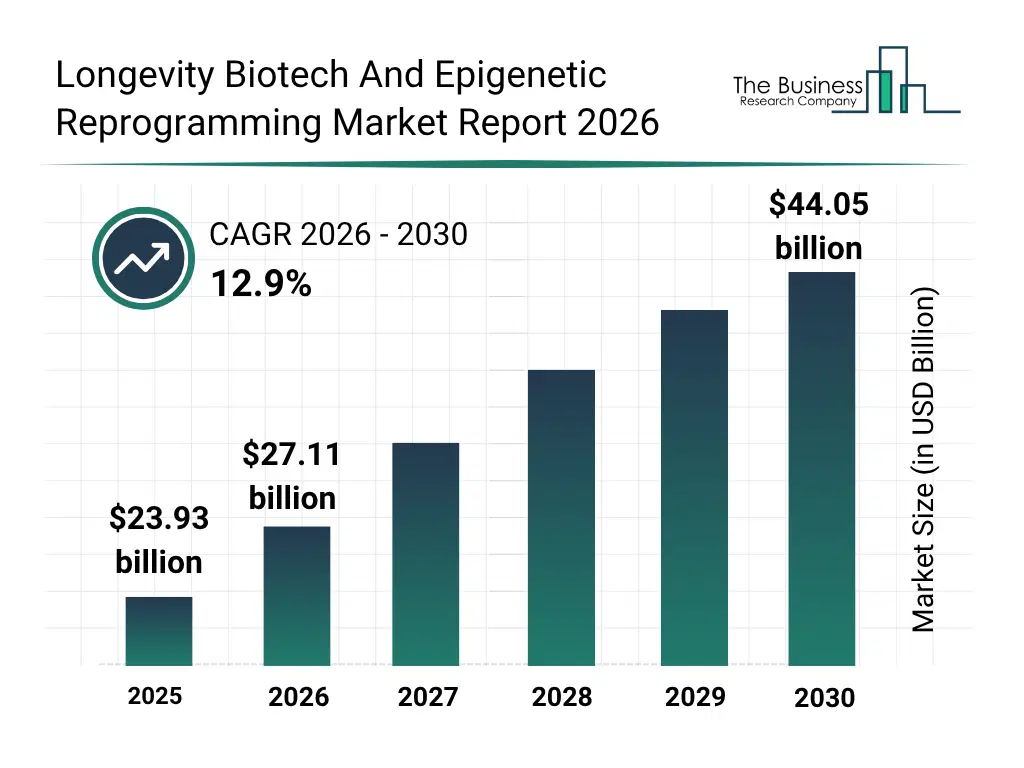
What Is The Longevity Biotech And Epigenetic Reprogramming Market Size and Share 2026?
The longevity biotech and epigenetic reprogramming market size has grown rapidly in recent years. It will grow from $23.93 billion in 2025 to $27.11 billion in 2026 at a compound annual growth rate (CAGR) of 13.3%. The growth in the historic period can be attributed to growth in aging population demographics, increasing investment in regenerative medicine research, expansion of genomic and molecular biology studies, rising prevalence of age-related chronic diseases, growth in venture capital funding for longevity research.What Is The Longevity Biotech And Epigenetic Reprogramming Market Growth Forecast?
The longevity biotech and epigenetic reprogramming market size is expected to see rapid growth in the next few years. It will grow to $44.05 billion in 2030 at a compound annual growth rate (CAGR) of 12.9%. The growth in the forecast period can be attributed to increasing development of personalized anti-aging therapies, rising demand for preventive healthcare solutions, expansion of gene editing technologies, increasing clinical trials for longevity therapeutics, growth in strategic partnerships across biotechnology ecosystems. Major trends in the forecast period include increasing development of partial epigenetic reprogramming therapies, rising focus on senolytic and senomorphic therapeutic approaches, growing investment in stem cell based regenerative interventions, increasing research activities in age-related disease targeting therapies, rising adoption of metabolic intervention strategies for healthy aging.
Global Longevity Biotech And Epigenetic Reprogramming Market Segmentation
1) By Technology Platform: Partial Epigenetic Reprogramming; Senolytics And Senomorphics; Gene Therapy; Stem Cell Therapy; Metabolic Intervention 2) By Therapeutic Focus: Age Related Ocular Disease; Cardiovascular Aging; Neurodegeneration; Musculoskeletal Decline; Metabolic Aging 3) By Delivery Method: In Vivo Therapies; Ex Vivo Therapies; Small Molecule Therapies; Biologic Therapies; Gene Editing Based Therapies; Cell Based Therapies; Other Delivery Methods 4) By Funding Source: Venture Capital; Government (Advanced Research Projects Agency For Health); Philanthropic; Public Markets 5) By End User: Biotechnology Companies; Pharmaceutical Companies; Research Institutes; Academic And Scientific Organizations; Hospitals And Clinics; Contract Research Organizations; Other End Users Subsegments: 1) By Partial Epigenetic Reprogramming: Transient Yamanaka Factor Delivery; Small Molecule Epigenetic Modulators; Messenger Ribonucleic Acid Based Reprogramming; Protein Based Reprogramming; Viral Vector Based Delivery 2) By Senolytics And Senomorphics: Apoptosis Inducing Senolytic Agents; Immune Modulating Senomorphics; Natural Compound Based Senolytic Agents; Targeted Antibody Based Senolytic Therapies; Combination Senescence Targeted Therapies 3) By Gene Therapy: Adeno Associated Virus Based Gene Delivery Systems; Lentiviral Gene Therapy Platforms; Clustered Regularly Interspaced Short Palindromic Repeats Gene Editing Systems; Messenger Ribonucleic Acid Gene Regulation Therapies; Ribonucleic Acid Interference Gene Silencing Approaches 4) By Stem Cell Therapy: Mesenchymal Stem Cell Based Therapy; Induced Pluripotent Stem Cell Based Therapy; Hematopoietic Stem Cell Based Therapy; Exosome Mediated Stem Cell Therapy; Allogeneic And Autologous Stem Cell Based Therapy 5) By Metabolic Intervention: Caloric Restriction Mimetic Compounds; Mitochondrial Function Enhancement Therapies; Nicotinamide Adenine Dinucleotide Boosting Therapies; Adenosine Monophosphate Activated Protein Kinase Activation Therapies; Hormonal And Insulin Sensitization TherapiesWhat Are The Drivers Of The Longevity Biotech And Epigenetic Reprogramming Market?
The rising prevalence of age-related chronic diseases is expected to propel the growth of the longevity biotech and epigenetic reprogramming market going forward. Age-related chronic diseases are long-lasting health conditions such as heart disease, diabetes, arthritis, and dementia that develop or worsen with advancing age due to a gradual decline in body functions. Age-related chronic diseases are increasing due to the long-term accumulation of unhealthy lifestyles, which progressively weaken body systems and raise disease risk with age. Longevity biotech and epigenetic reprogramming may help age-related chronic diseases by modifying gene expression to slow or partially reverse cellular aging, thereby improving tissue function and reducing disease progression. For instance, in December 2025, according to the Australian Institute of Health and Welfare, an Australia-based government agency, in 2024, approximately 425,000 Australians were living with dementia, and this number is projected to increase 2.5 times to over 1.1 million by 2065, including around 662,000 women and 390,000 men. Therefore, the rising prevalence of age-related chronic diseases is driving the growth of the longevity biotech and epigenetic reprogramming industry. The increasing healthcare expenditure is expected to propel the growth of the longevity biotech and epigenetic reprogramming market going forward. Healthcare expenditure is the total spending by governments, organizations, and individuals on medical services, healthcare products, and activities aimed at maintaining or improving health. Healthcare expenditure is increasing due to advancements in medical technology, as the adoption of innovative diagnostic tools, robotic surgeries, and advanced treatment procedures improves patient care but also raises the overall cost of healthcare services. Rising healthcare expenditure supports longevity biotech and epigenetic reprogramming by increasing funding for advanced research, clinical trials, and adoption of high-cost regenerative therapies aimed at slowing or reversing biological aging. For instance, in April 2025, according to the Office for National Statistics, a UK-based independent producer of official statistics, in 2024, the UK’s healthcare spending reached around $ 370.71 billion (£317 billion), reflecting a 6.5% nominal increase compared with 2023. Therefore, the increasing healthcare expenditure is driving the growth of the longevity biotech and epigenetic reprogramming industry.Key Players In The Global Longevity Biotech And Epigenetic Reprogramming Market
Major companies operating in the longevity biotech and epigenetic reprogramming market are Altos Labs Inc.; Retro Biosciences Inc.; NewLimit Inc.; Life Biosciences Inc.; Calico Life Sciences LLC; BioAge Labs Inc.; Juvenescence; Unity Biotechnology; Turn Biotechnologies Inc.; Moonwalk Biosciences; Rejuvenate Bio Inc.; Shift Bioscience Ltd; AgeX Therapeutics Inc.; YouthBio TherapeuticsGlobal Longevity Biotech And Epigenetic Reprogramming Market Trends and Insights
Major companies operating in the longevity biotech and epigenetic reprogramming market are focusing on developing innovative solutions such as an investigational new drug (IND) application to advance first-in-human clinical trials of epigenetic reprogramming therapies aimed at reversing cellular aging and treating age-related chronic diseases. An investigational new drug (IND) application is a regulatory submission that allows a company or researcher to test a new drug in humans by demonstrating initial safety, lab results, and clinical trial plans to the health authority before trials begin. For instance, in January 2026, Life Biosciences, a US-based biotechnology company, received U.S. FDA clearance for its investigational new drug (IND) application for ER-100, the first cellular rejuvenation therapy using partial epigenetic reprogramming to enter human clinical trials. The therapy is being evaluated in a Phase 1 clinical trial for optic neuropathies, including glaucoma and NAION, using controlled expression of Yamanaka factors (OSK) to rejuvenate aged retinal cells. This represents a significant advancement in translating epigenetic reprogramming technologies into human therapeutic applications.Regional Outlook
North America was the largest region in the longevity biotechnology and epigenetic reprogramming market in 2025. Asia-Pacific is expected to be the fastest-growing region in the forecast period. The regions covered in this market report are Asia-Pacific, South East Asia, Western Europe, Eastern Europe, North America, South America, Middle East, Africa. The countries covered in this market report are Australia, Brazil, China, France, Germany, India, Indonesia, Japan, Taiwan, Russia, South Korea, UK, USA, Canada, Italy, Spain.What Defines the Longevity Biotech And Epigenetic Reprogramming Market?
The longevity biotechnology and epigenetic reprogramming market consists of revenues earned by entities by providing services such as epigenetic age testing and biological age assessment, cellular rejuvenation therapy development, and gene therapy-based anti-aging solutions. The market value includes the value of related goods sold by the service provider or included within the service offering. The longevity biotechnology and epigenetic reprogramming market also includes sales of cellular reprogramming kits, epigenetic biomarker testing kits, and senolytic drugs. Values in this market are ‘factory gate’ values, that is, the value of goods sold by the manufacturers or creators of the goods, whether to other entities (including downstream manufacturers, wholesalers, distributors, and retailers) or directly to end customers. The value of goods in this market includes related services sold by the creators of the goods.How is Market Value Defined and Measured?
The market value is defined as the revenues that enterprises gain from the sale of goods and/or services within the specified market and geography through sales, grants, or donations in terms of the currency (in USD unless otherwise specified). The revenues for a specified geography are consumption values that are revenues generated by organizations in the specified geography within the market, irrespective of where they are produced. It does not include revenues from resales along the supply chain, either further along the supply chain or as part of other products.What Key Data and Analysis Are Included in the Longevity Biotech And Epigenetic Reprogramming Market Report 2026?
The longevity biotech and epigenetic reprogramming market research report is one of a series of new reports from The Business Research Company that provides market statistics, including industry global market size, regional shares, competitors with the market share, detailed market segments, market trends and opportunities, and any further data you may need to thrive in the longevity biotech and epigenetic reprogramming industry. The market research report delivers a complete perspective of everything you need, with an in-depth analysis of the current and future state of the industry.Longevity Biotech And Epigenetic Reprogramming Market Report Forecast Analysis
| Report Attribute | Details |
|---|---|
| Market Size Value In 2026 | $27.11 billion |
| Revenue Forecast In 2030 | $44.05 billion |
| Growth Rate | CAGR of 12.9% from 2026 to 2030 |
| Base Year For Estimation | 2025 |
| Actual Estimates/Historical Data | 2020-2025 |
| Forecast Period | 2026 - 2030 |
| Market Representation | Revenue in USD Billion and CAGR from 2026 to 2030 |
| Segments Covered | Technology Platform, Therapeutic Focus, Delivery Method, Funding Source, End User |
| Regional Scope | Asia-Pacific, Western Europe, Eastern Europe, North America, South America, Middle East, Africa |
| Country Scope | The countries covered in the report are Australia, Brazil, China, France, Germany, India, ... |
| Key Companies Profiled | Altos Labs Inc.; Retro Biosciences Inc.; NewLimit Inc.; Life Biosciences Inc.; Calico Life Sciences LLC; BioAge Labs Inc.; Juvenescence; Unity Biotechnology; Turn Biotechnologies Inc.; Moonwalk Biosciences; Rejuvenate Bio Inc.; Shift Bioscience Ltd; AgeX Therapeutics Inc.; YouthBio Therapeutics |
| Customization Scope | Request for Customization |
| Pricing And Purchase Options | Explore Purchase Options |