
Low-Altitude Economy Air Management System Market Report 2026
Global Outlook – By Component (Hardware, Services, Software), By Product Type (Urban Air Mobility Systems, Drone Delivery Systems, Environmental Monitoring Systems), By Technology (Artificial Intelligent And Machine Learning, Battery Technology, Navigation Systems), By Application (Tourism, Logistics, Medical, Inspection, Other Applications), By End-User (Commercial, Government, Industrial, Military) – Market Size, Trends, Strategies, and Forecast to 2030
Low-Altitude Economy Air Management System Market Overview
• Low-Altitude Economy Air Management System market size has reached to $3.34 billion in 2025 • Expected to grow to $7.47 billion in 2030 at a compound annual growth rate (CAGR) of 17.4% • Growth Driver: The Rise In Autonomous Aerial Vehicles Driving The Growth Of The Market Due To Increasing Urban Air Mobility Demand • Market Trend: Strategic Partnerships Drive Safer And More Efficient Urban Air Mobility Solutions • North America was the largest region in 2025 and Asia-Pacific is the fastest growing region.What Is Covered Under Low-Altitude Economy Air Management System Market?
The low-altitude economy air management system refers to a technological framework designed to efficiently manage and optimize air traffic, logistics, and operations for low-altitude aircraft. It integrates real-time data, automated routing, and safety protocols to enhance operational efficiency, reduce congestion, and minimize risks in low-altitude airspace. The main components of the low-altitude economy air management system are hardware, services, and software. Hardware refers to the physical devices and equipment used to monitor, manage, and safely coordinate low-altitude air traffic. The product types include urban air mobility systems, drone delivery systems, and environmental monitoring systems, which leverage advanced technologies such as artificial intelligence and machine learning, battery technology, and navigation systems. It is applicable in a wide range of applications, including tourism, logistics, medical, inspection, and others, and caters to various end users such as commercial, government, industrial, and military.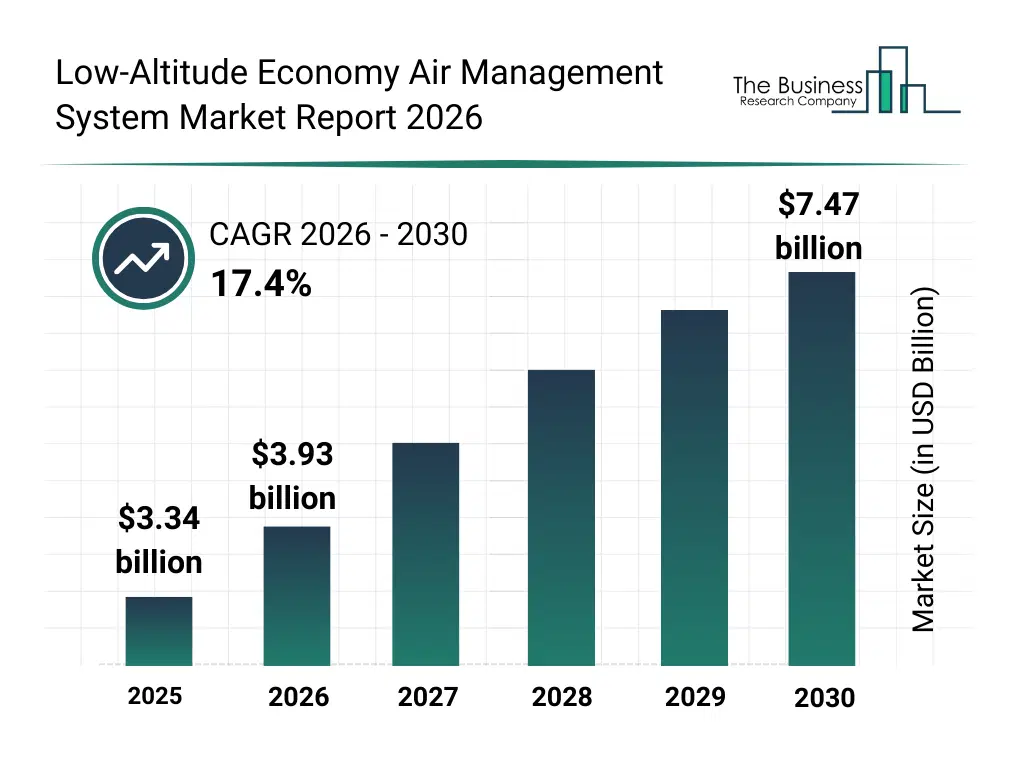
What Is The Low-Altitude Economy Air Management System Market Size and Share 2026?
The low-altitude economy air management system market size has grown rapidly in recent years. It will grow from $3.34 billion in 2025 to $3.93 billion in 2026 at a compound annual growth rate (CAGR) of 17.7%. The growth in the historic period can be attributed to emergence of commercial drones, rise in UAV deployments, smart city airspace planning, early unmanned traffic systems, regulatory pilots.What Is The Low-Altitude Economy Air Management System Market Growth Forecast?
The low-altitude economy air management system market size is expected to see rapid growth in the next few years. It will grow to $7.47 billion in 2030 at a compound annual growth rate (CAGR) of 17.4%. The growth in the forecast period can be attributed to expansion of urban air mobility, growth in drone delivery services, ai-enabled traffic optimization, low-altitude regulation frameworks, smart infrastructure investments. Major trends in the forecast period include development of urban air mobility management platforms, integration of automated airspace control, growth of drone traffic management, adoption of AI-based routing systems, expansion of low-altitude logistics.
Global Low-Altitude Economy Air Management System Market Segmentation
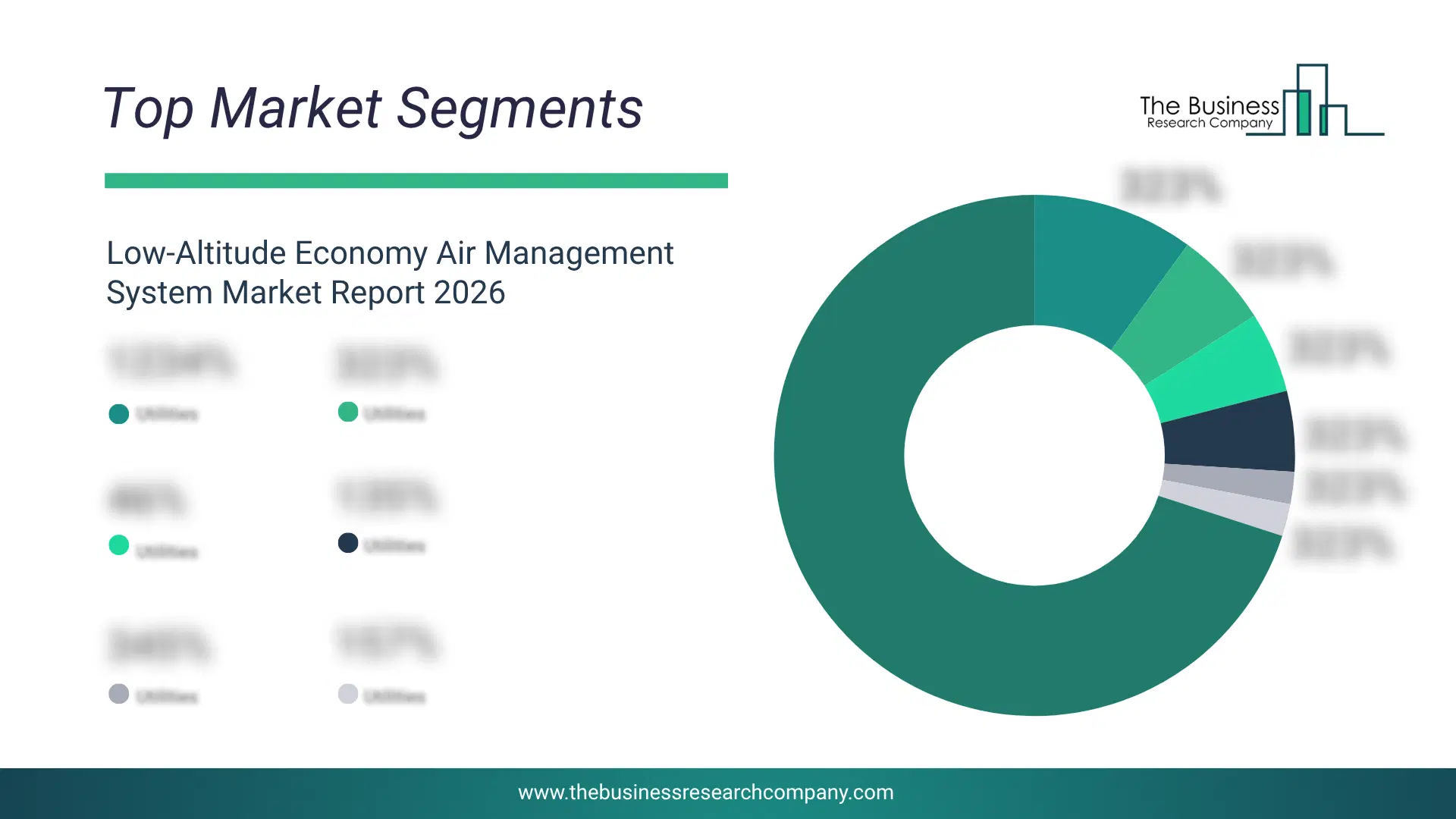
1) By Component: Hardware, Services, Software 2) By Product Type: Urban Air Mobility Systems, Drone Delivery Systems, Environmental Monitoring Systems 3) By Technology: Artificial Intelligent And Machine Learning, Battery Technology, Navigation Systems 4) By Application: Tourism, Logistics, Medical, Inspection, Other Applications 5) By End-User: Commercial, Government, Industrial, Military Subsegments: 1) By Hardware: Communication Equipment, Navigation Equipment, Surveillance Equipment, Control Systems, Power Supply Units 2) By Services: Consulting Services, Integration Services, Maintenance And Support Services, Training Services, System Upgrades 3) By Software: Air Traffic Management Software, Flight Planning Software, Unmanned Aerial Vehicle Traffic Management Software, Simulation And Modeling Software, Data Analytics And Monitoring SoftwareWhat Is The Driver Of The Low-Altitude Economy Air Management System Market?
The rising autonomous aerial vehicles are expected to propel the growth of the low-altitude economy air management system market going forward. Autonomous Aerial Vehicles are aircraft that navigate and operate independently using onboard systems without the need for human control. The adoption of autonomous aerial vehicles is rising due to growing demand for urban air mobility, providing efficient, low-altitude transportation solutions for congested urban environments. The low-altitude economy air management system ensures safe and efficient operation of autonomous aerial vehicles by delivering real-time traffic coordination, obstacle avoidance, and optimized routing in busy urban airspace. For instance, in June 2025, according to the Ministry of Defence, a UK-based government ministry, the UK is investing a record $407.09 million (£350 million) to boost Ukraine’s drone supply, aiming to increase the number from 10,000 in 2024 to 100,000. Therefore, the rising autonomous aerial vehicles are driving the growth of the low-altitude economy air management system industry.Key Players In The Global Low-Altitude Economy Air Management System Market
Major companies operating in the low-altitude economy air management system market report include Collins Aerospace, Thales S.A., L3Harris Technologies Inc., Leonardo S.p.A., Mosaic ATM Inc., Indra Sistemas S.A., Diehl Aviation GmbH, Frequentis AG, Lilium GmbH, Skydio Inc., NSFOCUS Global Inc., Eve Air Mobility, Wisk Aero LLC, Aloft AI Inc., EHang Holdings Limited., Terra Drone Corporation, Altitude Angel Ltd., ANRA Technologies Inc., Joby Aviation Inc., XPeng Aerospace Technology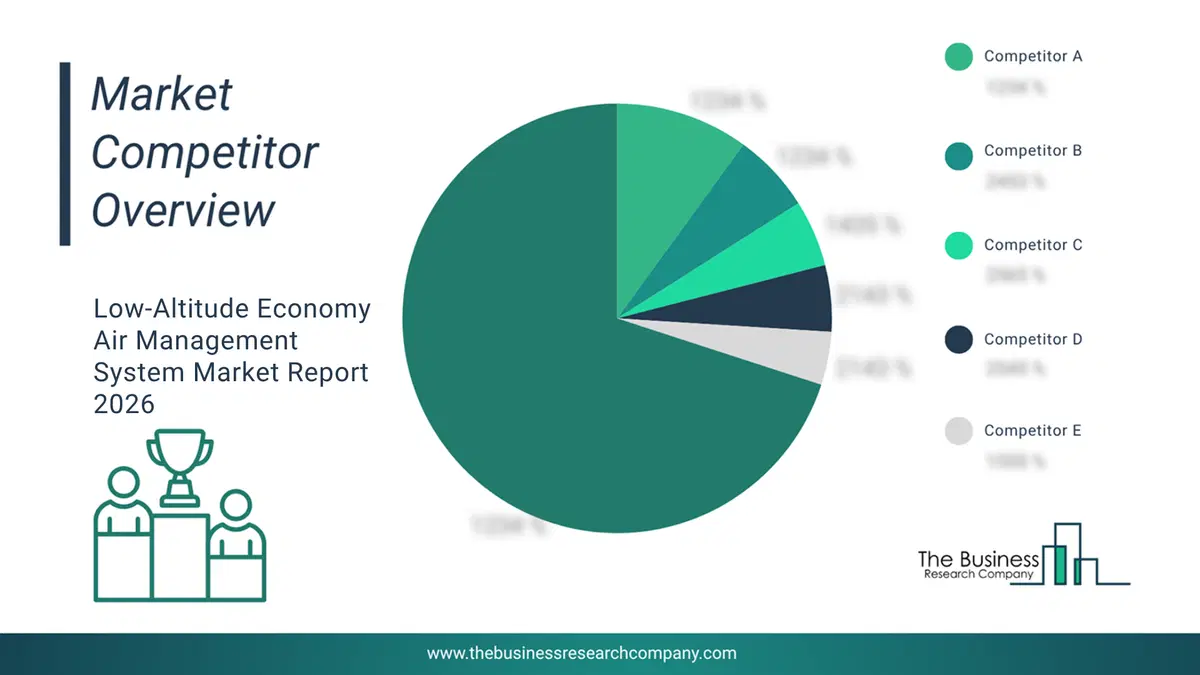
This chart is for illustrative purposes; the full report includes a detailed competitor analysis and comprehensive overview of the top 10 companies in the market.
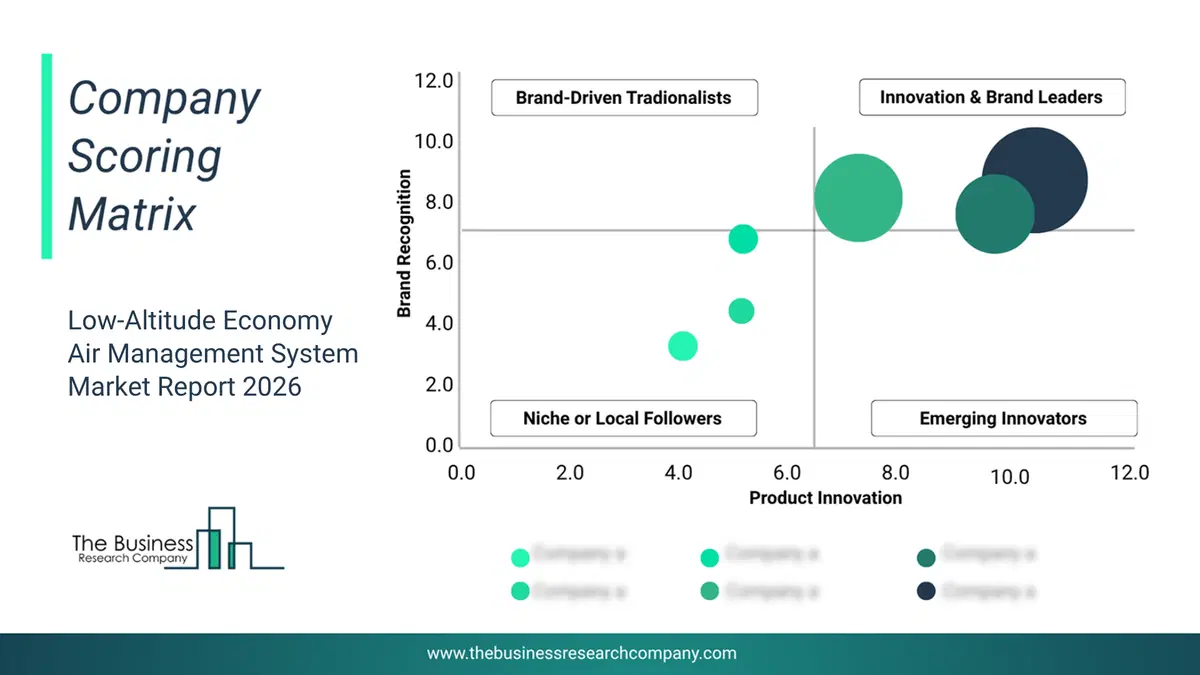
This chart maps companies by product innovation and brand strength, with bubble size indicating relative revenue, helping identify market leaders, challengers, and niche players. This is an illustrative chart; the full report provides a complete and accurate competitive analysis.
Global Low-Altitude Economy Air Management System Market Trends and Insights
Major companies operating in the low-altitude economy air management system market are focusing on adopting strategic partnerships to develop integrated air traffic management solutions for safer and more efficient low-altitude operations. Strategic partnerships propel the growth of the low-altitude economy air management system market by enabling technology sharing, joint research and development, and streamlined regulatory compliance, ultimately accelerating the deployment of advanced air traffic management solutions. For instance, in July 2025, EHang Holdings Limited, a China-based aircraft business company, partnered with Minth Group Ltd., a China-based auto parts company, to co-develop high-safety airframe systems for EHang’s eVTOL aircraft. The collaboration aims to enhance the structural integrity and safety of eVTOL vehicles, which are essential for their widespread adoption in urban environments. The partnership also includes plans to showcase the practical use of eVTOL aircraft in low-altitude cultural tourism scenarios, demonstrating their potential in real-world applications. This initiative underscores the industry's commitment to advancing eVTOL technology and integrating it into the broader low-altitude economy.What Are Latest Mergers And Acquisitions In The Low-Altitude Economy Air Management System Market?
In March 2024, Thales SA, a France-based aerospace company, acquired AstraUTM for an undisclosed amount. With this acquisition, Thales SA aims to create a scalable digital traffic management platform that leverages advanced technologies such as artificial intelligence and big data to ensure safer and more efficient drone operations and airspace management in urban and regional areas. AstraUTM is a UAE-based company that offers a drone traffic management system.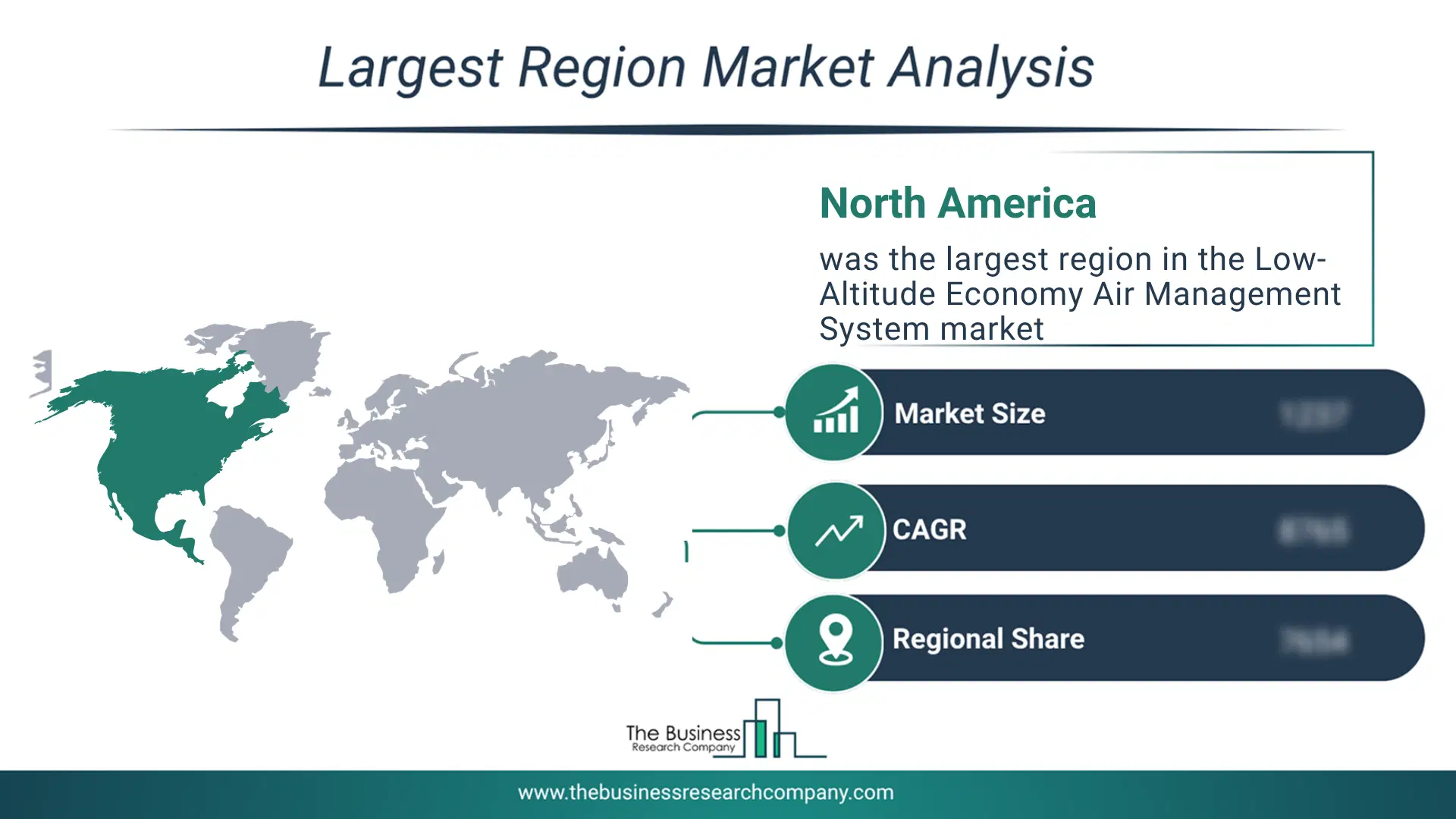
Regional Outlook
North America was the largest region in the low-altitude economy air management system market in 2025. Asia-Pacific is expected to be the fastest-growing region in the forecast period. The regions covered in this market report include Asia-Pacific, South East Asia, Western Europe, Eastern Europe, North America, South America, Middle East, Africa. The countries covered in this market report include Australia, Brazil, China, France, Germany, India, Indonesia, Japan, Taiwan, Russia, South Korea, UK, USA, Canada, Italy, SpainWhat Defines the Low-Altitude Economy Air Management System Market?
The low-altitude economy air management system market consists of revenues earned by entities by providing services such as traffic monitoring, flight path planning, collision avoidance, communication and navigation support, and regulatory compliance assistance. The market value includes the value of related goods sold by the service provider or included within the service offering. The low-altitude economy air management system market also includes sales of surveillance and security systems, infrastructure inspection systems, agricultural monitoring systems, disaster management systems, and search and rescue systems. Values in this market are ‘factory gate’ values, that is, the value of goods sold by the manufacturers or creators of the goods, whether to other entities (including downstream manufacturers, wholesalers, distributors, and retailers) or directly to end customers. The value of goods in this market includes related services sold by the creators of the goods.How is Market Value Defined and Measured?
The market value is defined as the revenues that enterprises gain from the sale of goods and/or services within the specified market and geography through sales, grants, or donations in terms of the currency (in USD unless otherwise specified). The revenues for a specified geography are consumption values that are revenues generated by organizations in the specified geography within the market, irrespective of where they are produced. It does not include revenues from resales along the supply chain, either further along the supply chain or as part of other products.
This chart presents market attractiveness based on a quantitative evaluation of growth, competition, strategic alignment, and risk, offering a clear view of opportunity areas for decision-making. This chart is for illustrative purposes; the full report contains the complete analysis.

This chart highlights the Total Addressable Market (TAM) by estimating the maximum revenue opportunity using an assumption-driven approach, supporting strategic planning and opportunity sizing across markets. The chart is illustrative; the full report provides a more comprehensive analysis.
What Key Data and Analysis Are Included in the Low-Altitude Economy Air Management System Market Report 2026?
The low-altitude economy air management system market research report is one of a series of new reports from The Business Research Company that provides market statistics, including industry global market size, regional shares, competitors with the market share, detailed market segments, market trends and opportunities, and any further data you may need to thrive in the low-altitude economy air management system industry. The market research report delivers a complete perspective of everything you need, with an in-depth analysis of the current and future state of the industry.Low-Altitude Economy Air Management System Market Report Forecast Analysis
| Report Attribute | Details |
|---|---|
| Market Size Value In 2026 | $3.93 billion |
| Revenue Forecast In 2030 | $7.47 billion |
| Growth Rate | CAGR of 17.7% from 2026 to 2030 |
| Base Year For Estimation | 2025 |
| Actual Estimates/Historical Data | 2020-2025 |
| Forecast Period | 2026 - 2030 - 2030 |
| Market Representation | Revenue in USD Billion and CAGR from 2026 to 2030 |
| Segments Covered | Component, Product Type, Technology, Application, End-User |
| Regional Scope | Asia-Pacific, Western Europe, Eastern Europe, North America, South America, Middle East, Africa |
| Country Scope | The countries covered in the report are Australia, Brazil, China, France, Germany, India, Indonesia, Japan, Taiwan, Russia, South Korea, UK, USA, Canada, Italy, Spain. |
| Key Companies Profiled | Collins Aerospace, Thales S.A., L3Harris Technologies Inc., Leonardo S.p.A., Mosaic ATM Inc., Indra Sistemas S.A., Diehl Aviation GmbH, Frequentis AG, Lilium GmbH, Skydio Inc., NSFOCUS Global Inc., Eve Air Mobility, Wisk Aero LLC, Aloft AI Inc., EHang Holdings Limited., Terra Drone Corporation, Altitude Angel Ltd., ANRA Technologies Inc., Joby Aviation Inc., XPeng Aerospace Technology |
| Customization Scope | Request for Customization |
| Pricing And Purchase Options | Explore Purchase Options |