

Low-Altitude Infrastructure Market Report 2026
Global Outlook – By Type (Low-Altitude Physical Infrastructure, Low-Altitude Air Management System), By Technology (Artificial Intelligence-Powered Navigation, Solar-Powered Charging, Global Positioning System And Communication Systems, Cybersecurity Solutions), By Application (Tourism, Logistics, Medical, Inspection, Other Applications), By Distribution Channel (Direct Sales, Distributors, Online Platforms), By End-User (Government, Commercial Enterprises, Logistics Companies, Agriculture Sector, Emergency Services) – Market Size, Trends, Strategies, and Forecast to 2030
Low-Altitude Infrastructure Market Overview
• Low-Altitude Infrastructure market size has reached to $0.3 billion in 2025 • Expected to grow to $0.93 billion in 2030 at a compound annual growth rate (CAGR) of 25.1% • Growth Driver: Growing Investment In Urban Air Mobility Driving The Market Growth Due To Rising Infrastructure Development • Market Trend: Next-Generation 3D Mapping Unlocks The Future Of Urban Air Mobility • North America was the largest region and fastest growing region.What Is Covered Under Low-Altitude Infrastructure Market?
Low-altitude infrastructure refers to facilities, systems, and networks that support the operation of aircraft, drones, and other aerial vehicles flying below approximately 1,000 feet. It ensures safe navigation, communication, and traffic management in busy airspaces. This infrastructure facilitates efficient urban air mobility, drone deliveries, and emergency response services while reducing the risk of collisions and operational delays. The main types of low-altitude infrastructure are low-altitude physical infrastructure and low-altitude air management systems. Low-altitude physical infrastructure refers to the network of ground-based facilities and structures, such as vertiports, landing pads, charging stations, and maintenance facilities, that support the operation, storage, and servicing of low-altitude aerial vehicles. These infrastructures integrate advanced technologies, including artificial intelligence-powered navigation, solar-powered charging, global positioning systems and communication systems, and cybersecurity solutions for a wide range of applications, including tourism, logistics, medical, inspection, and others. It is distributed through several distribution channels, such as direct sales, distributors, and online platforms, and caters to diverse end-users, including government, commercial enterprises, logistics companies, the agriculture sector, and emergency services.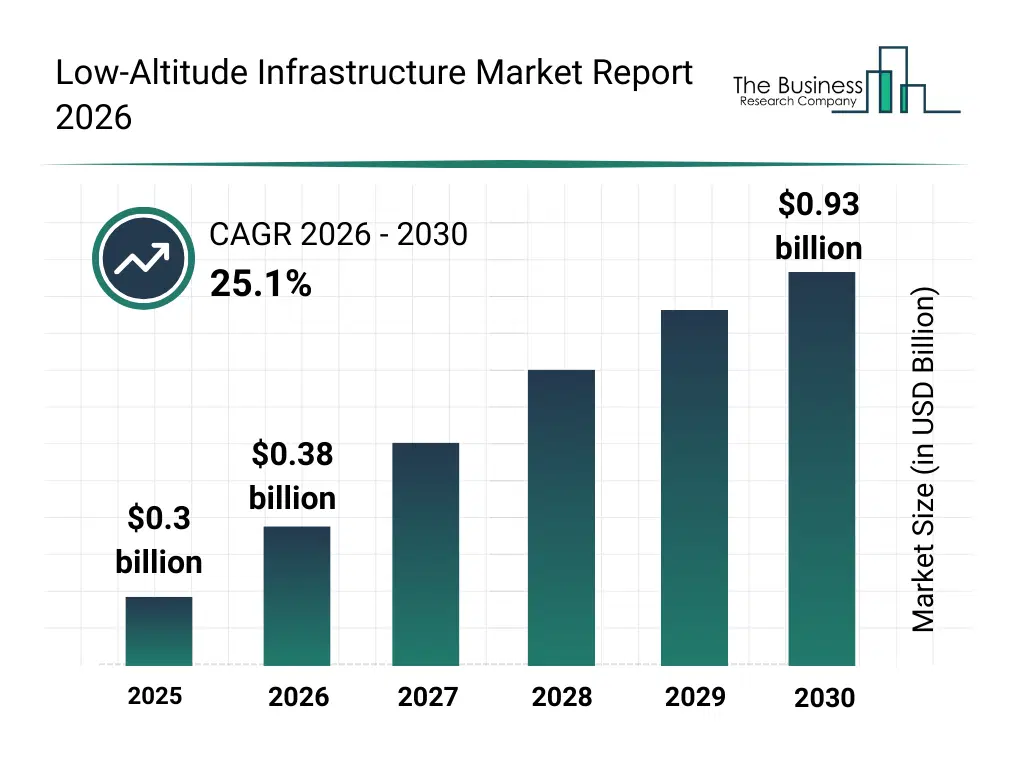
What Is The Low-Altitude Infrastructure Market Size and Share 2026?
The low-altitude infrastructure market size has grown exponentially in recent years. It will grow from $0.3 billion in 2025 to $0.38 billion in 2026 at a compound annual growth rate (CAGR) of 26.7%. The growth in the historic period can be attributed to rising adoption of low-altitude infrastructure for drones, increasing use in urban air mobility, growing deployment in logistics and delivery, expansion of air traffic management systems, rising demand for drone navigation and safety solutions.What Is The Low-Altitude Infrastructure Market Growth Forecast?
The low-altitude infrastructure market size is expected to see exponential growth in the next few years. It will grow to $0.93 billion in 2030 at a compound annual growth rate (CAGR) of 25.1%. The growth in the forecast period can be attributed to development of AI-powered navigation, expansion of solar-powered charging infrastructure, growth in GPS and communication system deployment, rising adoption of cybersecurity solutions, integration of IoT-enabled monitoring and management platforms. Major trends in the forecast period include integration of AI-powered air traffic management systems, deployment of IOT-based low-altitude vehicle monitoring, expansion of drone fleet operation services, implementation of real-time data analytics and monitoring platforms, development of sustainable low-altitude infrastructure solutions.
Global Low-Altitude Infrastructure Market Segmentation
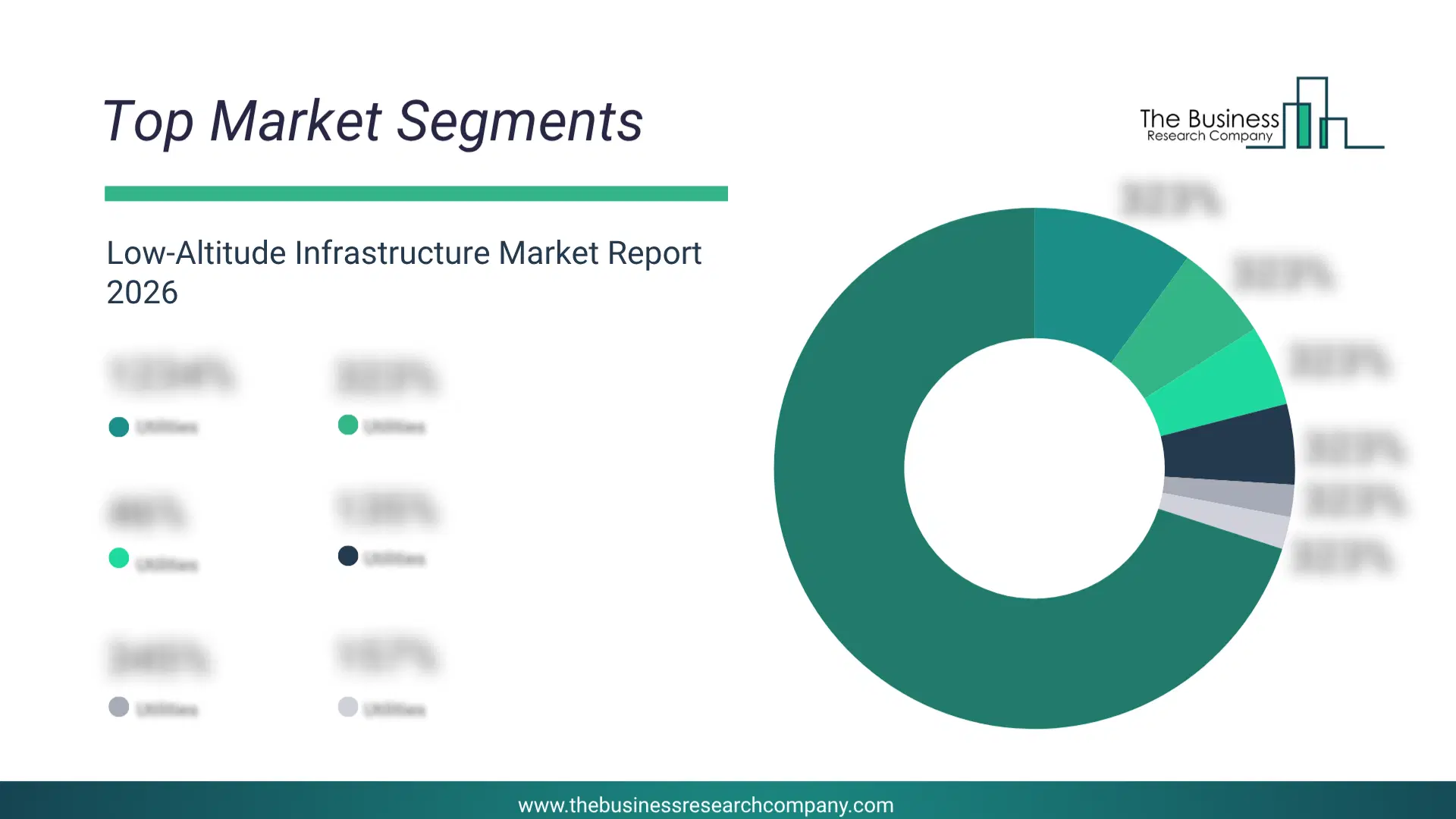
1) By Type: Low-Altitude Physical Infrastructure, Low-Altitude Air Management System 2) By Technology: Artificial Intelligence-Powered Navigation, Solar-Powered Charging, Global Positioning System And Communication Systems, Cybersecurity Solutions 3) By Application: Tourism, Logistics, Medical, Inspection, Other Applications 4) By Distribution Channel: Direct Sales, Distributors, Online Platforms 5) By End-User: Government, Commercial Enterprises, Logistics Companies, Agriculture Sector, Emergency Services Subsegments: 1) By Low-Altitude Physical Infrastructure: Vertiports, Charging Stations, Landing Pads, Maintenance Facilities 2) By Low-Altitude Air Management System: Traffic Monitoring Systems, Navigation Platforms, Collision Avoidance Systems, Communication NetworksWhat Is The Driver Of The Low-Altitude Infrastructure Market?
The growing investment in urban air mobility is expected to propel the growth of the low-altitude infrastructure market going forward. Urban air mobility investment involves financing the creation of aerial transport systems to improve efficient, low-altitude urban travel and connectivity. Investment in urban air mobility is increasing as cities seek faster, more efficient transportation solutions to cut travel time, alleviate traffic congestion, reduce emissions, and promote smart, sustainable urban development. Investment in urban air mobility strengthens low-altitude infrastructure by linking aerial transit with existing ground networks, boosting connectivity, efficiency, and accessibility in crowded areas while easing congestion and supporting smart city growth and faster movement of people and goods. For instance, in June 2025, according to the UK Ministry of Defence, a UK-based government department, the UK is investing a record $473 million(£350 million) to boost Ukraine’s drone supply, aiming to increase the number of drones provided from 10,000 in 2024 to 100,000 in 2025. Therefore, the growing investment in urban air mobility is driving the growth of the low-altitude infrastructure industry.Key Players In The Global Low-Altitude Infrastructure Market
Major companies operating in the low-altitude infrastructure market are Raytheon Technologies Corporation, Airbus SE, Thales S.A., L3Harris Technologies Inc., Leonardo S.p.A, Elbit Systems Ltd., Saab AB, Indra Sistemas, S.A., Rafael Advanced Defense Systems Ltd., Sichuan Jiuzhou Electric Group Co. Ltd., Lilium GmbH, Unifly NV, Airspace Link Inc., EHang Holdings Limited., Altitude Angel Ltd., ANRA Technologies Inc., Vizzbee Robotic Solutions Private Limited., Shanghai Volant Aviation Technology Co. Ltd., Joby Aviation Inc., AutoNavi Software Co. Ltd.
This chart is for illustrative purposes; the full report includes a detailed competitor analysis and comprehensive overview of the top 10 companies in the market.
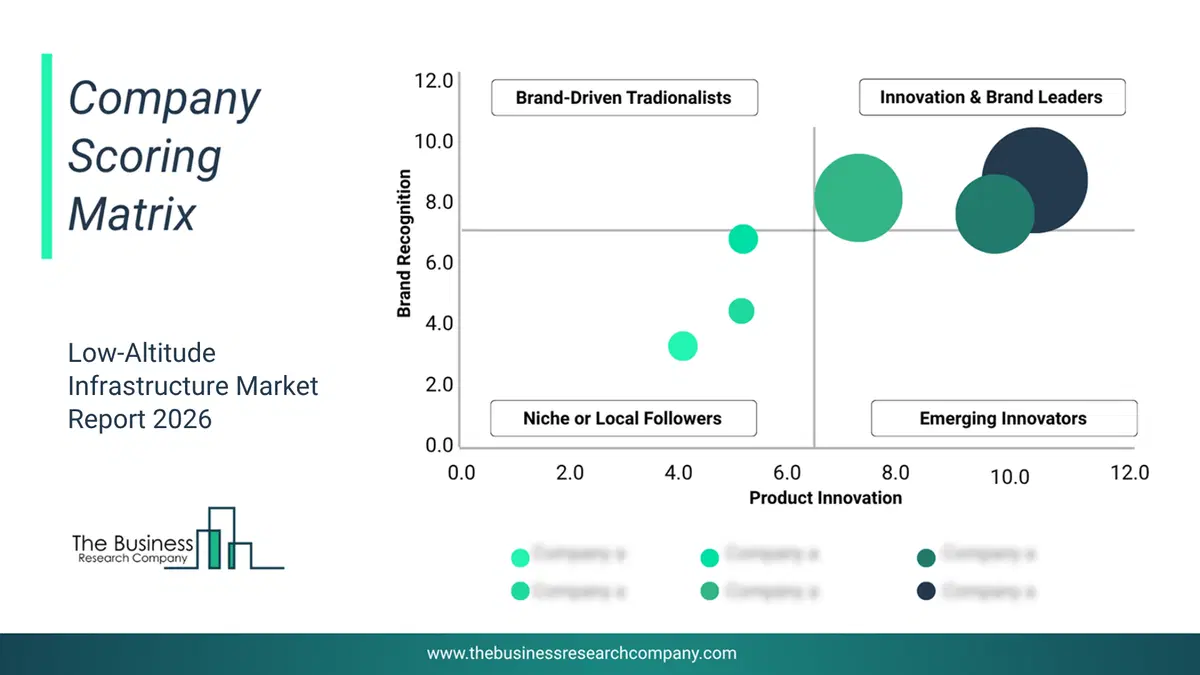
This chart maps companies by product innovation and brand strength, with bubble size indicating relative revenue, helping identify market leaders, challengers, and niche players. This is an illustrative chart; the full report provides a complete and accurate competitive analysis.
Global Low-Altitude Infrastructure Market Trends and Insights
Major companies operating in the low-altitude infrastructure market are focusing on developing advanced technology, such as 3D digital mapping, to enhance navigation accuracy and support autonomous aerial operations. 3D digital mapping is the technology and process of creating three-dimensional digital models of real-world objects, environments, or terrain by capturing, processing, and interpreting spatial data. For instance, in July 2025, Amap, a China-based navigation company, launched Air Amap, a low-altitude navigation product in Shenzhen’s Longgang District. It integrates 3D digital mapping and a temporal-spatial base to provide precise, real-time navigation for drones and aerial vehicles. This is an important step toward building smart airspace infrastructure for urban mobility. The platform enhances flight safety and spatial coordination in low-altitude environments.What Are Latest Mergers And Acquisitions In The Low-Altitude Infrastructure Market?
In September 2024, eVertiSKY Corp., a US-based company specializing in urban air mobility (UAM) infrastructure and operations, acquired Volatus Infrastructure & Energy Solutions for an undisclosed amount. With this acquisition, eVertiSKY Corp aims to enhance its integrated, sustainable urban air mobility infrastructure by combining vertiport development and dual-use charging solutions for both eVTOL aircraft and ground electric vehicles. Volatus Infrastructure & Energy Solutions is a US-based company that develops vertiports and charging stations for eVTOL aircraft.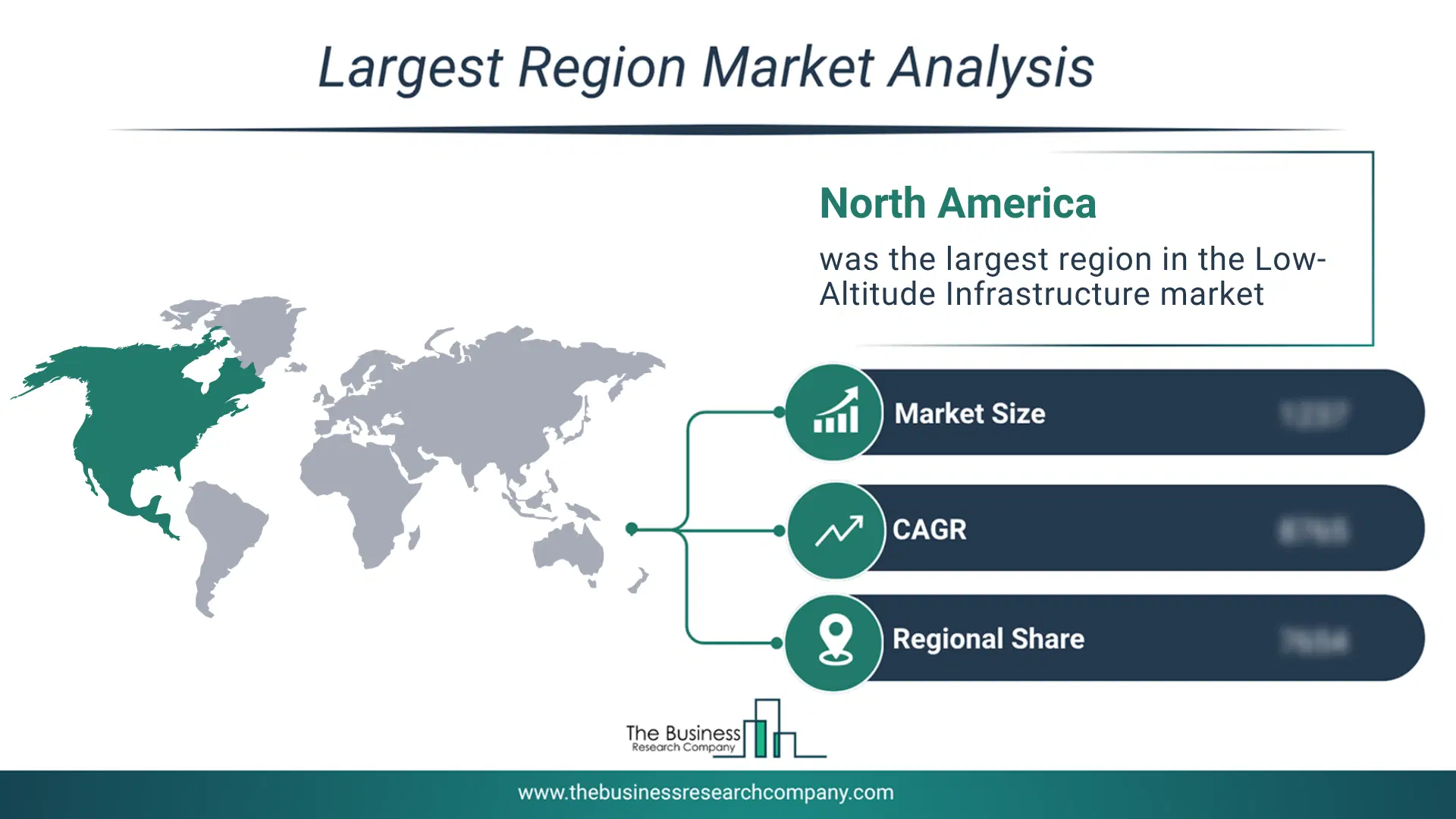
Regional Insights
North America was the largest region in the low-altitude infrastructure market in 2025. Asia-Pacific is expected to be the fastest-growing region in the forecast period. The regions covered in this market report are Asia-Pacific, South East Asia, Western Europe, Eastern Europe, North America, South America, Middle East, Africa. The countries covered in this market report are Australia, Brazil, China, France, Germany, India, Indonesia, Japan, Taiwan, Russia, South Korea, UK, USA, Canada, Italy, Spain.What Defines the Low-Altitude Infrastructure Market?
The low-altitude infrastructure market consists of revenues earned by entities by providing services such as maintenance and repair services, air traffic management services, drone fleet operation services, data analytics and monitoring services, pilot training and certification services. The market value includes the value of related goods sold by the service provider or included within the service offering. The low-altitude infrastructure market also includes sales of maintenance tools, communication terminals, propulsion systems, flight control software, and diagnostic tools. Values in this market are ‘factory gate’ values, that is, the value of goods sold by the manufacturers or creators of the goods, whether to other entities (including downstream manufacturers, wholesalers, distributors, and retailers) or directly to end customers. The value of goods in this market includes related services sold by the creators of the goods.How is Market Value Defined and Measured?
The market value is defined as the revenues that enterprises gain from the sale of goods and/or services within the specified market and geography through sales, grants, or donations in terms of the currency (in USD unless otherwise specified). The revenues for a specified geography are consumption values that are revenues generated by organizations in the specified geography within the market, irrespective of where they are produced. It does not include revenues from resales along the supply chain, either further along the supply chain or as part of other products.
This chart presents market attractiveness based on a quantitative evaluation of growth, competition, strategic alignment, and risk, offering a clear view of opportunity areas for decision-making. This chart is for illustrative purposes; the full report contains the complete analysis.

This chart highlights the Total Addressable Market (TAM) by estimating the maximum revenue opportunity using an assumption-driven approach, supporting strategic planning and opportunity sizing across markets. The chart is illustrative; the full report provides a more comprehensive analysis.
What Key Data and Analysis Are Included in theLow-Altitude Infrastructure Market Report 2026?
The low-altitude infrastructure market research report is one of a series of new reports from The Business Research Company that provides market statistics, including industry global market size, regional shares, competitors with the market share, detailed market segments, market trends and opportunities, and any further data you may need to thrive in the low-altitude infrastructure industry. The market research report delivers a complete perspective of everything you need, with an in-depth analysis of the current and future state of the industry.Low-Altitude Infrastructure Market Report Forecast Analysis
| Report Attribute | Details |
|---|---|
| Market Size Value In 2026 | $0.38 billion |
| Revenue Forecast In 2030 | $0.93 billion |
| Growth Rate | CAGR of 26.7% from 2026 to 2030 |
| Base Year For Estimation | 2025 |
| Actual Estimates/Historical Data | 2020-2025 |
| Forecast Period | 2026 - 2030 |
| Market Representation | Revenue in USD Billion and CAGR from 2026 to 2030 |
| Segments Covered | Type, Technology, Application, Distribution Channel, End-User |
| Regional Scope | Asia-Pacific, Western Europe, Eastern Europe, North America, South America, Middle East, Africa |
| Country Scope | The countries covered in this market report are Australia, Brazil, China, France, Germany, India, Indonesia, Japan, Taiwan, Russia, South Korea, UK, USA, Canada, Italy, Spain |
| Key Companies Profiled | Raytheon Technologies Corporation, Airbus SE, Thales S.A., L3Harris Technologies Inc., Leonardo S.p.A, Elbit Systems Ltd., Saab AB, Indra Sistemas, S.A., Rafael Advanced Defense Systems Ltd., Sichuan Jiuzhou Electric Group Co. Ltd., Lilium GmbH, Unifly NV, Airspace Link Inc., EHang Holdings Limited., Altitude Angel Ltd., ANRA Technologies Inc., Vizzbee Robotic Solutions Private Limited., Shanghai Volant Aviation Technology Co. Ltd., Joby Aviation Inc., AutoNavi Software Co. Ltd. |
| Customization Scope | Request for Customization |
| Pricing And Purchase Options | Explore Purchase Options |