
Low Carbon Buildings Market Report 2026
Global Outlook – By Type (Low-Carbon Concrete, Mass Timber, Sustainable Steel ), By Material (Low-Carbon Cement & Concrete, Engineered Wood (Mass Timber), Recycled Steel, Low-Carbon Steel ), By Application (Commercial, Residential, Industrial ) – Market Size, Trends, Strategies, and Forecast to 2030
Low Carbon Buildings Market Overview
• Low Carbon Buildings market size has reached to $620.87 billion in 2025 • Expected to grow to $1104.9 billion in 2030 at a compound annual growth rate (CAGR) of 12.2% • Growth Driver: Increasing Awareness Of Climate Change Fueling The Growth Of The Market Due To Demand For Sustainability And Energy Efficiency • Market Trend: Advancing Decarbonization Through Strategic Partnerships In Sustainable Building • Europe was the largest region and fastest growing region.What Is Covered Under Low Carbon Buildings Market?
Low-carbon buildings are structures designed and constructed to minimize their carbon emissions throughout their lifecycle, from design and construction to operation and demolition. These buildings are designed to be energy-efficient and incorporate sustainable practices, materials, and technologies that significantly reduce the carbon footprint associated with heating, cooling, lighting, and other energy uses. The main types of low carbon buildings include low-carbon concrete, mass timber, and sustainable steel. Low-carbon concrete is designed to reduce carbon emissions during production and construction. Different materials used are low-carbon cement and concrete, engineered wood (mass timber), recycled steel, and low-carbon steel, and they are used by several applications such as commercial, residential, and industrial.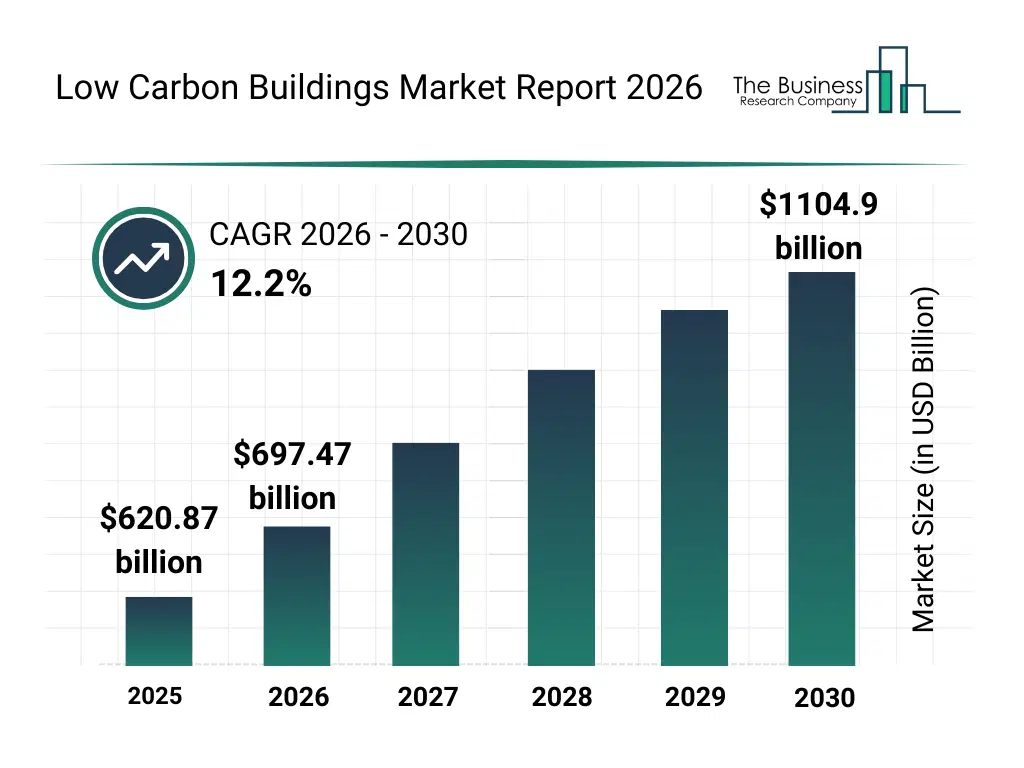
What Is The Low Carbon Buildings Market Size and Share 2026?
The low carbon buildings market size has grown rapidly in recent years. It will grow from $620.87 billion in 2025 to $697.47 billion in 2026 at a compound annual growth rate (CAGR) of 12.3%. The growth in the historic period can be attributed to increasing emphasis on energy-efficient construction, early adoption of low-carbon building materials, rising demand for green-certified structures, growth in corporate sustainability commitments, increased investment in carbon-reduction technologies.What Is The Low Carbon Buildings Market Growth Forecast?
The low carbon buildings market size is expected to see rapid growth in the next few years. It will grow to $1104.9 billion in 2030 at a compound annual growth rate (CAGR) of 12.2%. The growth in the forecast period can be attributed to increasing integration of renewable building systems, rising adoption of circular-economy construction materials, development of ultra-low-carbon concrete, expansion of large-scale green infrastructure, growth in AI-driven building energy optimization. Major trends in the forecast period include rising use of low-emission building materials, growth in green-certified construction, expansion of energy-efficient architectural design, increased adoption of renewable building systems, higher demand for carbon-neutral construction technologies.
Global Low Carbon Buildings Market Segmentation
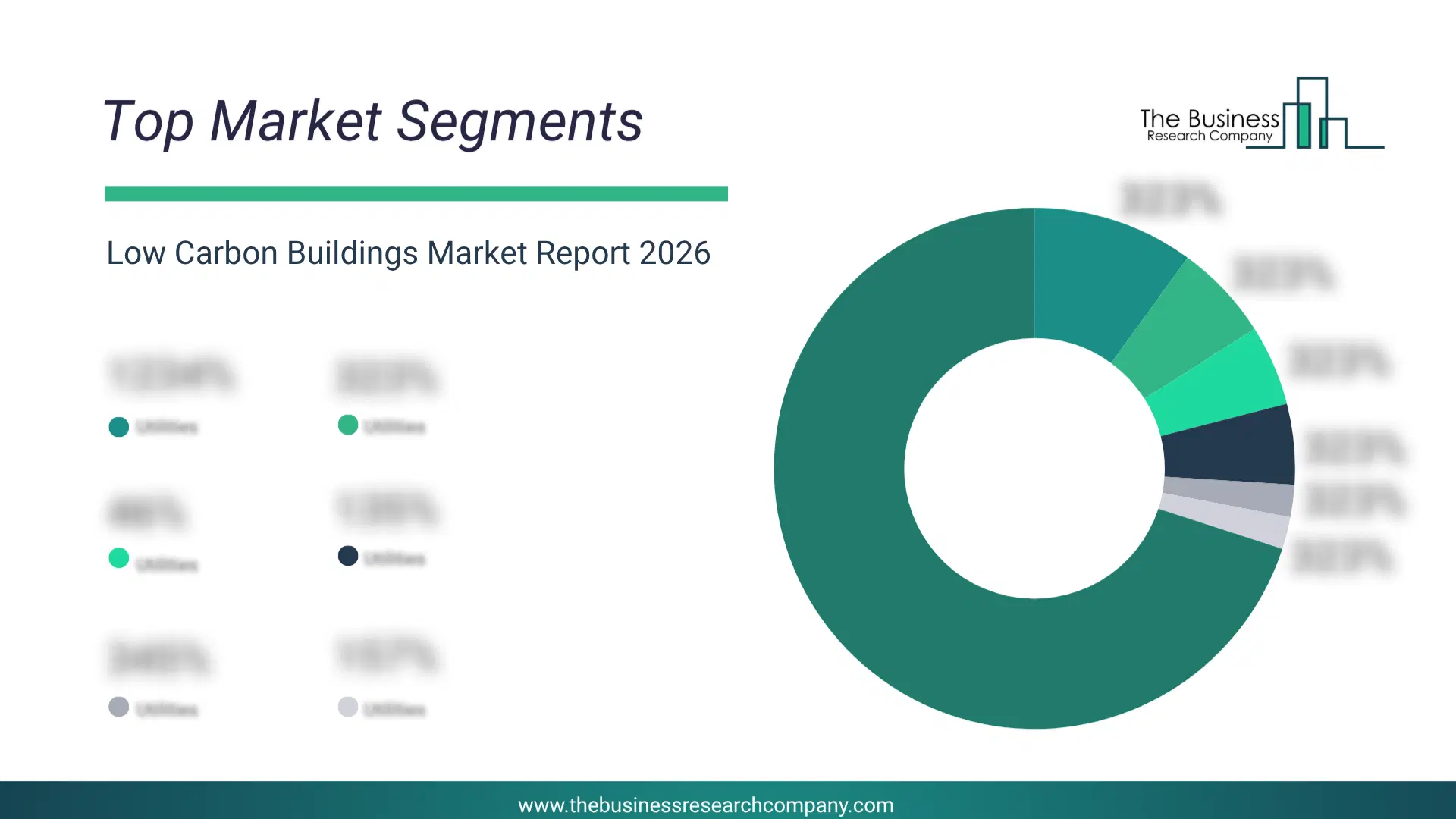
1) By Type: Low-Carbon Concrete, Mass Timber, Sustainable Steel 2) By Material: Low-Carbon Cement & Concrete, Engineered Wood (Mass Timber), Recycled Steel, Low-Carbon Steel 3) By Application: Commercial, Residential, Industrial Subsegments: 1) By Low-Carbon Concrete: Supplementary Cementitious Material (SCM) Concrete, Carbon-Cured Concrete, Recycled Aggregate Concrete, Geopolymer Concrete 2) By Mass Timber: Cross-Laminated Timber (CLT), Glue-Laminated Timber (Glulam), Nail-Laminated Timber (NLT), Laminated Veneer Lumber (LVL) 3) By Sustainable Steel: Electric Arc Furnace (EAF) Steel, Recycled Steel Rebar, Low-Carbon Structural Steel, Green Hydrogen SteelWhat Is The Driver Of The Low Carbon Buildings Market?
The increasing awareness of climate change is expected to drive the growth of the low-carbon buildings market going forward. The awareness of climate change is due to growing environmental concerns, widespread access to information, and heightened media coverage, leading to greater public engagement and demand for sustainable practices. Low-carbon buildings reduce greenhouse gas emissions through energy-efficient designs, sustainable materials, and renewable energy systems, promoting sustainability and combating climate change. For instance, in 2023, according to the European Commission, a Belgium-based government body, 87% of Europeans will favor increasing renewable energy use, and 86% will support enhancing energy efficiency by 2030. Therefore, the increasing awareness of climate change is driving the growth of the low-carbon buildings market.Key Players In The Global Low Carbon Buildings Market
Major companies operating in the low carbon buildings market are Holcim Group, Heidelberg Materials, CEMEX, Lafarge Canada, Vicat Group, CRH plc, Stora Enso, Binderholz GmbH, KLH Massivholz GmbH, Structurlam Mass Timber Corporation, Mayr-Melnhof Holz, Metsä Wood, Nippon Steel Corporation, SSAB AB, ArcelorMittal, Tata Steel Europe, Nucor Corporation, Steel Dynamics Inc., CarbonCure Technologies Inc., Ecocera Concrete Solutions.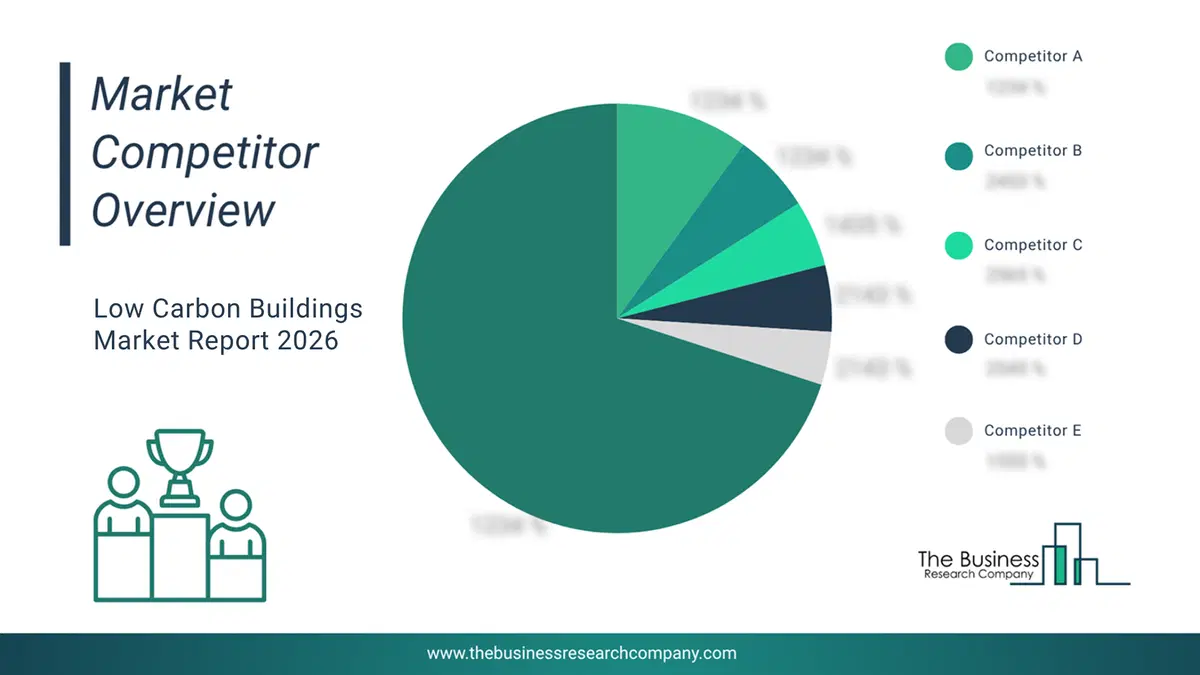
This chart is for illustrative purposes; the full report includes a detailed competitor analysis and comprehensive overview of the top 10 companies in the market.
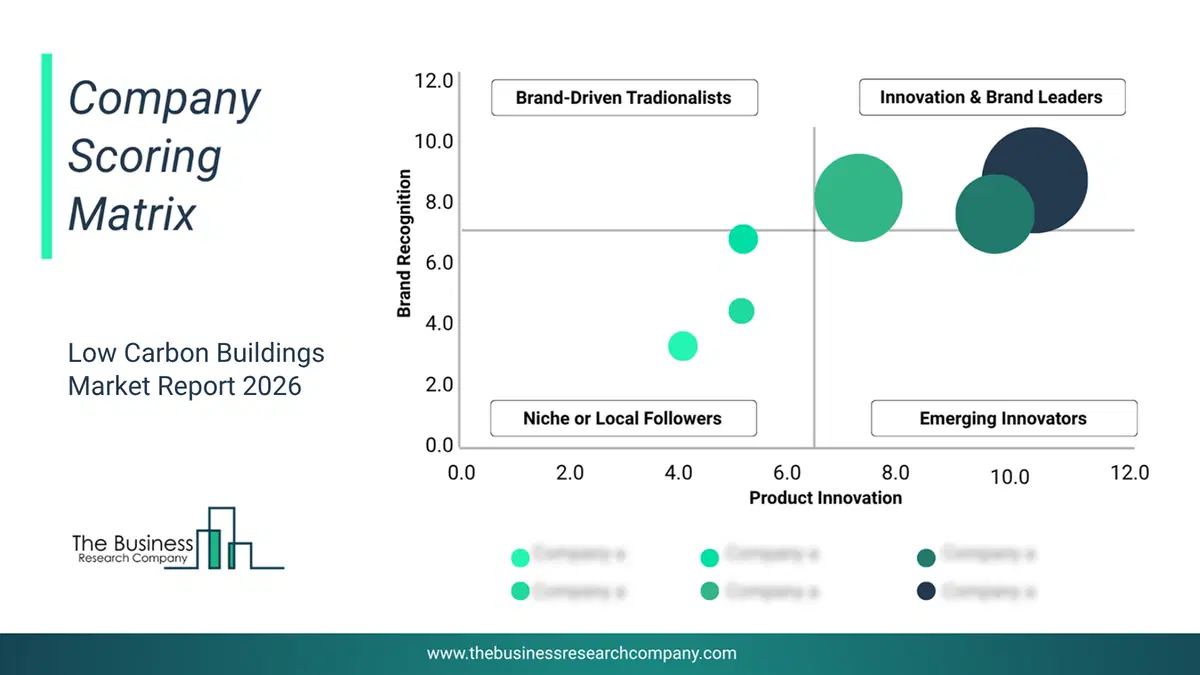
This chart maps companies by product innovation and brand strength, with bubble size indicating relative revenue, helping identify market leaders, challengers, and niche players. This is an illustrative chart; the full report provides a complete and accurate competitive analysis.
Global Low Carbon Buildings Market Trends and Insights
Major companies operating in the low-carbon buildings market are focusing on strategic partnerships to launch decarbonization programs to accelerate the transition to sustainable construction, improve energy efficiency, and reduce carbon emissions. Strategic partnerships are crucial in scaling sustainable construction practices, accelerating decarbonization programs, and fostering innovation in the low-carbon buildings market. For instance, in June 2024, Mahindra Group, an India-based industrial company, partnered with Johnson Controls, an Ireland-based industrial machinery manufacturing company, to launch a net zero buildings initiative. The initiative seeks to decarbonize India’s commercial, urban, residential, and public buildings by offering free toolkits and training programs. It streamlines access to essential resources and best practices, empowering organizations to implement sustainable building solutions. The initiative aims to drive a sustainable transformation in the built environment and support India’s low-carbon development objectives by guiding building owners on conservation strategies, regulatory adherence, financing options, and advanced technologies.What Are Latest Mergers And Acquisitions In The Low Carbon Buildings Market?
In July 2023, Kingspan Group, an Ireland-based provider of high-performance insulation and building envelope solutions, acquired a majority stake in STEICO SE for approximately $268.6 million (€251 million). Through this acquisition, Kingspan aims to expand its capabilities in bio-based and renewable insulation technologies and enhance its portfolio of sustainable building materials. STEICO SE, a Germany-based provider of wood-fiber insulation materials, engineered timber systems, and other bio-based construction products.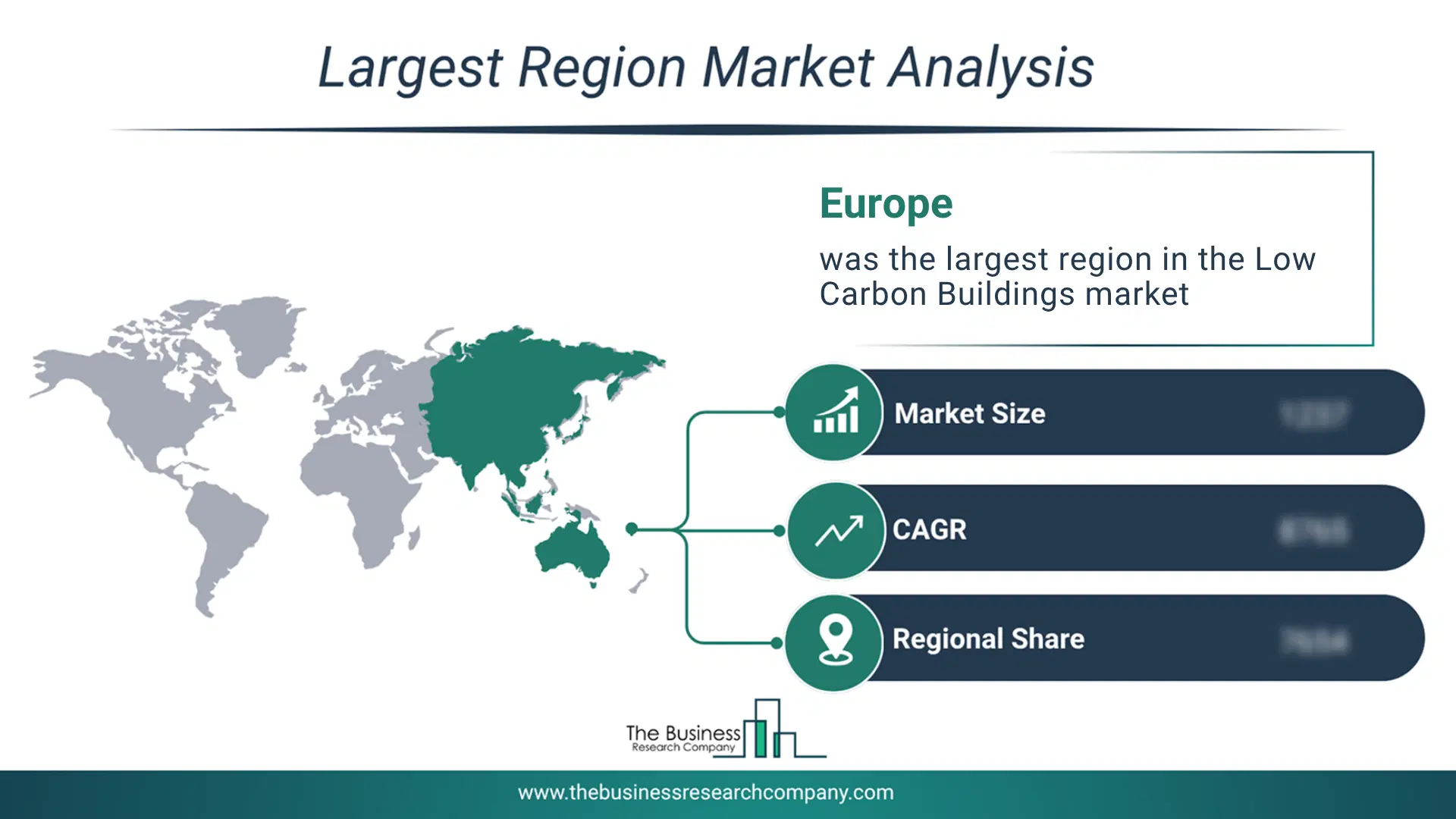
Regional Insights
Europe was the largest region in the low-carbon buildings market in 2025. Asia-Pacific is expected to be the fastest-growing region in the forecast period. The regions covered in this market report are Asia-Pacific, South East Asia, Western Europe, Eastern Europe, North America, South America, Middle East, Africa. The countries covered in this market report are Australia, Brazil, China, France, Germany, India, Indonesia, Japan, Taiwan, Russia, South Korea, UK, USA, Canada, Italy, Spain.What Defines the Low Carbon Buildings Market?
The low carbon buildings market consists of sales of low-carbon concrete, mass timber, and sustainable steel. Values in this market are ‘factory gate’ values, that is, the value of goods sold by the manufacturers or creators of the goods, whether to other entities (including downstream manufacturers, wholesalers, distributors, and retailers) or directly to end customers. The value of goods in this market includes related services sold by the creators of the goods.How is Market Value Defined and Measured?
The market value is defined as the revenues that enterprises gain from the sale of goods and/or services within the specified market and geography through sales, grants, or donations in terms of the currency (in USD unless otherwise specified). The revenues for a specified geography are consumption values that are revenues generated by organizations in the specified geography within the market, irrespective of where they are produced. It does not include revenues from resales along the supply chain, either further along the supply chain or as part of other products.
This chart presents market attractiveness based on a quantitative evaluation of growth, competition, strategic alignment, and risk, offering a clear view of opportunity areas for decision-making. This chart is for illustrative purposes; the full report contains the complete analysis.

This chart highlights the Total Addressable Market (TAM) by estimating the maximum revenue opportunity using an assumption-driven approach, supporting strategic planning and opportunity sizing across markets. The chart is illustrative; the full report provides a more comprehensive analysis.
What Key Data and Analysis Are Included in theLow Carbon Buildings Market Report 2026?
The low carbon buildings market research report is one of a series of new reports from The Business Research Company that provides market statistics, including industry global market size, regional shares, competitors with the market share, detailed market segments, market trends and opportunities, and any further data you may need to thrive in the low carbon buildings industry. The market research report delivers a complete perspective of everything you need, with an in-depth analysis of the current and future state of the industry.Low Carbon Buildings Market Report Forecast Analysis
| Report Attribute | Details |
|---|---|
| Market Size Value In 2026 | $697.47 billion |
| Revenue Forecast In 2030 | $1104.9 billion |
| Growth Rate | CAGR of 12.3% from 2026 to 2030 |
| Base Year For Estimation | 2025 |
| Actual Estimates/Historical Data | 2020-2025 |
| Forecast Period | 2026 - 2030 |
| Market Representation | Revenue in USD Billion and CAGR from 2026 to 2030 |
| Segments Covered | Type, Material, Application |
| Regional Scope | Asia-Pacific, Western Europe, Eastern Europe, North America, South America, Middle East, Africa |
| Country Scope | The countries covered in this market report are Australia, Brazil, China, France, Germany, India, Indonesia, Japan, Taiwan, Russia, South Korea, UK, USA, Canada, Italy, Spain |
| Key Companies Profiled | Holcim Group, Heidelberg Materials, CEMEX, Lafarge Canada, Vicat Group, CRH plc, Stora Enso, Binderholz GmbH, KLH Massivholz GmbH, Structurlam Mass Timber Corporation, Mayr-Melnhof Holz, Metsä Wood, Nippon Steel Corporation, SSAB AB, ArcelorMittal, Tata Steel Europe, Nucor Corporation, Steel Dynamics Inc., CarbonCure Technologies Inc., Ecocera Concrete Solutions. |
| Customization Scope | Request for Customization |
| Pricing And Purchase Options | Explore Purchase Options |