
Contact Us
  Search
The Business Research Company Logo
Low-Carbon Copper Global Market Opportunities And Strategies To 2035
Published :June 2026
Pages :209
Format :PDF
Delivery Time :2-3 Business Days
Why 2-3 days? We update the report with the latest data and news before delivery. Let us know if you need us to expedite.
Report Price :$4,490.00

Low-Carbon Copper Global Market Opportunities And Strategies To 2035

By Product Type (Wires, Plates, Sheets And Strips, Tubes, Bars And Sections, Other Product Types), By Technology (Electrowinning, Electrolytic), By Source (Recycled Copper, Virgin Copper), By End-User (Power Generation And Distribution, Building And Construction, Consumer Electronics, Automotive, Other End-Use Applications), And By Region, Opportunities And Strategies – Global Forecast To 2035

Low-Carbon-Copper Market Definition

Low carbon copper refers to copper that is produced, refined and fabricated using processes that emit significantly lower carbon dioxide and other greenhouse gases compared to conventional copper production. It includes both primary (virgin) and secondary (recycled) copper that is processed through low-emission technologies and energy-efficient methods. The low carbon copper market consists of sales, by entities (organizations, sole traders, or partnerships), of low carbon copper that are engaged in the extraction, processing, refining, manufacturing and distribution of copper products that meet defined carbon reduction thresholds. These thresholds are typically established by environmental certifications, regulatory standards or corporate sustainability initiatives.
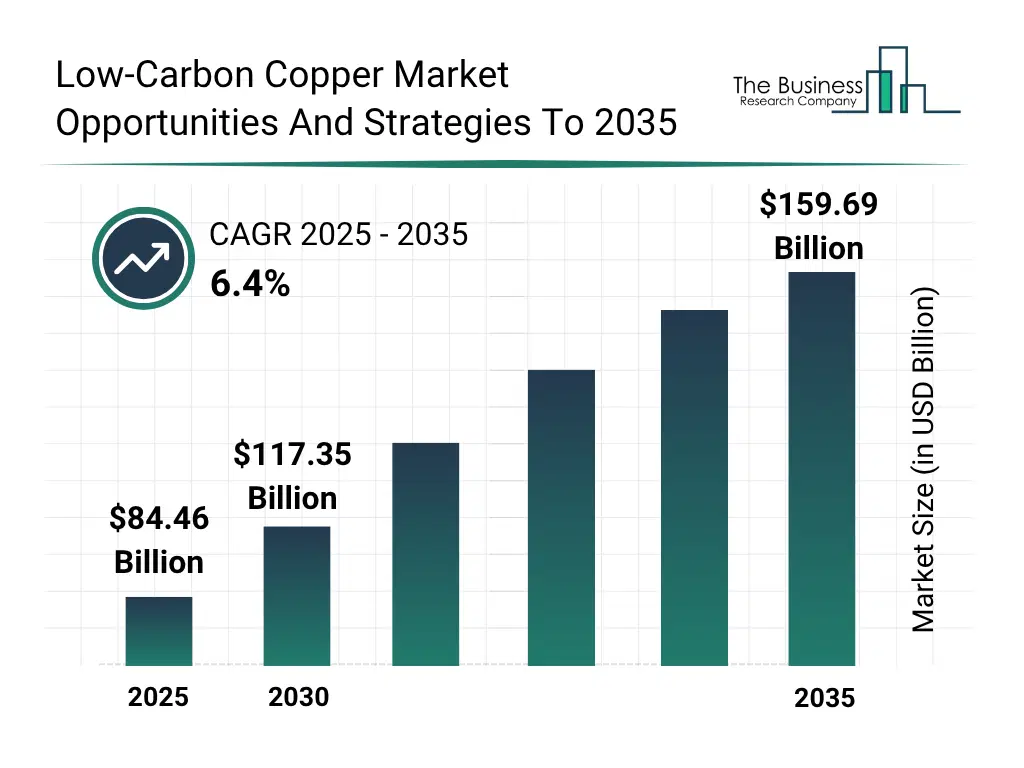
Low-Carbon Copper Global Market Opportunities And Strategies To 2035 Market Size and growth rate 2026 to 2030: Graph

Low-Carbon-Copper Market Size

The global low-carbon copper market reached a value of nearly $84,458.6 million in 2025, having grown at a compound annual growth rate (CAGR) of 7.5% since 2020. The market is expected to grow from $84,458.6 million in 2025 to $117,347.0 million in 2030 at a rate of 6.8%. The market is then expected to grow at a CAGR of 6.4% from 2030 and reach $159,688.3 million in 2035. Growth in the historic period resulted from the global decarbonization goals and net-zero targets, government incentives and green procurement policies, rapid electrification and energy transition and growing demand for green buildings and smart-city infrastructure. Factors that negatively affected growth in the historic period were supply chain complexity and limited traceability and lack of standardized carbon footprint definitions and certification. Going forward, the expansion of renewable energy infrastructure, infrastructure modernization and grid upgrades, growing preference for certified and traceable low-carbon materials and rising adoption of carbon pricing and emissions trading mechanisms will drive the growth. Factor that could hinder the growth of the low-carbon copper market in the future include high capital expenditure requirements and higher production costs compared to conventional copper and impact of trade war and tariffs.
Research Expert

Book your 30 minutes free consultation with our research experts

Low-Carbon-Copper Market Segmentation

The low-carbon-copper market is segmented by product type, by technology, by source and by end user.

By Product Type–
The low-carbon-copper market is segmented by product type into:
    • a) Wires
    • b) Plates
    • c) Sheets And Strips
    • d) Tubes
    • e) Bars And Sections
    • f) Other Product Types
The wires market was the largest segment of the low-carbon copper market segmented by product type, accounting for 29.0% or $24,521.3 million of the total in 2025. Going forward, the wires segment is expected to be the fastest growing segment in the low-carbon copper market segmented by product type, at a CAGR of 8.0% during 2025-2030.

By Technology–
The low-carbon-copper market is segmented by technology into:
    • a) Electrowinning
    • b) Electrolytic
The electrolytic market was the largest segment of the low-carbon copper market segmented by technology, accounting for 67.5% or $56,981.3 million of the total in 2025. Going forward, the electrowinning segment is expected to be the fastest growing segment in the low-carbon copper market segmented by technology, at a CAGR of 7.6% during 2025-2030.

By Source–
The low-carbon-copper market is segmented by source into:
    • a) Recycled Copper
    • b) Virgin Copper
The virgin copper market was the largest segment of the low-carbon copper market segmented by source, accounting for 64.7% or $54,631.2 million of the total in 2025. Going forward, the recycled copper segment is expected to be the fastest growing segment in the low-carbon copper market segmented by source, at a CAGR of 6.9% during 2025-2030.

By End-User–
The low-carbon-copper market is segmented by end user into:
    • a) Power Generation And Distribution
    • b) Building And Construction
    • c) Consumer Electronics
    • d) Automotive
    • e) Other End-Use Applications
The power generation and distribution market was the largest segment of the low-carbon copper market segmented by end-user, accounting for 31.1% or $24,499.7 million of the total in 2025. Going forward, the automotive segment is expected to be the fastest growing segment in the low-carbon copper market segmented by end-user, at a CAGR of 9.0% during 2025-2030.

By Geography - The low-carbon-copper market is segmented by geography into:
      o Asia Pacific
      • China
      • India
      • Japan
      • Australia
      • Indonesia
      • South Korea
      o North America
      • USA
      • Canada
      o South America
      • Brazil
      o Western Europe
      • France
      • Germany
      • UK
      • Italy
      • Spain
      o Eastern Europe
      • Russia
      o Middle East
      o Africa
Asia Pacific was the largest region in the low-carbon copper market, accounting for 48.0% or $40,535.9 million of the total in 2025. It was followed by North America, Western Europe and then the other regions. Going forward, the fastest-growing regions in the low-carbon copper market will be Asia Pacific and Western Europe where growth will be at CAGRs of 7.48% and 7.47% respectively. These will be followed by Middle East and Eastern Europe where the markets are expected to grow at CAGRs of 6.89% and 5.98% respectively.

Low-Carbon-Copper Market Competitive Landscape

Major Competitors are:

  • Boliden Group
  • Dahrén Group
  • Jiangxi Copper Corporation
  • BHP Group
  • Glencore plc
  • Other Competitors Include:

  • Vale S.A.
  • Aurubis AG
  • Zijin Mining Group Co. Ltd.
  • Pan Pacific Copper Co. Ltd.
  • Mitsubishi Materials Corporation
  • OZ Minerals
  • Sandfire Resources
  • Cyprium Metals Limited
  • South32 Limited
  • MMG Limited
  • Yunnan Copper Co., Ltd.
  • Tongling Nonferrous Metals Group Co., Ltd.
  • China Nonferrous Metal Mining (Group)
  • Jinchuan Group Co., Ltd.
  • Hindalco Industries
  • Vedanta Limited
  • PT Freeport Indonesia
  • PT Merdeka Copper Gold Tbk
  • PT Amman Mineral Nusa Tenggara
  • Sumitomo Metal Mining Co., Ltd.
  • JX Nippon Mining & Metals
  • DOWA Metals & Mining Co., Ltd.
  • Korea Zinc
  • Taihan Cable & Solution
  • Anglo American plc
  • Rio Tinto Plc
  • Luvata Company Ltd.
  • Elcowire Group
  • Wieland-Werke AG
  • ABB Ltd
  • Montanwerke Brixlegg
  • KGHM Polska Miedź S.A
  • Udokan Copper
  • Norilsk Nickel (Nornickel)
  • Baimskaya Copper Project
  • Teck Resources Limited
  • Foran Mining
  • Vale Canada
  • Taseko Mines Ltd
  • Hudbay Minerals Inc.
  • First Quantum Minerals Ltd
  • Grupo México
  • Rio Tinto (Nuton)
  • Southern Copper Corporation
  • Freeport-McMoRan
  • Florence Copper LLC
  • McEwen Copper Inc
  • Salobo Metais S.A.
  • Mineração Vale Verde
  • Ero Copper
  • Codelco
  • Collahuasi
  • SCM Minera Lumina Copper Chile
  • Sociedad Minera Cerro Verde S.A.A
  • Minsur S.A
  • Southern Peaks Mining (SPM)
  • Antofagasta plc
  • Iranian Babak Copper Co. (IBCCO)
  • Neveah Limited
  • Copper 360
  • Harmony Gold
  • Palabora Mining Company (PMC)
  • Low-Carbon-Copper Market Drivers

    The key drivers of the low-carbon-copper market include: Expansion Of Renewable Energy Infrastructure Expansion of renewable energy infrastructure is expected to be a key driver of the growth of the low-carbon copper market in the forecast period. Renewable energy systems such as wind, solar and energy storage installations rely heavily on copper for power transmission, electrical connections and energy management components. As renewable capacity expands at scale, demand for copper is expected to rise in parallel, while sustainability requirements across clean energy value chains will intensify. Developers and utilities are increasingly focused on reducing lifecycle emissions, creating stronger demand for copper produced with lower carbon intensity. This alignment between clean energy expansion and sustainable material sourcing will reinforce the adoption of low-carbon copper across renewable infrastructure projects. The expansion of renewable energy infrastructure growth contribution during the forecast period in 2025 is 2.0%.

    Low-Carbon-Copper Market Restraints

    The key restraints on the low-carbon-copper market include: High Capital Expenditure Requirements High capital expenditure requirements are restricting the growth of the low-carbon copper market during the forecast period. Low-carbon copper production often requires significant upfront investment in energy-efficient equipment, renewable power integration, advanced refining technologies, recycling infrastructure and emissions-control systems. These capital-intensive requirements can create financial barriers, particularly for smaller producers or operations in emerging markets, slowing market entry and capacity expansion. As a result, the high cost of initial investment may delay project timelines and reduce the number of producers able to transition toward low-carbon production pathways. Growth affected by high capital expenditure requirements across regions during the forecast period in 2025 is -2.0%.

    Need data on a specific region in this market?

    Opportunities And Recommendations In The Low-Carbon-Copper Market

    Opportunities – The top opportunities in the low-carbon copper markets segmented by product type will arise in the wires segment, which will gain $11,544.9 million of global annual sales by 2030. The top opportunities in the low-carbon copper markets segmented by technology will arise in the electrolytic segment, which will gain $20,696.8 million of global annual sales by 2030. The top opportunities in the low-carbon copper markets segmented by source will arise in the virgin copper segment, which will gain $21,136.0 million of global annual sales by 2030. The top opportunities in the low-carbon copper markets segmented by end-user will arise in the power generation and distribution segment, which will gain $10,575.8 million of global annual sales by 2030. The low-carbon copper market size will gain the most in China at $7,788.9 million. Recommendations- To take advantage of the opportunities, The Business Research Company recommends the focus on integrating recycled copper into low-emission production systems, focus on developing ultra-low-emission copper products for EV and battery supply chains, focus on expanding low-carbon copper wires for electrification and energy infrastructure, focus on expanding electrowinning capacity for low-emission copper production, focus on expanding recycled copper production for sustainable growth, expand in emerging markets, continue to focus on developed markets, focus on expanding strategic distribution networks and regional market access, focus on value-based and transparent pricing strategies for low-carbon copper, focus on building credible sustainability communication and market awareness, focus on targeted digital engagement and customer education initiatives, focus on expanding automotive applications for low-carbon copper growth.
    Chat with us