

Low-Cost Carrier Market Report 2026
Global Outlook – By Aircraft Type (Narrow Body, Wide Body, Other Aircraft Types), By Service (Passenger Service, Cargo Service), By Route Type (Short-Haul (<1 K Mile), Regional (1-3 K Mile), International), By Distribution Channel (Online, Travel Agency), By Application (Individual, Commercial) – Market Size, Trends, Strategies, and Forecast to 2030
Low-Cost Carrier Market Overview
• Low-Cost Carrier market size has reached to $266.07 billion in 2025 • Expected to grow to $516.89 billion in 2030 at a compound annual growth rate (CAGR) of 14.1% • Growth Driver: Rising Tourism Industry Fuels Demand For The Market Due To Increasing Disposable Incomes And Affordable Travel Options • Market Trend: Strategic Partnerships Drive Expansion And Accessibility In The Low-Cost Carrier Market • North America was the largest region in 2025.What Is Covered Under Low-Cost Carrier Market?
A low-cost carrier (LCC) is an airline that delivers air travel at reduced fares by cutting operational expenses and limiting traditional services. These airlines aim to make flying more affordable and accessible to a broader audience, often leveraging point-to-point routes, high aircraft utilization, and a no-frills approach. LCCs attract budget-conscious travelers, foster competition, and drive greater demand in the aviation industry. The main aircraft types of low-cost carriers are narrow-body, wide-body, and others. A narrow-body aircraft is a plane with a single aisle, mainly used for short- to medium-haul flights, offering cost-efficient operations. It offers various services, including passenger and cargo service across various route types, such as short-haul (<1,000 miles), regional (1,000–3,000 miles), and international flights. These are distributed through several distribution channels, including online platforms and travel agencies, for multiple applications, such as individual and commercial.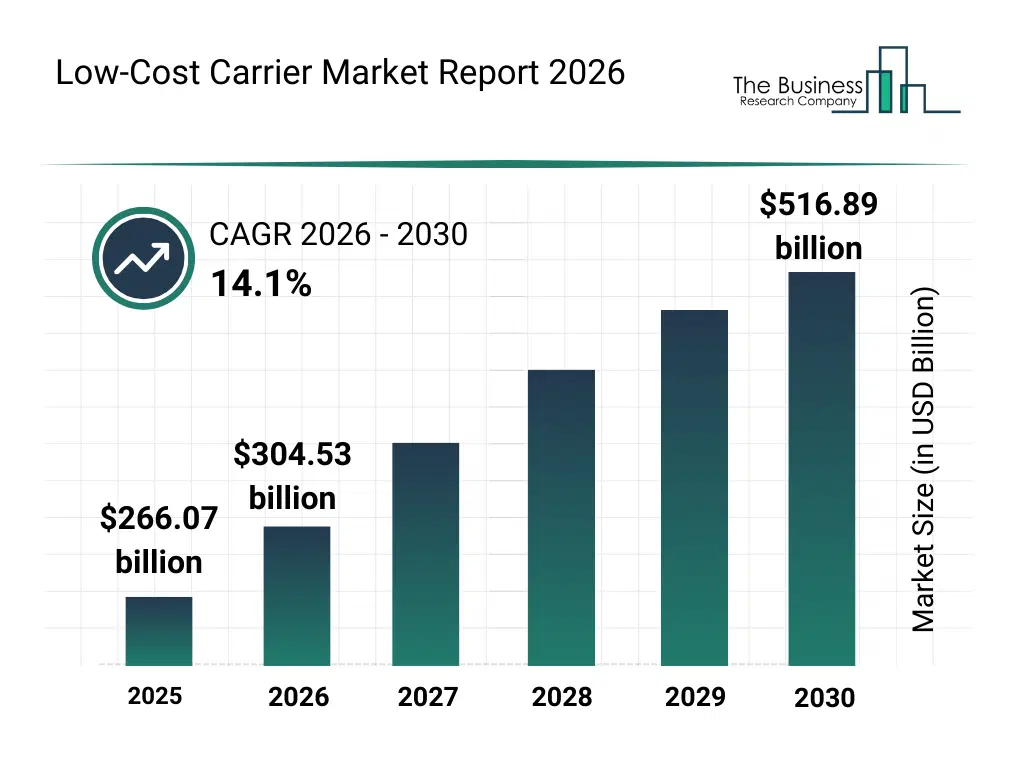
What Is The Low-Cost Carrier Market Size and Share 2026?
The low-cost carrier market size has grown rapidly in recent years. It will grow from $266.07 billion in 2025 to $304.53 billion in 2026 at a compound annual growth rate (CAGR) of 14.5%. The growth in the historic period can be attributed to deregulation of air travel, rising middle-class travelers, growth of budget tourism, aircraft leasing expansion, high aircraft utilization models.What Is The Low-Cost Carrier Market Growth Forecast?
The low-cost carrier market size is expected to see rapid growth in the next few years. It will grow to $516.89 billion in 2030 at a compound annual growth rate (CAGR) of 14.1%. The growth in the forecast period can be attributed to fleet modernization, sustainable aviation fuel adoption, digital airline operations, growth in regional connectivity, demand for affordable air travel. Major trends in the forecast period include expansion of point-to-point air routes, growth of ancillary revenue models, adoption of fuel-efficient aircraft, increase in digital booking platforms, demand for cost-optimized operations.
Global Low-Cost Carrier Market Segmentation
1) By Aircraft Type: Narrow Body, Wide Body, Other Aircraft Types 2) By Service: Passenger Service, Cargo Service 3) By Route Type: Short-Haul (<1 K Mile), Regional (1-3 K Mile), International 4) By Distribution Channel: Online, Travel Agency 5) By Application: Individual, Commercial Subsegments: 1) By Narrow Body: Single Aisle, Twin Engine, Turbo Prop 2) By Wide Body: Twin Aisle, Extended Range 3) By Other Aircraft Types: Business Jet, Commuter AircraftWhat Is The Driver Of The Low-Cost Carrier Market?
The growth of the tourism industry is expected to propel the growth of the low-cost carrier market going forward. The tourism industry refers to the sector that provides services and activities such as travel, accommodation, food, and entertainment to people traveling outside their usual environment for leisure, business, or other purposes. The tourism industry is increasing due to rising disposable incomes, allowing more people to afford leisure travel and related services. Low-cost carriers help the tourism industry by offering affordable flight options that make travel more accessible to a wider population, thereby boosting both domestic and international tourism. For instance, in May 2024, according to the Office for National Statistics, a UK-based official statistical agency, the number of overseas visits to the UK rose from 31.2 million in 2022 to 38.0 million in 2023. Therefore, the growth in the tourism industry is driving the growth of the low-cost carrier industry.Key Players In The Global Low-Cost Carrier Market
Major companies operating in the low-cost carrier market report include Southwest Airlines Co., Ryanair Group, easyJet plc, InterGlobe Aviation Ltd. (IndiGo), AirAsia Group Berhad, Wizz Air Holdings plc, Spirit Airlines Inc., Frontier Airlines, JetBlue Airways Corp., Allegiant Travel Company, Vueling Airlines SA, Flydubai, Air Arabia PJSC, SpiceJet Ltd., flynas Co., Eurowings GmbH, Norwegian Air Shuttle ASA, Azul S.A., Scoot Pte Ltd., Peach Aviation Limited, Cebu Pacific Air, VietJet Aviation JSC, Lion Air Group, Volaris, SKY Airline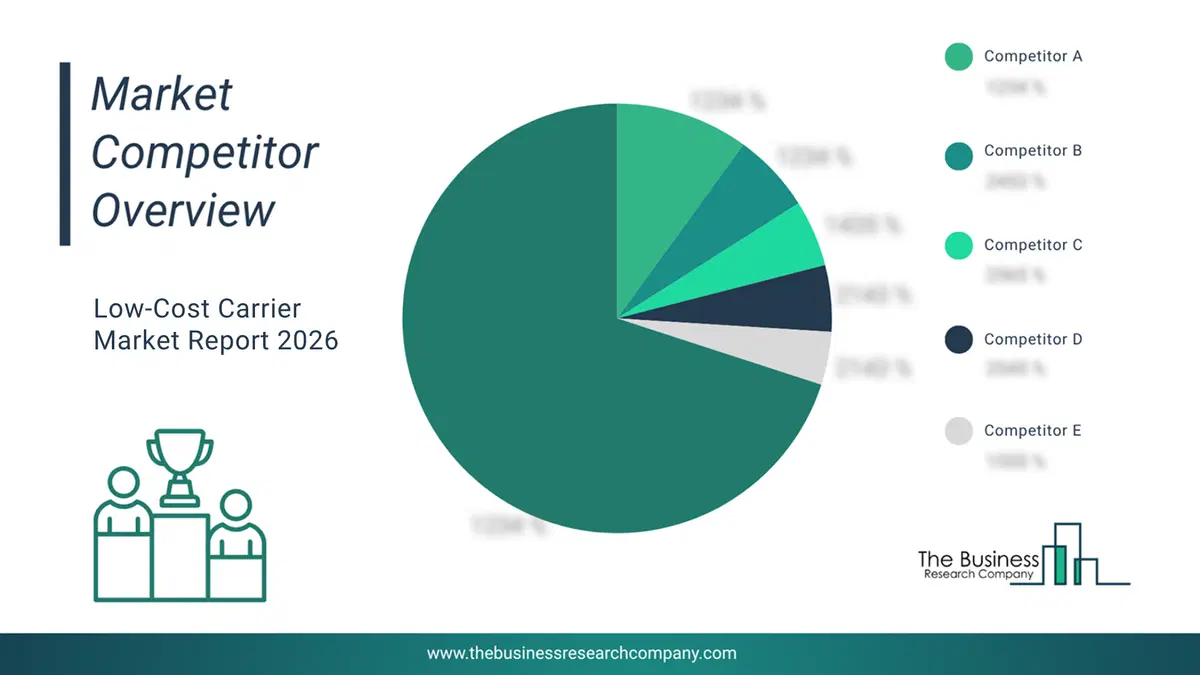
This chart is for illustrative purposes; the full report includes a detailed competitor analysis and comprehensive overview of the top 10 companies in the market.
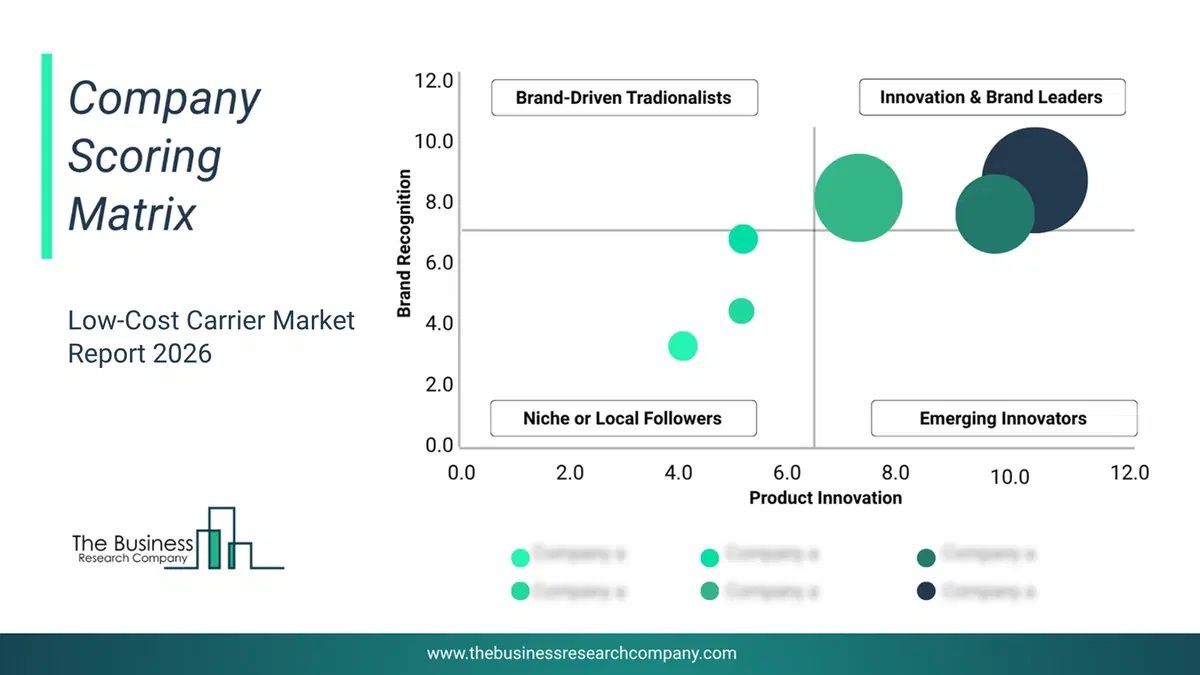
This chart maps companies by product innovation and brand strength, with bubble size indicating relative revenue, helping identify market leaders, challengers, and niche players. This is an illustrative chart; the full report provides a complete and accurate competitive analysis.
Global Low-Cost Carrier Market Trends and Insights
Major companies operating in the low-cost carrier market are focusing on adopting strategic partnerships to provide more affordable, accessible, and convenient air travel for a wider range of passengers. A strategic partnership is a cooperative agreement between two or more organizations to combine their strengths and work together for mutual advantage. Its primary aim is to accomplish common objectives, such as expanding into new markets, optimizing resources, or driving innovation. For instance, in May 2025, Qazaq Air, a Kazakhstan-based airline, collaborated with Vietjet, a Vietnam-based company that is expanding its fleet to meet growing travel demand. low-cost airline to launch Vietjet Qazaqstan, a low-cost carrier, This new airline aims to connect Kazakhstan with Southeast Asia and beyond, boost regional tourism, trade, and logistics, and operate a modern fleet of at least 20 Boeing 737 aircraft with advanced management and training systems, enhancing economic ties between the two countries and Central Asia's aviation landscape.What Are Latest Mergers And Acquisitions In The Low-Cost Carrier Market?
In October 2024, Air India Express Ltd., an India-based low-cost airline, merged with AIX Connect Pvt Ltd to improve operational efficiency and bolster its domestic and international network. This partnership aims to establish a larger, more scalable, and profitable low-cost carrier, expanding network coverage and catering to the rising demand for affordable air travel in India and the surrounding region. AIX Connect Pvt Ltd is an India-based passenger air transportation company that provides low-cost carrier services.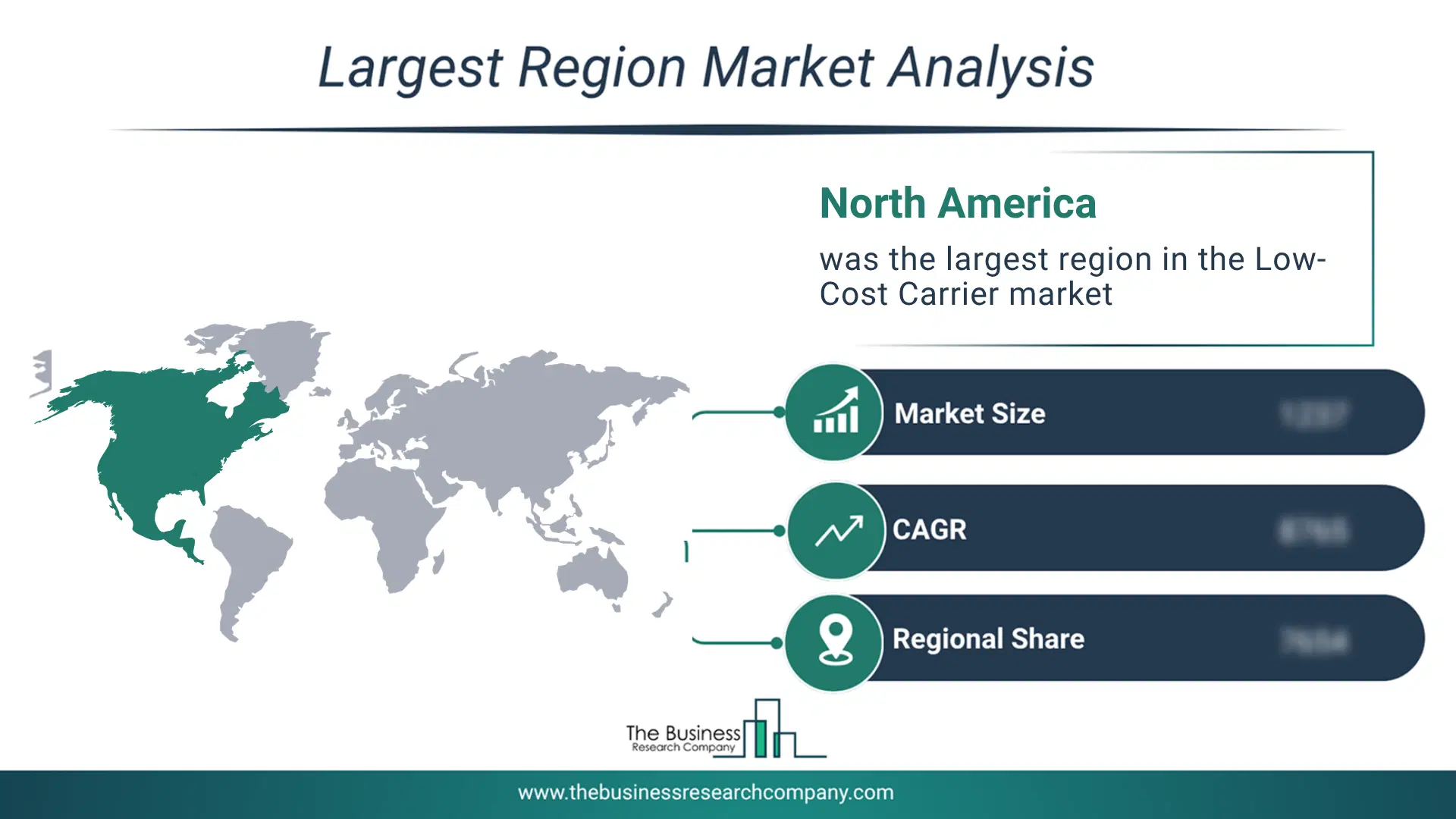
Regional Outlook
North America was the largest region in the low-cost carrier market in 2025. The Middle East and Africa is expected to be the fastest-growing region in the forecast period. The regions covered in this market report include Asia-Pacific, South East Asia, Western Europe, Eastern Europe, North America, South America, Middle East, Africa. The countries covered in this market report include Australia, Brazil, China, France, Germany, India, Indonesia, Japan, Taiwan, Russia, South Korea, UK, USA, Canada, Italy, SpainWhat Defines the Low-Cost Carrier Market?
The low-cost carrier market consists of revenues earned by entities by providing services such as online booking platforms, call centres and chat assistance services, loyalty and rewards programs, and check-in counters and boarding facilitation. The market value includes the value of related goods sold by the service provider or included within the service offering. The low-cost carrier market also includes sales of in-flight equipment, ground support hardware, and ancillary products sold to passengers. Values in this market are ‘factory gate’ values, that is, the value of goods sold by the manufacturers or creators of the goods, whether to other entities (including downstream manufacturers, wholesalers, distributors, and retailers) or directly to end customers. The value of goods in this market includes related services sold by the creators of the goods.How is Market Value Defined and Measured?
The market value is defined as the revenues that enterprises gain from the sale of goods and/or services within the specified market and geography through sales, grants, or donations in terms of the currency (in USD unless otherwise specified). The revenues for a specified geography are consumption values that are revenues generated by organizations in the specified geography within the market, irrespective of where they are produced. It does not include revenues from resales along the supply chain, either further along the supply chain or as part of other products.
This chart presents market attractiveness based on a quantitative evaluation of growth, competition, strategic alignment, and risk, offering a clear view of opportunity areas for decision-making. This chart is for illustrative purposes; the full report contains the complete analysis.

This chart highlights the Total Addressable Market (TAM) by estimating the maximum revenue opportunity using an assumption-driven approach, supporting strategic planning and opportunity sizing across markets. The chart is illustrative; the full report provides a more comprehensive analysis.
What Key Data and Analysis Are Included in the Low-Cost Carrier Market Report 2026?
The low-cost carrier market research report is one of a series of new reports from The Business Research Company that provides market statistics, including industry global market size, regional shares, competitors with the market share, detailed market segments, market trends and opportunities, and any further data you may need to thrive in the low-cost carrier industry. The market research report delivers a complete perspective of everything you need, with an in-depth analysis of the current and future state of the industry.Low-Cost Carrier Market Report Forecast Analysis
| Report Attribute | Details |
|---|---|
| Market Size Value In 2026 | $304.53 billion |
| Revenue Forecast In 2030 | $516.89 billion |
| Growth Rate | CAGR of 14.5% from 2026 to 2030 |
| Base Year For Estimation | 2025 |
| Actual Estimates/Historical Data | 2020-2025 |
| Forecast Period | 2026 - 2030 - 2030 |
| Market Representation | Revenue in USD Billion and CAGR from 2026 to 2030 |
| Segments Covered | Aircraft Type, Service, Route Type, Distribution Channel, Application |
| Regional Scope | Asia-Pacific, Western Europe, Eastern Europe, North America, South America, Middle East, Africa |
| Country Scope | The countries covered in the report are Australia, Brazil, China, France, Germany, India, Indonesia, Japan, Taiwan, Russia, South Korea, UK, USA, Canada, Italy, Spain. |
| Key Companies Profiled | Southwest Airlines Co., Ryanair Group, easyJet plc, InterGlobe Aviation Ltd. (IndiGo), AirAsia Group Berhad, Wizz Air Holdings plc, Spirit Airlines Inc., Frontier Airlines, JetBlue Airways Corp., Allegiant Travel Company, Vueling Airlines SA, Flydubai, Air Arabia PJSC, SpiceJet Ltd., flynas Co., Eurowings GmbH, Norwegian Air Shuttle ASA, Azul S.A., Scoot Pte Ltd., Peach Aviation Limited, Cebu Pacific Air, VietJet Aviation JSC, Lion Air Group, Volaris, SKY Airline |
| Customization Scope | Request for Customization |
| Pricing And Purchase Options | Explore Purchase Options |