
Low-Cost Electronic Warfare Drone Market Report 2026
Global Outlook – By Product Type (Fixed-Wing Drones, Rotary-Wing Drones, Hybrid Drones), By Range (Short Range, Medium Range, Long Range), By Platform (Aerial, Ground, Naval), By Application (Military Surveillance, Electronic Attack, Signal Intelligence, Jamming, Other Applications), By End-User (Defense, Homeland Security, Law Enforcement, Other End Users) – Market Size, Trends, Strategies, and Forecast to 2030
Low-Cost Electronic Warfare Drone Market Overview
• Low-Cost Electronic Warfare Drone market size has reached to $1.4 billion in 2025 • Expected to grow to $3.02 billion in 2030 at a compound annual growth rate (CAGR) of 16.7% • Growth Driver: Increasing Military Spending Fueling The Growth Of The Market Due To Rising Geopolitical Tensions And Demand For Advanced, Affordable Defense Solutions • Market Trend: Energy-Efficient Systems Enhance Signal Jamming Capabilities • North America was the largest region in 2025.What Is Covered Under Low-Cost Electronic Warfare Drone Market?
A low-cost electronic warfare drone is an unmanned aerial system designed to provide affordable electronic attack, protection, and surveillance capabilities. Its primary purpose is to jam, deceive, or disrupt enemy communications, radars, and sensors while protecting friendly forces. These drones can be deployed in swarms, ensuring effective battlefield coverage with reduced risk to high-value assets. The main product types of low-cost electronic warfare drone are fixed-wing drones, rotary-wing drones, and hybrid drones. A fixed-wing drone is an unmanned aerial vehicle with fixed wings, designed to perform electronic warfare tasks such as jamming, disrupting, or deceiving enemy communications and radar systems, while being affordable to produce and operate. It is available in short-range, medium range, and long-range variants and is operated across aerial, ground, and naval platforms. These drones support a range of applications, including military surveillance, electronic attack, signal intelligence, jamming, and other applications, serving diverse end-users such as defense, homeland security, law enforcement, and others.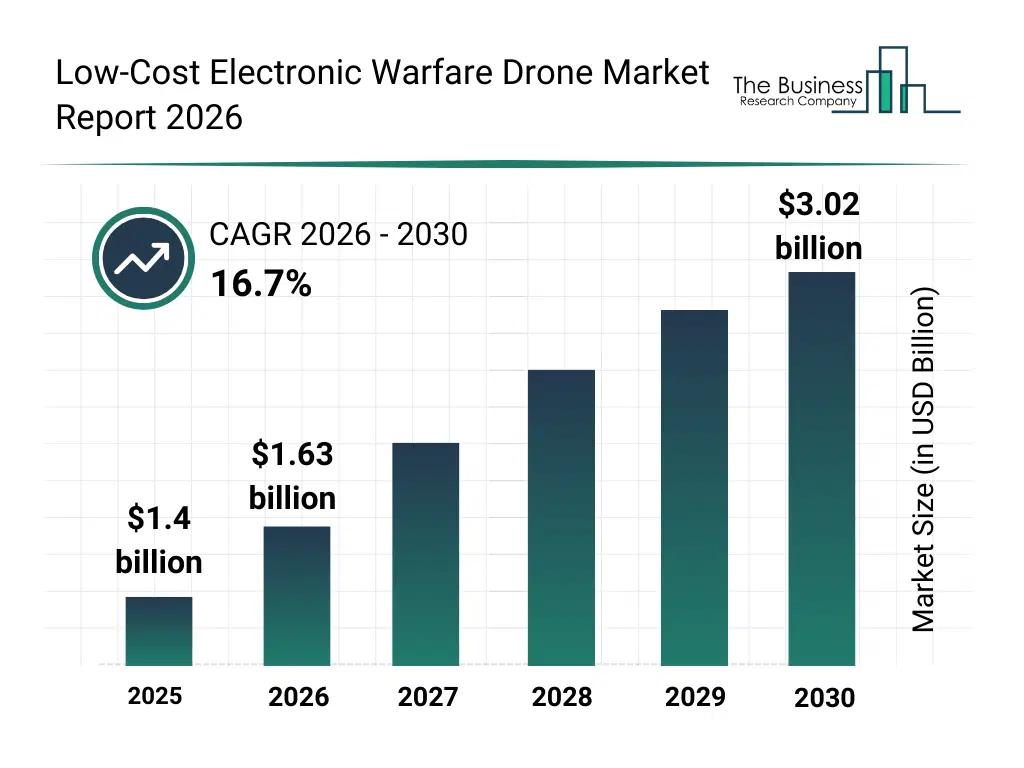
What Is The Low-Cost Electronic Warfare Drone Market Size and Share 2026?
The low-cost electronic warfare drone market size has grown rapidly in recent years. It will grow from $1.4 billion in 2025 to $1.63 billion in 2026 at a compound annual growth rate (CAGR) of 16.4%. The growth in the historic period can be attributed to proliferation of low-cost drones for battlefield use, advancements in electronic jamming modules, increasing need for battlefield communication disruption, deployment of swarm-enabled EW drones, rising defense procurement for asymmetric warfare.What Is The Low-Cost Electronic Warfare Drone Market Growth Forecast?
The low-cost electronic warfare drone market size is expected to see rapid growth in the next few years. It will grow to $3.02 billion in 2030 at a compound annual growth rate (CAGR) of 16.7%. The growth in the forecast period can be attributed to adoption of AI-enabled electronic attack systems, integration with manned-unmanned team operations, development of modular EW payloads, expansion in counter-UAV missions, growing demand from emerging defense markets. Major trends in the forecast period include swarm-enabled electronic warfare deployment, integration of jamming and signal intelligence capabilities, cost-optimized modular drone design, rapid deployable battlefield ew drones, enhanced communication disruption and defense penetration.
Global Low-Cost Electronic Warfare Drone Market Segmentation
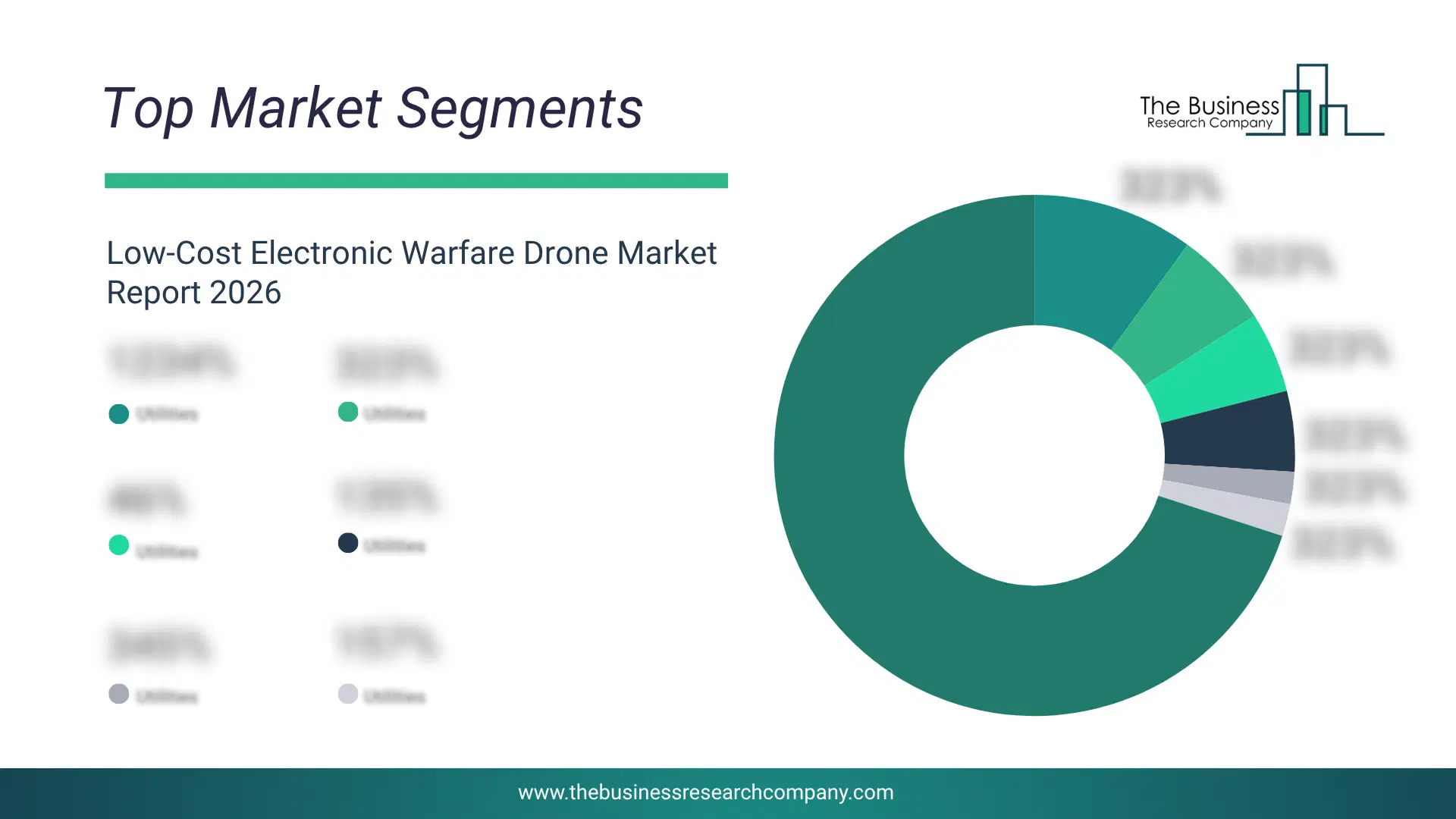
1) By Product Type: Fixed-Wing Drones, Rotary-Wing Drones, Hybrid Drones 2) By Range: Short Range, Medium Range, Long Range 3) By Platform: Aerial, Ground, Naval 4) By Application: Military Surveillance, Electronic Attack, Signal Intelligence, Jamming, Other Applications 5) By End-User: Defense, Homeland Security, Law Enforcement, Other End Users Subsegments: 1) By Fixed-Wing Drones: Small Fixed-Wing Drones, Medium Fixed-Wing Drones, Large Fixed-Wing Drones 2) By Rotary-Wing Drones: Single-Rotor Drones, Multi-Rotor Drones, Coaxial Rotor Drones 3) By Hybrid Drones: Fixed-Wing Vertical Takeoff And Landing Drones, Tilt-Rotor Hybrid Drones, Convertible Hybrid DronesWhat Is Driver Of The Low-Cost Electronic Warfare Drone Market?
The increasing military spending is expected to propel the growth of the low-cost electronic warfare drone market going forward. Military spending refers to the financial resources allocated by governments to maintain and enhance their armed forces, encompassing expenditures on personnel, equipment, research and development, and operational costs. The increasing military spending is due to rising geopolitical tensions, as nations seek to strengthen defense capabilities and safeguard strategic interests in an uncertain environment. Rising military spending enhances low-cost electronic warfare drones by enabling armed forces to invest in affordable, scalable, and technologically advanced solutions for electronic attack and defense operations. For instance, in April 2024, according to the Stockholm International Peace Research Institute (SIPRI), a Sweden-based non-government organization, global military spending reached $2.443 trillion in 2023, marking a 6.8% increase compared to 2022. Therefore, the increasing military spending is driving the growth of the low-cost electronic warfare drone industry.Key Players In The Global Low-Cost Electronic Warfare Drone Market
Major companies operating in the low-cost electronic warfare drone market are Raytheon Technologies Corporation, BAE Systems plc, Thales Group, Leonardo S.p.A., Elbit Systems Ltd., Saab AB, Aselsan A.S., General Atomics Aeronautical Systems Inc., QinetiQ Group plc, Kratos Defense And Security Solutions Inc., Anduril Industries Inc., AeroVironment Inc., Shield AI, DroneShield Ltd., Red Cat Holdings Inc., Parrot SA, Zuppa Geo Navigation Technologies Private Limited., Teal Drones Inc., Firestorm Labs Inc., TAF Industries
This chart is for illustrative purposes; the full report includes a detailed competitor analysis and comprehensive overview of the top 10 companies in the market.
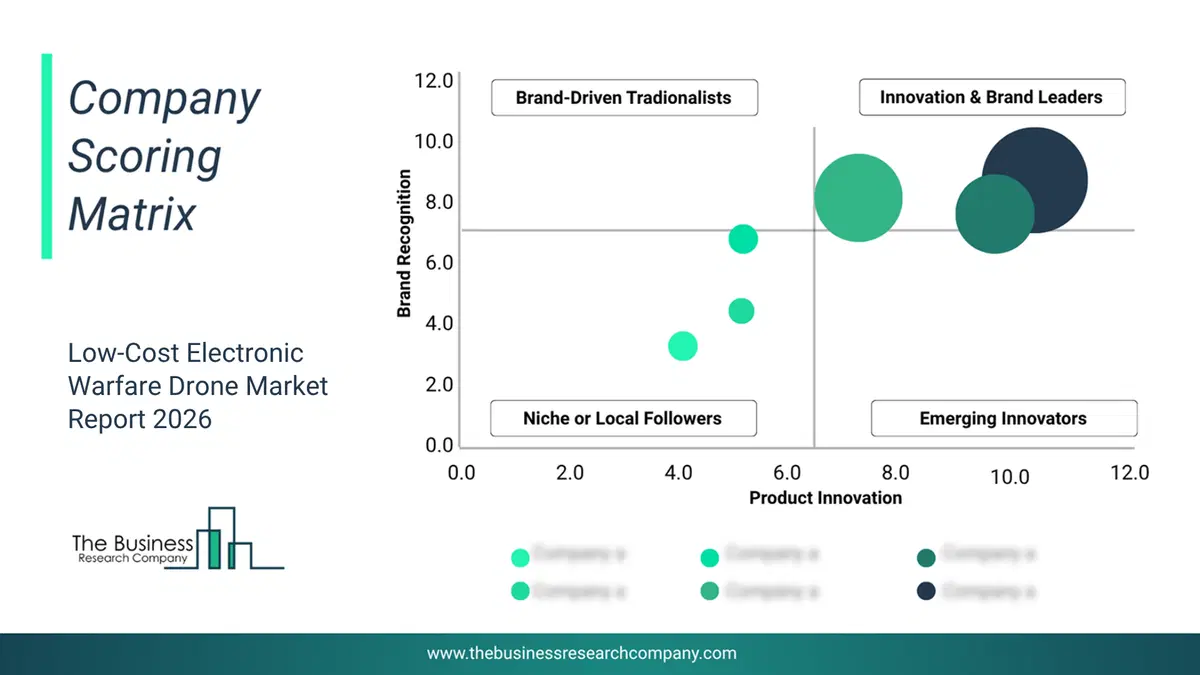
This chart maps companies by product innovation and brand strength, with bubble size indicating relative revenue, helping identify market leaders, challengers, and niche players. This is an illustrative chart; the full report provides a complete and accurate competitive analysis.
Global Low-Cost Electronic Warfare Drone Market Trends and Insights
Major companies operating in the low-cost electronic warfare drone market are focusing on developing innovative solutions, such as lightweight, energy-efficient payloads, to enhance signal jamming and electronic countermeasure capabilities. Lightweight, energy-efficient payloads are compact drone components that consume minimal power while performing tasks such as electronic jamming or surveillance, allowing drones to fly longer and carry out missions more effectively. For instance, in June 2025, Thales Group, a France-based aerospace company, launched a lightweight, remotely controlled electronic warfare payload designed for small drones to detect and locate radio signals. The system weighs under 5 kilograms (11 pounds) and consumes less than 40 watts of power, making it suitable for integration with free-flying, autonomous, or tethered drones. It operates passively, detecting and geolocating enemy radio frequency signals from tens of kilometers away without emitting any signals, thus avoiding detection in contested environments. This payload is user-friendly for personnel without specialized training and provides real-time electromagnetic intelligence, complementing dedicated EW assets and enhancing situational awareness for land or naval forces.What Are Latest Mergers And Acquisitions In The Low-Cost Electronic Warfare Drone Market? Terma Group And Odd Systems Partner To Develop AI-Powered Autonomous Drone Interceptor
In July 2025, Terma Group, a Denmark-based defense technology company, partnered with Odd Systems to co-develop a low-cost, AI-powered autonomous drone interceptor. This partnership aims to enhance battlefield protection by providing affordable, intelligent counter-drone solutions capable of detecting, tracking, and neutralizing hostile drones efficiently. Odd Systems is a Ukraine-based defense technology company specializing in low-cost electronic warfare drones.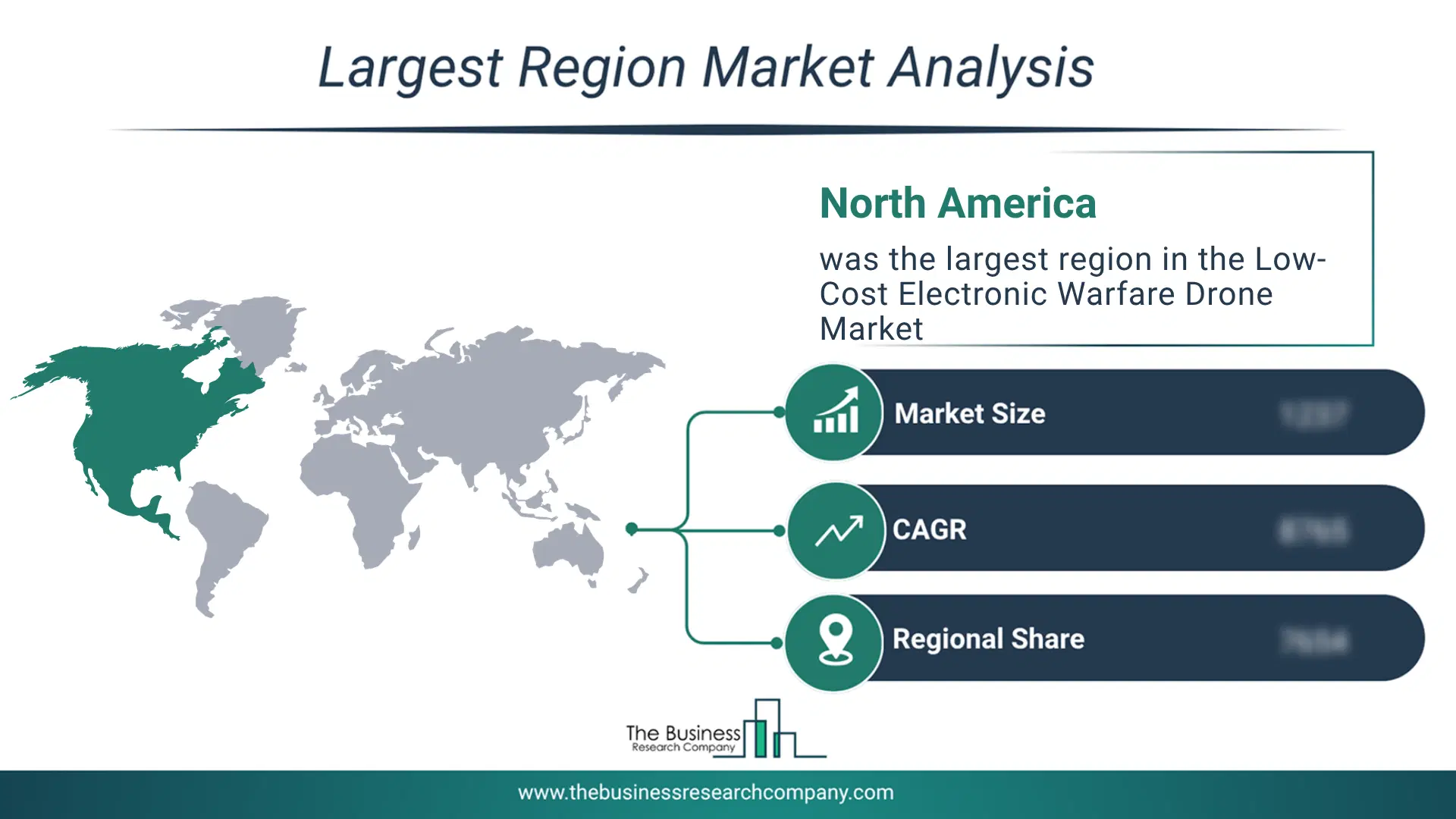
Regional Insights
North America was the largest region in the low-cost electronic warfare drone market in 2025. The regions covered in this market report are Asia-Pacific, South East Asia, Western Europe, Eastern Europe, North America, South America, Middle East, Africa. The countries covered in this market report are Australia, Brazil, China, France, Germany, India, Indonesia, Japan, Taiwan, Russia, South Korea, UK, USA, Canada, Italy, SpainWhat Defines the Low-Cost Electronic Warfare Drone Market?
The low-cost electronic warfare drone market consists of sales of jamming devices, radar deception modules, signal intelligence sensors, communication disruption devices, and swarm-enabled platforms. Values in this market are ‘factory gate’ values, that is, the value of goods sold by the manufacturers or creators of the goods, whether to other entities (including downstream manufacturers, wholesalers, distributors, and retailers) or directly to end customers. The value of goods in this market includes related services sold by the creators of the goods.How is Market Value Defined and Measured?
The market value is defined as the revenues that enterprises gain from the sale of goods and/or services within the specified market and geography through sales, grants, or donations in terms of the currency (in USD unless otherwise specified). The revenues for a specified geography are consumption values that are revenues generated by organizations in the specified geography within the market, irrespective of where they are produced. It does not include revenues from resales along the supply chain, either further along the supply chain or as part of other products.
This chart presents market attractiveness based on a quantitative evaluation of growth, competition, strategic alignment, and risk, offering a clear view of opportunity areas for decision-making. This chart is for illustrative purposes; the full report contains the complete analysis.

This chart highlights the Total Addressable Market (TAM) by estimating the maximum revenue opportunity using an assumption-driven approach, supporting strategic planning and opportunity sizing across markets. The chart is illustrative; the full report provides a more comprehensive analysis.
What Key Data and Analysis Are Included in the Low-Cost Electronic Warfare Drone Market Report 2026?
The low-cost electronic warfare drone market research report is one of a series of new reports from The Business Research Company that provides market statistics, including industry global market size, regional shares, competitors with the market share, detailed market segments, market trends and opportunities, and any further data you may need to thrive in the low-cost electronic warfare drone industry. The market research report delivers a complete perspective of everything you need, with an in-depth analysis of the current and future state of the industry.Low-Cost Electronic Warfare Drone Market Report Forecast Analysis
| Report Attribute | Details |
|---|---|
| Market Size Value In 2026 | $1.63 billion |
| Revenue Forecast In 2030 | $3.02 billion |
| Growth Rate | CAGR of 16.7% from 2026 to 2030 |
| Base Year For Estimation | 2025 |
| Actual Estimates/Historical Data | 2020-2025 |
| Forecast Period | 2026 - 2030 |
| Market Representation | Revenue in USD Billion and CAGR from 2026 to 2030 |
| Segments Covered | Product Type, Range, Platform, Application, End-User |
| Regional Scope | Asia-Pacific, Western Europe, Eastern Europe, North America, South America, Middle East, Africa |
| Country Scope | The countries covered in the low-cost electronic warfare drone market report are Australia, Brazil, China, France, Germany, India, Indonesia, Japan, Taiwan, Russia, South Korea, UK, USA, Canada, Italy, Spain |
| Key Companies Profiled | Raytheon Technologies Corporation, BAE Systems plc, Thales Group, Leonardo S.p.A., Elbit Systems Ltd., Saab AB, Aselsan A.S., General Atomics Aeronautical Systems Inc., QinetiQ Group plc, Kratos Defense And Security Solutions Inc., Anduril Industries Inc., AeroVironment Inc., Shield AI, DroneShield Ltd., Red Cat Holdings Inc., Parrot SA, Zuppa Geo Navigation Technologies Private Limited., Teal Drones Inc., Firestorm Labs Inc., TAF Industries |
| Customization Scope | Request for Customization |
| Pricing And Purchase Options | Explore Purchase Options |