
Low-Cost Satellite Market Report 2026
Global Outlook – By Type (Nanosatellites, Microsatellites, Minisatellites, Other Types), By Orbit Type (Low Earth Orbit, Medium Earth Orbit, Geostationary Orbit, Sun Synchronous Orbit), By Application (Earth Observation, Communication, Scientific Research, Technology Demonstration), By End Use (Commercial, Government And Defense, Research And Academic) – Market Size, Trends, Strategies, and Forecast to 2035
Low-Cost Satellite Market Overview
• Low-Cost Satellite market size has reached to $3.97 billion in 2025 • Expected to grow to $7.36 billion in 2030 at a compound annual growth rate (CAGR) of 13.1% • Growth Driver: Rising Commercial And Government Space Missions Fueling The Growth Of The Market Due To Increasing Demand For Affordable And Rapidly Deployable Satellite Solutions • Market Trend: Advancements In Modular ESPA-Class Satellite Technologies Driving Growth In High-Performance Earth Observation And Responsive Space Applications • North America was the largest region in 2025 and Asia-Pacific is the fastest growing region.What Is Covered Under Low-Cost Satellite Market?
Low-Cost Satellites refer to satellites designed, manufactured, and operated with a reduced overall cost compared with conventional satellites, achieved through simplified architectures, standardized components, mass production, smaller development teams, and cost-efficient launch and operational approaches. They are used for applications such as Earth observation, communications, scientific research, technology demonstration, and remote sensing. The main types of low-cost satellites include nanosatellites, microsatellites, minisatellites, and other types. Nanosatellites refer to small satellites with low mass and compact designs that are used to perform various space based missions while reducing launch and deployment costs. These satellites operate in low earth orbit, medium earth orbit, geostationary orbit, and sun synchronous orbit. The various applications involved are earth observation, communication, scientific research, and technology demonstration and they are utilized by end uses including commercial, government and defense, and research and academic organizations.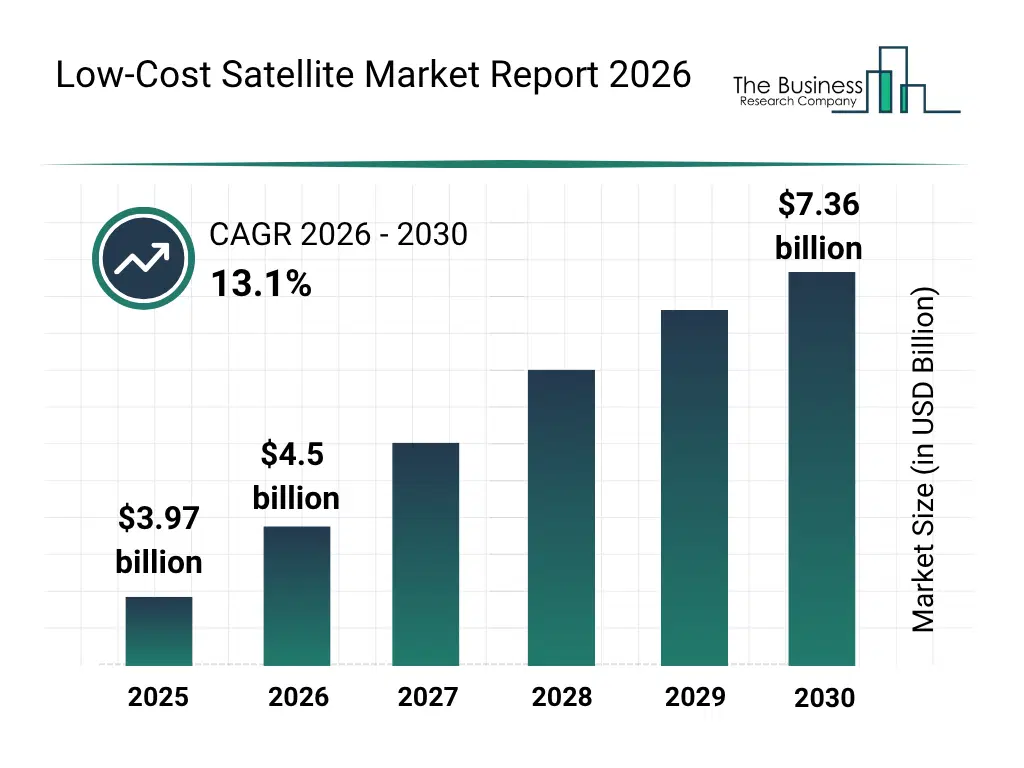
What Is The Low-Cost Satellite Market Size and Share 2026?
The low-cost satellite market size has grown rapidly in recent years. It will grow from $3.97 billion in 2025 to $4.5 billion in 2026 at a compound annual growth rate (CAGR) of 13.5%. The growth in the historic period can be attributed to increasing demand for affordable access to space, rising deployment of small satellites for earth observation, growing adoption of rideshare launch services, increasing demand for satellite-based communication services, expanding use of small satellites for technology demonstration.What Is The Low-Cost Satellite Market Growth Forecast?
The low-cost satellite market size is expected to see rapid growth in the next few years. It will grow to $7.36 billion in 2030 at a compound annual growth rate (CAGR) of 13.1%. The growth in the forecast period can be attributed to increasing demand for high-frequency earth imaging, rising demand for satellite connectivity in underserved areas, growing adoption of mass-produced satellite platforms, increasing demand for low-cost commercial space services, expanding deployment of small satellite constellations. Major trends in the forecast period include increasing adoption of standardized and modular satellite platforms, rising use of rideshare launch services for small satellites, growing demand for miniaturized satellite components, increasing adoption of rapid satellite manufacturing and testing processes, rising demand for cost-optimized satellite production and launch solutions.Tariff Impact On Low-Cost Satellite Market
Tariffs are impacting the Low-Cost Satellites market by increasing the cost of imported electronic components, optical and communication equipment, semiconductor-based devices, and specialized manufacturing equipment required for satellite production. This is increasing spacecraft manufacturing costs and potentially slowing deployment across commercial, government and defense, and research and academic applications, particularly in regions dependent on imported components such as Asia-Pacific and Europe. Hardware-intensive segments like nanosatellites, microsatellites, and minisatellites are most affected due to their reliance on globally sourced components and manufacturing inputs. However, tariffs are also encouraging local manufacturing, regional supplier diversification, standardized component sourcing, and increased investment in domestic space infrastructure ecosystems, creating greater long-term resilience in the market.
Global Low-Cost Satellite Market Segmentation
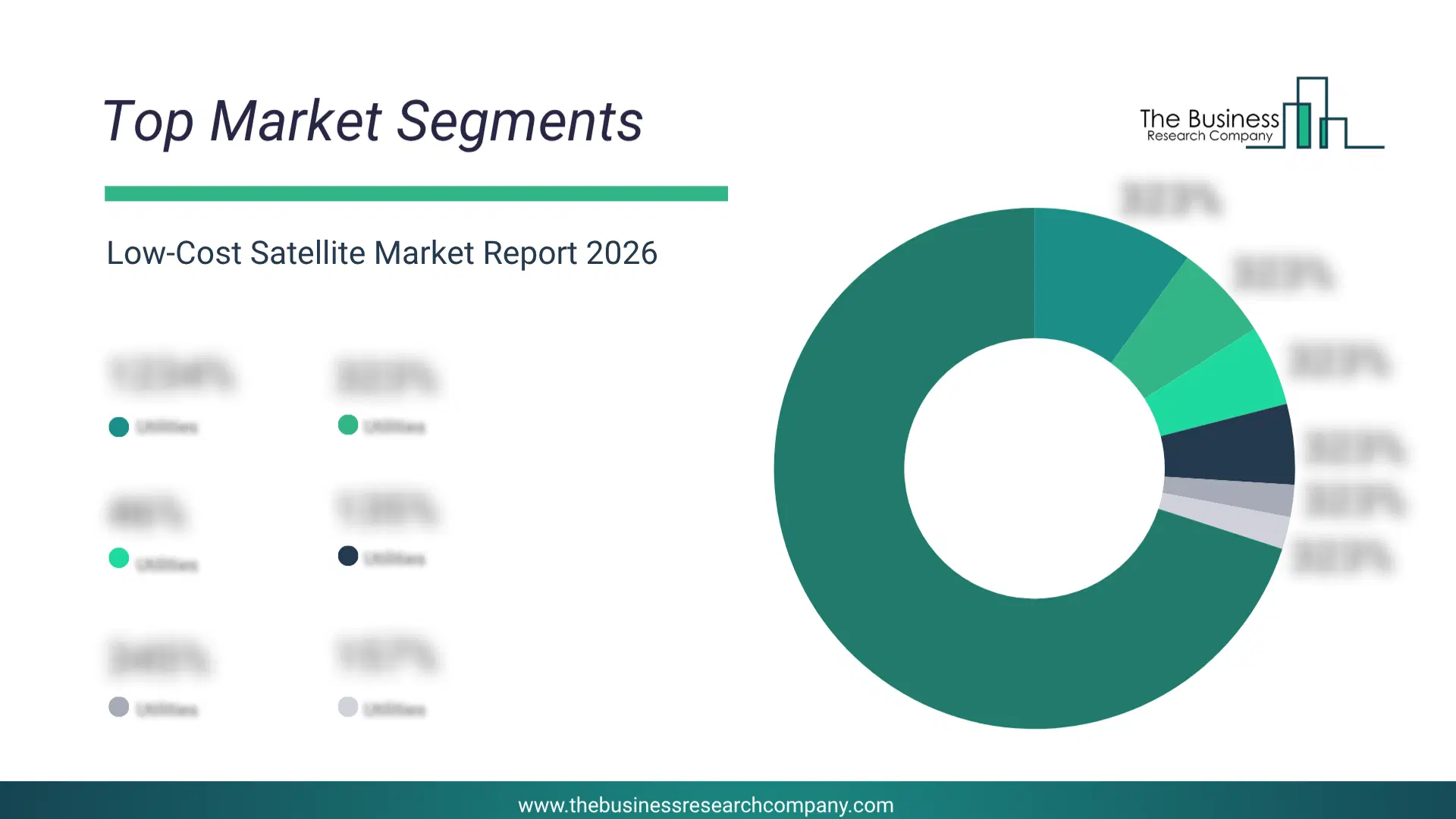
2) By Orbit Type: Low Earth Orbit, Medium Earth Orbit, Geostationary Orbit, Sun Synchronous Orbit 3) By Application: Earth Observation, Communication, Scientific Research, Technology Demonstration 4) By End Use: Commercial, Government And Defense, Research And Academic Subsegments: 1) By Nanosatellites: CubeSats, Pocket Satellites, Commercial Nanosatellites, Research Nanosatellites 2) By Microsatellites: Earth Observation Microsatellites, Communication Microsatellites, Scientific Microsatellites, Technology Demonstration Microsatellites 3) By Minisatellites: Imaging Minisatellites, Communication Minisatellites, Navigation Minisatellites 4) By Other Types: Picosatellites, Femtosatellites, Modular Small SatellitesWhat Is The Driver Of The Low-Cost Satellite Market?
The rising commercial and government space missions are expected to propel the growth of the low-cost satellite market going forward. Space missions refer to activities conducted by government agencies and commercial organizations involving the launch and operation of satellites and spacecraft for applications such as communications, Earth observation, navigation, scientific research, and national security. Commercial and government space missions are rising due to declining satellite launch costs, which are making access to space more affordable and enabling organizations to deploy satellites for communication, Earth observation, navigation, research, and defense applications. The rise in commercial and government space missions drives demand for low-cost satellites by increasing the need for affordable, rapidly deployable satellite solutions for communication, Earth observation, navigation, research, and defense applications. For instance, in August 2025, according to the Federal Aviation Administration (FAA), a US-based government agency, the agency marked its 1,000th licensed or permitted commercial space operation, highlighting the continued expansion of commercial spaceflight activities and the increasing frequency of space missions. Therefore, the rising commercial and government space missions are driving the growth of the low-cost satellite industry.Key Players In The Global Low-Cost Satellite Market
Major companies operating in the low-cost satellite market are Space Exploration Technologies Corp., Northrop Grumman Corporation, Sierra Space Corporation, OHB SE, Blue Origin LLC, Capella Space Corp., York Space Systems LLC, Planet Labs PBC, Spire Global Inc., EnduroSat AD, GomSpace A/S, Axelspace Corporation, AAC Clyde Space AB, Loft Orbital Technologies Inc., PixxelSpace Technologies Inc., Innovative Solutions In Space B.V., CubeSpace Satellite Systems Pty Ltd., Open Cosmos Ltd., SatRev S.A., Skykraft Pty Ltd., Berlin Space Technologies GmbH, Apex Technology Inc., HEX20 Pty Ltd., Astro Digital US Inc.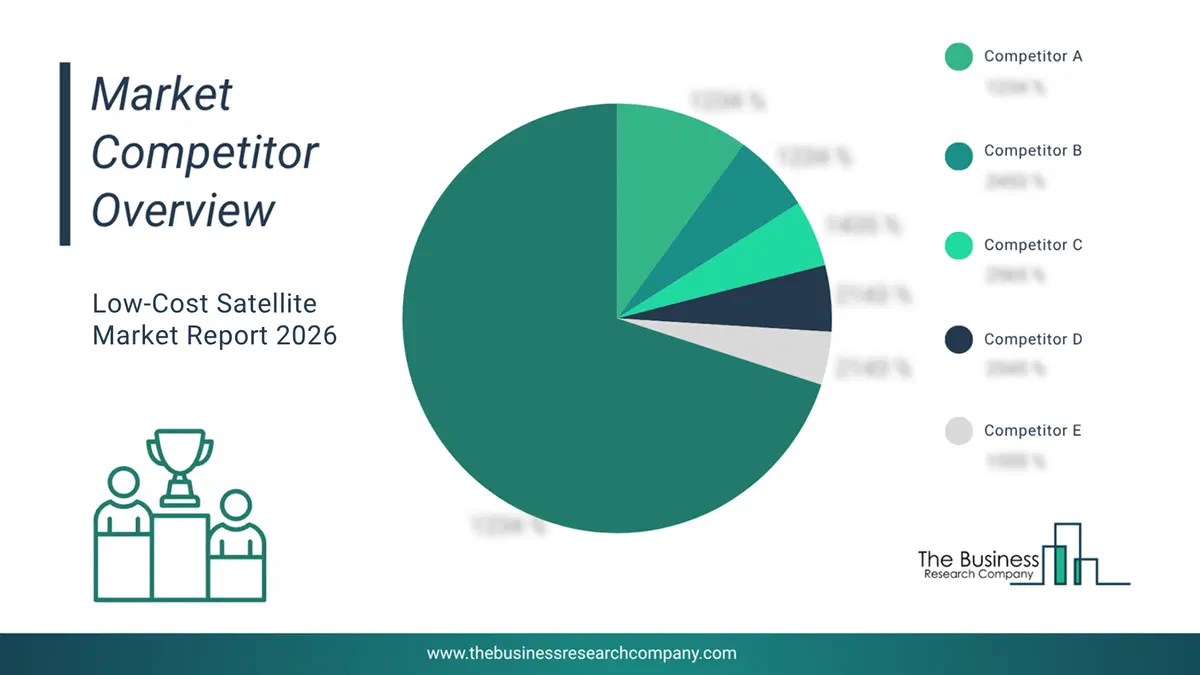
This chart is for illustrative purposes; the full report includes a detailed competitor analysis and comprehensive overview of the top 10 companies in the market.
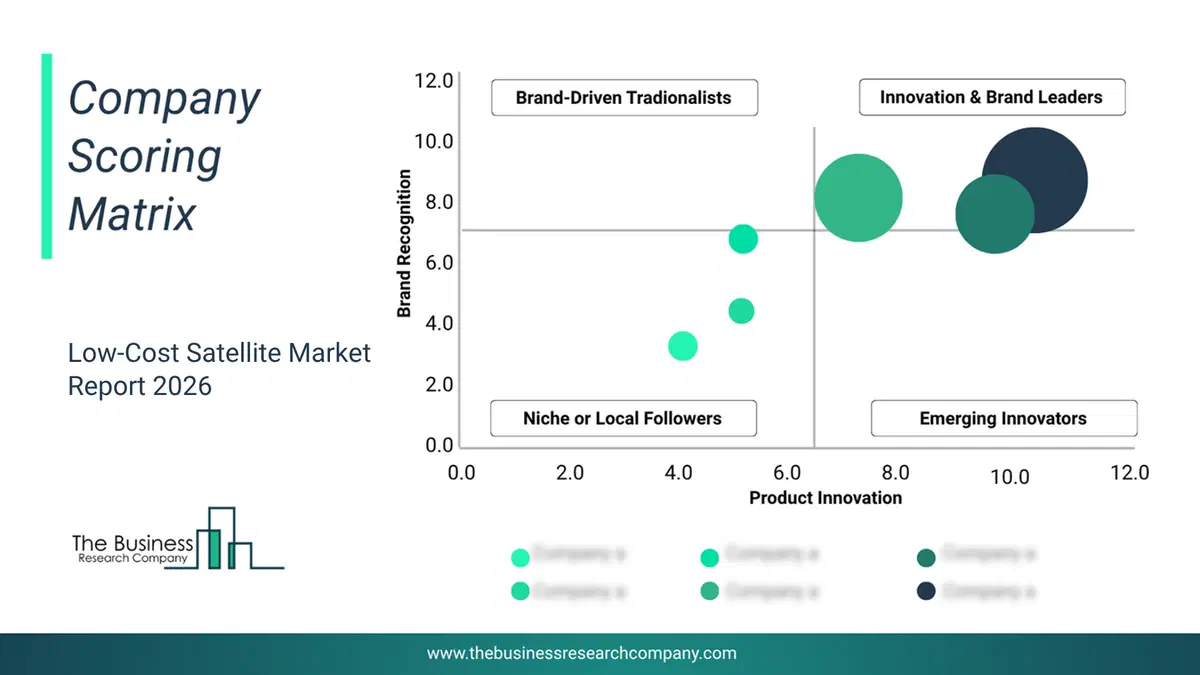
This chart maps companies by product innovation and brand strength, with bubble size indicating relative revenue, helping identify market leaders, challengers, and niche players. This is an illustrative chart; the full report provides a complete and accurate competitive analysis.
Global Low-Cost Satellite Market Trends and Insights
Major companies operating in the low-cost satellite market are focusing on developing innovative solutions, such as modular ESPA-class satellite technologies, to meet the rising demand for rapid satellite deployment, high-performance Earth observation, and scalable constellation missions. Modular ESPA-class satellite technologies refer to standardized, configurable small-satellite platforms designed to integrate with Evolved Expendable Launch Vehicle Secondary Payload Adapter (ESPA) launch interfaces, enabling flexible, cost-efficient, and rapid satellite deployment. For instance, in May 2025, EnduroSat, a Bulgaria-based satellite manufacturing company, secured $48.98 million (€43 million) to accelerate the production of its Gen3 ESPA-class satellites, an innovative satellite platform. The new 200–500 kg software-defined satellites feature advanced avionics, a fully modular cableless bus architecture, and are designed for rapid deployment of hyperspectral imaging, synthetic aperture radar (SAR), broadband, navigation, and other advanced payloads. The investment also supports the expansion of satellite manufacturing capacity and constellation-as-a-service offerings, enabling faster production, lower mission costs, and improved responsiveness for commercial and government Earth observation missions.What Are Latest Mergers And Acquisitions In The Low-Cost Satellite Market?
In September 2025, IHI Corporation, a Japan-based comprehensive heavy-industry manufacturer, collaborated with Surrey Satellite Technology Limited (SSTL) to develop an Earth observation satellite constellation to strengthen Japan’s intelligence, surveillance, and reconnaissance capabilities. With this collaboration, IHI aims to enhance Japan’s national security and resilience, promote the development of Japan’s space industry, and strengthen cooperation between Japan and the UK in Earth observation and ISR capabilities. Surrey Satellite Technology Limited is a UK-based small satellite manufacturer specializing in Earth observation and intelligence, surveillance, and reconnaissance satellites, as well as satellite operations and related services.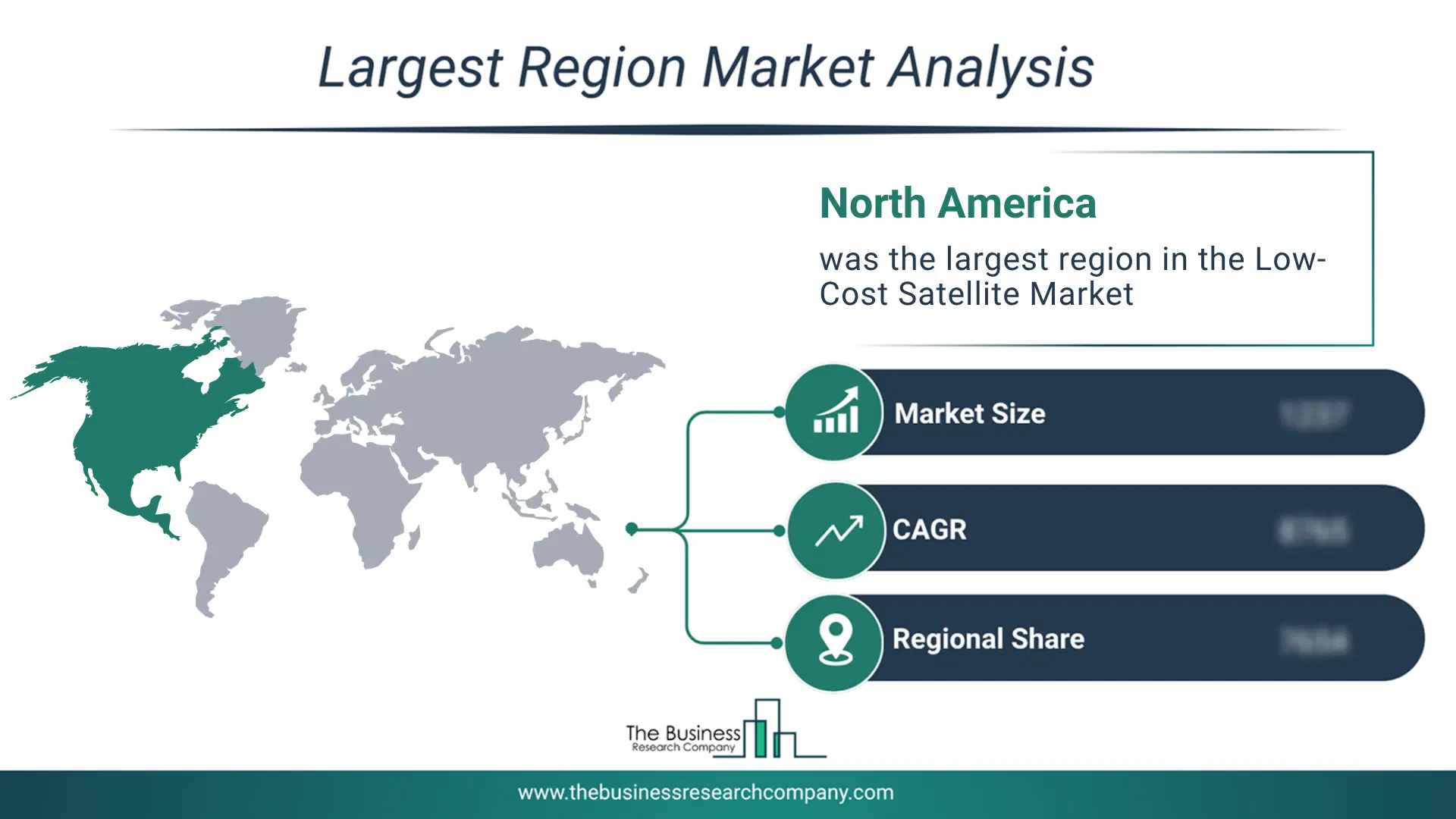
Regional Outlook/Insights
North America was the largest region in the low-cost satellite market in 2025. Asia-Pacific is expected to be the fastest-growing region in the forecast period. The regions covered in this market report are Asia-Pacific, South East Asia, Western Europe, Eastern Europe, North America, South America, Middle East, Africa. The countries covered in this market report are Australia, Brazil, China, France, Germany, India, Indonesia, Japan, Taiwan, Russia, South Korea, UK, USA, Canada, Italy, Spain.What Defines the Low-Cost Satellite Market?
The low-cost satellite market consists of sales of small low-cost satellites, microsatellites, nanosatellites, satellite communication payloads, onboard computers, satellite power systems, propulsion systems, attitude determination and control systems, antennas, and tracking and command systems. Values in this market are ‘factory gate’ values, that is, the value of goods sold by the manufacturers or creators of the goods, whether to other entities (including downstream manufacturers, wholesalers, distributors, and retailers) or directly to end customers. The value of goods in this market includes related services sold by the creators of the goods.How is Market Value Defined and Measured?
The market value is defined as the revenues that enterprises gain from the sale of goods and/or services within the specified market and geography through sales, grants, or donations in terms of the currency (in USD unless otherwise specified). The revenues for a specified geography are consumption values that are revenues generated by organizations in the specified geography within the market, irrespective of where they are produced. It does not include revenues from resales along the supply chain, either further along the supply chain or as part of other products.
This chart presents market attractiveness based on a quantitative evaluation of growth, competition, strategic alignment, and risk, offering a clear view of opportunity areas for decision-making. This chart is for illustrative purposes; the full report contains the complete analysis.

This chart highlights the Total Addressable Market (TAM) by estimating the maximum revenue opportunity using an assumption-driven approach, supporting strategic planning and opportunity sizing across markets. The chart is illustrative; the full report provides a more comprehensive analysis.
What Key Data and Analysis Are Included in the Low-Cost Satellite Market Report 2026?
The low-cost satellite market research report is one of a series of new reports from The Business Research Company that provides market statistics, including industry global market size, regional shares, competitors with the market share, detailed market segments, market trends and opportunities, and any further data you may need to thrive in the low-cost satellite industry. The market research report delivers a complete perspective of everything you need, with an in-depth analysis of the current and future state of the industry.Low-Cost Satellite Market Report Forecast Analysis
| Report Attribute | Details |
|---|---|
| Market Size Value In 2026 | $4.5 billion |
| Revenue Forecast In 2030 | $7.36 billion |
| Growth Rate | CAGR of 13.1% from 2026 to 2035 |
| Base Year For Estimation | 2025 |
| Actual Estimates/Historical Data | 2020-2025 |
| Forecast Period | 2026 - 2030 |
| Market Representation | Revenue in USD Billion and CAGR from 2026 to 2030 |
| Segments Covered | Type, Orbit Type, Application, End Use |
| Regional Scope | Asia-Pacific, Western Europe, Eastern Europe, North America, South America, Middle East, Africa |
| Country Scope | The countries covered in the report are Australia, Brazil, China, France, Germany, India, Indonesia, Japan, Taiwan, Russia, South Korea, UK, USA, Canada, Italy, Spain. |
| Customization Scope | Request for Customization |
| Pricing And Purchase Options | Explore Purchase Options |