
Low Dielectric Materials Market Report 2026
Global Outlook – By Type ( Thermoset, Thermoplastic, Ceramics ), By Material Type ( Fluoropolymer, Modified Polyphenylene Ether, Polyimide, Cyclic Olefin Copolymer, Cyanate Ester, Liquid Crystal Polymer, Other Material Types), By Application ( PCBs, Antenna, Microelectronics, Wire and Cable, Radome, Other Applications) – Market Size, Trends, Strategies, and Forecast to 2030
Low Dielectric Materials Market Overview
• Low Dielectric Materials market size has reached to $2.86 billion in 2025 • Expected to grow to $7.88 billion in 2030 at a compound annual growth rate (CAGR) of 22.6% • Growth Driver: Rise In The Production Of Electronics Is Anticipated To Fuel The Low Dielectric Material Market • Market Trend: Cutting-Edge Products For Enhanced High-Speed Communication • Asia-Pacific was the largest region in 2025.What Is Covered Under Low Dielectric Materials Market?
A low dielectric material refers to a poor conductor of electricity and also an efficient supporter of electrostatic fields. It can store electrical charges. These are made of solid, liquid, or gaseous substances such as paper, air, polyethylene film, or silicone oil. The low dielectric materials are used to reduce the loss of electric power for high frequency or power applications. Dielectric materials act as electric insulators that can hold electric charges. They serve as a medium for temporary charge storage. The main types of low dielectric materials markets are thermoset, thermoplastic, and ceramics. Thermoset are used in electronic fields as printed circuit boards and encapsulation due to their dimensional stability, and good chemical resistance, insulation, and adhesion properties. Thermoset materials refer to substances that will or have undergone a chemical reaction as a result of the action of heat, a catalyst, ultraviolet light, and other factors, leaving the substance in a state that is largely infusible. The different types of materials include fluoropolymer, modified polyphenylene ether, polyimide, cyclic olefin copolymer, cyanate ester, liquid crystal polymer, and others that are used in PCBs, antenna, microelectronics, wire and cable, radome, and others.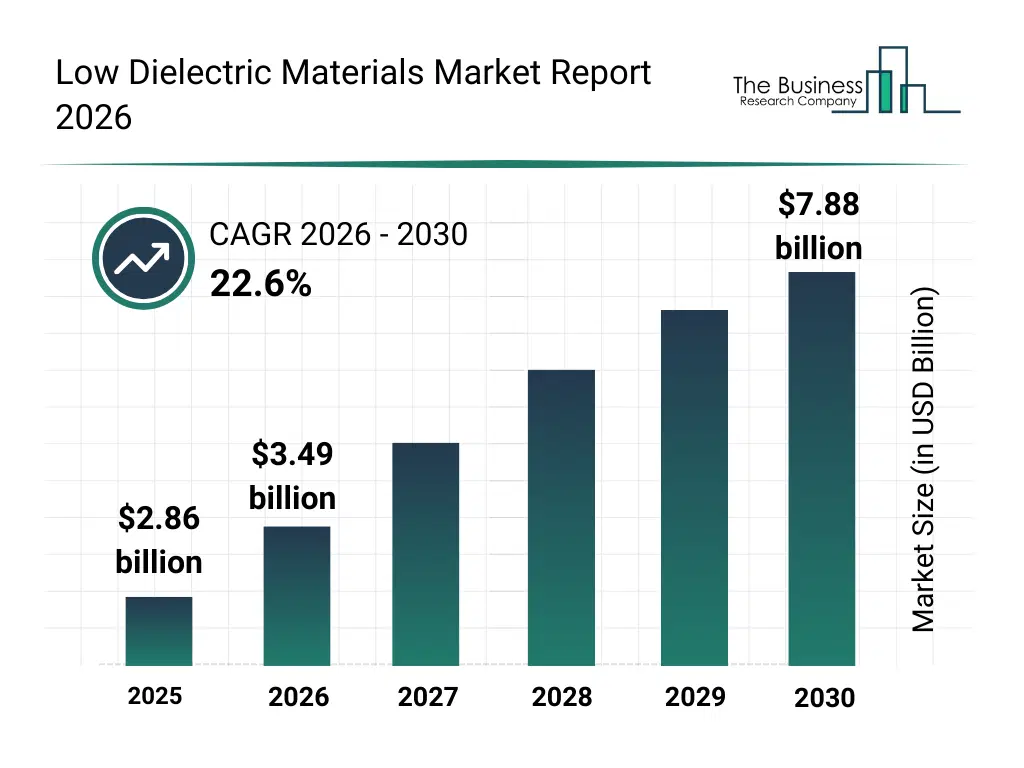
What Is The Low Dielectric Materials Market Size 2026 And Growth Rate?
The low dielectric materials market size has grown exponentially in recent years. It will grow from $2.86 billion in 2025 to $3.49 billion in 2026 at a compound annual growth rate (CAGR) of 22.1%. The growth in the historic period can be attributed to growth in pcb manufacturing, increasing need for insulation in microelectronics, rise in high frequency communication systems, early adoption of dielectric materials in aerospace, growing demand for lightweight polymer materials.What Is The Low Dielectric Materials Market Growth Forecast?
The low dielectric materials market size is expected to see exponential growth in the next few years. It will grow to $7.88 billion in 2030 at a compound annual growth rate (CAGR) of 22.6%. The growth in the forecast period can be attributed to rising deployment of 5g and advanced connectivity, increasing use of dielectric materials in autonomous systems, growth in semiconductor miniaturization, rising demand for high speed data transmission components, increasing focus on sustainable material development. Major trends in the forecast period include increasing use of advanced materials for high frequency electronic applications, rising demand for eco friendly and low loss dielectric materials, advancement in precision manufacturing for electronic insulation components, growing integration of low dielectric materials in iot and connected devices, increasing adoption of high performance polymers for autonomous and smart systems.
Global Low Dielectric Materials Market Segmentation
1) By Type: Thermoset, Thermoplastic, Ceramics 2) By Material Type: Fluoropolymer, Modified Polyphenylene Ether, Polyimide, Cyclic Olefin Copolymer, Cyanate Ester, Liquid Crystal Polymer, Other Material Types 3) By Application: PCBs, Antenna, Microelectronics, Wire and Cable, Radome, Other Applications Subsegments: 1) By Thermosets: Benzocyclobutene (BCB), Cyanate Ester, Low-k Epoxy Resin, Silicone Resins, Modified Polyimide 2) By Thermoplastics: Fluoropolymers (PTFE, FEP, PFA, ETFE), Cyclic Olefin Copolymer (COC/COP), Liquid Crystal Polymer (LCP), Modified Polyphenylene Ether (mPPE), Polyetheretherketone 3) By Ceramics: Low-k Advanced Ceramics, Low-k Glass Ceramics, Engineered Porous Low-k CeramicsWhat Is The Driver Of The Low Dielectric Materials Market?
The rise in the production of electronics is expected to propel the growth of the low-dielectric material market going forward. Electronics refers to the branch of physics and technology focused on the study, design, and application of devices and systems involving the controlled flow of electrons. Low dielectric materials are used in electronics to reduce signal interference and enhance the efficiency of electronic components by minimizing the capacitance effect. For instance, in May 2023, according to the reports published by the Office for National Statistics, a UK-based organization, in March 2023, monthly production output increased by 0.7%, with manufacturing being the primary contributor. Specifically, the manufacture of computer, electronic, and optical products rose by 3.3%, contributing positively to the overall production index. Therefore, the rise in electronics production is driving the low dielectric material industry.Key Players In The Global Low Dielectric Materials Market
Major companies operating in the low dielectric materials market are Daikin Industries Ltd., Nishimura Advanced Ceramics Co Ltd., Idemitsu Kosan Co Ltd., Saudi Basic Industries Corporation (SABIC), Applied Materials Inc., Sumitomo Chemical Co Ltd., Asahi Kasei Corporation, Shin-Etsu Chemical Co Ltd., TDK Corporation, Murata Manufacturing Co Ltd., DuPont (E.I. du Pont de Nemours and Company), The Chemours Company, Showa Denko Materials Co Ltd., JSR Corporation, Zeon Corporation, Tokyo Ohka Kogyo Co Ltd., Hindustan Fluorocarbons Limited, CeramTec GmbH, DNF Co Ltd., Gelest Inc.
This chart is for illustrative purposes; the full report includes a detailed competitor analysis and comprehensive overview of the top 10 companies in the market.
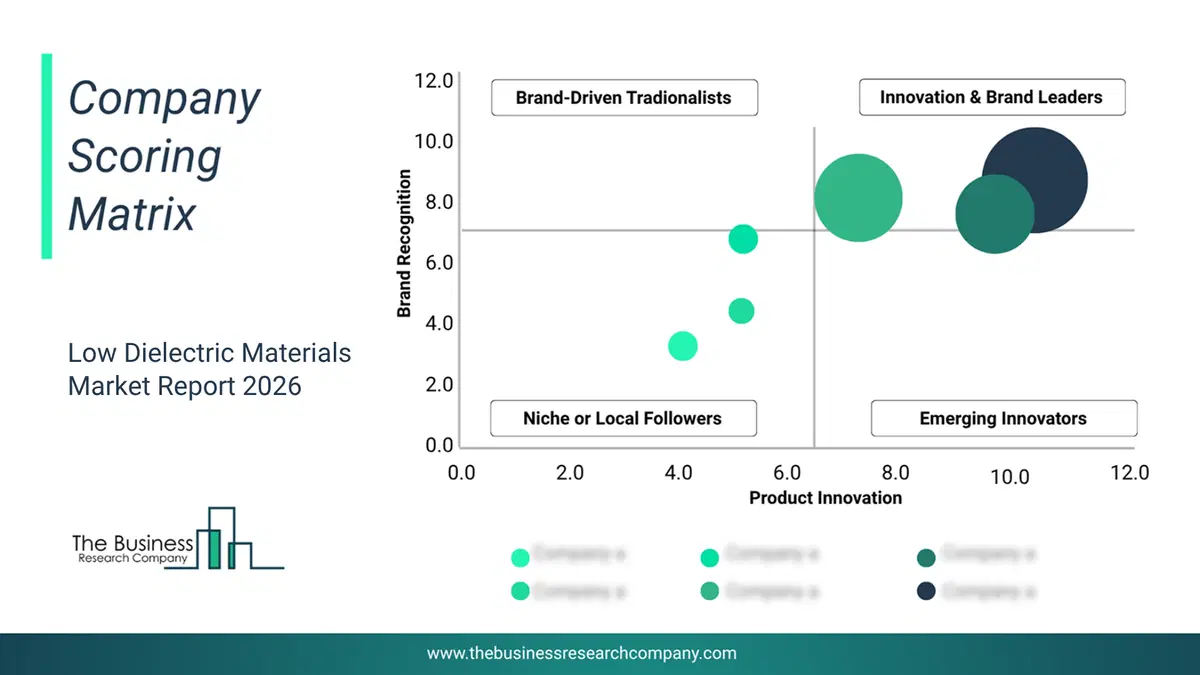
This chart maps companies by product innovation and brand strength, with bubble size indicating relative revenue, helping identify market leaders, challengers, and niche players. This is an illustrative chart; the full report provides a complete and accurate competitive analysis.
Global Low Dielectric Materials Market Trends and Insights
Major companies in the low-dielectric material market are focused on developing cutting-edge products, such as advanced dielectric and thermal solutions, to enhance PCB performance and reliability by introducing low-loss, high-thermal-conductivity materials. Advanced Dielectric and Thermal Solutions are innovative materials that enhance electrical system performance by improving thermal management and dielectric properties. For instance, in September 2024, Ventec International Group, a China-based manufacturer of electronic components, launched Pro-bond and Thermal-bond materials. These materials are essential for advanced multilayer PCBs, which are critical in computing and networking applications, including high-performance motherboards and cellular network power amplifiers. This initiative aims to enhance performance in low-dielectric materials, particularly for high-speed applications in printed circuit boards (PCBs).What Are Latest Mergers And Acquisitions In The Low Dielectric Materials Market?
In May 2024, JSR Corporation, a Japan-based provider of semiconductor materials and digital solutions, acquired Yamanaka Hutech Corporation for an undisclosed amount. With this acquisition, JSR aimed to expand its semiconductor materials portfolio and strengthen its position in the deposition field, enhancing product development and global technical support. Yamanaka Hutech Corporation is a Japan-based company that specializes in manufacturing low dielectric materials, including products such as low-K film and gas barrier film used in semiconductor manufacturing processes.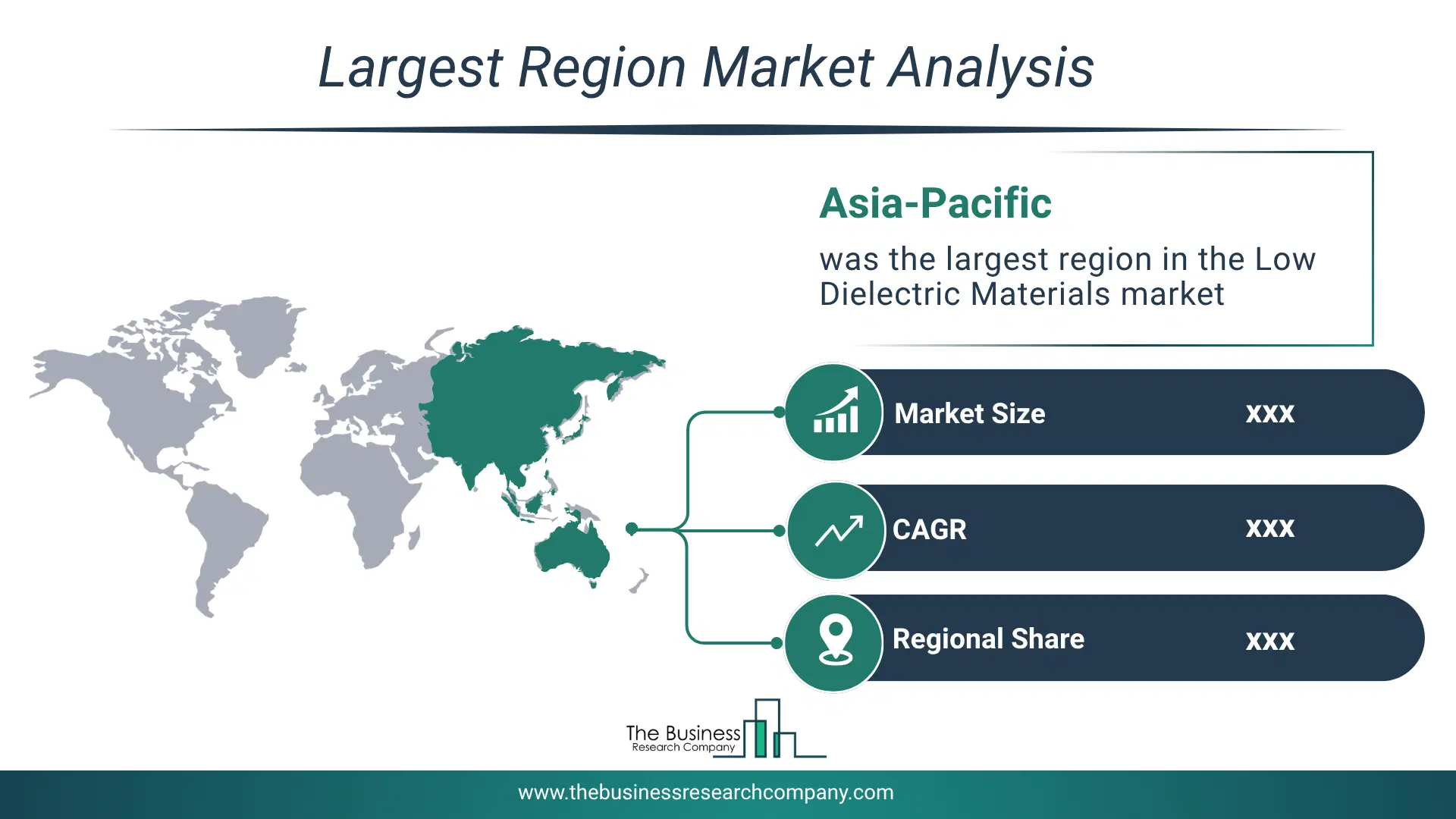
Regional Outlook
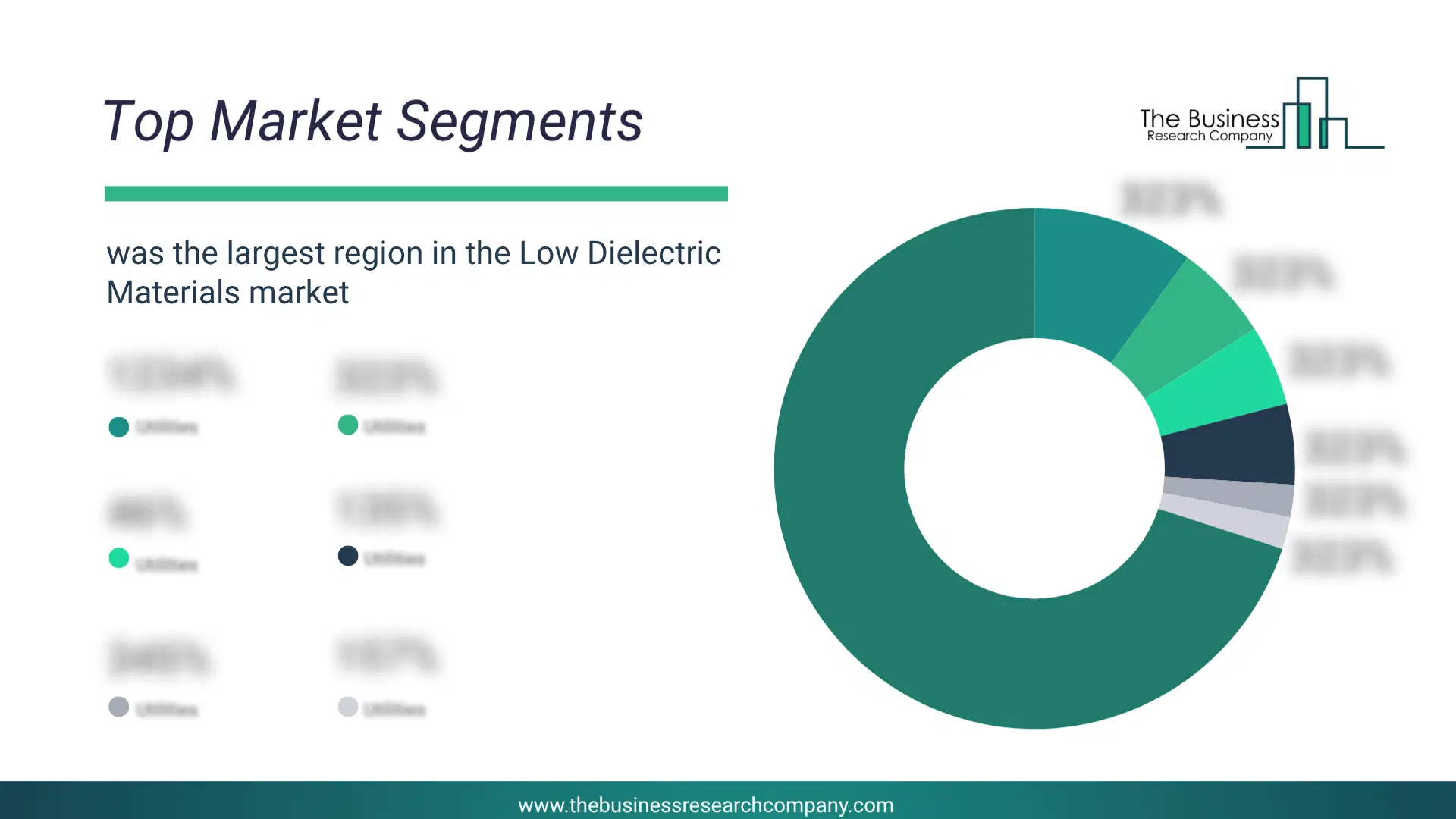
Asia-Pacific was the largest region in the low dielectric materials market in 2025. The regions covered in this market report are Asia-Pacific, South East Asia, Western Europe, Eastern Europe, North America, South America, Middle East, Africa. The countries covered in this market report are Australia, Brazil, China, France, Germany, India, Indonesia, Japan, Taiwan, Russia, South Korea, UK, USA, Canada, Italy, Spain.What Defines the Low Dielectric Materials Market?
The low dielectric material market consists of sales of ceramics, benzocyclobutene (BCB), SiLK, SLK, and polyetheretherketone (PEEK). Values in this market are ‘factory gate’ values, that is the value of goods sold by the manufacturers or creators of the goods, whether to other entities (including downstream manufacturers, wholesalers, distributors and retailers) or directly to end customers. The value of goods in this market includes related services sold by the creators of the goods.How is Market Value Defined and Measured?
The market value is defined as the revenues that enterprises gain from the sale of goods and/or services within the specified market and geography through sales, grants, or donations in terms of the currency (in USD unless otherwise specified). The revenues for a specified geography are consumption values that are revenues generated by organizations in the specified geography within the market, irrespective of where they are produced. It does not include revenues from resales along the supply chain, either further along the supply chain or as part of other products.
This chart presents market attractiveness based on a quantitative evaluation of growth, competition, strategic alignment, and risk, offering a clear view of opportunity areas for decision-making. This chart is for illustrative purposes; the full report contains the complete analysis.

This chart highlights the Total Addressable Market (TAM) by estimating the maximum revenue opportunity using an assumption-driven approach, supporting strategic planning and opportunity sizing across markets. The chart is illustrative; the full report provides a more comprehensive analysis.
What Key Data and Analysis Are Included in the Low Dielectric Materials Market Report 2026?
The low dielectric materials market research report is one of a series of new reports from The Business Research Company that provides market statistics, including industry global market size, regional shares, competitors with the market share, detailed market segments, market trends and opportunities, and any further data you may need to thrive in the low dielectric materials industry. The market research report delivers a complete perspective of everything you need, with an in-depth analysis of the current and future state of the industry.Low Dielectric Materials Market Report Forecast Analysis
| Report Attribute | Details |
|---|---|
| Market Size Value In 2026 | $3.49 billion |
| Revenue Forecast In 2030 | $7.88 billion |
| Growth Rate | CAGR of 22.6% from 2026 to 2030 |
| Base Year For Estimation | 2025 |
| Actual Estimates/Historical Data | 2020-2025 |
| Forecast Period | 2026 - 2030 |
| Market Representation | Revenue in USD Billion and CAGR from 2026 to 2030 |
| Segments Covered | Type, Material Type, Application |
| Regional Scope | Asia-Pacific, Western Europe, Eastern Europe, North America, South America, Middle East, Africa |
| Country Scope | The countries covered in the report are Australia, Brazil, China, France, Germany, India, Indonesia, Japan, Taiwan, Russia, South Korea, UK, USA, Canada, Italy, Spain. |
| Key Companies Profiled | Daikin Industries Ltd., Nishimura Advanced Ceramics Co Ltd., Idemitsu Kosan Co Ltd., Saudi Basic Industries Corporation (SABIC), Applied Materials Inc., Sumitomo Chemical Co Ltd., Asahi Kasei Corporation, Shin-Etsu Chemical Co Ltd., TDK Corporation, Murata Manufacturing Co Ltd., DuPont (E.I. du Pont de Nemours and Company), The Chemours Company, Showa Denko Materials Co Ltd., JSR Corporation, Zeon Corporation, Tokyo Ohka Kogyo Co Ltd., Hindustan Fluorocarbons Limited, CeramTec GmbH, DNF Co Ltd., Gelest Inc. |
| Customization Scope | Request for Customization |
| Pricing And Purchase Options | Explore Purchase Options |