
Low-End Field-Programmable Gate Array (FPGA) Market Report 2026
Global Outlook – By Type (Electrically Erasable Programmable Read Only Memory, Antifuse, Static Random Access Memory, Flash, Other Types), By Node Size (Less Than 28 Nanometre, 28 To 90 Nanometre, More Than 90 Nanometre), By Configuration (Standalone Field Programmable Gate Arrays, Embedded Field Programmable Gate Arrays), By Logic Density (Below 10,000 Logic Cells, 10,000 To 50,000 Logic Cells, Above 50,000 Logic Cells), By End User (Electronics And Semiconductor, Telecommunications, Automotive, Industrial Manufacturing, Healthcare, Aerospace And Defense, Consumer Electronics, Other End Users) – Market Size, Trends, Strategies, and Forecast to 2030
Low-End Field-Programmable Gate Array (FPGA) Market Overview
• Low-End Field-Programmable Gate Array (FPGA) market size has reached to $4.16 billion in 2025 • Expected to grow to $7.35 billion in 2030 at a compound annual growth rate (CAGR) of 11.9% • Growth Driver: Increasing Industrial Automation Driving The Market Growth Due To Enhancing Efficiency And Productivity • Market Trend: Innovations In Low-Power FPGA Technology Improve Performance And Efficiency For Edge And Embedded Applications • North America was the largest region in 2025 and Asia-Pacific is the fastest growing region.What Is Covered Under Low-End Field-Programmable Gate Array (FPGA) Market?
A low-end field-programmable gate array (FPGA) is a programmable integrated circuit designed to implement custom digital logic using a relatively small number of logic elements, limited memory, and basic input or output resources. It is optimized for cost-effective, low-power, and simple programmable applications that do not require the high performance or complexity of mid-range or high-end FPGAs. The main types of low-end field programmable gate arrays (FPGA) include electrically erasable programmable read only memory, antifuse, static random access memory, flash, and other types. Electrically erasable programmable read only memory refers to non volatile memory technology that can be electrically erased and reprogrammed, enabling flexible configuration and data retention without continuous power. These devices are manufactured using node sizes of less than 28 nanometre, 28 to 90 nanometre, and more than 90 nanometre, and are available as standalone field programmable gate arrays and embedded field programmable gate arrays. They support logic densities below 10,000 logic cells, 10,000 to 50,000 logic cells, and above 50,000 logic cells, while the end-users electronics and semiconductor, telecommunications, automotive, industrial manufacturing, healthcare, aerospace and defense, consumer electronics, and others.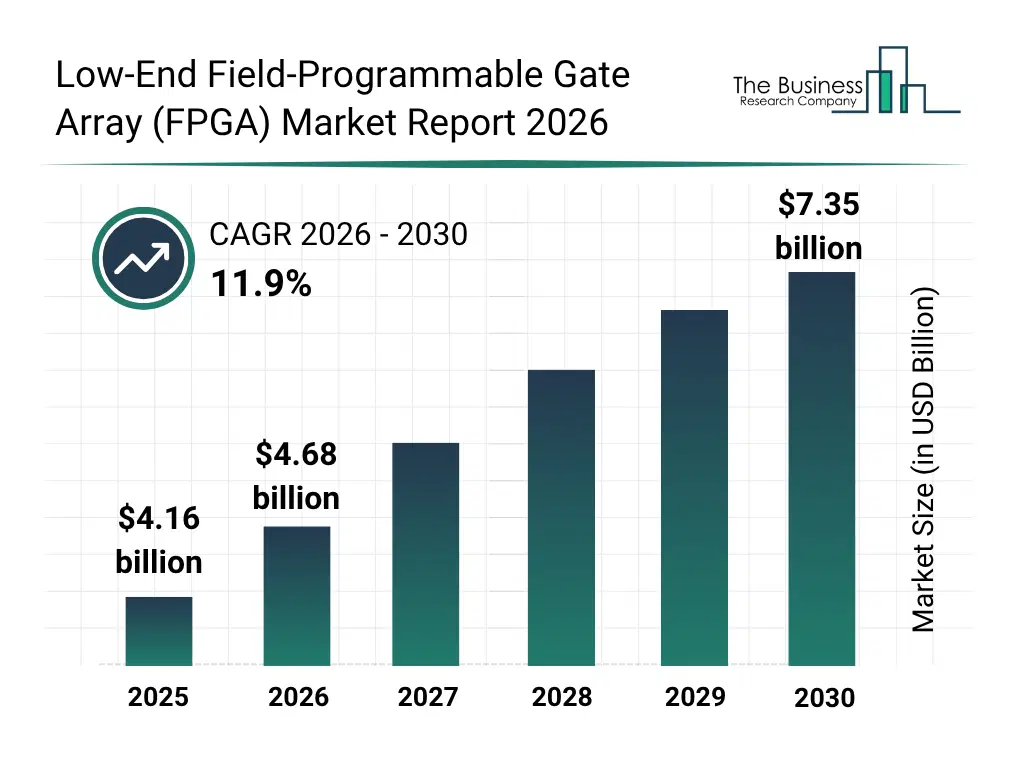
What Is The Low-End Field-Programmable Gate Array (FPGA) Market Size and Share 2026?
The low-end field-programmable gate array (FPGA) market size has grown rapidly in recent years. It will grow from $4.16 billion in 2025 to $4.68 billion in 2026 at a compound annual growth rate (CAGR) of 12.4%. The growth in the historic period can be attributed to growing demand for cost-effective programmable logic, increasing adoption of low-power electronic components, expansion of embedded control applications, rising demand for configurable digital logic, increasing use of FPGAs in telecommunications equipment.What Is The Low-End Field-Programmable Gate Array (FPGA) Market Growth Forecast?
The low-end field-programmable gate array (FPGA) market size is expected to see rapid growth in the next few years. It will grow to $7.35 billion in 2030 at a compound annual growth rate (CAGR) of 11.9%. The growth in the forecast period can be attributed to increasing demand for energy-efficient programmable devices, rising adoption of advanced low-cost semiconductor architectures, growing demand for flexible hardware customization, expanding deployment of programmable logic in compact electronic systems, increasing demand for high-reliability low-end FPGA solutions. Major trends in the forecast period include increasing adoption of cost-optimized low-end FPGA architectures, growing use of low-power programmable logic solutions, rising integration of embedded memory resources in FPGAs, increasing demand for smaller and more compact FPGA packages, expanding use of reprogrammable logic in resource-constrained applications.
Global Low-End Field-Programmable Gate Array (FPGA) Market Segmentation
1) By Type: Electrically Erasable Programmable Read Only Memory, Antifuse, Static Random Access Memory, Flash, Other Types 2) By Node Size: Less Than 28 Nanometre, 28 To 90 Nanometre, More Than 90 Nanometre 3) By Configuration: Standalone Field Programmable Gate Arrays, Embedded Field Programmable Gate Arrays 4) By Logic Density: Below 10,000 Logic Cells, 10,000 To 50,000 Logic Cells, Above 50,000 Logic Cells 5) By End User: Electronics And Semiconductor, Telecommunications, Automotive, Industrial Manufacturing, Healthcare, Aerospace And Defense, Consumer Electronics, Other End Users Subsegments: 1) By Electrically Erasable Programmable Read Only Memory: Serial Configuration Memory, Parallel Configuration Memory, Single Time Programmable Memory, Multiple Time Reprogrammable Memory, Low Power Configuration Memory 2) By Antifuse: One Time Programmable Antifuse, Metal To Metal Antifuse, Oxide Nitride Oxide Antifuse, High Reliability Antifuse, Radiation Hardened Antifuse 3) By Static Random Access Memory: Volatile Configuration Memory, In System Programmable Memory, High Density Memory, Low Power Memory, High Speed Memory 4) By Flash: Embedded Flash Memory, External Flash Configuration Memory, Serial Flash Memory, Parallel Flash Memory, Low Power Flash Memory 5) By Other Types: Ferroelectric Memory, Magnetoresistive Memory, Phase Change Memory, Resistive Memory, Hybrid Configuration MemoryWhat Is The Driver Of The Low-End Field-Programmable Gate Array (FPGA) Market?
The increasing industrial automation is expected to propel the growth of the low-end field-programmable gate array market going forward. Industrial automation refers to the use of control systems, robotics, and information technologies to operate industrial processes and machinery with minimal human intervention. Adoption of industrial automation is rising due to the critical need to bridge severe labor shortages and skill gaps, enabling companies to maintain continuous production output without being constrained by human workforce availability. Increasing industrial automation drives demand for low-end FPGAs due to their cost-effective, real-time parallel processing and reconfigurable flexibility for simple control tasks in high-volume edge devices. For instance, in September 2023, according to the World Robotics report published by the International Federation of Robotics, a Germany-based professional non-profit organization, there were 553,052 industrial robot installations in factories worldwide, marking a 5% year-on-year growth rate in 2022. Therefore, increasing industrial automation is driving the growth of the low-end field-programmable gate array market.Key Players In The Global Low-End Field-Programmable Gate Array (FPGA) Market
Major companies operating in the low-end field-programmable gate array (FPGA) market are Advanced Micro Devices Inc., QuickLogic Corporation, Microchip Technology Incorporated, Hercules Microelectronics (Beijing) Co. Ltd., Lattice Semiconductor Corporation, Shanghai Fudan Microelectronics Group Co. Ltd., iWave Systems Technologies Pvt. Ltd., Shanghai Anlogic Infotech Co. Ltd., Efinix Inc., Shenzhen Pango Microsystems Co. Ltd., Sundance Multiprocessor Technology Ltd., Guangdong Gowin Semiconductor Corporation, Rapid Silicon Inc., Trenz Electronic GmbH, Cologne Chip AG, Enclustra GmbH, AGM Microelectronics Inc., Shenzhen Sipeed Technology Co. Ltd., Achronix Semiconductor Corporation
This chart is for illustrative purposes; the full report includes a detailed competitor analysis and comprehensive overview of the top 10 companies in the market.
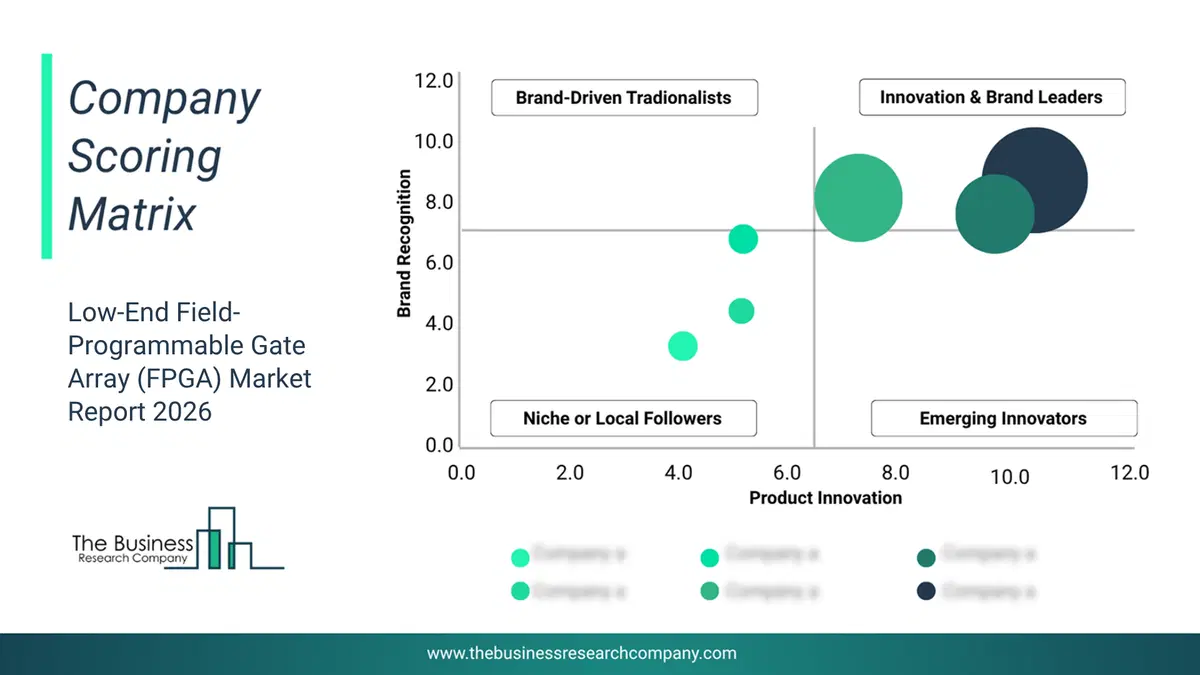
This chart maps companies by product innovation and brand strength, with bubble size indicating relative revenue, helping identify market leaders, challengers, and niche players. This is an illustrative chart; the full report provides a complete and accurate competitive analysis.
Global Low-End Field-Programmable Gate Array (FPGA) Market Trends and Insights
Major companies operating in the low-end field-programmable gate array (FPGA) market are focusing on developing advanced low-power and cost-optimized programmable devices to improve performance, reduce power consumption, and support cost-effective edge and embedded computing applications. A low-power and cost-optimized programmable device is a configurable integrated circuit that delivers flexible logic processing while minimizing power consumption and overall system cost. For instance, in March 2025, Altera, a US-based FPGA manufacturer, launched the Agilex 3 FPGA family, a new generation of low-power and cost-optimized programmable devices. It is built on Intel 7 process technology with second-generation HyperFlex architecture. The Agilex 3 family delivers higher fabric performance, lower power consumption, compact form factors, and enhanced connectivity, enabling efficient deployment across embedded, industrial, intelligent edge, and communication applications.What Are Latest Mergers And Acquisitions In The Low-End Field-Programmable Gate Array (FPGA) Market?
In September 2025, Silver Lake Technology Management LLC, a US-based private equity firm, acquired a 51% stake in Altera for $4.46 billion. With this acquisition, Silver Lake aims to establish Altera as an independent pure-play FPGA company, accelerate innovation in programmable semiconductor solutions, strengthen its position in AI-driven and edge computing markets, and support the company's long-term growth across industrial, communications, aerospace, and data center applications. Altera is a United States-based company that provides a wide range of low-end and power-cost-optimized field-programmable gate arrays.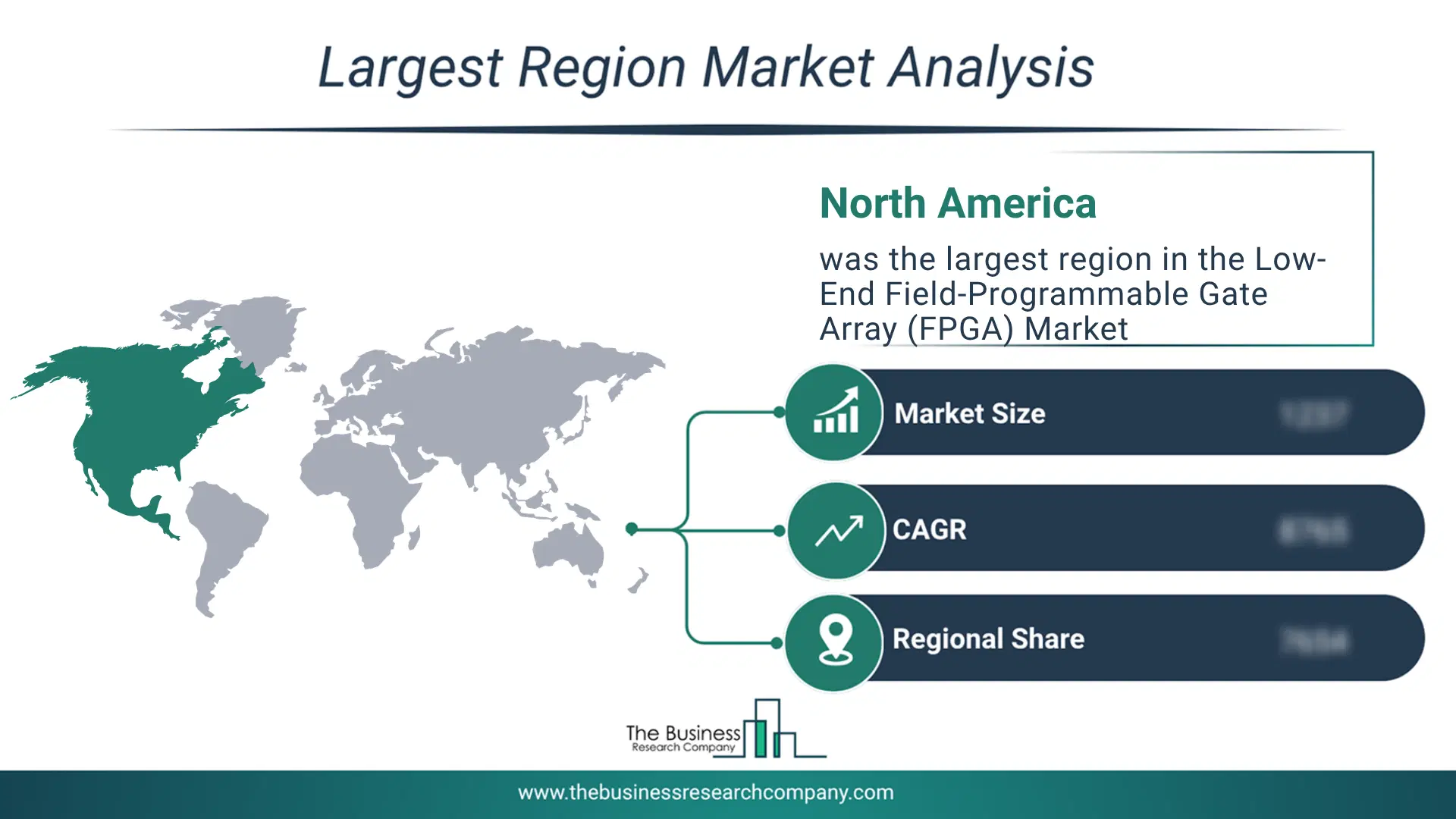
Regional Insights
North America was the largest region in the low-end field-programmable gate array (FPGA) market in 2025. Asia-Pacific is expected to be the fastest-growing region in the forecast period. The regions covered in this market report are Asia-Pacific, South East Asia, Western Europe, Eastern Europe, North America, South America, Middle East, Africa. The countries covered in this market report are Australia, Brazil, China, France, Germany, India, Indonesia, Japan, Taiwan, Russia, South Korea, UK, USA, Canada, Italy, Spain.What Defines the Low-End Field-Programmable Gate Array (FPGA) Market?
The low-end field-programmable gate array (FPGA) market consists of sales of low-end field-programmable gate array chips, low-end field-programmable gate array development boards and evaluation kits, field-programmable gate array programming devices, and field-programmable gate array system-on-module. Values in this market are ‘factory gate’ values, that is, the value of goods sold by the manufacturers or creators of the goods, whether to other entities (including downstream manufacturers, wholesalers, distributors and retailers) or directly to end customers. The value of goods in this market includes related services sold by the creators of the goods.How is Market Value Defined and Measured?
The market value is defined as the revenues that enterprises gain from the sale of goods and/or services within the specified market and geography through sales, grants, or donations in terms of the currency (in USD unless otherwise specified). The revenues for a specified geography are consumption values that are revenues generated by organizations in the specified geography within the market, irrespective of where they are produced. It does not include revenues from resales along the supply chain, either further along the supply chain or as part of other products.
This chart presents market attractiveness based on a quantitative evaluation of growth, competition, strategic alignment, and risk, offering a clear view of opportunity areas for decision-making. This chart is for illustrative purposes; the full report contains the complete analysis.

This chart highlights the Total Addressable Market (TAM) by estimating the maximum revenue opportunity using an assumption-driven approach, supporting strategic planning and opportunity sizing across markets. The chart is illustrative; the full report provides a more comprehensive analysis.
What Key Data and Analysis Are Included in the Low-End Field-Programmable Gate Array (FPGA) Market Report 2026?
The low-end field-programmable gate array (fpga) market research report is one of a series of new reports from The Business Research Company that provides market statistics, including industry global market size, regional shares, competitors with the market share, detailed market segments, market trends and opportunities, and any further data you may need to thrive in the low-end field-programmable gate array (fpga) industry. The market research report delivers a complete perspective of everything you need, with an in-depth analysis of the current and future state of the industry.Low-End Field-Programmable Gate Array (FPGA) Market Report Forecast Analysis
| Report Attribute | Details |
|---|---|
| Market Size Value In 2026 | $4.68 billion |
| Revenue Forecast In 2030 | $7.35 billion |
| Growth Rate | CAGR of 11.9% from 2026 to 2030 |
| Base Year For Estimation | 2025 |
| Actual Estimates/Historical Data | 2020-2025 |
| Forecast Period | 2026 - 2030 |
| Market Representation | Revenue in USD Billion and CAGR from 2026 to 2030 |
| Segments Covered | Type, Node Size, Configuration, Logic Density, End User |
| Regional Scope | Asia-Pacific, Western Europe, Eastern Europe, North America, South America, Middle East, Africa |
| Country Scope | The countries covered in the report are Australia, Brazil, China, France, Germany, India, Indonesia, Japan, Taiwan, Russia, South Korea, UK, USA, Canada, Italy, Spain. |
| Key Companies Profiled | Advanced Micro Devices Inc., QuickLogic Corporation, Microchip Technology Incorporated, Hercules Microelectronics (Beijing) Co. Ltd., Lattice Semiconductor Corporation, Shanghai Fudan Microelectronics Group Co. Ltd., iWave Systems Technologies Pvt. Ltd., Shanghai Anlogic Infotech Co. Ltd., Efinix Inc., Shenzhen Pango Microsystems Co. Ltd., Sundance Multiprocessor Technology Ltd., Guangdong Gowin Semiconductor Corporation, Rapid Silicon Inc., Trenz Electronic GmbH, Cologne Chip AG, Enclustra GmbH, AGM Microelectronics Inc., Shenzhen Sipeed Technology Co. Ltd., Achronix Semiconductor Corporation |
| Customization Scope | Request for Customization |
| Pricing And Purchase Options | Explore Purchase Options |