
Low-Glycemic Sports Drinks Market Report 2026
Global Outlook – By Product Type (Ready-To-Drink, Powdered Mix, Concentrates), By Ingredient (Natural Sweeteners, Artificial Sweeteners, Electrolytes, Vitamins And Minerals, Other Ingredients), By Flavor (Citrus, Berry, Tropical, Mixed Fruit, Other Flavors), By Distribution Channel (Supermarkets And Hypermarkets, Convenience Stores, Online Retail, Specialty Stores, Other Distribution Channels), By End-User (Athletes, Fitness Enthusiasts, Diabetics, Other End-Users) – Market Size, Trends, Strategies, and Forecast to 2035
Low-Glycemic Sports Drinks Market Overview
• Low-Glycemic Sports Drinks market size has reached to $2.07 billion in 2025 • Expected to grow to $3.45 billion in 2030 at a compound annual growth rate (CAGR) of 10.8% • Growth Driver: Growing Diabetes Prevalence Driving Demand For The Market Due To Rising Need For Blood Sugar Management And Healthier Energy Hydration Options • North America was the largest region in 2025 and Asia-Pacific is the fastest growing region.What Is Covered Under Low-Glycemic Sports Drinks Market?
Low-glycemic sports drinks are specially designed beverages containing carbohydrates with a low glycemic index (GI), enabling a gradual release of glucose into the bloodstream instead of sharp spikes. They are intended to deliver steady energy, enhance endurance, and support stable metabolism during physical activity, helping maintain consistent performance over time. The main product types of low-glycemic sports drinks include ready-to-drink, powdered mix, and concentrates. Ready-to-drink refer to beverages formulated with controlled sugar content to provide hydration and energy support while minimizing blood glucose spikes. These products are formulated using ingredients such as natural sweeteners, artificial sweeteners, electrolytes, vitamins and minerals, and other ingredients and are available in flavors including citrus, berry, tropical, mixed fruit, and other flavors. They are distributed through supermarkets and hypermarkets, convenience stores, online retail, specialty stores, and other distribution channels, while the end-user includes athletes, fitness enthusiasts, diabetics, and others.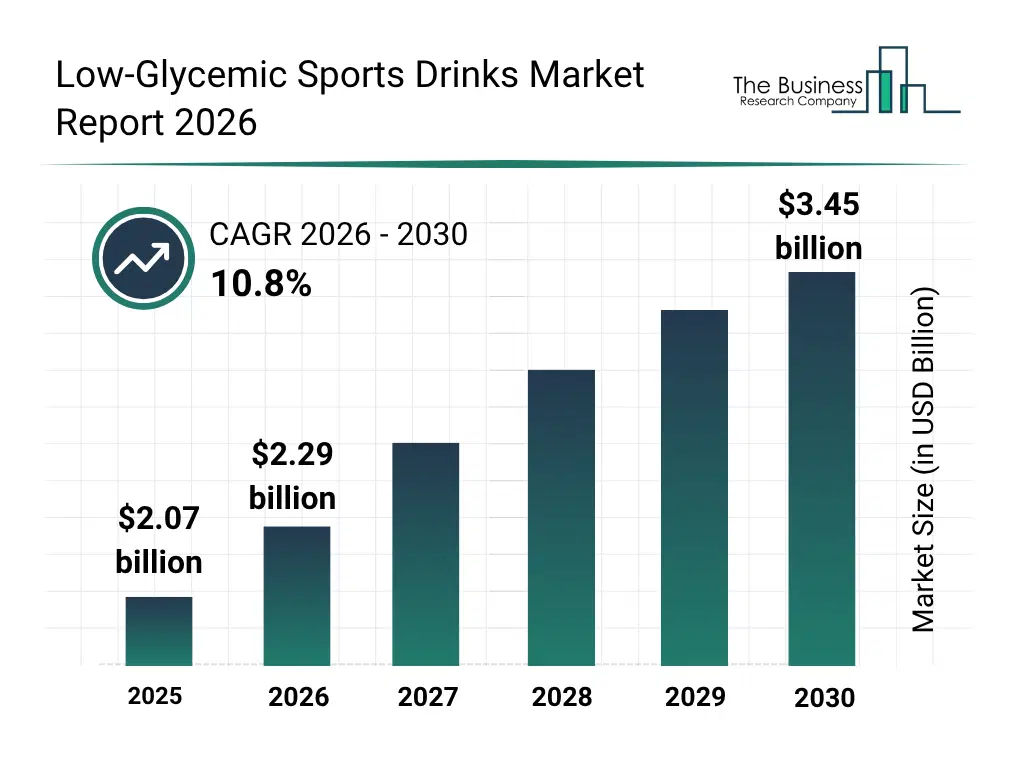
What Is The Low-Glycemic Sports Drinks Market Size and Share 2026?
The low-glycemic sports drinks market size has grown rapidly in recent years. It will grow from $2.07 billion in 2025 to $2.29 billion in 2026 at a compound annual growth rate (CAGR) of 10.6%. The growth in the historic period can be attributed to growth in sports and fitness participation, rising awareness of hydration and endurance nutrition, expansion of sports drink manufacturing and distribution networks, increasing consumer shift toward healthier beverage alternatives, development of carbohydrate-based energy formulations for athletes.What Is The Low-Glycemic Sports Drinks Market Growth Forecast?
The low-glycemic sports drinks market size is expected to see rapid growth in the next few years. It will grow to $3.45 billion in 2030 at a compound annual growth rate (CAGR) of 10.8%. The growth in the forecast period can be attributed to advancement in personalized nutrition and metabolic health tracking, rising demand for functional and performance-enhancing beverages, growth in diabetic-friendly and low-GI dietary consumption patterns, increasing innovation in plant-based and natural ingredient formulations, expansion of e-commerce-driven sports nutrition sales channels. Major trends in the forecast period include increasing demand for functional hydration products with sustained energy release, rising adoption of natural sweeteners and plant-based carbohydrate sources in sports nutrition, growing preference for clean-label and low-sugar athletic beverages, expansion of electrolyte-enriched endurance drink formulations, increasing personalization of sports nutrition based on metabolic and activity profiles.
Global Low-Glycemic Sports Drinks Market Segmentation
1) By Product Type: Ready-To-Drink, Powdered Mix, Concentrates 2) By Ingredient: Natural Sweeteners, Artificial Sweeteners, Electrolytes, Vitamins And Minerals, Other Ingredients 3) By Flavor: Citrus, Berry, Tropical, Mixed Fruit, Other Flavors 4) By Distribution Channel: Supermarkets And Hypermarkets, Convenience Stores, Online Retail, Specialty Stores, Other Distribution Channels 5) By End-User: Athletes, Fitness Enthusiasts, Diabetics, Other End-Users Subsegments: 1) By Ready-To-Drink: Isotonic Low Glycemic Index Drinks, Hypotonic Low Glycemic Index Drinks, Electrolyte-Infused Low Glycemic Index Drinks, Protein-Infused Low Glycemic Index Drinks 2) By Powdered Mix: Electrolyte Powder Mix, Protein Powder Mix, Branched-Chain Amino Acid (BCAA) Or Essential Amino Acid (EAA) Powder Mix, Pre-Workout Low Glycemic Index Powder Mix 3) By Concentrates: Liquid Concentrate Drops, Syrup-Based Concentrates, Electrolyte Concentrates, Carbohydrate-Controlled ConcentratesWhat Are The Drivers Of The Low-Glycemic Sports Drinks Market?
The growing prevalence of diabetes is expected to propel the growth of the low-glycemic sports drinks market going forward. Diabetes is a chronic disease in which the body cannot properly use or produce insulin, causing high levels of glucose (sugar) in the blood. Diabetes is increasing mainly due to unhealthy diets high in sugar and processed foods, which lead to weight gain and insulin resistance. Low-glycemic sports drinks help in diabetes management by providing energy and hydration with carbohydrates that are absorbed slowly, preventing sharp blood sugar spikes and helping maintain more stable glucose levels. For instance, in June 2024, according to the National Health Service, a UK-based government department, in 2023, the NHS identified over half a million (549,000) additional individuals in England at risk of developing type 2 diabetes, bringing the total number of people with non-diabetic hyperglycemia, or pre-diabetes, registered with a GP to 3,615,330. This represents a significant increase compared to 3,065,825 in 2022, highlighting a rise of nearly 20%. Therefore, the growing prevalence of diabetes is driving the growth of the low-glycemic sports drinks industry. The growing preference for functional beverages is expected to propel the growth of the low-glycemic sports drinks market going forward. Functional beverages are drinks formulated with added vitamins, minerals, herbs, or other bioactive ingredients to provide specific health benefits beyond basic hydration and nutrition. Functional beverages are growing as consumers are shifting toward preventive health, choosing drinks with ingredients such as probiotics, vitamins, and antioxidants that help reduce health risks and support long-term wellness. Low-glycemic sports drinks support functional beverages by delivering sustained energy with minimal blood sugar spikes while enhancing hydration, endurance, and health-focused benefits. For instance, in February 2024, according to Monster Beverage Corporation, a US-based beverage company that manufactures energy drinks, net sales for the company's Monster Energy Drinks sector increased to $1.60 billion in the fourth quarter of 2023, compared with $1.39 billion in the same quarter of 2022. Therefore, a growing preference for functional beverages is driving the growth of the low-glycemic sports drinks industry.Key Players In The Global Low-Glycemic Sports Drinks Market
Major companies operating in the low-glycemic sports drinks market are PepsiCo Inc., The Coca-Cola Company, Ingredion Incorporated, Glanbia plc, Döhler GmbH, The Vita Coco Company Inc., BENEO GmbH, Nth Degree Innovations Inc., Zevia PBC, Isagenix International LLC, Hammer Nutrition Ltd., Hydrant Inc., BioSteel Sports Nutrition Inc., HydraLyte LLC, Ultima Replenisher LLC, Skratch Labs Inc., NOOMA LLC, DripDrop Hydration Inc., LyteLine Nutrition LLC, Precision Hydration Ltd.What Are Latest Mergers And Acquisitions In The Low-Glycemic Sports Drinks Market?
In July 2025, BENEO, a Germany-based, low-glycemic natural ingredient manufacturer, partnered with California Natural Color and GELITA to develop an innovative performance drink concept. Through this collaboration, the companies aim to enhance sports nutrition offerings by incorporating low-glycemic carbohydrates such as Palatinose, enabling sustained energy release, improved endurance, and metabolic stability. California Natural Color is a US-based ingredient supplier specializing in natural color solutions, while GELITA is a Germany-based company focused on collagen peptides and gelatin products.Regional Outlook/Insights
North America was the largest region in the low-glycemic sports drinks market in 2025. Asia-Pacific is expected to be the fastest-growing region in the forecast period. The regions covered in this market report are Asia-Pacific, South East Asia, Western Europe, Eastern Europe, North America, South America, Middle East, Africa. The countries covered in this market report are Australia, Brazil, China, France, Germany, India, Indonesia, Japan, Taiwan, Russia, South Korea, UK, USA, Canada, Italy, Spain.What Defines the Low-Glycemic Sports Drinks Market?
The low-glycemic sports drinks market consists of sales of isomaltulose-based drinks, fructose-blend drinks, fiber-enriched sports drinks, and electrolyte-based low-GI drinks. Values in this market are ‘factory gate’ values, that is, the value of goods sold by the manufacturers or creators of the goods, whether to other entities (including downstream manufacturers, wholesalers, distributors, and retailers) or directly to end customers. The value of goods in this market includes related services sold by the creators of the goods.How is Market Value Defined and Measured?
The market value is defined as the revenues that enterprises gain from the sale of goods and/or services within the specified market and geography through sales, grants, or donations in terms of the currency (in USD unless otherwise specified). The revenues for a specified geography are consumption values that are revenues generated by organizations in the specified geography within the market, irrespective of where they are produced. It does not include revenues from resales along the supply chain, either further along the supply chain or as part of other products.What Key Data and Analysis Are Included in the Low-Glycemic Sports Drinks Market Report 2026?
The low-glycemic sports drinks market research report is one of a series of new reports from The Business Research Company that provides market statistics, including industry global market size, regional shares, competitors with the market share, detailed market segments, market trends and opportunities, and any further data you may need to thrive in the low-glycemic sports drinks industry. The market research report delivers a complete perspective of everything you need, with an in-depth analysis of the current and future state of the industry.Low-Glycemic Sports Drinks Market Report Forecast Analysis
| Report Attribute | Details |
|---|---|
| Market Size Value In 2026 | $2.29 billion |
| Revenue Forecast In 2035 | $3.45 billion |
| Growth Rate | CAGR of 10.8% from 2026 to 2035 |
| Base Year For Estimation | 2025 |
| Actual Estimates/Historical Data | 2020-2025 |
| Forecast Period | 2026 - 2030 - 2035 |
| Market Representation | Revenue in USD Billion and CAGR from 2026 to 2035 |
| Segments Covered | Product Type, Ingredient, Flavor, Distribution Channel, End-User |
| Regional Scope | Asia-Pacific, Western Europe, Eastern Europe, North America, South America, Middle East, Africa |
| Country Scope | The countries covered in the report are Australia, Brazil, China, France, Germany, India, Indonesia, Japan, Taiwan, Russia, South Korea, UK, USA, Canada, Italy, Spain. |
| Key Companies Profiled | PepsiCo Inc., The Coca-Cola Company, Ingredion Incorporated, Glanbia plc, Döhler GmbH, The Vita Coco Company Inc., BENEO GmbH, Nth Degree Innovations Inc., Zevia PBC, Isagenix International LLC, Hammer Nutrition Ltd., Hydrant Inc., BioSteel Sports Nutrition Inc., HydraLyte LLC, Ultima Replenisher LLC, Skratch Labs Inc., NOOMA LLC, DripDrop Hydration Inc., LyteLine Nutrition LLC, Precision Hydration Ltd. |
| Customization Scope | Request for Customization |
| Pricing And Purchase Options | Explore Purchase Options |