
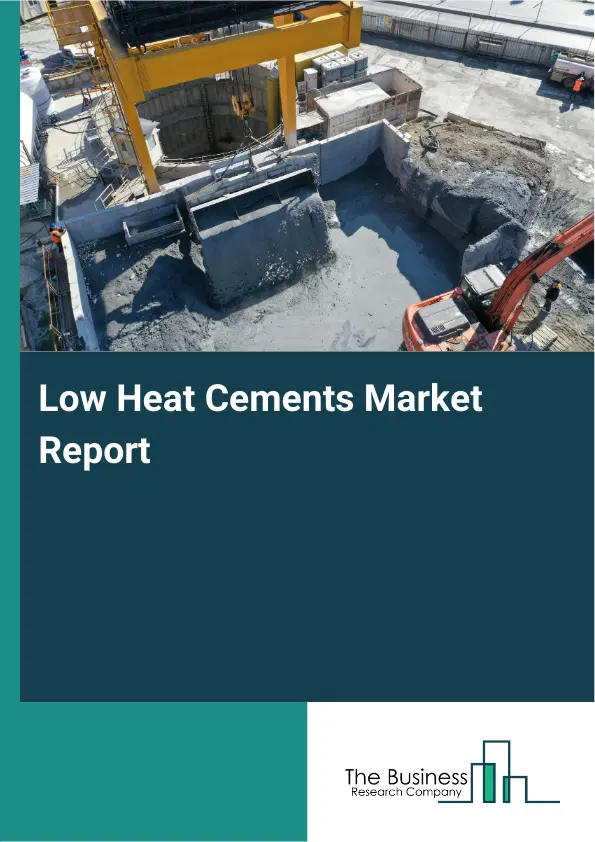
Low Heat Cements Market Report 2026
Global Outlook – By Type (Low Heat Portland Cement, Low-Heat Slag Cement, Low-Heat Pozzolanic Cement, Low-Heat Portland Composite Cement, Low-Heat Fly Ash Cement), By Production Process (Traditional Methods, Modern Techniques, Eco-Friendly Manufacturing), By Distribution Channel (Direct Sales, Distributors And Wholesalers, Online Sales Platforms, Retail Markets), By Application (Residential Construction, Commercial Construction, Infrastructure Projects, Industrial Applications), By End-User Industry (Building And Construction, Road And Highway Construction, Marine Applications, Oil And Gas Sector) – Market Size, Trends, Strategies, and Forecast to 2030
Low Heat Cements Market Overview
• Low Heat Cements market size has reached to $6.05 billion in 2025 • Expected to grow to $8.47 billion in 2030 at a compound annual growth rate (CAGR) of 6.9% • Growth Driver: Increasing Investments In Infrastructure Development Driving The Growth Of The Market Due To Rising Demand For Durable Concrete In Large-scale Construction Projects • Market Trend: Innovative Cement Solutions Supporting Carbon Reduction Goals • Asia-Pacific was the largest region and fastest growing region.What Is Covered Under Low Heat Cements Market?
Low heat cement is a type of Portland cement designed to release heat more slowly during the hydration process. It achieves this by having a lower content of tricalcium silicate (C3S) and higher amounts of dicalcium silicate (C2S), which reduces the risk of thermal cracking in large concrete structures. This cement is primarily used in massive constructions where controlling temperature rise is critical for structural integrity. The main types of low heat cements include low heat Portland cement, low-heat slag cement, low-heat pozzolanic cement, low-heat Portland composite cement, and low-heat fly ash cement. Low heat Portland cement is designed to reduce heat of hydration in mass concrete. Different production processes include traditional methods, modern techniques, and eco-friendly manufacturing. Multiple distribution channels consist of direct sales, distributors and wholesalers, online sales platforms, and retail markets. Various applications are residential construction, commercial construction, infrastructure projects, and industrial applications, and they are used by several end-user industries such as building and construction, road and highway construction, marine applications, and the oil and gas sector.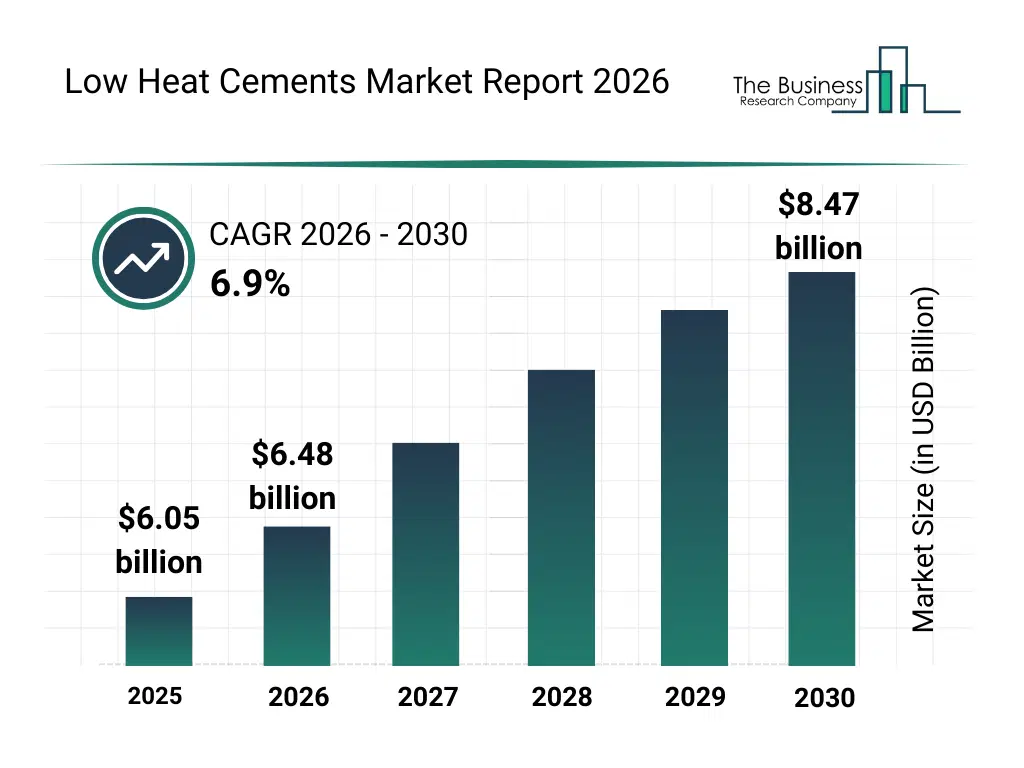
What Is The Low Heat Cements Market Size and Share 2026?
The low heat cements market size has grown strongly in recent years. It will grow from $6.05 billion in 2025 to $6.48 billion in 2026 at a compound annual growth rate (CAGR) of 7.2%. The growth in the historic period can be attributed to rising demand for temperature-controlled concrete, increasing adoption of low-heat cement in massive structures, reliance on specialized additives, expansion of infrastructure projects, growing need for thermal-crack resistant concrete.What Is The Low Heat Cements Market Growth Forecast?
The low heat cements market size is expected to see strong growth in the next few years. It will grow to $8.47 billion in 2030 at a compound annual growth rate (CAGR) of 6.9%. The growth in the forecast period can be attributed to increasing production of low-heat cements, development of advanced low-heat formulations, rising adoption in large-scale construction, integration of digital hydration monitoring, expansion of industrial and marine applications. Major trends in the forecast period include implementation of low heat cement technologies, adoption of AI-enhanced temperature monitoring systems, deployment of smart hydration control solutions, integration of digital production tracking, expansion of low thermal-crack concrete applications.
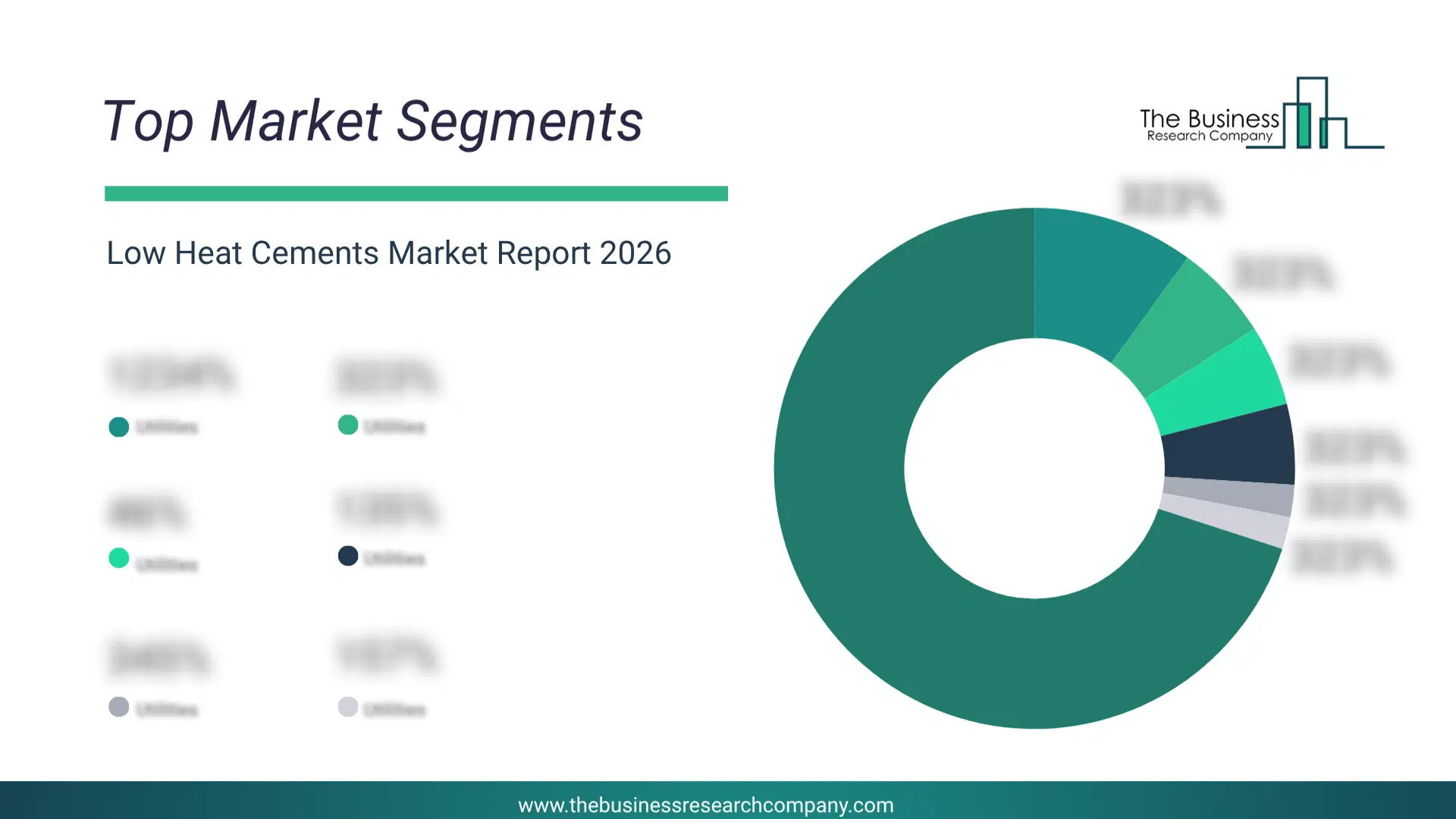
Global Low Heat Cements Market Segmentation
1) By Type: Low Heat Portland Cement, Low-Heat Slag Cement, Low-Heat Pozzolanic Cement, Low-Heat Portland Composite Cement, Low-Heat Fly Ash Cement 2) By Production Process: Traditional Methods, Modern Techniques, Eco-Friendly Manufacturing 3) By Distribution Channel: Direct Sales, Distributors And Wholesalers, Online Sales Platforms, Retail Markets 4) By Application: Residential Construction, Commercial Construction, Infrastructure Projects, Industrial Applications 5) By End-User Industry: Building And Construction, Road And Highway Construction, Marine Applications, Oil And Gas Sector Subsegments: 1) By Low Heat Portland Cement: Type II Low Heat Portland Cement, Type IV Low Heat Cement, Low Alkali Low Heat Cement, Blended Low Heat Cement 2) By Low-Heat Slag Cement: Granulated Blast Furnace Slag-Based Low Heat Cement, High-Slag Low Heat Composite Cement 3) By Low-Heat Pozzolanic Cement: Fly Ash-Based Low Heat Cement, Natural Pozzolana Low Heat Cement, Calcined Clay Low Heat Cement 4) By Low-Heat Portland Composite Cement: Limestone Composite Low Heat Cement, Mixed Mineral Admixture Low Heat Cement 5) By Low-Heat Fly Ash Cement: Class F Fly Ash Low Heat Cement, Class C Fly Ash Low Heat CementWhat Is The Driver Of The Low Heat Cements Market?
The increasing investments in infrastructure development are expected to propel the growth of the low heat cements market going forward. Investments in infrastructure development are rising due to the need to support urbanization and economic expansion in emerging and developed regions. Investments in infrastructure development significantly drive the demand for low-heat cements, as these materials play a crucial role in minimizing thermal cracking during the construction of large-scale concrete structures such as dams, bridges, and deep foundations. For instance, in July 2024, according to the Office for National Statistics (ONS), a UK-based statistical institute, in 2023, infrastructure investment reached $17.66 billion (£13.8 billion), reflecting a 3.9% increase over 2022. Therefore, the increasing investments in infrastructure development are driving the growth of the low heat cements industry.Key Players In The Global Low Heat Cements Market
Major companies operating in the low heat cements market are China National Building Material Group Co. Ltd., Heidelberg Materials AG, Anhui Conch Cement Company Limited, Cemex S.A.B. de C.V., UltraTech Cement Limited, Taiheiyo Cement Corporation, Vicat S.A., Mitsubishi UBE Cement Corporation, Shree Cement Limited, Dalmia Bharat Limited, The Siam Cement Public Company Limited (SCG), J.K. Cement Limited, The Ramco Cements Limited, Cement Australia Pty Limited, Buzzi Unicem S.p.A., JSW Cement Limited, Cockburn Cement Limited, Ecocem Materials Limited, Northern Cement Pty Limited, Rain Cements Limited (RCL).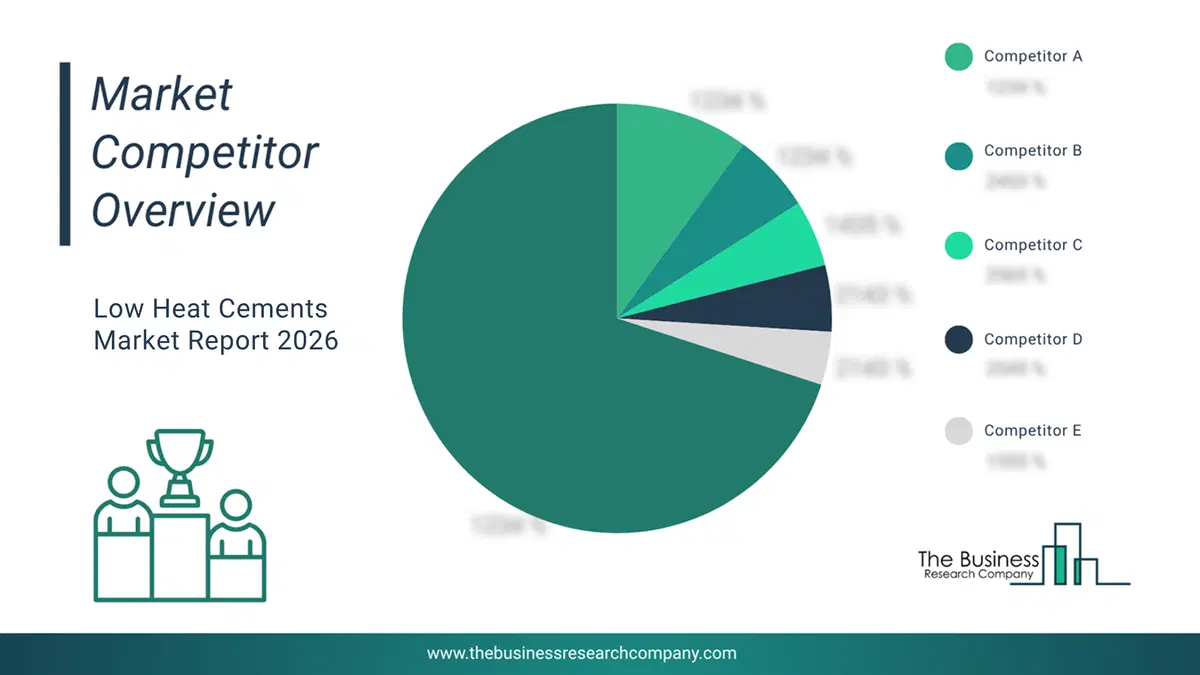
This chart is for illustrative purposes; the full report includes a detailed competitor analysis and comprehensive overview of the top 10 companies in the market.
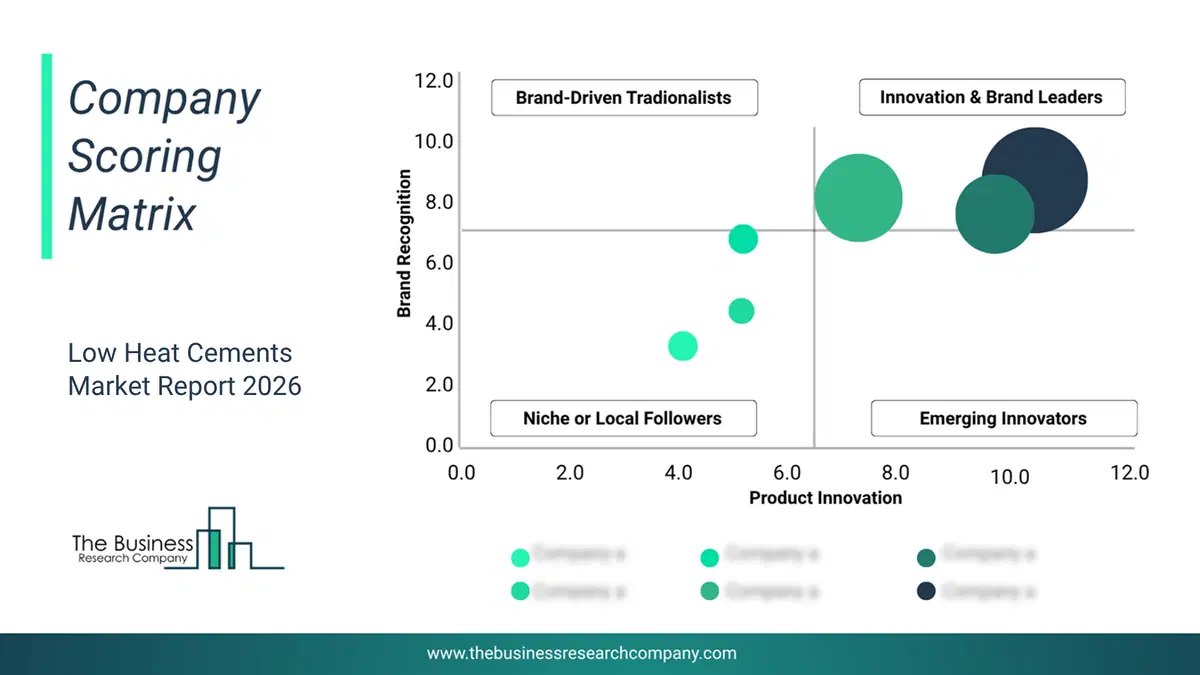
This chart maps companies by product innovation and brand strength, with bubble size indicating relative revenue, helping identify market leaders, challengers, and niche players. This is an illustrative chart; the full report provides a complete and accurate competitive analysis.
Global Low Heat Cements Market Trends and Insights
Major companies operating in the low heat cements market are focusing on developing advanced products, such as blast furnace slag cement, to enhance sustainability, reduce carbon emissions, and improve the thermal performance and durability of concrete in large-scale construction projects. Blast furnace slag cement refers to a blended cement produced by intergrinding or blending Portland cement clinker with granulated blast furnace slag, resulting in a material with lower heat of hydration, improved durability, and a reduced carbon footprint. For instance, in November 2025, Bamburi Cement Limited, a Kenya-based cement manufacturer, introduced DURAPLUS, a next-generation CEM III/A 42.5 N cement engineered to deliver over 45% lower CO₂ emissions than conventional Ordinary Portland Cement (OPC). Developed using blast furnace slag from the iron industry, the product aligns with circular economy principles and supports Kenya’s Vision 2030 and the UN Sustainable Development Goals (SDGs). Designed for high performance and durability, DURAPLUS offers superior resistance to chlorides and sulfates, exhibits low heat of hydration to minimize thermal cracking, and is optimized for challenging environments such as coastal and geothermal regions.What Are Latest Mergers And Acquisitions In The Low Heat Cements Market?
In July 2024, Seven Group Holdings Limited, an Australia-based diversified industrial services, media, and investment company, acquired Boral Limited for an undisclosed amount. With this acquisition, Seven Group aims to consolidate its ownership, strengthen its position in the building materials sector, and drive long-term value through operational efficiency and strategic growth initiatives. Boral Limited is an Australia-based manufacturer and supplier of construction and building materials, including low heat cement, concrete, asphalt, and quarries.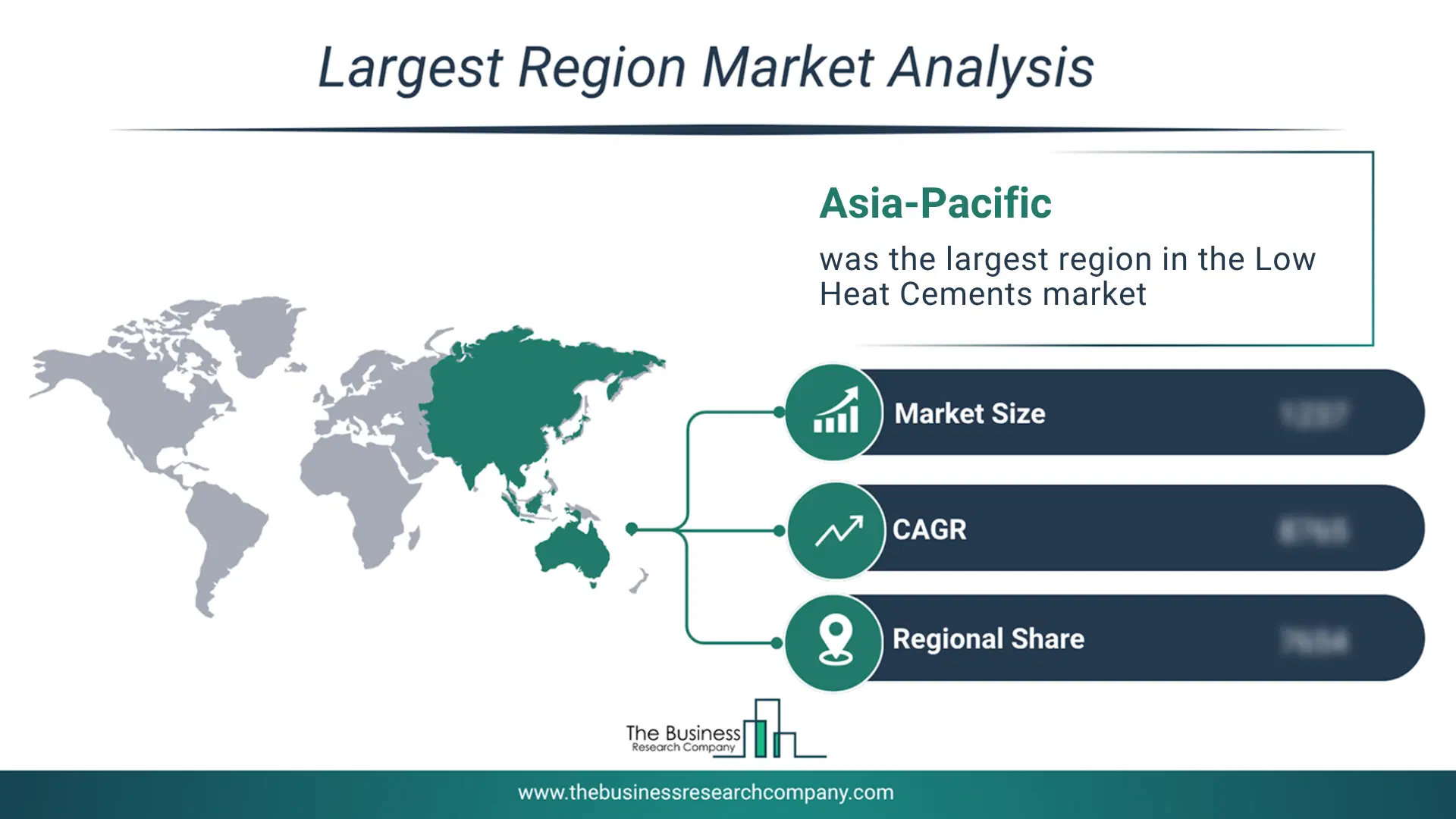
Regional Insights
Asia-Pacific was the largest region in the low heat cements market in 2025, and it is expected to be the fastest-growing region in the forecast period. The regions covered in this market report are Asia-Pacific, South East Asia, Western Europe, Eastern Europe, North America, South America, Middle East, Africa. The countries covered in this market report are Australia, Brazil, China, France, Germany, India, Indonesia, Japan, Taiwan, Russia, South Korea, UK, USA, Canada, Italy, Spain.What Defines the Low Heat Cements Market?
The low heat cements market consists of sales of moderate-heat cement (MHC), low-heat slag cement, low-heat pozzolanic cement, low-heat Portland composite cement, and low-heat fly ash cement. Values in this market are ‘factory gate’ values, representing the value of cement sold by the manufacturers or producers, whether to other entities (including wholesalers, distributors, and construction companies) or directly to construction sites. The market value also includes related services provided by the manufacturers, such as technical support, delivery, and quality assurance.How is Market Value Defined and Measured?
The market value is defined as the revenues that enterprises gain from the sale of goods and/or services within the specified market and geography through sales, grants, or donations in terms of the currency (in USD unless otherwise specified). The revenues for a specified geography are consumption values that are revenues generated by organizations in the specified geography within the market, irrespective of where they are produced. It does not include revenues from resales along the supply chain, either further along the supply chain or as part of other products.
This chart presents market attractiveness based on a quantitative evaluation of growth, competition, strategic alignment, and risk, offering a clear view of opportunity areas for decision-making. This chart is for illustrative purposes; the full report contains the complete analysis.

This chart highlights the Total Addressable Market (TAM) by estimating the maximum revenue opportunity using an assumption-driven approach, supporting strategic planning and opportunity sizing across markets. The chart is illustrative; the full report provides a more comprehensive analysis.
What Key Data and Analysis Are Included in theLow Heat Cements Market Report 2026?
The low heat cements market research report is one of a series of new reports from The Business Research Company that provides market statistics, including industry global market size, regional shares, competitors with the market share, detailed market segments, market trends and opportunities, and any further data you may need to thrive in the low heat cements industry. The market research report delivers a complete perspective of everything you need, with an in-depth analysis of the current and future state of the industry.Low Heat Cements Market Report Forecast Analysis
| Report Attribute | Details |
|---|---|
| Market Size Value In 2026 | $6.48 billion |
| Revenue Forecast In 2030 | $8.47 billion |
| Growth Rate | CAGR of 7.2% from 2026 to 2030 |
| Base Year For Estimation | 2025 |
| Actual Estimates/Historical Data | 2020-2025 |
| Forecast Period | 2026 - 2030 |
| Market Representation | Revenue in USD Billion and CAGR from 2026 to 2030 |
| Segments Covered | Type, Production Process, Distribution Channel, Application, End-User Industry |
| Regional Scope | Asia-Pacific, Western Europe, Eastern Europe, North America, South America, Middle East, Africa |
| Country Scope | The countries covered in this market report are Australia, Brazil, China, France, Germany, India, Indonesia, Japan, Taiwan, Russia, South Korea, UK, USA, Canada, Italy, Spain |
| Key Companies Profiled | China National Building Material Group Co. Ltd., Heidelberg Materials AG, Anhui Conch Cement Company Limited, Cemex S.A.B. de C.V., UltraTech Cement Limited, Taiheiyo Cement Corporation, Vicat S.A., Mitsubishi UBE Cement Corporation, Shree Cement Limited, Dalmia Bharat Limited, The Siam Cement Public Company Limited (SCG), J.K. Cement Limited, The Ramco Cements Limited, Cement Australia Pty Limited, Buzzi Unicem S.p.A., JSW Cement Limited, Cockburn Cement Limited, Ecocem Materials Limited, Northern Cement Pty Limited, Rain Cements Limited (RCL). |
| Customization Scope | Request for Customization |
| Pricing And Purchase Options | Explore Purchase Options |